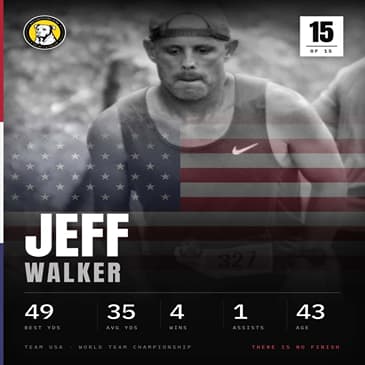
Jeff Walker is an ultrarunner and Team USA athlete who competed at the 2026 Big’s Backyard Ultra Team World Championships. After earning his spot with a victory at Queeny, Jeff completed an incredible 75 yards, covering more than 312 miles. His journey reflects the power of perseverance, mental toughness, and pushing beyond perceived limits.
👟01:03 Jeff Walker's Journey Into Running and the Hinge Moment That Changed His Life
👟 07:01 The Mental Toughness of Backyard Ultras: Fighting the Urge to Quit
👟 09:00 Running With Harvey Lewis: How Encouragement Changed Jeff's Mindset
👟 11:30 From Competitor to Encourager: A Powerful Lesson in Mental Toughness
👟 16:00 The Hinge Moment: Realizing the Dream of Representing Team USA
👟 22:00 Team USA's Comeback: Overcoming Early Struggles at the World Championship
👟 31:00 No One Gets There Alone: The Importance of Family and Crew Support
👟 37:00 The Mental Toughness of Staying Present: One Hour at a Time
👟 40:00 Reflecting on Team USA's Backyard Ultra World Championship Victory
👟 46:00 Jeff Walker's Advice for Aspiring Backyard Ultra Runners
[00:00:09] Welcome to Mental Toughness with Dr. Rob Bell. Each week, Dr. Rob sits down with athletes, executives, and expert coaches to talk about mental toughness and their hinge moment. Here's your host, Dr. Rob.
[00:00:29] It's difficult when you're used to being one of the better guys around you running and then all of a sudden you have to raise your hand and say, hey, I'm struggling here. I need someone to drop back with me. You do it for the team and it helped the team because there were a few people I know who were going to drop back with me. They had to drop out way sooner than they did. They went another 10 or 12 hours because they had people drop back with them.
[00:00:51] The Mental Toughness Podcast is brought to you by Morton Brown Family Wealth, helping people connect their financial resources to the life they want to live. Our guest this week is two-time Prairie on Fire champion. He was winner of the Queenie Backyard Ultra with 61 yards, which helped earn him a spot on Team USA. He just finished 75 loops, 75 yards, covering a distance of 312 mile, helping Team USA win the Ultra World Team Championships.
[00:01:21] Our guest today is fourth grade teacher, great person, awesome Cavs, Jeff Walker. Jeff, man, congrats on representing Team USA, man. Again, thanks for joining us. It's a pleasure being here. Thank you for having me and thanks for the shout out to my Cavs. You got it, bro. Well, every time I see you and I'm running, man, I'm like, man, look at that ass and look at those Cavs, dude. That guys can run, man. They're so far enough ass.
[00:01:48] I want to start out. I mostly want to talk about Team USA, your experience, your contribution there, which is so cool, man. And then about bigs. But first, like you were a wrestler growing up and you had an older brother. Again, you looked up to your older brother. He joins cross-country team his senior year. You're a freshman. Talk to us about that, man, because everything changed. Yeah. So we were both wrestlers throughout our lives and we both played football all the way from like second grade on. So football and wrestling were like the two sports I used to do.
[00:02:17] And we were together all the time. He's three years older than me. So, yeah, I definitely looked up to him. And then his senior year, out of the blue, he decides, you know what, I'm going all in on wrestling. I'm going to run cross-country. I'm going to get in the best shape of my life. And so I, following him, I said, OK, then I'm doing the same thing. I'm running cross-country. And it turns out, I mean, honestly, one of the best decisions I've ever made in my life, not only just running wise, getting involved with that, but those high school friends from that cross-country team are still some of my closer friends today.
[00:02:46] So just those lifelong friendships, but also just being able to find the joy and love of running that has kind of been hit or miss since then, but definitely been more loved than not. So it was a big turning point in my life for sure. Love that, man. So, Jeff, another, and again, like kind of a hinge moment, because from that moment on, like everything's different. But I mean, you're now in your late 20s. You go into an Ikea. There's a mirror and then there's a bathroom scale, man. Talk to us about that experience.
[00:03:15] Yeah, I bring this up every once in a while. So during college and right after college, I would still run. I would still work out every once in a while. I would go on, I would say like a 20 or 30 mile run, and then I would take like two or three weeks off and not run again. It kind of trashed my body and then rinse and repeat. And that was my idea of exercising. But then once I got into my mid-20s, late 20s, I stopped just exercising altogether.
[00:03:41] Had a job. I was married and just kind of sitting around basically. A sad time in my life, honestly. And we did. We went to that Ikea in Cincinnati. And I remember, I can specifically remember stepping on that scale and seeing 197 pounds on that scale. And I remember thinking, well, this scale is definitely not accurate. It's off. I'm going home that evening and stepping on and it says 198 at home.
[00:04:07] So the scale was accurate. And that was when I decided that I was going to be running from that point on for probably the rest of my life. So that following weekend, I decided to go out for, I had planned a 40 mile run. I don't know, in my head, 40 seemed like a good number for someone who hasn't run in a couple of years. Yeah, good. Yeah. I made it like 26. I got a marathon in and fell asleep on a park bench. That was the beginning of my return to running. Yeah. I love that, man.
[00:04:38] Running wise, just for you in general, what's it do for your mental state? It's a hard question for me to answer. So it definitely is a positive benefit to me. I see a difference in myself. I know my wife and kids probably see a difference in me as well. When I am running, when I'm tapering for an event, I just feel a little more anxious. I feel a little more like it's easier to ruffle my feathers a little bit.
[00:05:03] So I think it does like just make me a calmer, more patient person, which helps as a fourth grade teacher, obviously. But other than that, I mean, I do a lot of my deeper thinking, any kind of spiritual thinking, thinking about life, thinking about future past. A lot of that's what's going on in my runs. I don't listen to a ton of music while I run. So I am just kind of in my head thinking, and that's kind of my time to do that. Solving problems, planning lessons. It all happens kind of on the run.
[00:05:33] So it is an important part of my life for sure. You did mention the spiritual part of it. Like what part of that running experience for you, you know, encapsulates and connects like that spiritual life? I just think being in nature, like just being outside when you're running longer distances, like you're outside in the dark. It was dark. You're seeing sunrises. You're seeing birds waking up. You're seeing animals moving around. You're hearing all the different sounds that no one else is hearing. Like they're inside sleeping or they're, you know, their TV's on.
[00:06:03] You're hearing nature making the sound that it's naturally making. And it never gets old, like just to be outside on a trail or even on the road, honestly, and just kind of by yourself and just taking in just natural beauty. Yeah, great point, man. Totally agree with you. So COVID hits and then you find this format. And again, you've done 100 miles before. You've said on podcasts you're not fast. You are fast. You know, sub-1800 milers.
[00:06:33] I mean, it's pretty fast, man. But the backyard format of it just seemed to fit you perfectly, man. And right away, then you win a couple of the Prairie on Fire who, I mean, you were a great champion on that, but you win them back to back. It just seemed like that format was like set up for you. When I first signed up for my first backyard, which was, I think it was 21 or 22, I saw the format. I had somehow missed the format. I had been around for a few years since then.
[00:07:03] But just looking at it, I knew it kind of was going to fit me. I felt pretty good about that. And I was really looking forward to the mental aspect of that. Because physically, it is physically demanding, I'm not going to lie, to run that far. But if you have a background in running, if you can run without being injured a fair amount, you can run a 13, 14-minute pace pretty easily. Like it's not a challenging pace to keep up. So I knew that physically it would get hard, but it would take a little bit for it to get there.
[00:07:33] And before you would reach your physical limit, you're going to feel like you reached your mental limit. And I think wrestling kind of helped me play into that. Because wrestling is a sport where you are going to mentally want to quit multiple times. You would not think that in six minutes you would want to quit as many times as you do. But it's a very difficult sport. So a backyard is kind of like stretching that wrestling match out over a long period of time. Where you don't get these deep, intense, like painful moments.
[00:08:00] You just get these long, drawn out, dull, burning pain that just weighs on your mind. Like it doesn't physically just like all at once make you want to quit. It just wears your mind down to where you can't see going any farther. You can't look ahead and see two hours in the future because that's too painful to look that far ahead. So I was looking forward to bringing my body and mine to that point.
[00:08:24] And I think having that desire to kind of see what I was made of mentally as well as physically kind of helped me be successful from the start in this format. One of the pieces I want to talk to is about the Ohio Backyard Ultra. One of those aspects of running with Harvey Lewis. I mean, what did Harvey Lewis see in you that you couldn't see in yourself? And how did that change everything for you?
[00:08:49] My favorite backyard experience until this year was getting the chance to, it was me and Harvey, I think for the last nine or 10 hours of that race. We were the last two. There was a downpour that night. We got like four inches of rain over a six hour period. Ice cold. It was miserable. But he kept a smile on his face the whole time. And he kept just saying, how lucky are we that we're out here doing this? And in my head, I'm like, I don't feel lucky at all, Harvey. But he noticed.
[00:09:19] I mean, I think he could tell I was hurting. I was in a bad spot. That was my first night I'd ever hallucinated. I was telling him I was seeing things. I wasn't eating very well at that point. But he saw that I just was not giving up. And I just kept on coming out. And he kept encouraging it. He was pulling me around. He was leading me through that night. I ran every step with him for nine or 10 solid hours. And I just daylight came. I ran another loop. I think he expected me to give up on that one. Like not not even attempt it.
[00:09:48] I did. I think he just saw some grit in me that I was willing to just keep going and go another lap and go another lap. Yeah. And he told me he's like, hey, you can do this. Like you can be on the big stage. And that's kind of when my mindset shifted two and a half years ago during that time. And then how else? Because, I mean, with a wrestling mentality and grit mentality, it's just like dig it out of the dirt, right? Just find a way. But Harvey had a different approach. It kind of wore off on you in terms of the cooperation part, right? Helping one another.
[00:10:18] Talk to us about that. Yeah. So he's all very positive. If he's feeling bad, he's not going to let you know. He's going to stay very positive the whole time. He may let his crew know. But when he's out there on the loop, he wants everything as positive as possible. And he wants to be as helpful as possible. He wants everybody working together. That's one thing. After him working with me like that and kind of guiding me and showing me, hey, here's how we're going to do this. We're going to run this many meters. And then we're going to walk this many steps.
[00:10:47] And then we're going to take a drink here. We're going to eat something here. Hey, we're going to listen to music on this lap. He's just constantly just adjusting things, just getting you moving forward. And I saw him. He just basically forced me to go to run all these night loops in the cold rain. And I didn't even second guess it. I just knew that he was out there, had my best interest in mind, and we were going to get through it.
[00:11:11] And so looking at myself, I'm like, okay, in the past, if I'm down to the final two or three in a backyard, I kind of had that wrestling mindset where I was like, okay, I'm going to bury these guys. That would flat out. That's kind of what I thought. It doesn't really go with the backyard ethos of, you know, we're all here to go as far as we can. I was there to win. And that changed with Harvey. Whereas, you know, my goal now is to see how far I can go. And my goal is to see how far others can go as well. Can I get more out of them? Like he got more out of me that day.
[00:11:42] Yeah. Like at Prairie last year, we had myself and two others. We were down at the end. I was feeling pretty good. I started to take off and I'm like, no, let's drop back. Let's see if we can help these guys. We'll see if we can get them a couple more laps. They were ready to quit. We got them a couple more laps in before they did. So it's just trying to get the most out of everybody because when you do, you get the most out of yourself. And I found it's kind of a performance enhancer for myself.
[00:12:08] When I'm positive and I'm helping someone else, I feel better as a runner. I'm not feeling as bad. I'm not as sore. I'm not as tired if I'm helping other people. So it helps everyone all the way around, I think. Success doesn't make financial decisions easier. Sometimes it gives us more decisions to make. Morton Brown Family Wealth works with executives, business owners, and families to connect their financial resources to the life they want to live.
[00:12:38] It means comprehensive financial planning, looking beyond investments into taxes, retirement, estate planning, generosity, and long-term future. Morton Brown helps their clients see beyond the numbers into an understanding and plan about what those numbers are there to support. If you want a thoughtful, strategic approach to life's transitions, retirement, selling a business, or even playing for future generations, connect in the link. Morton Brown Family Wealth.
[00:13:08] The qualifier into bigs. Queenie, Backyard Ultra. You ran 251 miles for that to win. But talk to us about the one part, because you thought your race was going to be ending. You had a really difficult spot there. So this was on, I don't know, day two, evening, second evening. So we were just about at, we were probably around 180 miles. And my stomach had just kind of turned.
[00:13:38] And I was making my way around. It was my slowest loop of the entire race. I think it took me like 56 minutes to get around there. I know that pace, Jeff. Yeah. I do too now. I'd been running like some 48s mostly. And I dropped down to a 56 that quick. And that's kind of scary when you're going from like a 48 to 50 and you drop all the way down to a 56. That's usually a sign that something's not good.
[00:14:04] Now, the thing with the backyard is you've got to keep an open mind that things can change for the worse really quickly, but they can also change for the better really quickly. And I was having a hard time doing that. I was, my stomach was just feeling so bad. And I was like, if this continues, I don't see myself continuing too much farther. But it quickly turned around, honestly. I think I had one of my faster loops, one or two loops after that. And then it was kind of smooth sailing from that point out.
[00:14:32] Queenie was really one of the smoothest races I had from start to finish. I had that one little hiccup. But other than that, things went very, very closely to play in. Was Uriah, was he crewing for you at that race? Yep. Uriah. Yeah. We were on a run together and he even told me, he said, that wasn't even close to Jeff's max, man. And he won that sucker. Yeah, I felt good. I felt like I could have gone a lot farther. Somewhere when we talk about Biggs, I feel like I haven't reached that potential yet.
[00:15:02] Well, that was going to be one of my questions. So, I mean, you qualify, I mean, Team USA. And then that becomes a reality, man. I mean, you're representing the United States, Team USA, heading into the world championships. Like, even before you got there, when did that realization just hit? Yeah, Biggs was something I had always watched, always intrigued with. But it was always like something for better runners than myself. It wasn't something I was able to aspire to until that race with Harvey in Ohio. And then I kind of had an angle.
[00:15:32] Maybe I can. He believes in me. Maybe I can't. So winning Prairie got me into Queenie. And then winning Queenie got me into Biggs. I didn't allow myself to really think about it leading up to Queenie at all. Queenie was my sole focus, obviously, just trying to win that. When it was my last loop and I knew if I finished this loop, I was going to be the winner. It did kind of hit me then a little bit. I mean, there were some tears shed on that last loop, just of joy, of just thinking all the work I'd put in.
[00:16:00] Because, I mean, I really have put in a couple years of really, really hard work to reach this goal. So it kind of settled in there. But then you get to, okay, that was March, the beginning of March. I have until mid-October before this race. So you can't just be on cloud nine for that entire time. So now the whole chore was, okay, I've got to put an entire spring and summer of training in without the tendency, I think, for many people, including myself, would be to overdo it,
[00:16:29] do too much, burn yourself out, and then go in and underperform at Biggs. So it was kind of a fine line of respecting this race so much that you want to give it all you have to, okay, I don't want to give it so much that I'm underperforming when I get there. Jeff, you're training all summer. Obviously, I'm going to follow it. You know, obviously, it was flat here in Indiana. But you go to Biggs, and Queenie was a little bit hilly as well. But you arrive at Biggs.
[00:16:57] When you're there, talk to us about then just that experience, showing up, you're part of the team. What was that like? Yeah, so getting there, seeing the arch of the corral where the start-finish line is, seeing all the country's flags that I've seen on the live stream and all that in past years was kind of a surreal experience. But then you get there, and it's like, this is smaller than I thought. It's literally his backyard. So it is a smaller venue than you would expect to be there.
[00:17:26] Like, I don't understand how they fit all the tents in there that they do. So such a cool experience. We went and walked some of the trail loop that night before the race when we got there, and got to see exactly just how challenging and technical the trail loop is there. What part about that is the technical piece? The single loop? Single track? Yeah, it's single track, and it's a lot of hopping from boulders to boulders and running down in dry creek beds and things like that.
[00:17:55] So it's one of the most challenging trails I've run on. More challenging than anything you'll probably find around us here in Indiana, central Indiana. Luckily, I had done some... There was a lot of hill work as well. A lot of hills on the trail. So I had done some stair climbing and things like that to kind of prepare my legs for it. But the technical aspect, I just kind of had to roll with because we don't really have a lot of that technical trail here where we are in central Indiana. So I adapted fine, I guess.
[00:18:24] But it was definitely a touch and go at the start. So the race kicks off. You have your plan. How was the first 100 miles? You kind of start this. The first 100 miles, you hope is just like no issues. Like you want it to be pretty calm and just kind of get it over with. So the quote unquote real race can start, I guess. For me, it went pretty smooth. For some others on the team, there were some struggles like on night one before we'd hit that 100 mile mark.
[00:18:52] Some people struggling already with sleep and hallucinating. And even earlier in the day on those last few trail loops during the day, some people struggling to hit paces that they were trying to hit. So we knew it was going to be a struggle pretty early on day one. Luckily, I'd say probably half the team handled it pretty well. I was able to handle it pretty well. And maybe the other half were struggling a little bit. So that kind of bonded us together as a team. We got together that first night or that next morning and kind of said,
[00:19:22] we need to let us know if you're struggling so we can help. Like the strong ones can drop back and help the ones who are struggling. So that's kind of what happened. The people that were struggling let it be known that they were struggling so that we could step in and assist. And it's kind of a great team bonding moment for them because it's difficult when you're used to being one of the better guys around you running. And then all of a sudden you have to raise your hand and say, hey, I'm struggling here. I need someone to drop back with me. You do it for the team.
[00:19:51] And it did help. It helped the team because there were a few people I know who were going to drop out way sooner than they did. They went another 10 or 12 hours because they had people drop back with them. So it was awesome to see. Looking for more ways to strengthen your own mental toughness? I've written numerous books to help you perform better, overcome adversity, and get to that next level. Check out my books today at drrobbell.com and remember, subscribe to this podcast.
[00:20:21] The next day leading into the next night, talk to us about that. Going into night two? Night two, yeah. That's when we had our first drops was going into that second night as a team. We had some people go out at like hour 41 and 42. So that's when we start falling behind because it's a competition between every country's top 15 runners. So once we started losing them, there were plenty of other countries that had kept all their runners, all 15 of their runners.
[00:20:50] So we started falling behind and I think we ended up dropping into fourth place there. But that second night, that's when everybody starts dealing with that sleep deprivation part of it. I started dropping back and running with some people who were struggling to stay awake while running. So I kind of slowed my pace a little bit. And that probably didn't hurt me too much, but it probably didn't help me get the sleep I needed as well. But looking back, I think I probably slept 20 to 30 minutes for the entirety of the race.
[00:21:20] What were you getting? Were you getting four or five minutes? Yeah, four or five minutes at a time, maybe two or three, four or five. It kind of depends. I struggled with just blocking out noises and being able to kind of drift off. My best sleep took place on course, laying at a stop sign. I ran up ahead. I looked back and I was like, OK, I've got about two minutes before they show up. So I laid down, fell instantly asleep as soon as my head hit the grass. And they woke me up when they when they ran by.
[00:21:49] So that was sleep. Great dirt nap, man. That's awesome. What was the hallucination like for you during that race? These were pretty tame. So night two, I would look at trees and I would just see like origami in the trees. That's what it looked like to me. Nothing like spectacularly like distinct or anything like that. And then on day three, I would look at the road and I would see like superheroes in the road. Just black and white superheroes.
[00:22:18] So nothing like remarkable, but always cool to kind of see what your brain is doing. What it's what it's with. I always know that they're they're not real. I haven't had any like realistic ones yet. So we'll see. Yeah. No Elvis talking to you. Yeah. So talk to us then about day three. I mean, you're into the race now. People have dropped. Other countries struggling. Like what was your mindset? How was the team doing? Day three. I'm still feeling really strong. We jumped back on the trail.
[00:22:47] We were only on the trail for like one loop. And there were like four of us who came in at like 54 minutes. And then everyone else came in at like 58 or 59 that was left on the team. And so we had a meeting real quick as a team. Like we need to get back on the road because if we keep this up, people aren't going to make it on this trail loop. So we ran one. We couldn't get a vote done quick enough. So we had to run one more trail route. I think everybody made it. And then we had to go back to the road.
[00:23:17] So we ran from that point on. We were on the road. We didn't go back on the trail. What do you mean? Like help me understand that. You could pick which one you wanted to do. Yeah. So they're both sanctioned backyard courses. Typically, the trail is only running in daytime. But we decided as a team because you can choose which one you want to do. We decided it would be best for the team to move to the road and to get rid of the trail for now. With the trail being more technical, why wouldn't that be a better option? It was just tougher doing the road.
[00:23:47] Yeah, it is tougher. It's slower. And then we start looking at other countries that they're performing on their own courses. They're pancake flat. They're, you know, what Prairie on Fire is like, right? That course. That's the kind of course most countries are going to be running on is something very flat and easy to run on. Whereas U.S., it's the home of the backyard. We tend to stick with, you know, the course where it was designed and born. It just happens to have 470 feet of elevation gain and a lot of boulders you have to jump across.
[00:24:16] So I have a feeling that there'll be a new location in the future. Oh, okay. But yeah. So we made the call to go to the road after that. Problem is, it was still in the 70s there. So very hot, not a cloud in the sky. So on the road, you're exposed. You had to pick your poison there. Like either deal with the technical aspect of the trail and run slow or run on the road where you may run a little faster, but you're going to be drained by the sun as well.
[00:24:44] So, you know, we're all doing our best to stay cool, wearing ice bandanas and helping each other out. But we started getting some attrition there. We started losing some people throughout that third day. And then night three, that's where end of that day three into night three is where I started noticing and my crew started noticing. I was having some breathing issues, like audibly loud breathing and then shortness of breath and things like that. So best I can tell, I don't know.
[00:25:14] I got a lot of dust from the trail and things into my lungs. Went to the doctor after, you know, right after my race ended and was diagnosed with pneumonia. So it was very difficult that last, you know, 30 miles, 30, 40 miles of just keeping my heart rate down because my breath was so shallow and I couldn't take breaths. And that's ultimately what did me in was just not being able to complete the loop because I couldn't.
[00:25:43] I mean, it's tough to do with pneumonia. Yeah, right, man. So, I mean, your normal heart rate when you're running is like a 125. What did it spike up to? I did not turn on my watch because I did not want to know what it was. Okay. I would say it would feel like if I was going to run, you know, like if I was going to run like a hard 400 as part of a workout. Anytime I would attempt to walk up a hill, that's kind of what it would start getting. It would start getting really fast. And that was kind of the, I knew, I held on.
[00:26:12] My breathing was audibly very loud. And I think it sounded almost, I kept telling myself this is sounds worse than it is. Because I was still completing the loops at a decent time. But then as we went on, I just noticed that my pace kept dropping and I felt like I was working harder and harder until it got to that end point on hour 75 where, I mean, I was almost, it was like an all out effort. But I was barely moving.
[00:26:38] I did a 16 minute mile and most of that was downhill on the first mile of the course. So that was kind of the sign that, hey, this isn't going to, this isn't going to turn around for it to work out for you. Help me understand like the pneumonia piece. Like, did you catch pneumonia then while you were running and while you were out there? I believe, I think so. Yeah. I think there's a few things. I've got people from the area in Tennessee saying this is like the pollen in the air right now is the worst time of the year to be doing that.
[00:27:08] I've never really had an issue with allergies. I've never, I mean, I used to have issues with pneumonia as a child, but that was a long time ago. I've never had anything like this happen to me while running. So I still am not quite sure something. A doctor just assumed something dust or pollen or something got in my lungs and settled and just inflamed the lungs and made them angry. Wow. You know, I wrote the book Puken Rally. Maybe we have like pneumonia and rally or something, man. Like, dude, that's pretty badass, Jeff.
[00:27:36] Well, I wish it wouldn't have happened because I was very surprised with how physically good I was still feeling at the time. And mentally for as little sleep as I'd had, I was surprised at how like with it I still was and aware and willing to get up and get back out there and start the next lap. And I thank my crew for that a lot. My wife and my uncle Mark, wife Jenna, uncle Mark.
[00:28:02] They were there every second of the entire race and followed the plan to a tee. They made changes where they needed to make changes. They didn't consult me. They just knew something needed changed. And they motivated me to get me up and out and going. And they did perfect. Almost makes me cry. I told Jenna, I don't think I could ever do. I hope I never have to do one of these without her because I don't think I could.
[00:28:31] I don't think I would have the same motivation if someone else was doing the work that she normally does. So, yeah, she's awesome. You know, you've spoken before about how much of your success belongs to Jenna. What does she talk to you about yourself? She's just like she believes in me so much. Like we've known each other for four or five years. And honestly, from the beginning, like we were talking about running. She believed I could probably before Harvey did. Definitely before I did.
[00:29:01] She believed I could be a, you know, I could run at bigs or I could do good things. She knew I was a hard worker. She's like, you can do this. Like you're you're so talented. Like she just believed in me from day one so much that, you know, I couldn't help but believe in myself. Her belief in me was so strong that I'm like, I guess I have to believe this because she's not wavering. She totally believes this or she's the best actor I've ever met. She's been the rock. Like she makes it possible.
[00:29:31] The training wouldn't be possible without her. The races. I'm sorry. I've done one backyard without her and I don't think I ever want to do it again. She's the reason why it's all happening in the way it is, I think. Your race ends emotionally like then. What was it like for you at that time? I'm still playing with that in my head a little bit.
[00:29:54] Like I still haven't done a social media post about the race because I don't know exactly what story to tell or how to tell it and how I'm honestly feeling about it. What I've settled on is I'm satisfied with the effort I gave. I don't think I could have. I honestly don't think I could have gone. I couldn't have gone 76. So I think 75 was my limit that day. But I'm so hungry because I also know the 75 is not my limit on another day.
[00:30:21] So I've got one side of me who is pleased and the other side of me that's like, but this isn't the end. And I think that's a good place to be. Mentally, I think it's a good place to be. I've got those two sides of the coin that I'm kind of toying with in my mind and trying to see which one it lands on. And maybe it just stays 50-50 right down the middle and the coin stands on end. But I can't be mad at how I performed. But I guess I'm just another way.
[00:30:48] I'm just not overly pleased with it either because I felt like there was a bigger number there to be had. And I kind of miss that opportunity on a big stage. You know, Lou Holtz said you can be pleased but never satisfied. I always kind of hung on to that one because it was like, I always thought that was a really interesting take. What about this when people, everybody you run into then says the same thing? Jeff, congratulations, man. Like, way to go. Like, you guys won.
[00:31:13] But you still had that sense of like, not, it was still, I know I could have done better. Like, how do you reconcile that piece then? Yeah, and I have to put the team side and the individual side kind of separate because we did win as a team. And that was the goal. That was our goal as a team. And I can't say I'm not, I am absolutely thrilled that we pulled it out. It didn't look good. So we were in fourth place there for a bit. And it did not look like we had a chance. Australia was way up there.
[00:31:42] But when we were able to catch them and I got, I mean, we were all a big part of that. I was a big part of being able to catch them, staying in as long as I did. But, but yeah, people, you know, congratulating me as they are going to, right? I'm used to it. You just have to kind of, I don't put them down and say, no, no, I didn't do as well. No, you just, thank you very much. It was a great experience. And it was. But I'm not, I don't let that congratulations like get into my head and shape the way I'm thinking about my race or anything.
[00:32:12] I think that's going to be more of an internal dialogue with myself or with Jen and my wife, you know, talking about how we felt it went. And we both felt like there were more miles out there that we could have gotten on a different day without the issues we had. Episode 194, Dennis Morton and Katie Brown, the relationship side of wealth management. That is the idea at the heart of Morton Brown's family wealth.
[00:32:39] Money doesn't exist separately from the rest of your life. Your career, family, relationships, goals, and values all shape the decisions you make with it. Morton Brown helps clients bring those pieces together. Check out the link, Morton Brown, family wealth. When you just reflect on this race here, what did you learn about yourself? As far as running, I'll give you two sides here. As far as a backyard runner, I think what I learned, and I'm thinking about this today,
[00:33:09] was my floor, what I'm going to get if I were to go and give my all-out effort at a backyard is pretty high. I think I'm going to be a very consistent runner. If I'm able to run at the World Championships again, I think that's something you can count on, that I've got a pretty high floor. I'm not going to go out there and give you 40 hours or 40 yards. I'm going to give you 70, 80 or more yards. So I think that's a good spot to be in.
[00:33:36] I feel like some people are kind of wildly drastic on what they're able to run on a given day. But personally, what I learned about myself, it's the same thing I learned, I think, in every backyard. You just learn it a little better. And that's just that you are able to answer the call, the bell, hour after hour. Even when, you know, if you were to look ahead, you're in the middle of a race and you look and you say, okay, 10 hours from now, am I going to be able to do this?
[00:34:05] In your head, most of the time you're thinking, no, I can't. The way I feel now, if I project 10 hours ahead, no, I'm going to be done. But if you're actually able, and I'm getting better and better at this every time, if you're actually able just to run that hour, run that hour and only run that hour and don't think about it at all. Don't think about anything else. And for some reason, I really was able to do that really well last week at Big. Was able to run in that hour and then reset when you get back to camp.
[00:34:35] Lay down, close your eyes, eat your food, get back up, focus on the next hour. If you're able to just turn everything out and focus on one hour at a time, it is so hard to do. But man, if you can just keep practicing that, you can go so much farther than you think you can. Because if not, you're projecting ahead. You're looking ahead and you're thinking, I can't do two more hours. But I promise you, if you go one hour a time, you can probably go 20 more hours.
[00:35:02] Your body and your mind are capable of more than you think. And I'm learning that every time. A little bit better. Do you ever puke when you're running? I've never puked while running. Oh, dude, man. We got to do some more runs together then, man. I puked while wrestling, but never running. You puked while wrestling? Yeah, yeah. Or training or like in a match? Training, yeah. Oh, okay. Like live wrestling. Go over to the corner into a bucket. Yeah. Yeah.
[00:35:31] Where you get that different kind of file going. Yeah. Yeah. One of the pieces that I love about you is you're a pretty affable guy. I mean, you're very approachable. But I mean, you just, it's your element, man. I mean, you're happy out there and you're really encouraging of other people. You just have a spirit and aura about you, man, that people want to be around. I just think that's pretty cool. Well, thanks. It's funny you say that because I was at the race.
[00:35:58] I was kind of the one that was kind of joking with people and making jokes. And a couple of the runners, the veterans who had run at previous championships were like, man, we appreciate this because a lot of times people come in and they're just so nervous and they're so kind of afraid to joke around or say too much because we appreciate you just jumping in and having fun. It makes it a lot easier on everybody.
[00:36:22] So yeah, I try to be, it's kind of my normal way about myself is sometimes Jenna has told me people probably think you're a jerk because you make fun of them all the time. I go, well, that's how they know I like them because I make fun of them. So I tell my students the same thing. I only make fun of the ones I like. Yeah, I look forward to being made fun of them. And I mean, it's more of like a British, you know, Scottish wit about you. You know, it's a real treat, man.
[00:36:50] If you make fun of other people and they're laughing at themselves like that's a gift. Yeah, my family, that's what we do. We make fun of each other. We make fun of ourselves. We make fun of everyone else. Sorry. What was your take then on, you know, how like the Belgium runners did setting that record? I mean, they're awesome. They do that every year. I think it may be the third year that they've been the final country that was running. At least a second. I know there was another time where they set the record and all three of them just stopped
[00:37:19] at the same time. And this year there were two of them. They set the record. And they looked like they could have kept going. I think they could have, but they stopped at 124 hours. So over five days. And looking at them, it gives me a little bit of hope because I think one was 52 and the other was 56 years old. So I'm sitting here at 43 thinking, okay, I'm getting older, but maybe I do have some time left.
[00:37:45] So I'm looking at them with a smile on my face, hoping that it means maybe I can be doing that when I'm 52 or 56. Yeah, that's awesome, man. I think you can win this, man. It'd be a dream come true, but I'm going to keep trying for sure. Want to build your mental toughness beyond this podcast? Sign up for my free mental toughness newsletter. Every week I share practical insights and strategies to help you be the best at getting better. And remember, it's not about the setback. It's about the comeback.
[00:38:16] Subscribe today. Dr. Rob Bell dot com. Being a part of that team and on a national team, does that get you in next year as well? So next year is what's called. So they alternate each year. So even years like 2026 is a team year. Next year, 2027 will be an individual year. So they'll take all the national champions plus roughly about 20 what they call at large runners.
[00:38:42] So whoever have the highest totals that didn't win their national championship and they'll get to run in the championship. So where I'm sitting right now at 75, I'm kind of on that edge of whether I would make it or not. If I had to guess with the way the backyard's going and how popular it's getting, I would say I would probably be on the outside looking in for next year. So I'm going to be looking. I've got a couple of races in my mind looking to try to maybe get that 75 total up to closer to 100.
[00:39:10] And I think if you can get in the 80s, you got a much better shot of making it. So that's the goal is to try to to get that total up and be back in Tennessee next year. What does your schedule in 2020 end of 2026, 2027? What's that look like? I'm planning on taking an extended break for the rest of 26. I don't think I'll run any other races this year. I'm going to take my time kind of getting back into running, just make sure there's
[00:39:39] no little niggles or soreness that's lingering around. And then I've got invited to another backyard in February. It's called Last Soul. And there's going to be a lot of big runners there. So that is definitely an opportunity I could have. I'm a little torn. I mean, February is not that far away. If you look at it in the grand scheme of things, I don't really like pushing races too close together. Not race often and spread them out.
[00:40:08] But I almost think this is almost too big to kind of to pass up. So I think I'll spend the next three months kind of recovering from bigs and just kind of keeping a good base. Not going to do any like not going to throw any 130 mile weeks like I did this summer in there. And I'll probably do that one. There's going to be some other, you know, some professional runners that are running it and some of the same runners who were Harvey Lewis and Mark Dattle, the champion. And he's going to be there as well.
[00:40:35] So it's definitely an opportunity to get that number up. And then I will always run Prairie on Fire every September. It's my favorite race. And then I usually run. So in Greencastle, Indiana, they have a six hour and a 12 hour race right off of DePaul's campus. Awesome race. It takes place in a quarry, a former quarry. So you're running up and down some hills on rocks and along a creek and beautiful race.
[00:41:05] So I'll run. I run that every year. Those are kind of my two mainstays. Prairie and Vulture Vista is what the Greencastle race. Okay. And then my first ultra I ever do, I do that most years as well as a relay. A group of guys, a group of friends and I run Hawthorne Half Day in Terre Haute. It's a 12 hour relay where we have a team. We have like four different teams of six guys and we compete against each other for 12 hours. Nice. So I love it, Jeff. Yeah.
[00:41:34] Jeff, what questions should I be asking here that I'm not asking? What have I missed? You haven't missed much. You kind of covered my running life. I would just say one thing I want to get out there is just some people I've gotten the question a lot. It's like, how are you able to do this? Like, how are you able to run for three plus days without stopping? And it's like, well, I think most people can given the opportunity to like start really slow.
[00:42:02] Like, I think some people when they get into, you know, they want to start running, they tend to do too much too soon and they tend to run too fast. Like, but honestly, if you're starting to run and you haven't run before, it needs to start out as mostly walking, a little bit of jogging and just slowly building up to it. And that's what I had to do. Like when I started running again and I was, you know, in my late 20s, it wasn't pretty. It was ugly.
[00:42:28] I remember running that 26 mile night run and looking at my watch, thinking I was running. I'm like, I'm probably running like eight minute pace. And I looked down at my watch and it said I was running 13 something pace. It wasn't pretty. I know I didn't look good doing it. But with just consistent effort, like it took just consistency, not quitting on myself. And if you can do that, who knows where you're going to end up. You might end up in the race of your dreams. So, yeah, that's awesome.
[00:42:59] Man, Jeff, I really enjoyed this. Glad we got to connect. And just appreciate you coming on and sharing your experience, strength and hope, man. No problem. It's been great. Thanks for having me. Thanks for listening to Mental Toughness with Dr. Rob Bell. To find out more about Dr. Rob, visit his website at drrobbell.com or follow him on Twitter at Dr. Rob Bell and subscribe to the show on your favorite podcast platform to get the next
[00:43:28] episode of Mental Toughness as soon as it's available. Thanks for listening and we'll see you next time.