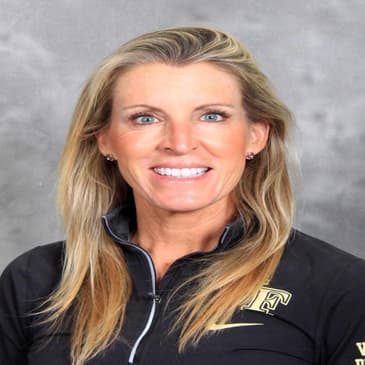
Kim Lewellen is the Head Coach of Women’s Golf at Wake Forest University, where she has built one of the nation’s premier collegiate programs. Since taking over in 2018, she has led the Demon Deacons to the program’s first NCAA National Championship in 2023, multiple ACC Championships, and numerous conference and national honors. She is widely recognized for her leadership, competitive excellence, and ability to develop athletes both on and off the course.
01:03 Living the Dream: Coaching and Connection at Wake Forest
02:52 No One Gets There Alone: Why Relationships Matter
04:38 Leaving 10 Minutes Early Can Change Someone’s Life
08:32 HINGE MOMENT: The 15 Seconds That Changed a Coaching Career
13:07 Mental Toughness: Don’t Overvalue a Bad Shot
14:40 The Power of the Debrief in Coaching and Performance
16:30 How an ACC Loss Helped Fuel a National Championship
23:43 Staying Present When the Pressure Is Highest
25:40 Winning Feels Better Than Having Won
28:08 Build Your Armor When Things Are Going Well
30:49 Two Rules for Building a Championship Culture: Be Kind and Work Hard
33:00 What Separates Elite Performers: Persistence and the Process
35:14 Building Confidence and Keeping Doubt From Taking Over
37:07 Giving Athletes Ownership of Their Development
44:51 When Elite Athletes Start Asking, “Am I Good Enough?”
49:37 The “Just One More” Mental Toughness Mindset
Don't forget you can also follow Dr. Rob Bell on Twitter or Instagram!
Follow At:
- X @drrobbell
- Instagram @drrobbell
5 Mental Toughness Advantages for Financial Advisors:
If you enjoyed this episode on Mental Toughness, please subscribe and leave a review!
Dr. Rob Bell
Exclusive Podcast Partner:
Morton Brown Family Wealth
Morton Brown Family Wealth is the Presenting Partner of The Mental Toughness Podcast with Dr. Rob Bell. Sponsorship of this podcast does not imply endorsement of the views, opinions, products, or services expressed by individual guests.[00:00:09] Welcome to Mental Toughness Podcast with Dr. Rob Bell. Each week, Dr. Rob sits down with athletes, executives, and expert coaches to talk about mental toughness and their hinge moment. Here's your host, Dr. Rob.
[00:00:35] We put too much value in our failures. I definitely feel like if you want to call it a failure or something that you felt like you didn't do well, it's never a failure, it's a learning moment. A missed shot is an opportunity to figure out what could I have done different? Was it a mechanical issue? Was it a lie issue? Did I not play the wind? Was I just not in the correct mindset?
[00:01:01] So whatever that might be, I always feel like that particular shot is helpful, not harmful. On the Mental Toughness Podcast today, our guest, she's built an accomplished coaching career in college golf. She's the head women's golf coach at Wake Forest University. She led the Demon Deacons to the program's first national championship in 2023. She was named the National Coach of the Year and six-time ACC Coach of the Year.
[00:01:28] Before Wake Forest, she spent 11 seasons at the Head Coach of Virginia, where she won back-to-back ACC championships. She was also head coach at East Carolina and the Citadel before that. As a player, our guest was first-team All-American at North Carolina, competed professionally at Women's European Tour, Futures Tour, LPGA Tour events, a big break. Excited about this conversation today. Coach Kim Llewellyn. Kim, thanks for joining us.
[00:01:58] Hello, hello. I'm excited to be here. I look forward to what's to come here in the next hour. So you take a golf cart to work every day. You have the gig. Yes, I do. So I'm very, very fortunate. I actually am a pitching wedge away from our golf facility and then also on the 13th tee box of our home course at Old Town.
[00:02:22] So I take a golf cart to work. And I'll tell you what, I feel like I've got a dream every single day the way that my whole home situation and work situation is set up. So yes, golf cart. That's awesome. And I have not played there, but I was at Fratelli's one time. Fratelli's is still there, right? Oh my goodness. Fratelli's, their calamari. Okay, their steaks, obviously they're known for their steaks, but their calamari is fantastic.
[00:02:48] And I can actually take my golf cart to Fratelli's too. Come visit and I'll take you at golfing facility and Fratelli's all on the golf cart. Well, I would do that coach. I mean, I assume cause I want to get into coaching, but I mean, I assume like that still even just has to help with the relationship with your players, right? Like they can even come over your house if there's an issue, but I mean, you're right there. Like always having those touch points have to be huge.
[00:03:13] I agree. One of the reasons why I coach doc is I enjoy the relationships with my players and to be that close. A lot of them will just stop by. They'll say hello to my dog and my cat, and they'll actually go out my gate and play old town. They'll go on the way through my house to the golf course. And also in some serious moments, if there's ever an emergency or a situation,
[00:03:35] they can find me really quickly, knock on the door. And that's happened a few times too. So I'm accessible either for great fun times or if they need a quick talk about something. Coach, so no one gets there alone. We met at the Western Girls Am and I took an uncomfortable, well, not too uncomfortable, but I took an uncomfortable 15 seconds to introduce myself and gave you a copy of the book. No one gets there alone.
[00:04:00] And then even on our intro, like it meant a lot to me because that obviously then just made a difference in your life. And that was a hinge moment. But I was hoping you could maybe talk about that book and what a difference that it has made. So it's interesting and not to discredit how wonderful you are in the book is, right? I receive a lot of books and a lot of things in literature to read.
[00:04:26] Sometimes I get to it. Sometimes I don't. And so you had handed me this book. We had a wonderful encounter. So I grabbed the book and I stuck it in my backpack. And so I'm on the airplane and I couldn't get Wi-Fi and I couldn't get a signal. And so I pulled out this book and I said, well, I'll just start this. And from page one, I couldn't put it down. No one gets there alone. Really, at that time, it just made a lot of sense to me.
[00:04:55] And so I was thrilled, obviously, that you handed me the book. And then the funny thing is, a few weeks later, you reach out not knowing you could have thought she never read the book. She's still in her backpack. You reached out to me and said, hey, would you be interested in this podcast? And my husband was sitting where I was like, yes, this is awesome, because I can probably quote a ton of these pages from your book. So I was thrilled to be able to have a conversation with you about it.
[00:05:22] Yeah, that's awesome. So, Coach, share with us about leaving 10 minutes earlier, how that's made a difference. In one of the chapters in your book, you talk about no one gets there alone. And the first chapter was, would you stop? And you actually wrote that when you wrote, signed your book, would you stop?
[00:05:41] It was in relation to, if there was somebody that you saw in the way that might need some help, whether it be in a race or was on the side of the road or whatever it might be, would you stop? And your conclusion was, you would stop, and you noticed it through some studies that were done, that you would stop if you had enough time. So if you didn't have time and you were late for something, you were more at not to stop than if you had more time.
[00:06:11] So I immediately, Doc, I started leaving 10 minutes early for every appointment. Out the door, I was 10 minutes early. I even get up 10 minutes earlier. And the reason is, is I wanted to make sure that if I was needed, that it was that I had the time to stop and share and have a conversation.
[00:06:32] And it's interesting because as soon as I did that, I actually noticed how many times I'm more, I will stop more often. A friend of mine was walking by and I was in my golf cart going to work. And usually I would have just honked the horn and waved and kept on going. But because I wasn't late and I had more time, I decided to stop the car. I'd read your book. And, you know, the most important person at that time is a person in front of you, which is what you had written in your book.
[00:07:00] And I sat and had a conversation with him and he had just lost his wife. And he wanted to stand there and have a conversation and discuss some memories of his wife. And so at that moment, I think I was needed for him. And, you know, it also meant a lot to me to be able to sit there and have that conversation with him. I wouldn't have done that if I had left 10 minutes early.
[00:07:24] And also if I hadn't said, you know what, this person is the most important at this moment in time, which is something else you have in your book. So I'm leaving 10 minutes early all the time now and getting up earlier. I kind of tear up a little bit because that's why I wrote these books. Ironically enough, I wrote airplane books like I'm not that smart. So I wanted somebody to get on from the flight from Indianapolis to Boca Raton or, you know, from BWI to L.A. and be done.
[00:07:51] And to hear like the impact of that, like we don't know always the result from our actions. But if we take no action, there will be no results. So the fact that we are doing something because you don't know the impact of just being there and listening to him. But you just know that, boy, that made a difference. It did. And not only that particular piece, but walking around. So I had I recently just had a camp and I again, I was there 10 minutes earlier than I usually would be.
[00:08:21] In order to set up everything. But because those junior golfers, they all want to have a conversation with me. I wasn't in a hurry to set up a putting station or hitting station. I'd already done it. And each one of them had a moment with me and I had a moment with them. It's just a great point. Make sure you have enough time for everybody. Maybe that's the title of this podcast, too. We probably titled it already. Yeah. I don't know. You've got a lot of good points in this book. So we'll have to see which one makes the most sense.
[00:08:52] I appreciate that. So we hinge moments is a big part of what we talk about in this podcast and mental toughness. And you play golf at North Carolina. You were an All-American. You were playing professionally and you were instructing. But you were out of coaching. And then early 2003, you're living in Charleston and you and your husband decided to go to a tennis match. And that made all the difference. Pick us up from there. I had been in the golf industry.
[00:09:20] I was an instructor and then played up until my first child was born. So when I turned 30 and my first child was born, I stopped in the golf business for about three years, just raising my children and we were moving around. And so they were three and I was wanting to get back in the golf business. And we lived in Charleston, South Carolina. And I thought, well, I'll just become a golf instructor. That's what I knew. That's what I had done. And so I put some feelers out and I hadn't gotten any bites on that yet.
[00:09:50] And so we happened to be at a tennis match. Well, first of all, I know nothing about tennis. So I don't know why I was at this tennis match. Probably a friend had given me some tickets. And so my husband and I had this tennis match. He looks over and he says, Kim, that's Les Robinson. Well, Les Robinson was the athletic director at NC State. And I'm from Raleigh, North Carolina. And so was my husband. And so he, at that time, was the athletic director at the Citadel.
[00:10:16] My husband said, you should go over there and introduce yourself and just see if he has any potential job opportunities in a golf team, whatever it might be. So I said, I'm just going to, okay, I'm going to walk over there. I always say it might be a difficult 10, 15 seconds, but I'm going to put myself out there. And so I went up to him and I said, hi, I'm Kim Llewellyn. And I noticed, you know, I know you from being an athletic director.
[00:10:45] I'm from Raleigh, but you're now at the Citadel. If you have any golf job for me, I would love to get back into the golf business. I'd love to, if you have a coaching opportunity. And so he said, well, let me take your number down. So he took my number down. And the next week he calls and he says, well, I have a marketing job. Would you be interested in that? And I said, no, no, no. That's not quite my thing. I'm really, I have a passion for golf. So a week later he calls and he says, you know what?
[00:11:14] We have an opening for a men's and women's golf coaching position. Would you be interested? And I was like, yes. So that started my path. That was the hinge moment and started my path for coaching. But it even went more than that. That one moment, what that does is set up for the rest of my life because Les Robinson knew Terry Holland, who was the coach at East Carolina. So I was at the Citadel and we had done a nice job there.
[00:11:43] So I wanted to move to East Carolina. So Les called Terry and said, Terry, you need to hire this girl. Then I end up at East Carolina. Well, Terry Holland had been at Virginia. He played basketball and he had worked at Virginia. So when the Virginia position came available, he talked to Craig Littlepage and said, you need to hire this person. And so just that one moment and that having the confidence for the 10 seconds and meeting
[00:12:10] that one person and then all of the folks that they knew led to me now being at the University of Virginia where we had some success. And then now at Wake Forest University and now I'm coaching and I love it. And who knows what I'd have been doing. So you ever turned down an invite to a tennis match in the future? Never. I love that, coach. I really appreciate you sharing that. And that's the part where I look at, you know, faith interjects like it's going to give us
[00:12:38] these situations, but it's our job to show up, right? To be there, to say yes, to try and make things work like that. So I appreciate you sharing that. I love that. The part about tennis that's interesting. So having worked with athletes, all different sports, one part of tennis that we always emphasize when it comes to the mental game. And I'm tying this in with you is don't overvalue the shot. So you have a really long rally, right? A 20 point rally and you lose the point. And now it's 4-3.
[00:13:07] Now you're down 4-3. It's just one point. It's just one point. But that's one part of your coaching that you really emphasize as well, right? Is don't overvalue bad shots. I was hoping you could talk about that. I think all of us and we're all our human nature. We put too much value in our failures. I definitely feel like if you want to call it a failure or something that you felt like you didn't do well, it's never a failure. It's our learning moment.
[00:13:36] And you talk about that a lot with what you do and in your books. And I always feel like a missed shot is an opportunity to figure out what could I have done different? Was it a mechanical issue? Was it a lie issue? Did I not play the wind? Was I just not in the correct mindset? So whatever that might be, I always feel like that that particular shot is helpful, not harmful. Yeah, I love that coach.
[00:14:05] How powerful do you think is the debrief in your coaching? Because one of the parts about the mental game that I think is, yeah, I can help people before, but I can really help them afterwards. How powerful do you think that debrief is with coaching? Because I know you and Ryan do a great job of that and really emphasize that. We do. We do that quite a bit. So we, and we call it debriefing, which is funny because after every event, and it might be after a tournament. It might be after a practice round.
[00:14:35] It might be just because a player wants to debrief. But I finding, and it could be even walking down the fairway when somebody's not having one of their best rounds. And even at that moment, they want to be debriefing. Is that the best time to be debriefing? Possibly not, right? But at that moment, if that's the time that I'm going to get the best information, and it's not an ACC championship or an NCAA championship, it's a regular season, I will let my guard down
[00:15:04] instead of being processed at that one particular shot. And if they need to debrief at that moment, I'm going to debrief. And we're going to figure out what's going on. Is it an equipment issue? Is it a process issue? Is it a routine issue? Is it whatever it might be? We're going to debrief. And it could be, again, in a regular season tournament. It could be right after round, before round, or they may just walk into the office.
[00:15:31] But debriefing and really understanding what's going on with a player is a valuable tool in any golf business and whatever it is. Coach, I want us to go to 2023 national championship. One of the pieces that you said in the interview before is that losing to Virginia in the ACC semifinals may have actually helped you win the national championship because it forced your team to be less reactionary and more solution focused. Talk to us about that.
[00:16:01] Yeah. So we lost to Virginia at the ACC championship in the semifinal match. And I had five phenomenal players. I mean, they were all ACC. Four of the five were all American. The fifth one was a shoot. Now she's on tour and is one. So, I mean, I'm just saying I had five tour players. And so it was surprising, you know, at that moment that we did not win.
[00:16:29] And it was obvious from an outside view that their expectations to win, all of their emotions were hype. You know, if a missed shot, to your point, to them at that moment, they just put so much value on a missed shot. A bad lie. A bad win direction or a bad call. Everything, the small details were exaggerated.
[00:16:58] I think because of the expectations they had. And so we really reset after that. They knew they were great players. It was really more of just the mindset that they were going into before they were playing that was causing them not to flourish. So they went into a different mindset and it was a non-reactionary mindset. So they would hit a golf shot. If it wasn't what they wanted, they immediately did a post routine and they left it and they
[00:17:28] went to the next one. If they didn't get a good score on a particular hole, they left it. They regrouped. They went into a practice routine and they went into the process of the next shot and they went and hit the next shot. We always say stay in the process, remember the next shot, but it's hard to do. They really took that in and did that. We got through regionals and it was interesting because one of my players, Amelia Migliaccio,
[00:17:55] now Doran, we're playing regionals to get to the NCAA championship, which we won. And she had gotten a seven on a par five. And that just never happens to Amelia. She's still one of the best players in the world. And she gets a seven. You would have no idea what she had gotten. But three weeks later, you would have known what she had got, you know? And so she had just said, I'm going to take that. I'm going to throw it away. And she went on. One of my players went birdie, birdie, birdie again with that mindset.
[00:18:25] And we made it to the national championship. And then we won from there. So really made a turn into our season to change that mindset. Appreciate that, coach. Success doesn't make financial decisions easier. Sometimes it gives us more decisions to make. Morton Brown Family Wealth works with executives, business owners, and families to connect their financial resources to the life they want to live.
[00:18:51] It means comprehensive financial planning, looking beyond investments into taxes, retirement, estate planning, generosity, and long-term future. Morton Brown helps their clients see beyond the numbers into an understanding and plan about what those numbers are there to support. If you want a thoughtful, strategic approach to life's transitions, retirement, selling a business, or even playing for future generations, connect in the link. Morton Brown Family Wealth.
[00:19:21] So you had been to the NCAA tournament, had made match play several times. But with Wake Forest in this year, it was different. And you talked about staying with a player in one of the matches. I was hoping you could talk to us about that and that insight and how that made a difference. Yeah, yeah. So in Virginia, there was one particular time where we almost won an NCAA championship. We signed an incorrect scorecard and lost that championship by that amount of strokes.
[00:19:48] And so I learned from that particular piece that I needed to spend a little bit more time and attention to detail. And the interesting thing, the reason why that scorecard wasn't signed correctly, it had played as a different par in regular season when we had played it. And then also, the young lady who signed an incorrect scorecard, her teammate had just shot 67, which was her lowest collegiate round.
[00:20:14] And she was so excited to go congratulate her that I'm sure she just didn't pay attention as she should when she signed it. So again, it was just more of an attention to detail. So then we fast forward. We had had a few Final Fours when I was at Virginia. Yeah. Fast forward to Wake Forest my first year. We finished runner-up in 2019. And again, there was a particular moment where I thought, maybe I should have done something a little bit different.
[00:20:44] And again, it was more of an attention to detail. I knew that there was a particular player that had a shot shape of a draw when she was under pressure. And I probably should have stepped in, especially in that pressure of a situation, maybe changed a game plan for. And I did not do that. Again, because my attention to detail, I probably should have spent a little bit more time with. So fast forward again to 2023.
[00:21:11] It was a really cool scenario for me. But the Golf Channel and all of the cameras are on the match that was behind us because it looks like that's going to be the match that's going to win the national championship. And it was. But I was with a player that was in front. And it was just in case that match didn't finish as we all were hoping. This young lady was Mimi Rose.
[00:21:36] And she was putting for birdie in order to go one up on the match that she's playing. And she's on the 17th hole. And we just stayed together. There wasn't a camera. There was nobody. It was just me and her and her opponent. And everybody was back there. And I made sure I stayed there. And then my attention to detail was on this match. And that I was going to see myself from everything that I'd learned previously. I was not going to leave this position.
[00:22:05] I was going to not leave my process. And I was going to help this young lady make this putt just in case something happened there. So she's looking at the putt. And I'm looking at it the other side. And she's about to make it probably to go to win this hole. And we hear in the back just all of the screams and all of the yelling and all of it going on in the back. And me and her just embraced. And it was just an unbelievable moment to have with a student athlete.
[00:22:30] But also as a coach to know, hey, everything that I had learned in these last 10 years, it came to fruition here with a group of young ladies that we made a memory of a lifetime. When you have that memory, coach, and you think back, what is the piece that stands out to you the most?
[00:22:53] Again, it was the piece that when things are heightened and everything is heightened, and this is the biggest stage. And, you know, we're working. And these student athletes, by the time they're a freshman and whether whatever year they're in, we're working for these national championships and to be in that moment. And you know, and everybody knows, and a lot of times in that moment, time is just, it just goes fast on you. And your brain starts to go fast on you.
[00:23:21] And you've got to really, really hold back a little bit and just be in that moment. But that moment to your book is the most important moment at the time. And you've got to be 100% present in that moment and not let the distractions get in the way. And that's what we did. And I think really, truly believe that's why we won.
[00:23:44] And did winning because of what you had, I mean, how many years you had been coaching and the journey you had been on, did that even make the winning that much more sweeter? Oh, much, much so. I mean, you know, when you're close so many times and you're always evaluating, what could I have done different? What could I have done different? And those opportunities don't happen that often.
[00:24:06] I mean, you know, to make it through all of those, to make it through regular season, then regionals, and then the stroke play piece of match play, and then all of the matches to get to that final piece. You know, you got to have a lot of things going your way. I love it, Coach. I always, when I'm talking with athletes and just in general as well, one of the things I like to say is that winning feels better than having won.
[00:24:33] And what I mean by that is because the next day, no matter what, it's going to come and go, right? And that's why I really don't like sports media a lot, because whoever's going to win championship, the very, that is still at the bottom. It's going to be, okay, well, can they win again next year? Or what are the rankings for next? Like, it's already on to the next season. It's like, wait a minute, the confetti just dropped here. Like, let's just enjoy this for a minute. But that's the media's job. But it's already on to the next.
[00:25:01] Like, how do you equate that with your life? Does winning feel better than having won? You know, that's a great point. And you actually bring this up in your book. And it talks about expectations. And once you win, you now have even more expectations put on yourself. And you do it yourself. We have now won. It felt great. I won it again starting tomorrow.
[00:25:26] And that can be a very difficult, and it can be a rabbit hole that you start to go down. And I see that with my players. And after I had read that in your book, it really made me think about my players that they'll win a regular season event. And then all of a sudden, they have expectations. Well, now I need to win the conference championship individually. Now I need to win the NCAA championship individually.
[00:25:51] And they start to put more pressure, if you want to use the word pressure, on themselves because of the wins that they've had. And I think they, and to your point, okay, it's wonderful that win. And enjoy it because you've worked hard and it's great. But then also, you need to, after that, just enjoy the process of getting better. Enjoy the 1% of getting better. Enjoy the journey of getting better with your teammates.
[00:26:19] And just let all of that stuff happen naturally so you can enjoy what you're doing. Because when you start going down that rabbit hole and just trying to collect as many trophies as you can, I think you stop enjoying the process of digging in the dirt and really just trying to figure out how to get good at your craft. There's a phrase that you use with your coaching. And that is, you've got to build your armor when everything's going well because there's going to be a time when it's not.
[00:26:48] What does building that armor actually look like? Yep. And so I actually use that a lot. I use it in my coaching. I use it in my life. I use it in all aspects. And that means when things are going well, build your armor to the best that you can. For golf, that would be when things are going really well and you're in a great mindset. Get as strong as you can in the gym. Go practice as much as you can on your technique.
[00:27:17] Figure out if your equipment is good. Get in a good, good mindset and come up with some strategies and some things that are working for you. Get your routines down. Do all of that when you are feeling great. Because at some point, something is going to turn, whether it's a slight injury or maybe you had a really poor round.
[00:27:37] And you need that armor that you did when you were in a great, great, great mindset to fall back on when you might have a little lull in that. And so we do that in golf and I think we should do that in our lives as well. And just making sure our armor is as strong as it can be, especially when we're doing well for those moments in life when things might be a little bit of a struggle. You know, and I'm thinking about your husband. I'm asking this question, though.
[00:28:06] But do you think about like, you know, putting when it says like putting on the armor of God, do you do that in your personal life? Very much so. And so in your book, it was interesting. So I'm reading and I read. I'm like, really, I'm getting a lot out of this. And then you have a chapter in faith. You say God is everything or God is nothing. You know, that's an important piece for me and my family. And if you look at as God being everything, he's got a plan for everything that you're doing.
[00:28:37] That can help you build your armor for when those little chisels and those little things are coming in to realize that he is everything. And so that's only going to be a temporary thing and it'll help you get through a lot of things. You've built your program around two rules. Be kind and work hard. Yes. Yes. Yes. Those are my own two rules. You can be a little bit late. I don't care. You can forget the white shirt for your competition.
[00:29:06] That's OK. But if you say an unkind word to somebody on the team, then we're probably going to have a conversation in the office. So how important is that? Talk to us about that. The part of that being kind. You're not in this world alone. Right. Every person in this world is a person that you can either help, you can use your skills to help or they can help you.
[00:29:29] I feel like our team, the people in the environment around us is a great training ground for that. Right. We're eight, nine people and we're together all the time. It's just like a family. And so there is obviously going to be times where there's too many people in the kitchen. Do you know what I mean? There's something going on.
[00:29:50] But this is a great testing ground for you to be kind and realize that there are more people in the world than just ourselves and we can use our skills to be helpful. I think a part of a team is a great place to cultivate and work on that. I mean, I assume and I've seen that as well. Well, I mean, that translates into the game itself, whether it's your competitors, whether it's the volunteers that are helping out. I mean, just the fact about being kind can really make a difference.
[00:30:21] And kind to yourself. Right. You know, I mean, it's a lot easier to to be kind to the person beside you and good morning. How you doing? But you got to be kind to yourself, too. And hey, good morning to yourself, too. You know, and I think that's an important piece as well. Coach, you've worked with a lot of elite, a lot of alphas, a lot of people that are playing at the highest level and having success there.
[00:30:49] And I always say like everyone's thing can be a little bit different. Right. It's like some people, their positivity is sort of their superpower. Some it's it's their putting. Some it's they want to be in that moment. But what are some things that you've seen about some of the really great players that they possess? It's a great question. No give up. And so when you again, you bring that up in your book, but it's just persistence.
[00:31:15] And I mean, these these young ladies are very, very, very talented. The ones that are the most persistent, they might fail, but they they do it again and they they might not have a great tournament and they do it again. Eventually, they're going to be successful because they're talented and they do all the right things. So I think really just being persistent and realizing you will get there.
[00:31:44] And those are the ones that have had had a lot of success. And I think the ones that enjoy the process of figuring it out like it's a puzzle. Golf is a puzzle and I'm going to figure it out instead of, oh, no, here I go again. Oh, no, I hear I go again. I had a bad round. My chipping wasn't good. My putting wasn't good. And so where that can accumulate into a lack of confidence instead of let me figure this out.
[00:32:13] Let me get this piece of the puzzle. Let me get this piece of the puzzle because you never know. And you brought this up. You never know what piece of that puzzle is going to be the answer to it all. And so the ones that continue to try to figure it out like a puzzle and the ones that are persistent seem to be the ones that are successful. Coach, have you seen the difference between the level of belief? They just believe that it's just going to work out for them. Yeah. One way or another. I do.
[00:32:41] And I do think confidence is a big piece to them. You need to continually train yourself to be confident. And you bring this up in a chapter in your book where confidence is the house and don't let doubt be a squatter, I think was the words that you used. And I think that's very, very important. You've got to be confident and doubt's going to come in. I mean, we all have doubts. We all have random thoughts that come in your mind. But just let those play through.
[00:33:11] You know, listen to them. And maybe if they're helpful a little bit, like I need to go work on my putting because I haven't done great. But then let it play through. Don't let it sit there for a while. And I think those folks that are confident, and they can't be confident from external things. It needs to be confident from coming inside. Faith helps a lot for me. But it needs to come from inside.
[00:33:37] And if it comes from inside, you're a lot more likely to let those squatters leave in that doubt. I like what you said there, Coach. Just let them play through, right? I let a lot of things play through, Doc. That's really good because I just try to play faster. I know, right? Yeah. Just let it play through. I think ownership when it comes to one's game is very, very important. You know, having Mike Small on the podcast.
[00:34:05] He talked about, like, his job as a coach is letting them take ownership of it and knowing that they have ownership of it. Like, they'll do everything they can, but it's their journey. It's their shot. One of the pieces that I find impressive about how you've set up your program is you and Ryan, you allow them to set up their own practices, to work on what they need to work on. You are the resource from that. But that even builds up their own ownership of it, right? Right, right, right.
[00:34:31] So Ryan and I, they've come to us and they're good players. And so we are here to be a resource. I look at ourselves as a general practitioner. Meaning we're here, both Ryan and I, as a set of eyes for them to be able to debrief, right? We're here if they have an equipment issue. And if we don't know it, then we're going to send them to somebody who knows about equipment. We're going to send them to somebody that has more knowledge about the mental aspects of it.
[00:35:00] We're going to send them to somebody that might have a little strength training in physio and physical therapy. You know, we're here to maybe be able to diagnose some of it and be here for a set of eyes. But then we just sort of try to direct them where they need to go. And the way that we set up practices is we don't say you're there from two to five. They can float in and out and we'll have things set up for them.
[00:35:29] They'll say, hey, based off of stats, we do use a lot of statistical information, but we'll have things set up for them in different thoughts or they'll come in and brainstorm and say, I need to be able to do a performance drill that looks like this, or I need to do this to improve this part of my game. So we're really just in collaboration with our team. And that seems to give them ownership, but it also allows them to walk away when they're playing professional golf and have a routine for themselves and us doing everything.
[00:35:58] That's a great point. Great point, because I see it like all the time, right? And now they get professional. Now it's like, wait, I've been told my entire life what time, what to do. And now I have to figure it out. Yeah, exactly. Develop the routines and habits. I love it. Even just working out. There are a lot of them will come and they don't enjoy working out. But if I say, you know, make it, give them this habit.
[00:36:25] You're going to work out Monday, Wednesday, Friday at seven o'clock, no matter what. And even if you're just getting up there and you're just going through the motions or whatever it is, at least you're developing the habit. And it's interesting, those ones that didn't love it when they went into college, they graduate and they're the ones that have developed the habit and they're not going to miss a day anymore. How great is that? Episode 194, Dennis Morton and Katie Brown, the relationship side of wealth management.
[00:36:55] That is the idea at the heart of Morton Brown Family Wealth. Money doesn't exist separately from the rest of your life. Your career, family, relationships, goals, and values all shape the decisions you make with it. Morton Brown helps clients bring those pieces together. Check out the link, Morton Brown Family Wealth. Coach, what is, if you don't mind me asking, what is one statistic that you find really equate to success?
[00:37:23] In reference to golf, I think greens and regulation and proximity to the hole definitely, to me, is one of the number one correlations. I find playing and competing as much as possible. So this is one that you probably might not hear much of. But my players that compete more than the rest will have more success.
[00:37:53] So I'll just use Carolina Chacarra as an example. She graduated and she could have turned professional, but she stayed amateur because she was going to be able to get more player invites as an amateur than as a professional because she, at that time, didn't have anywhere to play yet. And she was preparing to go to qualifying school. And so she stayed amateur because she could compete every single week as an amateur. And she wanted to keep competing.
[00:38:21] So it became not, you know, a dramatic event. Q school wasn't going to be a dramatic event. It was just going to be another competition. And Doc, she went in there and owned Q school. Got through LPGA's Q school first time. That doesn't happen. Rarely does it happen. Went through L.A.T. tour school and got through that extremely easy. So she received LPGA and L.A.T. Her status first time.
[00:38:51] And that just doesn't happen that often. And again, I truly believe, yes, she's an awesome player. But there's a lot of awesome players. But she set up by competing every single week to that just became another event. And she had her swing thoughts. She had her playing thoughts. She had her mental thoughts. And so she was ready to compete. Coach, I've really enjoyed this. And hopefully questions have been great. And, you know, I haven't had a guest that has dropped so many references to my book. So I do appreciate that.
[00:39:20] You know, ironically, I have another Wake Forest guest coming on next. And that's the next episode is with Webb Simpson. And but so you're kicking this off. I love it. But what questions should I be asking that I'm not asking? And again, I think so much of you since I've been been reading your book. The question that I have is obviously I've read your your No One Gets There Alone. What other and I'm actually this is no plug.
[00:39:48] You haven't said, you know, you didn't even know that I had read these this book. Right. What other book would you recommend that I should read of yours? And what other things should I be doing for continued education, in your opinion, to continue my process of getting better? Well, coach, I mean, iron sharpens iron. So, again, I do appreciate that. I mean, I'm going to send you the book over my shoulder here is I can't wait to be patient.
[00:40:15] If I'm talking to players and athletes, I tell them puke and rally because it's not about the setback. It's about the comeback. But when I was working with Scott Stallings and I remember we were talking about it, we were, you know, actually talking about patience. And he said, yeah, man, I can't wait to be patient. And I kind of always held on to that nugget. And so that's a really good title for a book. So that's the copy I'm going to send to you because, well, you're already putting that in there. Right.
[00:40:39] And that's how I think, like, you don't win, you don't beat this game by working harder, trying harder. I think you beat it through patience and slowing down and just having the mental awareness. So that's the copy I'm going to send to you. And the only part I can share, coach, is that I am going to start leaving 10 minutes earlier as well. The fact that you have helped me with that. And I mean, the secrets, you know, as well as I did, it's not one secret.
[00:41:05] It's just the habits you build end up building you. But I'm just thankful we got this time to break bread together and have this conversation. This was awesome. One more question. You good? You got it. Yeah. So I have a lot of players that as they get closer to graduating and they start to see themselves turning professionally, they're deciding, am I good enough?
[00:41:32] And these players are usually good enough, but they're in their mind, they're battling, am I good enough? Am I not good enough? And every single golf shot that they hit is a validation of I'm good enough or I'm not good enough. And they become consumed with it. And it inevitably happens to almost every one of my seniors at some point within their senior year. And maybe this will be something about the patience book.
[00:42:02] The persistence book is a good one. The confidence book, you know, part of the chapter and the no one gets there alone. But if you had a piece of advice in reference to that, what would that be? It's not here yet. And here's what I mean by that. Is if you start living and dying off every shot, number one, you're going to be dead. But it's not here yet. You haven't turned professional yet. But now what we're doing is now we're testing ourself instead of training ourself.
[00:42:32] If today was the day, would I have made it through? If today was the day, would I have won? And that's the wrong way to think about it. So what I see oftentimes, I'll just equate it, coach, kind of like to a tournament that's coming up on Saturday. And Wednesday, really bad session, hitting it, horrible. Well, automatically we start time traveling to Saturday. If I'm hitting it like this on Wednesday, how am I possibly going to be teeing it up on Saturday? I'm going to hit it horrible.
[00:42:57] When you and I both know the person who loses the bet on a Tuesday is probably going to be making the cut and like playing really well. And that's the biggest piece that I can always share is like it's not here yet. And that's the job of you just stay back into what you're doing and training yourself, getting ready. Because when do you need to make that decision? Well, the decision is a month from now. Hey, make the decision then. But that's the part I always get back to. It's not here yet. Why are we time traveling?
[00:43:27] Train yourself. Don't test yourself is really what I get back to with that. What do you think? I love that. I love that. I love that. I'm going to use that. It's not there yet. I love that. Train yourself. Don't test yourself. So the question I'm always asking my players, well, when does the tournament start? Well, it starts on Thursday. Well, no. What time? The afternoon? Yeah, 140. That's when you need to be ready. And so what it allows us, I think, is it allows us that room to breathe, relax.
[00:43:56] And because the brain operates a whole lot better when we're relaxed rather than I'm more stressed and, well, you know, I can't be hitting this. And then we're now more in problem solving mode instead of like just, hey, what's the problem? And then the second question, since I, since, you know, I have a wonderful coaching staff and myself, what do you think the environment? And I feel like I know this, but I'd be curious to your take.
[00:44:21] The environment should be around these players to get the optimal out of them at that moment. You know, what environment can I be providing for them for their magic to come out? Yeah. Yeah. That's a great question, coach. I mean, I think you've done that. So I'm a little bit remiss to try and answer it. But I think the basis of every type of coaching relationship always gets back to love.
[00:44:49] I think athletes want to be coached hard. They want to be pushed. If long as that love is there underneath and that you value me as a person. And this is something I do and I take it very, very important, but it's not all that I am. And, you know, coaching the athlete. And I think once love is underneath that. So we always hear the quote, people don't care how much, you know, until they know how much you care. Well, what's the extension of that one? They care once, you know, once they know that you care. And that's the part.
[00:45:19] I just always think it's just love is underneath. And that's the real difference when it comes to any kind of coaching relationship. Wonderful. I love it. Great. Well, let me ask you another question, coach. What about the just one more syndrome? Yeah. Talk to us about that one. I mean, I had it as a player in it and we just call it just one more. And it is usually we're practicing and we feel like we figured it out.
[00:45:48] But let me just have one more to make sure. Let me just have one more. And you're a hundred balls later. Still just making sure you have that one more. And I love that you have a chapter in your book. This is just do one more. So it's funny. My husband and my son have this bet. They've got to do a hundred pushups for 80 days. And so they're both going down there and they're doing it. And I'm like, just do one more. Just do one more. And I find myself getting up a little bit earlier to work out. Why?
[00:46:18] So I can just do one more. I can do one more rep. I can make one more phone call. I can have one more conversation with the person down the street. You know, just having time for one more. I'm getting a few minutes early to be able to do that. Hitting one more golf shot. You know, I just feel like you can move the needle a lot quicker in every aspect, whether it's sports, social relations. One more prayer. You know, like just, you know, pray for that person.
[00:46:47] One more prayer. So I think there's a lot to the one more rule. Yeah. And I think when we're looking for the secret, how to exponentially get better, I think that is really the key. And where I came up with, I didn't come up with that idea, but where I heard about that idea was when Steve Young was going over with coach Shanahan before they're playing the Chargers for the Super Bowl in 94, he had 300 plays memorized and he went through them all.
[00:47:15] And coach Shanahan, you know, he went, went through all 300 plays and their goal on that one, I think was to score like eight touchdowns. And coach Shanahan said, you got it. Let's just do it one more time. And they went through all 300 plays just one more time. And I was like, okay, well, if the best quarterback in the NFL is doing that, like, yeah, that's what we have to do. So it's like, once you have that speech done, just go through it one more time. Once you've written that paper, just go through it one more time.
[00:47:43] It's going to make exponentially the difference. Well, it's funny that you say, so my son, again, referenced to not necessarily sport, but he's going to flight school and he had to take his flight exam. And I said, just do the practice test till you get a hundred, but then do it one more time. Then, you know, one more time, get two 100s, get three 100s on the practice test. So when you go in there and you have a moment where you might, you know, the squatter comes
[00:48:11] in for a minute that you've done so many that it's almost instant for you to make those quick decisions. So, and he did great, by the way, passed it in flying colors by doing one more. I love it. I love it. Can't wait to see what his call sign is going to be. I know, right? What is it? Goose. We got Goose and Maverick, right? The reason why I brought up that debrief is that that is what the Blue Angels are exponentially
[00:48:40] great at, is when they debrief their training flights, especially starting out, is those debriefs will last two hours. And then they get it down to where the debriefs are about 15 minutes. Now that is after months and months of training, but that power in the debrief. Yeah. And I think to your point, once you, you have to dive in and know your athlete, to your point of know it, love the athlete. So, you know, really developing the relationship, understanding them, know their language because
[00:49:10] everybody has a certain language that they think in. And knowing that particular person inside and out can help those debriefs become quicker and easier and more helpful. And so probably to that same point, once you get to know that person really, really well and take a deep interest in them personally, those debriefs happen more often and can be even more helpful. Coach, I love this. Thank you so much for taking the time to join us. This has been great.
[00:49:40] Yeah. Well, I thoroughly enjoyed it. And so, you know, I'm going to be in contact a lot now after our conversations. And I can't wait to read these other books. And oh my goodness, the notes that I have in this particular book, I still go to it every single day. So I won't forget it. I love it, Coach. Thank you so much. Thank you. Thanks for listening to Mental Toughness with Dr. Rob Bell.
[00:50:06] To find out more about Dr. Rob, visit his website at drrobbell.com or follow him on Twitter at Dr. Rob Bell. And subscribe to the show on your favorite podcast platform to get the next episode of Mental Toughness as soon as it's available. Thanks for listening and we'll see you next time.