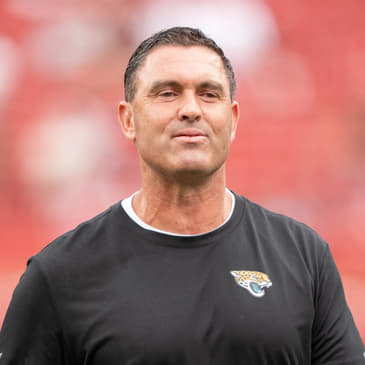
Eric Ciano is the Director of Strength and Conditioning for the Jacksonville Jaguars. Now entering his 17th NFL season, he previously spent 15 years with the Buffalo Bills, where he was named the NFL Strength and Conditioning Coach of the Year in 2020. He was also while strength and conditioning leadership roles at Georgia Tech, Tennessee, and Louisiana Tech.
0:58 The Hinge Moment That Led to an NFL Strength & Conditioning Career
2:43 Winning a National Championship and Building Championship Culture
3:27 Leadership Lessons from Legendary Strength Coach Johnny Long
4:19 Building Mental Toughness Through Accountability and Standards
5:37 Daily Habits That Create High-Performance Athletes
6:38 How Mental Toughness Is Built Every Single Day
8:03 Building Confidence During an 0–8 NFL Season
9:10 Creating a Winning Team Culture with the Buffalo Bills
10:49 The "13 Seconds" Game and Recovering from Heartbreak
13:47 Leadership, Recognition, and Bringing Out the Best in People
15:33 Using Competition to Build Mental Toughness and Accountability
19:24 Why Talent Without Discipline Never Creates Champions
21:37 Getting Fired After 15 Years in the NFL and Moving Forward
24:21 Mental Toughness When Life Doesn't Go According to Plan
25:54 Leadership Lessons from Nearly Two Decades in the NFL
27:41 Why Passion Still Separates Great Athletes from Good Ones
28:43 What's Wrong with Youth Sports and Athlete Development Today
30:14 Calvin Johnson and the Habits of Elite Performers
33:02 Daily Training, Longevity, and Performing at a High Level
35:08 Purpose, and Life Beyond Football
Don't forget you can also follow Dr. Rob Bell on Twitter or Instagram!
Follow At:
- X @drrobbell
- Instagram @drrobbell
5 Mental Toughness Advantages for Financial Advisors:
If you enjoyed this episode on Mental Toughness, please subscribe and leave a review!
Dr. Rob Bell
Exclusive Podcast Sponsor:
Morton Brown Family Wealth
Morton Brown Family Wealth is the Presenting Partner of The Mental Toughness Podcast with Dr. Rob Bell. Sponsorship of this podcast does not imply endorsement of the views, opinions, products, or services expressed by individual guests.[00:00:09] Welcome to Mental Toughness Podcast with Dr. Rob Bell. Each week, Dr. Rob sits down with athletes, executives, and expert coaches to talk about mental toughness and their hinge moment. Here's your host, Dr. Rob.
[00:00:23] I always kind of stress that we have to crawl before we can walk. You've got to build a great foundation first, and then we're going to start seeing results. But our society now is win now. I mean, some of these coaches are getting fired after one year in the NFL as a head coach.
[00:00:49] That, I just don't think they're giving coaches enough time, you know, in certain places at certain times. But yeah, like everybody wants to win now and there's no room for error. There's no where we're like, we need to build the foundation first before we can go on and win multiple years back to back to back to back. On the Mental Toughness Podcast today, our guest is Director of Strength and Conditioning for the Jacksonville Jaguars.
[00:01:14] He's now entering his 17th NFL season, previously spent the last 15 years with the Buffalo Bills. He was also named NFL Strength and Conditioning Coach of the Year in 2020. He has also been Strength and Conditioning Coach and leadership roles at Georgia Tech, University of Tennessee, and Louisiana Tech. Excited for this conversation today. Our guest is Coach Eric Ciano. Eric, glad we were able to do this, man.
[00:01:42] Yeah, I appreciate you having me on. I'm excited for this. Like I said, I enjoy your work, so once I had a chance to do this, I for sure wanted to do it. Well, I love it, man. I mean, we met at the NFL Combine, man. We got to kind of break bread together. And, you know, it's kind of always sharing, hey, this is the premise of the Mental Toughness Podcast, right? Just share your story. We talk about hinge moments. And let's just start out with that, man. Your hinge moment. I mean, you got a call from University of Tennessee, 10 hours a week, minimum wage. Pick us up from there, man.
[00:02:09] Yeah, I was the intern at Boston College and my mentor at the time was Mike Portamani. And we had gone on a trip and visited Tennessee, Georgia and Georgia Tech in the spring and nothing came out of it. And I was back at Boston College as an intern for the training camp and got a phone call and said, hey, you know, a guy left and we have a spot. Pays you a minimum wage for 20 hours a week, but you have to be here in 24 hours. Pat my car and left and took it and changed my career forever.
[00:02:34] So, you know, I was blessed to go to Tennessee, obviously, and work with some great, amazing people there at the time. And, you know, that was probably the moment where it was just, hey, just take a chance, you know, get out of the Northeast and just go do something different. It paid dividends. I learned a lot there and they helped shape me and, you know, mold me. It was great. I love that because we see the careers, they're all on the highlight reels. But when you get offered like minimum wage and like, man, that takes a leap of faith, doesn't it?
[00:03:02] Yeah, I just bet on myself and said, hey, I'm going to go there and I'll earn a GA spot, which I did. And then, you know, left from there and wanted to be the head guy at Louisiana Tech. And two and a half years later, I went back as the associate head. And so it was a blessing. Like I said, there was some great people there. You know, I had John Stuckey was my boss and Tommy Moffitt and Chris Carlisle, Johnny Long. I mean, we had a great staff. We had great people there. You know, still there's so many of them still in this field today. Was that 97? 97, yeah.
[00:03:31] Okay, so 97, Peyton Manning's last year. Peyton Manning, I was there last year and then one of the following year at T-Marc. Yeah. What I remember about that team in 98, I remember when Jeff Hall kicked that game winner, the very first game of the year against Syracuse, man. Syracuse, yeah. There was two games that year. That was an undefeated season. And the Syracuse game winner, game one, and the Arkansas game that, you know, we were basically lost in the fourth quarter. Right. And center stepped on the quarterback's foot, fumbled the ball, and ended up winning that one, too.
[00:04:00] I mean, but those two games changed the entire year. You know, it always comes down to one or two plays. We just don't know which plays those are going to be, right? That's fine. So important. Like, we talked about mental toughness and discipline and accountability and all that stuff. Like, for those moments right there. What Johnny Long story can you share, Coach? What stands out about that one, man? Oh, God. I could have stories for days. I will tell you, Johnny is the most fun person that you'll ever be around.
[00:04:26] He's the greatest guy to work for. Just his positivity and energy and attitude, he is the best. Like, he was so much fun to work for and just a good person. Yeah, we still talk to this day. He was awesome. But it was different for me because I came from Boston and he was from straight Louisiana. It was, he took me actually to New Orleans for my first experience. I didn't know places like that existed. Yeah, that's awesome, man.
[00:04:54] You know, one of the pieces that you've always emphasized, obviously the accountability, the discipline, like the mental toughness piece. It was fascinating to me about really just the, how you stress the accountability. And I was hoping you could just kind of delve into that a little bit more, man, about the importance of that, just that asset alone. And I've kind of realized now in my career here that good teams that I've been on, you know, coaches held the players accountable.
[00:05:23] But on the great teams, players held the players accountable. And that's always been the thing that I see. You know, we have it here. Like, our older veteran guys are on the younger guys and teach them how we do things the right way. And this is how things are done. And, you know, the little details matter and all of those. And, like, this is how we do things. You know, we've got a great DB room and there's great DB leadership in there.
[00:05:51] And, you know, we brought in two free agents, Jordan Lewis and Aaron Murray. And, you know, those guys came in. And, you know, when we signed Jordan from Dallas, I mean, their strength coach told me, he's like, you know, you just are our best guy. Immediately, he came in right away, first day of workouts, stepped up and spoke in front of everybody. And I was just like, oh, wow, this guy's special, you know, and he is. But when it matters to the players and they're holding each other accountable, you know, you've got a chance to be really, really good.
[00:06:16] What are some of those details then that you, I mean, throughout all your years you've seen, right? I mean, there are some of these things then that stand out in terms of details. What stands out when it's like, okay, that guy's different or this is different? You know, we had some of them in Buffalo. You know, Jordan Poirier and Micah Hyde, you know, they kind of ran the DB room there. And just the way that DBs were always up first. I mean, it was rare that, you know, a DB room was probably your hardest working room in the entire team. Like, never had to worry about those guys. And they just, they all trained together.
[00:06:45] They all held those guys accountable. They all did things together. And it was just neat to see, like, a couple guys like that could shape an entire room. And then all the young guys follow in because they realize, oh, this is how things are done. This is how you play in the league this long. And that just builds the culture, right? That's the key at the end of the day is the culture. You know, with all these, like, most of the games in the NFL are decided within seven points. That's the part where the mental toughness is built on a daily basis.
[00:07:14] What are some of those things that stand out to you in terms of, hey, man, this really becomes important in terms of focus, confidence, but letting go mistakes and focusing on the next play? Yeah, I mean, like I said, we talked about it as a team, you know, in our last team meeting that, you know, every play, everything was down to the fourth quarter. I mean, almost all the NFL games come down to three to seven points. And the last drive, it's just when we first got here, you know, first spring, you know, it was a lot of offsides, penalties, mental mistakes and stuff like that.
[00:07:42] And then a year later, seeing how much of that is cleaned up and how much better we are and how much it is enforced, you know, on our meetings, it's shown, you know, missed assignments and errors and things like that. Like, hey, we can't win if we're having this many mistakes. We've got to clean this up. And we'll go through that, you know, almost every day at training camp of like these games are so close. We just can't make errors and we can't have mental lashes and Emmys and stuff like that. So it's a huge emphasis from Liam, you know, to our players, how important that stuff is.
[00:08:11] Coach, one of your first years there at the Bills, I mean, you started 0-8. 0-8, yep. And then we lost, Ryan Fitzpatrick became our quarterback. And then the last eight, we won four and lost four in overtime. So, yeah, 0-8 was hard. What happens in your own mental game when that's going on? Well, it was my first year in the league, so it was all new to me. You know, it was definitely different. But every Monday morning, Chan Gailey, you know, having to eat breakfast at the same time,
[00:08:40] and he would just sit at my table and be me and him. And, you know, I worked for him at Georgia Tech, and it really wasn't a word said. And Chan would just say, how was your family? I'd say, good coach. You'd say, okay, great. You know, Chan was the best family person, greatest person ever, just an amazing human being and stuff that people don't realize how good of a human being he is. And just, that was hard for me. You know, the first year in the league of being 0-8 was tough. But then seeing at the end of the year, like, okay, hey, we can be competitive, you know,
[00:09:09] and Fitz is good, and we got a chance. But, yeah, and coming from college, I wasn't used to 16 games plus four preseason games. I mean, the season, my first year, was long. I mean, I got to week 12 or 13. I was, whoa, I'm tired. And we still got a long way to go. We weren't very good at the time. Then when Coach McDermott comes in, and obviously, I mean, there's always some turnover that happens. But talk to us about that transition and then being a part of that regime.
[00:09:36] Yeah, it was, you know, the thing that Sean and Brandon and those guys did is change the culture. And it started with bringing in the right kind of people in the organization, in the locker room, you know, started bringing in quality, like, really, really good people. And that's what their philosophy was, is that this building is going to be about having the right kind of people in here. And that's when it started, you know. And then it just kept building and building.
[00:10:02] And, you know, and you might have taken them maybe a little lesser of an athlete, but a guy that you knew you could count on. The guy was going to be a count on him. He was going to show up to camp in shape. He's always going to be in his playbook. He's going to study. You know, sometimes people overlook that stuff and saying, oh, I'm going to take this amazing athlete. I'm going to take him and, you know, we'll fix him. Well, not always the case. So I'm going to take a smarter, harder working guy that I can trust. And I know that on four down, we talked about those mental errors. He's going to be where he's supposed to be, you know, things like that.
[00:10:28] So I think that was one of the big things that they did right from the get go is people. That's what they were about. Yeah. I remember when he took over, I remember just kind of that culture piece of taking out like ping pong table. They released some guys that were, you know, higher profile guys and, you know, sending a message that, you know, basically nobody was untouchable. So, coach, it's Bill's Mafia is one of the best fan bases in the United States, obviously, when it comes to NFL.
[00:10:57] And then one of the plays obviously stand out at the 2021 season, end of that season. It's the only play that time represents the actual play, right? We got like red right 88 or the catch or mac at the reception, but 13 seconds, right? It's the only play where time stands out. Walk us through that as a coach, you know, going through that experience. Yeah, that was probably my toughest loss in my coaching career.
[00:11:27] Still to this day, I mean, yeah, it still haunts you. But just having to be 13 seconds, the emotion change in such, you know, score, we go ahead. Got 13 seconds. This game's over. We're going to AFC championship game. I mean, the place is going bananas, you know, sideline, everybody happy. And then to lose and then to go in that locker room afterwards and everybody just the highs and the lowest of the lows emotion wise.
[00:11:56] And just that was extremely difficult. Like that was a tough, tough deal. Yeah, that was hard. The locker room afterwards was tough. I mean, the crying and just it was amazing just how you could go from we are one play away or basically we're going to be in the AFC championship game to lose it. 13 seconds. When that happens due to locker room, I mean, is that emotion numbness? Everybody responded differently.
[00:12:24] But I just remember just the look at people's faces and the crying and just knowing that you should have gone to the next round and had a chance to go to the, you know, Super Bowl and do all that. Because we were a good team, you know, and that's the hardest part, too, is when you know you're a good team and you lose and you shouldn't, you know, that's harder to swallow. And you were even ice fishing that a couple weeks later, right? Yeah.
[00:12:45] Me and the trainer were out on Lake Erie ice fishing and, you know, we had started drilling our holes and Buffalo people were coming by dragging their sleds and they had a case of beer and all their stuff. And they didn't know who we were. And they started talking to us. And like that community is really built on the fan base. And that for those people live for football there and them talking to us and just, you know, they couldn't even get over the fact, you know, of the loss.
[00:13:11] And it's when I really realized, like how much football meant to the people of that town and area. You know, that's why they sell out all the games and you can't get tickets to training camp. And those people live or die for that. That's what I really recognized that day in the ice when all these people just kept coming by and that's all they wanted to talk about. They didn't know who we were. We were just random people on the ice. You didn't have anything on. That was a tough one. Success doesn't make financial decisions easier.
[00:13:39] Sometimes it gives us more decisions to make. Morton Brown Family Wealth works with executives, business owners, and families to connect their financial resources to the life they want to live. It means comprehensive financial planning, looking beyond investments into taxes, retirement, estate planning, generosity, and long-term future. Morton Brown helps their clients see beyond the numbers into an understanding and plan about what those numbers are there to support.
[00:14:06] If you want a thoughtful, strategic approach to life's transitions, retirement, selling a business, or even planning for future generations, connect in the link Morton Brown Family Wealth. Coach, one thing that stood out to me in terms of your coaching was how intentional you've always been about recognizing effort. You've had lift of the week or lift of the year. You'd have leaderboards. Why is recognition so important with a power of leadership tool?
[00:14:36] What I found when I first got in the league, something that I created was I realized that the league was very different. There was guys in the locker room that couldn't tell me who the locker mate that was sitting next to him. I had times where I'd ask a player like, hey, coach so-and-so on defense. And they'd be like, yeah, I don't know who that is. So then I was like, okay, we need to do something that I can create a team atmosphere in a professional setting. All right? So I created the Iron Jaguar games.
[00:15:07] And basically there's some things about it. So number one is team building. So we did it the entire last two off seasons that we've been here. We're trying to create a competitive atmosphere. Like we want guys here that hate to lose. Okay? And that's what we have. I want to know who the lead, like the leadership in our locker room. Who are the leaders? You know, how do they lead? Obviously mental toughness. Hey, like we do a bunch of challenges. We do tug of war. We do bar hang. Who are the guys that are going to push through when the times are tough?
[00:15:36] You know, we want to prove off-season attendance. Yes. And we want to reinforce habits for daily performance. And I'll give you an example. Like last year, you know, we include the rookies here when they get into the competition. You know, we break them up into three rookie teams. So one day we had a bar hang. So the older guys had just gotten done. So I said, okay, each team, give me one representative from your team. Just hang on the bar. Hang on the bar as long as you can. Thank you. Three rookies up there. Well, the kid in the middle was LaQuint Allen. He's running back out of Syracuse.
[00:16:05] And there was a kid from Nuke and another kid from Navy on the side of him. The whole room was watching you. Like everybody's in there. Everybody's yelling and screaming and you're just hanging. So the Duke kid falls. And then it's down to Navy and LaQuint. Navy kid falls. So they've been up there like two and a half minutes. Yeah. And then LaQuint Allen, after he falls, everybody thinks he's just going to drop down. And then he proceeded to rip out 12 plus pull-ups in front of everybody.
[00:16:35] I mean, the room went absolutely crazy. Like I could show you the video and everybody kind of sat back and said, that kid's different. That was probably one of the most impressive things I've seen as a strength and conditioning coach, period. Well, here he is. He's a seventh round pick out of Syracuse, whatever else. And turns out to be one of our probably best players. I mean, he is tougher than shit. He is hardworking. He's got great energy every day. And he's the most competitive person.
[00:17:03] But like when everybody talks about, oh, competition, that stuff doesn't matter or whatever else. Well, yeah, it does. And those are the kind of guys that we want in the locker room here. You know, and the enforcement from upstairs, from, you know, Liam, Tony, James. I mean, they come and watch all of them, you know, and everybody's involved and everybody's going. And it's changed our culture and it's helped, you know, like help build a team at this setting. So it hangs and then rips out 12 pull-ups?
[00:17:32] It was the most impressive thing, you know, I've ever seen. And at the end of the offseason, like I said, like we make it worth their while for this competition. You know, the winning team, like no conditioning test at training camp. Don't have to stay in the hotel room during training camp. And then they get like a catered meal and whatever. But yeah, like so it's good. And like I said, when you talked about like the recognition stuff, like these guys are competitors. They want to compete. Like every one of our TVs, I'm looking at our TV screens in here now.
[00:18:02] It's all the highlights from all of our offseason competition stuff. So lifters of the week and lifter of the year, you know, so each week we give out two T-shirts. It's voted on by strength staff. So it's lifter of the week. And we have like a criteria. So one, you got to be, you know, one of the hardest workers on the entire team. You got to be a standout leader, either vocally or by example. You got to have a positive attitude towards yourself and your teammates. You must be a team player. Can't be an eye guy.
[00:18:28] But at the end of the day, the guy each week that gets it is a guy that makes the other guys around him better. So like who is the guy that's in there making all the other guys in that group better? You know, in this past year, you know, our lifters of the year where Austin Trammell, he's actually been a two-time winner. I mean, this guy does, goes above and beyond. I have not seen many skill guys that can train like this kid does and how he motivates people. And he's so smart and so hardworking. And then, you know, Josh Hines Allen was the guy on defense this year. I mean, he was continually challenging all the guys on defense.
[00:18:58] But they're the only guys, like if you get lift of the week, like you get a T-shirt in your locker. There's only 18 of those handed out the entire offseason. So like that's the only way you get one of those shirts. At the end, they get a giant trophy they take home and do that kind of stuff. So guys come in every week. First thing they do is look at the board in the locker room. We got a board in the locker room. We got a board in the weight room. We got TVs all throughout and their stuff is rolling all the time. And just those guys love that stuff. Yeah, that's huge.
[00:19:24] So on that standpoint, no names needed on this. But I'm just curious, right? Like if somebody is kind of in the middle there, they just do just enough. What do you think? Do they just try to like rely on their talent? Are they not pushed? Do they not want it bad enough? Is the why not deep enough? Like what have you discovered there about those that just do enough? Yeah, we don't have too many guys that just do enough.
[00:19:51] You know, and our offseason like stuff is set up where an example like we have the offensive lineman who was in first place most of the offseason. And unfortunately, the bar hang probably hurt him and he ended up finishing. We finished top 10. But I mean, he went from first place for most of offseason to that. Because the bar hang? Yeah, the bar hang. 300 pounds. 10 pounds. 300 pounds was a little disadvantaged. And that's why we try to make our competition too where, you know, a lot of them are team competitions, tug of war, stuff like that. There's also, of course, and then some are individual.
[00:20:21] And there's a bunch of other bonus points and stuff that tie into it. But, you know, now look, am I going to reach every single guy in our entire team? Is every guy going to look at me, you know, and say like, oh, this is important. You know, there's probably one or two that are like, yeah, I do it because you make me, but I don't love it. But on this team we have here, like our leaders are the guys that are running this and pushing this. And I mean, they're talking in the locker room and in the lunchroom and in the weight room. And I mean, that's what it's all about.
[00:20:50] I mean, it's about building, you know, a winning culture and guys that want to work together and compete against each other and aren't scared to compete against each other. But, I mean, our final week, we went into the last competition and we basically had four teams that could win it. And we ended in a tie. First time ever in my career.
[00:21:10] But we had stated before we started because we knew it was going to be that close to, hey, if this ends in a tie, the winning team were taking the average of the top eight scores on each team. So, I mean, when that team meeting, when that came out, who won? I mean, there were some upset people, you know, because it was just so close and it came all the way down to the last week, you know. But these guys compete so hard each week. It's what we love to see. Coach, I appreciate you sharing.
[00:21:37] When you're at Buffalo for so many years and then you're let go and Tony Buscelli calls you up because he hears from all these people in the league, like, hey, man, this is the guy that you need. Talk to us about that experience, man, for you. Kid let go was different, you know. And unfortunately, like I said, in Buffalo, the standard had changed. Just, you know, anything less than a Super Bowl, you know, the season was a failure.
[00:22:06] I got let go and it was probably hardest on my family at first, you know, like dad got fired. And then, you know, you started to like kind of, you know, you're looking back like, did I do something wrong or whatever? And I will give Todd Monken credit. He, the head coach of Cleveland, we had worked together at Louisiana Tech. I mean, friends all the way through kind of called me that day. And he was like, hey, look, I've been fired before or whatever else. Like, don't question yourself. That's the first thing people do, whatever else. You're a great coach.
[00:22:35] You do a great job, you know, whatever else. And he kind of went through all this stuff with me. And I was like, I really appreciate him for the, you know, the words and kind of some of the stuff that he told me that day. But, you know, so we get through that. And that night, it was like a Wednesday. I got let go that morning. And about 11 o'clock at night, Tony Buscelli called, had a great conversation. He said, I want to interview you tomorrow morning at 8 a.m., you know, on Zoom. So I was with, you know, Ferg, our head athletic trainer, and Chris Bach, our sports science director.
[00:23:02] And, you know, and Tony and Liam, you know, hopped on. And so we went for about an hour that morning. And they're like, OK, well, look, we want you to come here tomorrow for an in-person interview. So this would be Friday. You know, and I kind of expressed to them. I said, well, is there any chance that you can get me back Friday night? It's my twin boys' senior night for hockey. Is there any shot? If not, I get it, whatever. And Tony said, you know what? Give me 10 minutes. Let me call you back. It's OK. He said, you know what? You've had a long week. You've got a lot going on, whatever. I'll make you this deal.
[00:23:33] No BS this weekend. You're not allowed to interview with anybody else. We will not be anybody else to interview anybody else. You're our first interview Monday morning. We believe that family comes first in our organization. We believe this is that important. We want you to go to that game. And, you know, that's kind of when, to me, it was said, like, these are the right kind of people. For them being able to wait on me. And then it's more important that I go to my kids' game and go to senior night than be on a plane and come here for an interview or whatever.
[00:24:01] So, I mean, that was really one of the exciting factors that I knew, like, the people in this building were the right kind of people. Coach, how did you manage your own mental game? Because as a strength conditioning coach, I mean, an integral part, and you touch every single player and every single coach, but there's so much then out of your control as well. Like, how did you used to manage, like, your own mental game when it comes to wins and losses during the week? And, you know, I guess I've been through teams, like, when we first started at Buffalo, we
[00:24:31] weren't very good. And then, you know, to the point where, you know, we made the playoffs every single year. And like I said, we got to the point where, you know, if you didn't win a Super Bowl, it was a failure. You know, I think that I want to say that, you know, we're on that trajectory here of, you know, now, hey, like, we're expected to win. We have the right kind of guys. I try to be, I think, in our level, too, that you have to be, as a coach, have to be consistent. You know, players are always going to look at us.
[00:24:58] Whether we win or lose on Monday, I'm the same person. I'm not super high when we win, and I'm not super low when we lose. I think that we have to send a message to them that, you know, hey, look, we're going to play 17 games. Yeah, I'm upset about yesterday. But the consistency and it can't be the ebbs and flows coming from the coaching staff. They have to know that, you know, we're the cool heads and that we're going to be fine and we'll be okay. Do I like losing? Absolutely not. But they have to be consistent. Yeah, consistency. That's the hallmark of greatness.
[00:25:28] Coach, I mean, you've been in a lot of different eras of football now, man. I mean, you know, when you look at today's NFL, let's say, compared to like when even when you first entered the league, what's most changed? And then on that standpoint, what hasn't changed? I think the thing that most changed now, at least for my eyes, is just now that the college kids are transferring so much. I don't know that we had a rookie that went to the same school for all four years of his college career. Some of these guys have been to three different schools.
[00:25:57] So I think that you get a lot of guys that transfer, transfer, transfer. I don't want to say necessarily they're always as developed as maybe they were back in the day where they were in a good strength program for a different year on four or five years. And, you know, coaches had their hands on them. I think they keep transferring, transferring, transferring. So I would say that would be probably the biggest. And a lot of these guys are coming in and already making good money out of college. You know, this isn't new to them. Some of these guys are taking pay cuts at our level, which is crazy.
[00:26:27] I think that's been the biggest thing. But the things from my eyes that can't change in here is that we have to give great effort. We've got to be super hard work. We've got to be competitive. Like there are standards in our room that have to be held up no matter who, what and when it is. You need to be, but we're going to work on that. But the way we're going to do it is through those other things. But yeah, it's definitely been a different experience with, you know, kids coming from so many different schools now and got money.
[00:26:55] And you're seeing now that a lot of these younger guys are retiring after one year. We've got two guys retire rookie year already. So times are definitely different, but our standard can't change in our room. Episode 194, Dennis Morton and Katie Brown. The relationship side of wealth management. That is the idea at the heart of Morton Brown Family Wealth. Money doesn't exist separately from the rest of your life.
[00:27:22] Your career, family, relationships, goals, and values all shape the decisions you make with it. Morton Brown helps clients bring those pieces together. Check out the link, Morton Brown Family Wealth. What do you experience as a coach, like inside when you come across players that just love, I mean, you know, they love the game and they love everything about it. I love those guys. Those are the guys you love.
[00:27:49] Guys that love football and guys that love to prepare and get ready for every season. I mean, those are guys that you absolutely love. Like there's guys in our locker room that love football and, you know, they're the first guy in the building every day. The last guys to leave. They're always in their playbooks. They're always in the weight room. Like those guys that you just know that you can win with. Like that matters to those people. They're not in it for the money. Yeah, obviously, yes, they made money, but they're in it for the bigger purpose of like, hey, I want to win a Super Bowl.
[00:28:18] And what can we do to do that? And those are the kind of guys that you love to coach. Yeah, I appreciate you sharing that, man. We're in this culture now and kind of just on that standpoint about NIL and results. I mean, you've built your career about not rushing development. Why do you think so many coaches and parents like struggle trust in that process?
[00:28:44] Yeah, I always kind of stress that we have to crawl before we can walk. You've got to build a great foundation first and set that. And then we're going to start seeing results. But our society now is, you know, it's win now. I mean, some of these coaches are getting fired after one year in the NFL as a head coach. That I just don't think they're giving coaches enough time, you know, at certain places, certain times. But yeah, like everybody wants to win now and there is no room for error.
[00:29:13] There's nowhere like we need to build the foundation first before we could go on and win multiple years back to back to back to back. I mean, Buffalo, we won. We went to the playoffs the first year, Sean's first year. Cincinnati won that game. At the end, we were in the locker room in Miami. Everybody was going crazy. But then the second year, like, we didn't go to the playoffs year two. But we had the culture set, whatever. And then we went, I don't know, nine more times or something like that in a row. But then it was set and it was in place.
[00:29:41] And that, you know, consistent winning, not just a fluke of one year going. Yeah, I appreciate you sharing that in terms of that foundation has to be built. With that said, Coach, one of the questions I wanted to ask, man, like, obviously, if I'm talking to kids today, they know Michael Jordan, but they never watched Michael Jordan, right? I mean, that's a long time ago. That's not even back in the day. So, like, they never even got to watch, like, Calvin Johnson. When you experience watching even him develop, you know, at the college level,
[00:30:10] like, when that type of level stands out, like, what stands out to you about watching him being a part of that process? I'll tell you what, Calvin was special. And I'll never forget, I have a video of it on my computer, you know. At that point, he was a local kid. They could come in after the season ended and he could start training with the older players, you know, during that spring, even though he wasn't in enrolled school. I'll never forget, we were running 110s. And I think we had 10 or 12 that day.
[00:30:38] And he was about 20 yards ahead of everybody else on the team. So, everybody kind of looked back and said, you know, ah, yeah, you know, he's the, you know, freshman kid. He's going to get tired here soon, whatever else. Calvin never stopped. And that was the one thing about him. I mean, Calvin was one of the, is probably one of the most gifted athletes that I've ever had the opportunity to work with. But he was also probably one of the hardest working athletes I've ever had. I mean, we'd never had anybody that could hang with him.
[00:31:08] Conditioning, I mean, he was so strong in the weight room, so powerful. His high school strength coach did an amazing job with him. I mean, when he came in, I mean, he was already ready. And I mean, his conditioning and the way that he could run, but like the way he competed, he never said a word, he never talked. He just worked, worked, worked. And I mean, I'll never forget, we were power clean, Max, on one day. And, you know, we had no straps on the floor or whatever. And he cleaned like 330 pounds, you know, and he's just smoking. Like it was nothing.
[00:31:37] And the head coach, my mind was like, he's done, he's done, he's done, do it. Like he was that kind of a genetic freak of just so strong, so powerful and big. And like, but what was more special about him was his work ethic and his personality, his smile and just the way, you know, he didn't say much, but he just worked. And he was a great one. Like I said, he was a blessing to work with. You know, he was so good, such a good guy. So he would be leading early on and then even at the end. He led from the first day he stepped on campus and he never gave it up.
[00:32:07] It was the most amazing thing to see just how for his size, how well he could run and nobody could keep up with him. It was unbelievable. Kind of like some Jerry Rice stories, right? Like, I mean, he was so, so amazing. I was just a blessing to see a piece of that, just to know that something like that exists. Coach, what do you do, like lifting, exercising wise, own mentality? Like what's your routine like? You go for myself? Yeah.
[00:32:36] I lift every morning. I lift about between 5.15 and 5.30 before the guys come in. I lift four to five days a week. And then, you know, like tonight my son, my other son has football and I'll go walk for an hour while he's practicing and try to do that. But yeah, I'm strictly an upper lower guy. And generally I work out with Baseli every morning. And he's an extreme hour worker. There's basically no talking. And it is straight go, go, go, go. But yeah, I still lift every day. I think that's the key to staying young. It's the key to staying healthy.
[00:33:05] And, you know, am I putting 1,000 pounds on my back anymore? No. But I'm still squatting and doing some of those things. I'm definitely about to be 53 in August. But, I mean, that is the key to staying young, is lifting weights and taking care of yourself and eating right and doing all that. And I try to practice what I preach the best I can and try to stay in shape as I get older. And, you know, my kids are around. So I've been here for a summer break. I'll train with them a couple times a week and just, you know, make sure they know who boss is.
[00:33:34] That's special, man, the one-on-one lifts, isn't it, with coach and just kind of getting after it? It's great. I love it. It's like, it's great for me in the morning. There's really, like, just the time we go every day. I have to go in the mornings because I have to go. So there's no interruptions in my workout. Nobody needs anything. Basically, I like when there's nobody in here. You know, it might just be me and him or me and a couple other coaches. But, like, it's straight business. There's no BS. There's no talking.
[00:34:00] It is just straight going, get through the lift, good, have a good day, you know. But I like it where, like, the hardest part of my day is over first thing in the morning. And there's been no, oh, I got to do it this afternoon. Oh, I got to. There's nobody bothering me at 5 o'clock in the morning. No, same here, coach. I mean, I've got to get it done, man, or, you know, just not right the rest of the day. What role has faith played in terms of not only your life but then your career when it comes to – I mean, because there's a lot of faith that comes into it.
[00:34:29] But, I mean, I was hoping you could talk about that. I mean, I'm not a super religious guy. So, I'm not, you know, I'm not huge. I did a lot of that when I was younger. You know, I did communion and stuff like that. So, I'm probably not the most religious person, like, in terms of that kind of faith. I believe in God. I do all the other stuff. But I'm not an every Sunday morning in church kind of person either. Now, my youngest son, like I said, went to Catholic school. He probably knows more about church than the rest of the family for a while. But I believe all that stuff's important.
[00:34:59] At the end of the day, I really believe that just being a good person, I think that's the most important thing. It's not hard to do that. Yeah. Love it, coach. Coach, man, I've enjoyed this. Like, what questions should I be asking, coach, that I'm not asking? Hmm. Yeah, you covered a lot of stuff. I know we talked a little bit, you know, me and you previously about how important, you know, like, maybe routines and habits were. I mean, I think that's a huge thing for our, especially for our rookies and, you know, and new players coming in here.
[00:35:29] You know, even with my own twins, I was teaching them about routines are going to set you up for success. I mean, having a daily routine, what does an in-season routine look like? What does an off-season routine look like? Like, how do we stand to what time do you go to bed every day? What time do you get up every day? You know, are you eating, you know, six meals a day that you're supposed to because you're supposed to be gaining weight? Are you taking your creatine and you're doing your protein shakes and trying to create habits for success? You know, I think that's an important one.
[00:35:55] I know we talked a little bit, too, about training for kids and the youth. I think that's... Yeah, talk about that, coach. You know, it's funny. I had given a presentation to Orchard Park High School, you know, a long time ago. And it was about, you know, because they were asking about weight training for youth. And when I talked to them about it, talked about what the kids, you know, they can start training at seven or eight years old. Like, my twins started training when they were eight. Now, were we power cleaning and back squatting at that age? No.
[00:36:22] But we were training and body weights and dumbbells and building to, you know, obviously what they are today. But also in my research for all that, they were finding that the kids that were training four days a week were, you know, A students. The kids that were training three days a week were B. And the kids that were training two days. But it was helping, you know, those guys create routines and habits. It was important, you know, for performance and preventing injury.
[00:36:48] But it was also important for, you know, self-esteem, creating habits, sort of working out something as a part of their life all the way through their career and through their lifetime. But the grades one really stood out to me because I'm thinking like, okay, if you're training four days a week as a youth, the age, the training age that you're gaining on everybody else, by the time you're 17, I mean, you could already have 10 years of training experience over all these other kids. Which my older boys did. I mean, they trained all the way through. And then we had Corona. We used to train every day at the house and the basement.
[00:37:17] But, you know, the other part, too, is I think a lot of these athletes now are specializing at a lot younger age. I mean, where the research showed that you should basically play as many sports as you can play until age 14 and then start trimming, you know, back. And so what I do with my older boys, unfortunately, my youngest specialized a lot in hockey for a long time. We lived up north. And now it's kind of gotten a little more spread out since living down here, which has been good. But I think that's extremely important.
[00:37:43] You know, the youth training, the lifting and running and just getting outside and getting off your phones and off the iPads and like being a kid again. I think that's super important. But the importance of sprinting, coach? Oh, I think it's so important. You know, I still believe to my older boys, the twins, they played a club soccer team all the way up until they were about 13 or 14. You know, it was high level soccer. And I still believe that's what made them as fast as they are.
[00:38:12] The sprinting in that sport and those speed years, you know, the 8 to 12. I mean, that was super important. They used to have a race at my kid's school and it was always the fastest in your grade, whatever else. And I think it was one of the Seattle kids every single year all the way through. So it was good to see. But I also believe that soccer played a huge role in that, you know, because they were sprinting so much in that sport. I think sprinting is the key to everything. Yeah, I love that, coach.
[00:38:41] Man, coach, I really appreciate the time. I'm glad we're able to connect on this, man. And that was awesome, man. Thank you so much. Well, I appreciate you having me. And like I said, it was fun being on your show. Looking forward to seeing you again here soon. And like I said, police sent me any new books you got coming out. I love the reading material. I actually read books every Friday morning when I'm in the locker room doing weigh-ins. So I always sometimes I go back and reread your book while I've been there just as refresher and stuff. So it's that I love but can't wait to be patient. That's one of my favorite ones.
[00:39:10] Love it, coach. Thanks, man. Thank you. Thanks for listening to Mental Toughness with Dr. Rob Bell. To find out more about Dr. Rob, visit his website at drrobbell.com. Or follow him on Twitter at Dr. Rob Bell. And subscribe to the show on your favorite podcast platform to get the next episode of Mental Toughness as soon as it's available. Thanks for listening, and we'll see you next time.