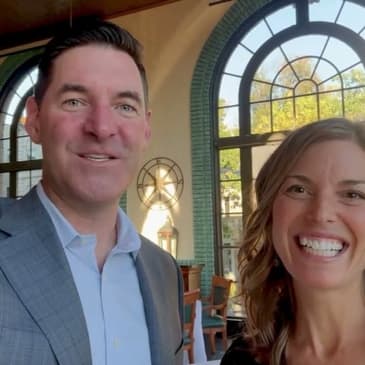
Dennis Morton and Katie Brown are the founders of Morton Brown Family Wealth, a firm dedicated to helping individuals and families align their financial decisions with their values and long-term goals. Through their client-centered approach, they guide families in building financial confidence, creating meaningful legacies, and navigating life's opportunities and challenges with clarity.
04:13 Billion-Dollar Vision & Goal Setting
06:01 Building a Purpose-Driven Client Experience
10:17 The Founders' Success Exercise
14:17 Transparency, Ownership & Business Growth
20:13 Consistency, Leadership & Client Trust
22:21 Wealth Beyond Money
26:22 The Future of Financial Advice
29:37 Financial Advisor Client Service Mistakes
35:23 Succession Planning for Financial Advisors
53:02 Overcoming Fear as a Financial Advisor
Don't forget you can also follow Dr. Rob Bell on Twitter or Instagram!
Follow At:
- X @drrobbell
- Instagram @drrobbell
Download Your Daily Focus Map!
5 Mental Toughness Advantages for Financial Advisors: https://pages.drrobbell.com
If you enjoyed this episode on Mental Toughness, please subscribe and leave a review!
Dr. Rob Bell
[00:00:09] Welcome to Mental Toughness with Dr. Rob Bell. Each week, Dr. Rob sits down with athletes, executives, and expert coaches to talk about mental toughness and their hinge moment. Here's your host, Dr. Rob.
[00:00:30] So our guests today, but two guests on the Mental Toughness Podcast is a conversation about building wealth with intention, navigating family legacy. Today's guests have built a firm focused on guiding high net worth families, business owners, professionals through the long game of wealth and relationships. I'm excited about this conversation today. Their work and reputation industry have led their firm to being recognized on Lehigh Valley style, who's who in business for the last five straight years.
[00:01:00] Founders of Morton Brown Family Wealth are guests today, Dennis Morton and Katie Brown. Thank you so much for joining us, both of you. Thanks, Rob. Thank you, Rob. Excited to be here. So you're located in Allentown, Lehigh Valley. I mean, this is not the Billy Joel song as we know anymore. Tell us about how Allentown is. Allentown is an amazing place and neither one of us are from here originally. So we've been in the last 20 plus years.
[00:01:29] I think we both had discovered this place in eastern Pennsylvania that's an hour and a half west of New York, an hour and a half north of Philadelphia, but just has so much to offer families and a great place to grow a business. So it's just it's been an awesome home, I think. Yeah, it's been really cool to witness its growth to over the past decade. Plus, there's a lot of energy in this area and a lot of things in the works.
[00:01:55] So we are our office is located in downtown Allentown. And I absolutely love being down here and just seeing the evolution and the new activities and the foot traffic. It's it's a really exciting place to live right now. Love it. Building the business that you have created. So both of you were partners. You knew each other, but didn't connect on that deep level.
[00:02:22] But you both opted out of succession because there was misalignment and mission and values, lack of transparency. But you so you kind of both knew what you didn't want. And there were intense conversations about what this was going to look like. Bring us up from there. Yeah, you know what we it is interesting. You bring up a good point. Dennis and I worked together for about a decade prior to launching Morton Brown Family Wealth.
[00:02:49] We were working at a similarly structured RIA firm, but we had different focuses in the firm and our past and it crossed a whole lot for the first six or seven years.
[00:03:03] Um, but when it did start to come together is really when we started bringing in outside voices into what we were doing in the firm and receiving a lot of guidance around, you know, getting on the same page with our mission, our vision, kind of thinking through the process of what we want the next decade plus to look like.
[00:03:22] And it was during that process that we had that realization that Dennis and I were very well aligned, but not so much with the managing partner of the firm at the time. And, and so we started having some conversations around, okay, if we could build something from scratch, what would we want it to be like? And I think that was, that was really kind of the, the, you know, the initial, the roots of what eventually became Martin Brown.
[00:03:52] Yeah. And we, I think we were both in a season of our careers where we were 10 to 15 years into the business and we started to think about, do we want to wake up, you know, 10 years from now, having not done some of the things that we know we need to do to do our best work, to build a team, to create kind of a lasting legacy. And we, it just, the more we talked out loud about that really was, it was kind of prompts, as Katie said, prompts that came from the outside. We saw what great work other firms were doing around the country. And I think we just looked at each other and said, why couldn't we do that?
[00:04:22] I think we know what to do. We had very complimentary skills. You know, everybody has financial advisors somewhere on their business card, it seems, but we were, came at it from very different angles. And when you put it all together, I think we felt this is a well-rounded leadership team and it made us more confident in trying something. Appreciate you sharing that with part of that attracted to me to both of you was the vision.
[00:04:48] So we met at RIA Edge in Nashville and really what drew me in right away was the vision. You said you didn't want to accidentally get there. And you both created that vision. And the part that really attracted me was even like the spreadsheet, the percent, what the team members are going to look like, like how many clients, what the assets were. Talk to us about that experience. So that's a reference to our big, hairy, audacious goal.
[00:05:16] And this came about, you know, a couple of years into the business. We'd, you know, gotten our sea legs. We'd started building a team. And we do these quarterly offsites. And we sat down, you know, over coffee one day and said, we should, should we have a big, hairy, audacious goal? Should there be something out there that we're chasing after? And we decided, well, we're sitting at about a little over 100 million in assets. What if we were to 10x that in 10 years and become a billion dollar firm? What would that look like?
[00:05:46] And we started, Katie created a spreadsheet that she's very good at. That's not my skill. But the spreadsheet had everything from revenue numbers, assets, number of employees, number of clients, just all of these metrics year by year by year. Like this is what we would need to do to get there. And then we started socializing that with our team. And we sat down and said, this is, if we wanted to serve more families, what would that look like?
[00:06:15] And Katie talked about the other half of that, the qualitative side. Because it didn't, it felt a little bit hollow to just have a number out there that we would be chasing. So Katie, you want to talk about the qualitative side to round it out? Yeah, we, you know, very much how we work with clients. We'll often say to clients, it's not as much about the number. It's the experience of what you're trying to achieve and the way that those numbers support the things you're trying to do.
[00:06:44] And we very much took on that same approach when we put together our BHAG. And that we wanted to make sure it, you know, it wasn't about making more money. It was about how do we, how do we invest in the experience that our clients are having, the experience our staff is having. And if you're a growing firm, then you have to invest in those processes.
[00:07:10] You have to invest in what that output is going to look like and feel like. But also, we wanted it to be enjoyable. You know, we wanted to make sure that it was reflective of, you know, not only the people we're serving, but the community around us. And so the ability to be more supportive, the community around us, support the things that our employees are passionate about as well. And we wanted to take time for ourselves.
[00:07:35] So one of the big components, one of the things that we added to the process was because we didn't want to look up. But, you know, at that time in 2020, both Dennis and I still had pretty young kids. We still have kids in our household. And so we didn't want to miss those formative years. So one of the things that we built in were these mini sabbaticals. So every five years we take, every employee can take five weeks off and totally disconnect.
[00:08:04] And adding that into the mix was not only rewarding for the individuals, but also on the business side, it really highlighted or really opened up where do we need to fill a gap? And how do we make sure that there's no one indispensable person in the firm that is going to help us achieve our goals, that we have enough support across the board and that our clients know the full team and the full capabilities of everyone?
[00:08:31] And so there's very much a sort of narrative built around that what started out as a spreadsheet and doing what we're doing. And it forced us to plan for it, just like we want our clients to, but we had to sit down and say, make the time to do it and don't put it off. And I think there's a lot of excitement and great feedback from clients. You know, they love it. You know, the stories that we come back with, stories and travails of traveling with young families and all those things that they really enjoyed it.
[00:09:01] And it was interesting. Last year, we went to our quarterly offsite at the end of 2025. And we were talking about this big, hairy, audacious goal, which is now approaching its midway point. And Katie happened to pull up the spreadsheet. And she kind of nudges me and says, look at this. And I think the spreadsheet said we were going to be at $464 million or something like that at the end of 2025. And I think we had just crossed like $466. And we had nine employees.
[00:09:30] We were right on trend. We're really close to it in so many things. So it's just kind of validation of being intentional in our planning. And of course, it's going to zigzag and go all over the place. But it was a nice validation for that vision and then putting in the work behind it. And I'll just add one more quick little note to that. We actually just had a celebration a couple of weeks ago. You know, something else that we want to be intentional about is celebrating along the way.
[00:09:58] So we threw a party for our downtown Allentown friends and other professionals we work with because we crossed over at the $500 million mark. And we're excited once again that we're tracking along very well and actually a little bit ahead of schedule. When you talk about, you know, both take sabbaticals for months at a time, I always say if you want to go fast, you can go alone. If you want to go far, you go together.
[00:10:25] Like you really exemplify that because one person can leave and everything is still going to operate as it is. And you've created that vision. Like talk to us about then just kind of like reflecting on this process that you've been on. What else stands out to you? Because I just find that to be absolutely fantastic. I think we went into it. Some of the most important work we did was before there was ever a Morton Brown.
[00:10:52] It was, you know, in the months leading up to in the planning process. And it was Katie and I sitting down and being very honest about where we were in our life, professionally, personally, where we wanted to be, and just laying out that this is what I still remember sitting in a Panera one day. And each of us had the homework. We gave each other homework to come back and say, what's your ideal day? What words matter to you? What what's you know, what's your vision?
[00:11:22] And it wasn't like Katie and I sitting there creating some alphabet soup of stuff. It was each of us saying, this is me personally. And then we started putting it together. And I remember Katie describing her ideal workday, you know, on a Tuesday in 2033. What would you love to be doing? And then kind of start with the end in mind. And doing that together was was really important. And it's become kind of a. Not just something that we come back to all the time when we do our annual planning or even our, you know, weekly strategic time.
[00:11:50] But it's something you've now invited the team in to contribute to. What would you say, Katie? I agree with that. I think a lot of the legwork was kind of early on in those. I'd say softer conversations. But, you know, as they say, the soft stuff is the hard stuff.
[00:12:09] You know, figuring out where we were on the same page with alignment and like values, alignment of our values and the things that we really wanted to prioritize. And that really was the foundation for our vision and mission. And we've revisited our vision statement about two years ago, bringing in contributions from the team.
[00:12:37] And ultimately, our vision is to positively impact the experience people have with money, relationships and life and their lives. So it. I think as we think about how we build stuff, we constantly point back to that. But a lot of those early conversations was that foundation to say not just for our clients, because we feel, you know, so strongly about that for our clients.
[00:13:03] But we also believe you lead by example for, you know, within the firm as leaders for our for our employees and and for our clients as well. But a lot of that was really work. Remember that time we communicated that to our spouses and took them out to dinner, the whole vision thing? We said so in the months leading up, we're sort of putting together a plan and we decided to invite our spouses out to dinner to unveil this plan to them.
[00:13:33] Because, again, modeling behavior, we want people to communicate to this all the stakeholders what's happening. This is not a black box. So we take our spouses out to dinner and say, this is what we're going to do. This is how we're going to do it. And then we get to the financials. And I think Katie said something like we might not be profitable for about nine months or something along those lines. My wife in her mind heard there's going to be no money for nine months. And that was it. And she carried that out of the dinner. That was an interesting car ride home.
[00:14:00] So we just it was a lot of this just it was lumpy, but we figured it out. And I think everyone everyone kind of felt like the transparency was there from the get go. Yes, I agree. It is. It is fun. We get together, you know, at least annually. We'll go out to dinner and kind of talk about our plans for the next year with our spouses, just the four of us.
[00:14:21] And and it is funny how those conversations have now shifted to where for the most part, I think both my husband and your wife and no offense to either one of them. But you can see them starting to zone out a little bit. And then somebody else say, can we just get to the food now? Like, OK, it's very conversational. Yeah, I love it. But the teamwork.
[00:14:46] So Morton Brown, Family Wealth, you and your team, you challenge each other on your own processes, stress test, if you will. I mean, about how you work together, about how you serve your clients. Talk to us about that process.
[00:15:02] You know, I starting with just that where we came from in the previous firm that we were at as Dennis and I were, you know, really kind of building our careers. One thing that I think really bothered the both of us is that there wasn't enough transparency. There wasn't enough teamwork. There wasn't enough communication, period.
[00:15:30] And and that is something that we have been super intentional about with Morton Brown. And we probably over communicate, if anything. But that, you know, between our staff meetings, we have we have we have things that are on the calendars. We have the staff meetings. We have quarterly off sites. We get outside of the office and we spend a whole day kind of working on the business, the strategy, the business with the entire team.
[00:15:59] And we want to hear all the different voices because every single one of them contribute to that ultimate experience that our clients have. But in addition to that, at any given time, I just kind of see it out of the corner of my eye. There are members of our team that are collaborating on something that are constantly talking about something. That's something that we've never done is like squash down the chatter in the office. I know oftentimes you hear that from the boss, like there's too much chatter. We need to squash it down.
[00:16:27] We really encourage that because it has it is truly allowed not only for like new, fresh ideas, but an appreciation for what everyone does and how it contributes and really new ideas around. OK, you're doing that. I'm doing this. But like what where are we going to meet that in the middle and how do we make that happen? And sometimes it's an idea for somebody that's in a totally different role.
[00:16:53] And I that in my mind, that that communication has has really been the root of just kind of getting those processes to run smoothly. You know, the best things that we did, Katie, was I think early on when we first we did this disk assessments on ourselves and if you're familiar with the disk rep. So we did disk assessments ourselves and actually even going back before that, we did the what was it? The Colby. Colby.
[00:17:19] Back years ago, the Colby was interesting because Katie and I each took it and then they did a Colby AB where you compare each other, you know, say how well would you work together? And somewhere in the language there in the period readout, it said don't ever build anything together. And we can't recall why that was. We just remember that being in there. So, of course, here we are. But so we've been a fan of those over the years. But we did disk assessments on ourselves. So it was just two of us.
[00:17:46] And then with each new employee during the interview process, they would take a disk assessment and we would in like the final interview process, we would share ours and share theirs with them. And I think what that's helped to do is tell the team from day one, we appreciate who you are individually. We're not coming here and trying to shoehorn you into a role or a personality or anything else.
[00:18:12] So there's ownership of who you are, how you like to work, how you work with others and, you know, go do your best work. And I think everyone on the team, almost to a person, is here because they kind of hit a ceiling where they were and couldn't grow. And they've really seized upon the opportunity for growth here. And that's been amazing. You mentioned ownership because one of the buzzwords that I hate, and this is just me, but I just can't stand buy-in, right? Hey, we've got to get them to buy-in and buy-in.
[00:18:41] But you mentioned ownership. And ownership, because if I buy my kids a pair of shoes, a pair of sneakers, they're going to like it. But if they buy it for themselves, right now they have ownership of it, they're going to clean it, they're going to take care of it. I never have to ask them to put them away. All electrolyte and hydration mixes and drinks are not created equal. I mean, check the ingredients. They have sugar or sugar alternatives, and there's tons of added stuff.
[00:19:07] Allow me to introduce you to the best electrolyte mix, Light Balance, L-Y-T-E Balance.com. It's a naked electrolyte mix, which means no preservatives, no sweeteners, no flavoring, no caffeine or gluten, and no calories. I'm always on the search for the best hydration, and I've found it. My entire family uses it, and I use it on all my runs. It solved all my hydration issues.
[00:19:37] Your body needs magnesium, potassium, and sodium, which Light Balance conveniently provides in liquid or powder form. Pure, powerful hydration. Light Balance. Go to L-Y-T-E Balance.com. It seems like that is exactly what you've created, this culture of ownership. Even through the client experience, when you bring them in and walk them around and have them meet everybody.
[00:20:03] I was hoping you could just elaborate deeper on that, that culture and that ownership piece. Examples of that. There have been some moments, and this is probably the last 12 to 18 months, where we've seen what real ownership looks like. And it's people saying that, one, coming to us and saying, I've got it. And Dennis, Katie, you don't need to have your hands on this. We've been taking off the proverbial hat ever since we started just to focus more on what we're best at.
[00:20:32] But last year, when we had two new employees starting right around Thanksgiving timeframe, and it's a sprint in that season. And two of our employees said, we've been meeting on the side just trying to figure out what a training program would look like. Here's what we put together to make sure these people are ready to go on January 1, all trained up, and we can seamlessly head into 2026. And we went, this is incredible. I think we closed the door. I went, can you believe this?
[00:21:01] They just felt as though this is in the best interest of the team. We can see what needs to happen, and we're going to do it. And we were ready to go on the beginning of 2026. And I think that's only helped to reiterate how much we can continue to kind of lean on that and make sure that we're doing our highest and best work and knowing that they're empowered to do it. So that was ownership showing up in a very distinct way.
[00:21:31] When consistency is, I think consistency is the hallmark of greatness. When you know who's going to be showing up, not only for your teammates, but also for your clients. Talk to us about how mental toughness plays into that, also being a practitioner and a leader.
[00:21:49] You know, every year we go into the year in preparation, say, what are three words that are going to motivate us for this next year ahead? And consistency happens to be one of our words this year. And it's a great exercise because we'll look at what are our goals for the year, where do we need to focus and spend our energy.
[00:22:17] And exactly as you said that, that consistency to continually show up and be present is so important. So once again, that's one of the words that we chose for this year. And we'll we continually go back to that and saying, OK, how how can we consistently show up for the client? How can we consistently communicate? How can we consistently be present in the community?
[00:22:44] And and so I think I think one of the. You know, one of the ways that we do that is kind of holding each other accountable and sitting down and, you know, in our staff meetings and saying, OK, this is, you know, maybe an element of the client experience that we want to make sure is showing up consistently. Is everything supporting that to happen? Do we have all of the workflows together? Do we have the right process?
[00:23:14] Is there any efficiencies in there? How do we how do we fine tune all of those elements to make sure that that client experience is consistent, you know, every step of the way? So I wholeheartedly agree with that consistent process and consistent showing up is that that's what's going to drive that success for the clients and for us. Revenue. I believe revenue is the byproduct of like excellent customer service.
[00:23:43] And that's why I was so excited to have this conversation. And you've mentioned before. Growth is just it's never just about the numbers for you. The question is, is how does money connect relationships? I think it can be done. I think it can be done very well. And we've seen. We've seen some epiphanies in recent years. I'll give you an example.
[00:24:10] We had a client who's been with us for many years and he and his wife would come in for a meeting and there was always a lot of pressure on performance. You know, how are we doing? Could we be doing more? Could we be doing better? And he was he would always get a little bit panicky when the market was down, get a little bit euphoric on the upside. So there was there's a behavioral component to our conversations that we would have. But this is about two years ago. He and his wife came in and I started into the presentation, which I don't like to do is starting right in on portfolio performance.
[00:24:41] But that's usually where we went. And about 10 minutes in, he just paused and said, can we just put a pin in this for a second? Because I was talking to our sons recently about their financial plans. And we've been saving so much for our lives and making sure they're going to be OK. They're going to be OK. And you know what? They're going to be OK. So can we start talking about how we can spend our money on high quality of life as we approach our 70s and everything else?
[00:25:07] And I closed up the laptop and I said, I've been waiting 10 years to have this conversation. They had to get to it in their own way. But that's the kind of if you can create that connection. And I don't think our industry is doing as good a job at it as they could. But if you can create that connection between, you know, what our friend Brian Portnoy calls, you know, funded contentment.
[00:25:30] You know, how does the financial resources you have translate into your version of a contented life and relationships? And that's where it comes back to money, relationships and life. You know, it can work. But I think a lot of times some financial advisory relationships are working at cross purposes to that. And we really have invested a lot of time and energy to seek out those outcomes because they feel incredible.
[00:25:56] When you see those kind of trends, whether it's between the spouses, between parents and children or multi generations, it's possible. I think once again, I think we that's another place where celebration shows up. I think we really like to celebrate with our clients when we see them utilizing their money and their resources to build experiences for their families,
[00:26:21] to do something that they've always wanted to do, but, you know, felt held back in some way or another. And it's funny because sometimes clients will call us up and like, OK, I know you said, you know, everything's good financially. I think I'd like to take a distribution. I want to do this, you know, amazing adventure trip with my family. And but I feel bad taking money out of my account.
[00:26:46] And so for us to show up with enthusiasm and excitement for the things that they're spending their money on, once again, I think it's kind of counterintuitive for a lot of financial advisors to celebrate those distributions. But that's that's what it's all about. I mean, it's all about funding the things that are going to create experiences and deepen relationships. And that's that's what's going to lead to longevity. So I think for us to be supportive and celebrate with our clients along the way is has been a lot of fun.
[00:27:17] Yeah, that's excellent. When when the teachers ready to I'm sorry, when the students ready, the teacher will appear. So, I mean, on on that note and in general terms and where where is the industry? Like, where do you think that the industry just needs to get better at the financial services industry in general? I think there are a lot of things.
[00:27:43] We've talked about this a lot recently because, you know, we see the evidence when a new household comes on board to Morton Brown. We see what they've been doing either as do it yourselfers, you know, with large institutions, with other advisors. And I think there are a lot of forces converging our industry right now. It's things like succession planning and the role of private equity and succession planning. Who's calling the shots?
[00:28:10] We're seeing abundant technology. I mean, the technology offerings are just crazy right now. The number of things that tools that are made available, especially in the independent space. And then third, there aren't enough. I don't think there are enough financial advisors. And McKinsey says there's going to be a shortage of 100,000 in the next decade or so. And that's part of this air pocket that's going back 20 years to the great financial crisis.
[00:28:33] But I think the industry is going to could struggle with meeting the expectations and needs of clients. If we don't get the staffing right, the technology right, succession right, it could turn very inward looking and try to fix problems instead of outward looking trying to solve for client confidence.
[00:28:52] So we're thinking about, one, we relish our independence and what we can do, what we can continue to do for our clients in designing this business in their image. But we also think that there could be some speed bumps for the industry at large. What do you think, Skating? I agree with that. I do think that there are a lot of outside forces that are creating a lot of distractions at the very least for a number of financial advisors.
[00:29:21] On the flip side of that, I think clients and families want and expect more. And I think they should want and expect even more. I think that there's a level up that we're maybe on the cusp of, but has further to go. I think clients should expect their advisors to show up holistically. And I think planning needs to be part of the conversation far more than it is right now.
[00:29:51] It's rare when we have new clients come on board that they come on board with an existing financial plan. Usually it's just those investment statements. And there's still so much on our client. There's still so much on not just our clients, but population as a whole, individual shoulders trying to figure out all the things. And I think people are starting to raise their hand a little bit more. And the industry is having some challenges.
[00:30:19] And I do think technology will help fill some of that gap, but there has to be that human component ensuring that it's accurate. And there has to be that attention and focus that's provided throughout the process. I think we're going through some growing pains for sure. But ultimately, it'll hopefully land in a very positive spot at some point. I want to raise my hand for a second.
[00:30:47] Katie, can you go a little bit deeper into that point? Because I just think you've made so many good points there. I'm just hoping you can elaborate on it. Sure, sure. So I think one of my big frustrations is when I have a new family maybe that is coming to us. And they're like, all right, do I need to do these Roth conversions? Should I start Social Security? Should I? And they have a thousand questions about.
[00:31:16] And I love that they're throwing it out there, but they're almost not throwing it out there for me to answer because they don't expect a financial advisor to give that answer to them entirely. And they'll say, I've been working with my advisor for five years, but I still don't know all the answers to this stuff. I just need somebody else to take it over and then I'll figure this out. And so to go deeper and explain, that's what we're here for. I want you to bring all those questions forward.
[00:31:45] I want to be one of the first people that you ask. Not necessarily, I don't want you to spend two hours researching Roth conversions and then come to me and say, what do you think? Or should I do it? Come to me first. Let us be part of that process and be part of that educational process. And I think that there's a mind shift that needs to happen.
[00:32:05] I think there's a lot of just low expectations for what a financial advisor, the full breadth of services that we can provide and be present for. So I don't know if that goes deep enough to what you're looking for. No, it's fantastic because one of the things I've experienced is justifying the value that financial advisors, even their own value from their, you know, justifying the value that they bring for themselves.
[00:32:35] I mean, it's getting back to customer service, right? Communication, customer service, being there for the client and doing what's best for the client. I think, Rob, one of the things that we've, if we could be cynical for a second, sometimes we see that confusion or creating confusion can be job security for financial advisors. Because I can't tell you how many statements I've seen where us with, you know, 20 plus years of experience, we don't know what we're looking at.
[00:33:05] And certainly the client doesn't either. But that confusion, like it's kind of the Wizard of Oz effect. Don't pull back the curtain to see all, you know, machines that are going back there. It's, I think we've really pushed back on that to say we have to fight for simplicity and clarity in a financial world that wants complexity. And the hero advisor is the only one who knows all that's going on.
[00:33:32] You know, our job is that I want to make sure that the spouse that doesn't speak up in the meetings can understand things just as much as the spouse might be much more engaged. And if we can get, if we can get to that place, get it out of our heads and empower them, that would be a great outcome. Yes, Katie, please.
[00:33:51] I think our role is just as much in educating our clients and the people we have the privilege of sitting across the table from as it is, you know, the nuts and bolts of the investing and the planning. Obviously, that is extremely important.
[00:34:12] But if there isn't a firm understanding of what is being owned, why it's owned, the pieces of the puzzle, then you're not going to get that full buy-in or adoption of the work that's being done. I think that that educational piece is so important. And Dennis, you are spot on.
[00:34:34] I think too many advisors just speak over that and they lean on, you know, the financial jargon and don't worry about it. I've got it. And that just, it doesn't, that just creates anxiety at the end of the day. And it's always been a turnoff to both of us. That was one thing. That was one early thing we found common ground on. I think we both looked at some of the stereotypical ways that advisors would talk, ways that they would structure meetings.
[00:35:04] And it took us a while to figure this out. But I think we looked at each other and said, we don't want to be that. That's not who I am. That's not who Katie is. So why does it have to be that way? And what if we did it differently? And it seems to me how you're doing it and doing it differently in the education piece, like that's now then, that's being on the cusp of the wealth transfer that's happening and is going to happen. Yes.
[00:35:30] I think it's, this is me coming from kind of a liberal arts background in college. I only took one finance class and it was my worst grade. But this is like when we talk to people about, again, using their financial resources to, to, you know, live their best life. I think it's a, it's a matter of you're coming at it from a place where people are thinking about legacy. They're thinking about their family.
[00:36:00] They're not suddenly the conversation shifts to, I'm not trying to just get more, more, more. It's getting comfortable with the concept of enough. Now, what do I do with that concept? So as Katie put it, we're seeing people spending money on that trip with their grandkids or, you know, just having the experiences with their spouse while they still have their health.
[00:36:21] And I think that's been a lot of the reason for our growth is because at some point you just hit up against that ceiling of one complexity, like you have big decisions to make. But two, what's all this for? And I need somebody to help me work through that. And I think we really relish that role. Well, the secession planning, you had a really good quote. Secession isn't a future problem to solve.
[00:36:50] It's a leadership obligation. What would you mean by that? So I think it's something and this goes back to my military experience and the way, you know, the chain of command works in the military is that you're never there for more than a couple of years. You're never in command of a company or battalion or brigade for more than a couple of years. You know that you're in that chair for a two or three year window and then somebody else is going to come in and take it over.
[00:37:19] And I think it's kind of like having a business and you've heard always had it ready to sell. Well, it means because it means you're running a really good business and you have you're always working at having it to be optimized. I think the same goes for succession planning is that, you know, we see businesses that just kind of whistle past the graveyard and pretend like we don't need to have this together. We'll get this together sometime later. Katie and I, while we're not near, you know, a succession for ourselves, we've thought about being in being dispensable.
[00:37:49] Like that Katie can go on a sabbatical and everything's fine. I can leave and everything's fine and we can, you know, not have to be every decision running across our desks every day. And that is a leadership. It's a leadership mentality. It's not a heroic. I think the contrast is a heroic mentality where I'm the only one who can do this and I'm going to be in the chair forever.
[00:38:10] And we've seen that turn out badly for some, you know, fellow business owners, unfortunately, some clients that just didn't let succession be part of who they were before it needed to happen. I want to discuss more personal experiences and hinge moments. But you mentioned the military real quick, Dennis.
[00:38:33] I was wondering if I could just touch on that because you were a platoon leader, an officer, served in Operation Iraqi Freedom. And the question I wanted to ask, because when September 11th happened, I mean, you were serving, but you were stop lost. And I know that's going to fly over a lot of people's heads, but I just think it's an important distinction. I was hoping you could just share with us what that experience was like for you. So, yes. So I had a four-year commitment.
[00:39:01] I was an RMTC scholarship in college. I had a four-year commitment to the Army. And that four-year commitment was scheduled to be up in the summer of 2003. But in January of 2003, I deployed in Operation Iraqi Freedom. I was stationed in Kuwait. And at that time, I issued what's called a stop-loss order, which means effectively your papers to get out of the Army are taken away and say, well, we'll tell you when you can get out, but you're indefinite at this point.
[00:39:28] So at that time, I was engaged, scheduled to be married in October of that year. I was thinking about what my career was going to be after that and had to put all of that on hold because I couldn't commit to – I was overseas. I couldn't interview. I didn't know when I was going to be available. So that created just kind of a fog of uncertainty at a time of my life where I was really discerning. Like, what do I – am I going to go to law school? And what do I do with this history degree? And I was shooting Patriot missiles. So how do you merge that skill set together?
[00:40:00] And I think what ended up happening was I think sometime in August, we got back from the war in July, June or July. And in August, I got a call from the Army saying, you're done. You can start out processing. You're done in two weeks. So within three weeks, I left the Army, got married, and moved to eastern Pennsylvania and started looking for a job. And I found something that wasn't a good fit for me. What I thought the Army taught me was management.
[00:40:27] And while it did, it wasn't something that I enjoyed. So it wasn't until two years after taking a job in Allentown, Pennsylvania, sight unseen, and landing here with my wife that I actually took the time to discern what I really – what gets me excited. What do I want to do? And to her infinite credit, my wife said, you know, you're obviously miserable in your job. Think about what you want to do and come back to me. And I came back here and said, I think I want to be a financial advisor.
[00:40:55] And I had that time then that I didn't have when I was leaving the Army to think it through, and it was the best career decision I could have made. I love this job. Hinge moments. You know, Lehigh Valley, Raleigh Hospital, Children's Hospital is profoundly personal cause for you. Dennis, you and your wife, Gina, I mean, you lost a four-month-old son, Teddy. I was hoping you could talk to us about that experience.
[00:41:25] Yeah, so Teddy was our second son. He was born in 2008. And at that time, I had just met Katie. I had left my first job on Wall Street and moved to an independent firm where she was already a partner. So I would, you know, call it early 2008, I was restarting my career in the independent space. And shortly thereafter, my wife was pregnant with our second child.
[00:41:53] And Teddy was born in December of 2008. And right from the get-go, we knew something was amiss. He was born with congenital leukemia, AML. And he was born at a local hospital. And the first thing they said is, he's going to need to go into treatment immediately. He's not going to be able to be treated here. So Children's Hospital of Philadelphia is a renowned medical center in Philadelphia, about an hour and a half south of here.
[00:42:21] And then there's Hershey Medical Center in the center of the state, another hour and a half away. We ended up being sent to Hershey. So Teddy went to Hershey Medical Center on his third day on Earth and started chemotherapy. And we effectively moved our family to a Ronald McDonald house in Hershey for the next four months. And I would commute back and forth from the Ronald McDonald house while he was in treatment. And it was a very hard time for our family.
[00:42:47] Gina was taking care of a two-year-old and the needs of our oldest son. And Teddy was having hits and misses. He was only home for a couple of weeks. We were hoping for a, we had a match and his brother for a bone marrow transplant. But in the end, he caught a cold and he didn't have an immune system to fight it off. And we lost him in April of 2009. So it was a very challenging time for our family. A lot of blessings came out of it though.
[00:43:17] And I think one of the things that, again, coming back to discernment, having the space to think about what does this mean for us. When we came back, you know, there are all sorts of, we were the beneficiary of all sorts of amazing causes related to cancer and just at Hershey Medical Center, the care was incredible. But I think the lesson that we settled in on is that one of the most damaging things about the whole experience was that he couldn't be treated in your home. And here we are in the third largest population center in Pennsylvania.
[00:43:48] And we had to leave to go get, to go get care. So we just started kind of asking around to anybody who would listen with the hospital systems in our area to say, if anybody ever plans to build a children's hospital here, let us know. We'll do whatever we can. Didn't mention that we didn't have two nickels to rub together, but I just said, whatever we can do, we will, we will do. We will raise money or whatever.
[00:44:11] I think it was six years later that we got a call from Lehigh Valley Health Network saying we're doing a feasibility study for a children's hospital. And somebody had your name written down. Would you come in and do an interview? And we did the interview and just told about our experience, what we think the possibilities are and how this area is ready for it. And within a few years, they had built the Riley Children's Hospital and we were part of the campaign executive committee and have been supporters of that cause.
[00:44:37] But now the same things that Teddy was treated for far away would now be able to be treated here. And it's when Katie talked about just the amazing things that are happening in our community, that's been a really great one. And just to follow up on that, and I appreciate you sharing with when tragedies like that happen, how does your perspective change about life and what's really important? I think for us, it was about commitment.
[00:45:06] You know, we were here, we joke that we're 23 years of our two-year plan in Allentown. We didn't know anybody. We're not going to stay. We're not going to meet anybody. We're not going to get involved. Coming back from that, literally like reemerging back into the community. We realized we had friends. That I like where I was working, like my job, like my career. And maybe we're not going to leave. We'll stay here and do this.
[00:45:35] And started getting involved on some nonprofit boards. Started getting involved in my neighborhood, in our church. And started building a life. And realizing that we've been extracted from it. We wanted to come back in. And I think ever since then, it's just been life-changing. Just immersed in the culture of this community and building a business and everything else.
[00:46:01] So it definitely, I think you can go one of two ways when that happens. In fact, marriages go one of two ways when that happens. Because they either go further or further, they go closer. And I think the momentum through everything has been closer. Very grateful for that. Thank you. Katie, in 2018, you ran the Boston Marathon, a sub-four hour Boston Marathon, mind you. In horrible conditions.
[00:46:28] That was the marathon that Des Linden won. But the story started before then. You had a hinge moment then that started even while you're starting Morton and Brown. Morton Brown Family Wealth. I was hoping you could pick us up from there. Sure. Yes, I did have the privilege of running the Boston Marathon in 2018. I started running marathons.
[00:46:55] And I think I've run seven total. So not a ton, but enough. But started running them in 2014. And for my first one, I thought it would just be incredible to make it to the Boston Marathon. Like I really, and I have a really wonderful community of girlfriends that I've been running with now for, you know, decade plus. I guess, yeah, probably 15 years.
[00:47:22] And running has always been my, kind of my, the place where I can go to just, you know, let my mind wander, to clear my thoughts, to put all technology, all things aside. And just, I love running with my girlfriends because we just talk, you know, and it's, it's, it's a good downtime. And so in 2017, May of 2017, I qualified for the Boston Marathon.
[00:47:51] I was very, very excited, obviously. And, and it was fun because I qualify with, I think, four other girlfriends that, that were all going as well. So we had a nice group of us that were going. And, um, but in October of 2017, I, a whole long story to get there, but discovered, um, a lump and was diagnosed with breast cancer in October of 2017.
[00:48:20] And the timing of this was, um, Dennis and I had, we were, I think we really kind of dove into the planning of Morton Brown, um, to like May and June of 2017. And so we were knee deep in the planning. We had already decided, okay, we're going to launch this thing as close to January 1st as possible. Be ready to launch January 1st. I think our target, you know, was March, April timeframe.
[00:48:49] And, and so we were kind of well underway with the preparing to launch the firm. So that was on the horizon. The Boston Marathon was on the horizon. Um, my kids were five years old and eight years old at the time. And, um, once again, the diagnosis, the breast cancer diagnosis was totally caught me off guard. There's not a history of cancer in my family.
[00:49:16] Um, I, I don't know any other members of my family that had breast cancer overall, you know, I kind of pay attention to, um, my health and what I'm doing. And, and I was, I was young. I was still in my thirties. And so, um, it was definitely a surprise.
[00:49:37] And, and I remember the day that I received, like, I remember the, you know, I, I had a biopsy and honestly, I didn't think that much of it because I knew that most biopsies were benign. And quite honestly, I just, once again, no family history or anything. I really didn't think that much of it. And so they said, you know, come into the office. We'll talk to you about the biopsy. I didn't even bother to have my husband come along. He was like, do you want me to come along? I'm like, no, it's not a big deal. I'm just going to stop there. It's fine. And I stopped there.
[00:50:06] Um, and, and I was given the diagnosis and I was once again, just shocked. Um, and, but I, I just say one of the first things I said, I was like, okay, well, we need to figure this out and I need to tackle it. We need to just be done with this. And I have, it has to be done in the next couple of months because I need to train for the Boston marathon. Cause that's, that's coming up.
[00:50:33] And, and I, I'm actually really grateful that that was there because I think between that and my family, like in, in, in the business, like those are really healthy, good distractions to have. And then I left there and I went to my daughter's Halloween parade. Um, and she was five years old at her daycare. And I just remember showing up to the parade and like crying the entire way there and then showing up and being like, okay, it's my five-year-old. So, you know, put on the Halloween costume. We both dressed up as witches.
[00:51:02] And, and so like being at the Halloween parade together and, um, yeah, it was, it was a really tough time. But once again, having some like healthy, exciting things happening going forward, I think was really, really helpful to work through the process. Dennis was amazing. And he, he just basically said, okay, we can pump the brakes, like take whatever time you need, do whatever you need to do to be healthy.
[00:51:30] And for the, the most part, I mean, I, I did, I had, I had to go three surgeries. And so obviously there was a little bit of downtime related to that, but, but for the most part, I was like, no, I, I need this. I want to, to stay involved, to stay active and let's, let's keep that timeline going. And so I think within like a 10 day span, I had my final surgery. We, um, I ran the Boston marathon and then we launched Morton Brown that all kind of converged in about 10 days.
[00:52:02] And how going through that and then reflecting on how is, how is your perspective about life changed? Um, I think it really does. Once again, we hear chatter in the office and I love that because it's usually, I mean, obviously it's, it's, it's, it's a lot about what we're doing and the work that we're doing, but it's showing up. It's showing up, supporting somebody's life.
[00:52:30] It's showing up, supporting either, you know, something that's happening with our, our staff and they're talking about things that are personal to them and they're deepening their own relationships or it's deepening their relationship with a client. And, and so I think how I think about it is whatever we can do to help support those relationships and deepen relationships across the board in the community with clients, with our staff, with our families.
[00:53:00] Um, I think that's just knowing that that's the ultimate important thing. Um, more so than, you know, the numbers on the page. Yeah. I appreciate you sharing both of you. Um, one, one quick, one quick thought on that.
[00:53:19] Just, I think, um, the thing that we discount sometimes is the role of, of fear and conquering fear in, in, in what we do. I think in, in our own ways, each of us is, has had to, um, embrace a different version of ourselves as we've grown over, over time.
[00:53:45] Um, but I, but I think, you know, when you, when you stare at zero sometimes, and when we started Morton Brown, we, we, we celebrate on March 27th, Katie, every year, like call day. Yeah. Yeah. And that was, that was the day when we, we walked into our little, you know, tiny office and we had a list of clients and we didn't have a business yet, but we could pick up the phone that day and start calling people and saying, it's kind of a Jerry Maguire moment.
[00:54:14] Who's, who's coming with me? Yeah, that's right. And, you know, by the end of the day, we had a business, you know, people were, they were excited for us. They had questions. They were, you know, it's a confusion and everything else, but you stare at zero and think like, what do we need to do to make this, to live up to their expectations and make it, make this exact, validate that choice to, uh, to come along with us and be part of what we're doing. Um, I think overcoming that fear.
[00:54:44] And then I think we have a pretty fearless culture right now. I think a lot of that comes from people just saying, we're going to do this together. Katie, is there anything else that I should be asking that I'm not asking? Um, I was going to add on to maybe what, what Dennis said that, that overcoming that fear.
[00:55:14] And I think a lot of that is rooted in the culture that we've built where people can speak up and we can make mistakes and we do make mistakes and we own those mistakes. So really addressing that, that trying to help to minimize that fear of failure, um, I think allows us to, to go after things.
[00:55:40] And, and I think so much of that is just culturally driven and saying that it's okay. We're not perfect and that's fine. Nobody is as we all know. Um, but that's, yeah, that's, that's a hard thing to accept. And yeah, but I, I think we're getting better and better at supporting it.
[00:56:07] Uh, Dennis, Kate, uh, thank you so much for taking the time and joining us and, uh, really appreciate it. Thanks for having me. Hey golfers. You might not even know that you're looking for it, but this is the best golf sock that you can have. The golf sock. The grip technology is absolutely stunning.
[00:56:36] I even use it when I'm running. That's how good these socks are. You're absolutely going to love it. It's like a golf glove for your feet. The golf sock. Click on the link.