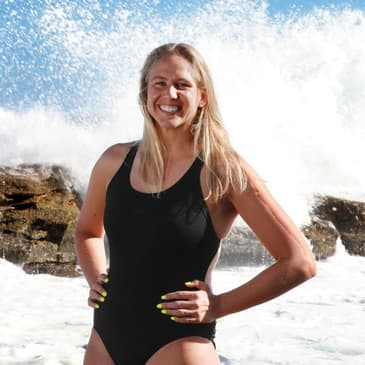
Chloë McCardel holds multiple long distance swimming records. In October 2021 she set the record for the most English Channel crossings at 44. She also holds the Australian record for triple non-stop crossing of the English Channel. Chloë is a speaker and coach, having coached many marathon swimmers. She is also an advocate for domestic violence victims and involved in Marine Rescue - NSW (New South Wales) “Volunteers Saving Lives on the Water.”
- 4:00 The Hinge Moment Of Starting Swimming From Pure Embarrassment
- 5:39 Being Motivated From A Young Age
- 7:25 Getting Swimming Taken Away
- 9:36 Deciding To Be The Best In The World
- 12:37 Having A Dream And Committing To That
- 14:12 An 11.2k For A First Swim
- 16:31 Inviting Death Into The Sport
- 21:39 Having The Confidence To Do A Double Crossing Of The English Channel
- 26:20 Outsmarting The Competition On The Hudson River
- 29:05 Gaining The Ability To Stay Mentally Focused
- 31:28 Failing At A Triple Crossing But Still Choosing To Go Back
- 34:29 Creating A Mindset Of A Future Identity
- 38:32 Choosing Not To Try To Prove People Wrong
- 43:13 The Most Memorable Moment Of Finishing The Triple Crossing
- 47:35 The Power Of Visualization And Staying In The Right Headspace
- 56:03 The Quad Attempt From 2018
- 57:51 Accepting The Quad Failure
- 1:01:35 Deciding To Become The Queen Of The Channel
- 1:03:50 Developing A Love For The Channel From The Start
- 1:08:35 Telling Yourself It’s Ok You Can Stop
- 1:14:37 Box Jellyfish Attack
- 1:19:29 Converting The Love For Water To Help People
- 1:24:34 The Need For Passion To Complete Your Goals
- 1:26:48 The Channel Queen Foundation
Don’t forget you can also follow Dr. Rob Bell on Twitter or Instagram.
Follow At:
- Twitter @drrobbell
- Instagram @drrobbell
Download Your Daily Focus Road Map!
If you enjoyed this episode on Mental Toughness, please subscribe and leave a review!
Dr. Rob Bell
[00:00:10] Welcome to Mental Toughness with Dr. Rob Bell. Each week, Dr. Rob sits down with athletes, executives, and expert coaches to talk about mental toughness and their hinge moment. Here's your host, Dr. Rob.
[00:00:23] All electrolyte and hydration mixes and drinks are not created equal. I mean, check the ingredients. They have sugar or sugar alternatives, and there's tons of added stuff. Allow me to introduce you to the best electrolyte mix.
[00:00:56] Light Balance. L-Y-T-E Balance.com. It's a naked electrolyte mix, which means no preservatives, no sweeteners, no flavoring, no caffeine or gluten, and no calories. I'm always on the search for the best hydration, and I've found it. My entire family uses it, and I use it on all my runs. It solved all my hydration issues.
[00:01:23] Your body needs magnesium, potassium and sodium, which Light Balance conveniently provides in liquid or powder form. Pure, powerful hydration. Light Balance. Go to L-Y-T-E Balance.com. The journalist at the very end, Charles O'Reilly, he looked at me, and I was laying down horizontally in a hospital bed with oxygen support, and he said, thank God you survived.
[00:01:53] You know, I'm so relieved. Like, that's done now. And he was kind of implying, like, now we can just set this aside. You know, you've had your go. It's done. And then I turned to him, and I couldn't even speak clearly because I was needing the oxygen to support my breathing.
[00:02:09] And I was like, I'm so glad I survived because now I can go back for another attempt. Like, I'd already decide in that hospital bed, this is intensive care emergency in Canterbury Hospital in the UK. I was like, yep, I'll be going back. Like, I'm alive, and that's all I need to reattempt it.
[00:02:27] Our guest today on the Mental Toughness Podcast is an Aussie. I love having our Aussie guests. She holds multiple long-distance swimming records, and in October 2021, she set the record for the most English Channel crossings at 44.
[00:03:11] She's dubbed Queen of the Channel for that accomplishment. She also holds the Australian record for triple nonstop crossing of the English Channel. She's a speaker and a coach, having coached many other marathon swimmers. She's also an advocate for domestic violence victims and involved in Marine Rescue NSW, New South Wales. Volunteers saving lives on the water. I'm excited for our guest today, Chloe McCardle. Chloe, thank you so much for taking the time and joining us.
[00:03:41] Well, you're welcome. I'm really excited to have a chat to you today. So, I always like to start, like, when you're younger, and you kind of said on one of the podcasts, swimming got introduced as something you had to do in school, and kind of parents say they forgot to put you in swim. Like, pick us up from there, because I was always fascinated by that. Yeah, so in Australia, we have a primary school system, and kids are usually about 10 or 11 in the last year of primary school before you hit high school.
[00:04:07] And our school, for the first time, introduced compulsory swimming lessons as a part of the curriculum. They shipped us off on buses to the local swimming centre, and they sat us down on the benches and said, hands up if you've never had swim lessons before. And I didn't even know at that age that in Australia, if you're at least middle class, it's absolutely kind of mandatory socially that you've had swimming lessons, and you can swim a few lengths in the pool.
[00:04:33] So, I was like, I put my hand up, I'm like, oh, I don't know the strokes, but I was happy, like, in the water. I could bounce up and down waves, and that. I wasn't scared of the water. So, then they put me and three other kids in my year level in the baby pool section, and there was, like, pictures of whales and octopus hanging over us, and the water was only two feet high, and I was just so embarrassed.
[00:04:56] So, the bizarre thing is, I got into swimming, and a pure embarrassment that I was like, no way, I'm going to be stuck in the baby pool. My other kids in my year level were doing at least one or two non-stop laps of a 25-yard pool. We call them metres over here, so a 25-metre pool. I was like, what? No, I'll be over there with those kids. So, yeah, shame and embarrassment got me into swimming. And in Australia, starting to swim at 11 is really late. Like, that is kind of, like, twice the age that kids generally start swimming.
[00:05:26] So, generally, it's like four or five years of age. So, when you got immersed, though, I mean, you kind of went all in, right? I mean, you obviously had a passion and love for being able to do it, but then you started all in and progressed pretty quickly. Yes. So, I can have quite a determined mindset, even as a very young person, and literally that desire that I wanted to be one of those other kids that could do a few laps of the pool was so ingrained in my brain. It didn't come from swim teachers or my family or anyone else.
[00:05:56] It was very internally driven. And so, when I spoke to my mum that very night, that first swim lesson, I said, can you put me in outside school lessons? Because we have, in Australia, a strong out-of-school lesson program that people can sign up to. It's private. You've got to pay extra for it. And she's like, yeah, yeah, yeah, we'll put you in. We just forgot. So, when she put me into that, I was so driven and focused that I was excelling about through the levels of swimming over the next two years, about three times faster than the average kid.
[00:06:26] And I know this for sure because later on in my late teens, I got into swim school teaching and also swim administration. So, I know literally how fast kids move through each of the swim school levels. And, yeah, I was just so determined. And then that got me into competitive swimming. And it really, competitive swimming was great for me because it honed that competitiveness and that desire to reach the next level and to compete against myself and to compete against others.
[00:06:52] And it was more like a continuous self-improvement loop that I loved. And I was so self-driven. I didn't need mom or dad to get me up in the morning. I didn't need my swim coach to tell me that I had to should or need to do more sessions a week because of that self-driven belief that I had. And then at like 15, 15 and a half, what took place then? Because you're immersed in swimming. I mean, you love practicing even more necessarily than the competitions that you said.
[00:07:21] But what took place like when you were 15 and a half? About that time, I was moving into the last two years of our high school system over here. So, year 11 and 12. And our grading is really important in those years because setting us up for our future, whether that's university or a different future. And my parents had invested a lot of time, energy and finances into my education of my 13 years as a young person. And they're like, you need to focus on school.
[00:07:51] Like this whole competitive swimming thing, you need to put it aside. This is the big game here as in the school stuff. Like this is where it all counts these last two years. So, they basically put their foot down and said, you can't do competitive swimming. If you want to do recreational swimming a few times a week, that's fine. But I was swimming like seven to nine swim sessions a week plus gym plus competitions on top of that, you know, usually in any week. So, they'll say you can do it for fun, but you can't do it seriously. And my brain just switched off.
[00:08:20] It's like if I can't do this to get better and to, you know, push myself and try and excel in this, then there's – for me, there's no draw card. So, I had to let it go because they forced me. But unfortunately, because that decision was taken away from me, the fire never burnt out. Like they didn't realize they were actually creating a monster by forcibly taking me out of something I loved doing.
[00:08:46] It actually just – it festered there that desire to excel in sport and make an impact and improve. So, it kind of hibernated for a couple years but never went away. So, there's two hinge moments early on. One being put in the baby pool when you were really young and then another being pulled out of it because, no, you've got to focus now on your studies and real life. But that fire never went out and you had that passion.
[00:09:15] And I mean, it's interesting because like when you speak with someone like yourself, I mean, you know what that fire is, right? Like nothing is going to prevent you from reaching your goal or whatever that goal is going to be. When did you hop back in and then really start rededicating yourself? And when was that vision there about what you wanted to become? When was that planted?
[00:09:37] Yeah, that's really interesting because I actually went through a really difficult transition because in my mind, I had the identity that I was an athlete. And I was never like super talented. I wasn't on track for the Olympics but I was definitely one level below. So, the next few years, it was hard. Like I did focus on my studies to a degree like my parents wanted, got into the university degree that I wanted, was at uni.
[00:10:02] And I'd never really let go of this desire in my head to really keep improving and push myself. And when I was at first university, so I was 17, half, 18, I was like, I really feel that I can do something great with myself and contribute to this world and make something of myself.
[00:10:24] But I felt that it wasn't going to be through the professional route as in riding the corporate train and the ladder, which could probably take decades. I thought, I have a background in sport. I love sport. I know that swimming was my thing growing up, but I probably missed the train, so to speak, on being a competitive pool swimmer. And so, I just developed the desire to become the best in the world at something. So, it wasn't necessarily swimming.
[00:10:54] It wasn't necessarily any particular one sport. But I just said to myself, look, my strengths are sport. I love sport and I think it's a much quicker route to becoming the best in the world or the best in history at something. And I knew that I could go on a journey of pushing myself, excellence, and also self-discovery through that process. And I wanted to share with the world that self-discovery process.
[00:11:20] So, even when I was just starting out, I wanted to find ways to share my story like I am with you or keynote speaking that I do with corporates in schools. And I decided that was going to be it. And you can imagine how much my parents loved this idea.
[00:11:34] Hey, good looking.
[00:11:57] If you like this podcast and are already a badass, but it's all way too complicated, then visit our website, drrobbell.com, and schedule a call with us to help capture your very own hinge moment.
[00:12:24] When did you have visions in terms of and the decision about being able to be the best in this sport? Those early on days. There wasn't really one turning point for this vision or belief. I think in Australia, there is a very strong culture of sport.
[00:12:50] So, sport as an armchair consumer, watching it on TV or attending live events per capita would have to be one of the highest attending big sporting events in the world. We also have a culture where we invest heavily as a country in funding Olympians and socially. We put them on this huge pedestal.
[00:13:10] So, I think that in the back of my mind, I lived in a culture where sport was prized, where it's encouraged generally to have a go at trying to be a professional. It's not something super strange. It's just that if your family structure or your immediate or extended family are not into that sort of a particular professional career route, then it can get really hard.
[00:13:37] Because training up to be a professional athlete, you need a lot of support around your community, your family. And unfortunately, I didn't have that at the start. So, I really was out on my own. So, I guess I just dreamed in my head that I wanted this and I was prepared to make a lot of sacrifices. So, it was a dream and I could commit to it. But I didn't have commitment around me for that same dream to be very self-driven.
[00:14:04] What was that first ultra swimming race that you did? What was the first long distance one? So, my first marathon swim was in Victoria where I used to live. It's a southern part of Australia. And it was between Frankston and Mornington. And it was 11.2 kilometers. So, just over the distance of an Olympic marathon swim.
[00:14:35] I had a question. So, like, why do they call it marathon swim? Because it's a whole lot. I've done tons of marathons. I mean, tons. I've done so many marathons in training. I think, like, a marathon's hard. But what you do is way harder than, like, a marathon. Why don't they just call it, like, long distance swimming? I mean, do you still refer to it as just marathon swimming? Because I just – I'm sorry for, like, the tangent. But it's just, like, it's ultra distance. God, because it's way harder than a marathon. Oh, well, thank you for those kind words.
[00:15:06] I've also run a marathon, by the way, the Melbourne Marathon. That was a very punishing experience. So, I wouldn't put down running marathons at all. I'm not saying it's easy. I'm not saying it's easy. But there's, like, way harder. To get just quick, briefly technical, I believe the 10-kilometre distance that they call a marathon swim is equivalent in time for professionals, which is about two hours, to those that run marathons, which is, you know, 42 kilometres.
[00:15:36] Sorry, back to metrics. I'm Aussie. And both take about two hours, right? The 42-kilometre run and the 10-kilometre swim. And that's why they're both called, like, standard marathons. But then with the swimming, anything over, not over 10 exactly, but maybe over 15 or 20, they'll start calling ultra marathons. So, I tend to refer to myself as an ultra marathon swimmer, but it gets a bit wordy. So, sometimes it's just swimmer or marathon swimmer. But I would consider myself particularly an ultra marathon specialist.
[00:16:07] Okay. Love it. I think we just titled the podcast. I appreciate that you delineate that for us as well. Sorry for the tangent on that, but it was like, man, it did all. So, I mean, you're obviously, I mean, 4.30 a.m., you're waking up, you're swimming, you're getting after it. And you kind of said, like, I always love this line. You were inviting death into your sport. Can you elaborate kind of on that line? I don't even remember saying that. Oh, it was great.
[00:16:36] I'm sure I did. So, you can get into some really dark places marathon swimming. And maybe you have two or others in ultra marathon running because at some point, maybe not in every marathon, but there are particular marathons where you're running in survival mode and you don't have that extra cognitive capacity to present your best self to the world
[00:17:03] or to mentally kind of keep yourself in a nice, comfortable, even keel. And what can happen both mentally and physically is you are, like, dancing between this line, between being alive and or being with the world and slipping into a darker place where you're not even quite sure exactly that you're in that place.
[00:17:27] So, mentally, for example, for me, but also for other athletes, swimming in the English Channel through the full night can be extraordinarily mentally destructive because what can happen with a lot of athletes, especially those that haven't practiced swimming for many hours at night continuously before an English Channel swim, and I use that because it's the most common big marathon swim in the world, is that these terrible dark thoughts start, like, lifting to the surface.
[00:17:57] And I think it's we all have these negative self-limiting beliefs to a degree and fairly unique to each of us because of our life experiences and things like that. And they really start taking over. So, some people are literally battling demons in their head. So, that's the, I guess, the mental side of that darkness, although not death specifically, but physically when you immerse yourselves, and I've done various marathons, but I'll use the English Channel
[00:18:25] because it's the most famous one that people can probably connect with right now. It's just, it's trying to push you on so many levels. There's the water temperature, which is less than 60 Fahrenheit, so it can go down to, you know, 50, 55 Fahrenheit, which is really sapping the life out of your body. So, water conducts heat away from the body 25 times more efficiently than air. So, 60 Fahrenheit. Water temperature is deadly if you're in there long enough
[00:18:55] and you're not trained to do activity. And even if you are trained, eventually it's going to catch you at some point. It depends how long you're in there for. And hypothermia is what can set in, which is when your core temperature drops so low that your body can't re-warm itself. And eventually you will die. Like, you get to a point where below 28 core temp Celsius that your body is going to struggle to re-warm itself and it won't unless it's pulled out of that environment. So, the marathon swimmer in a big swim like the English Channel where it's cold
[00:19:24] is basically trying to finish the marathon swim before hypothermia takes over, drops their core temp so low that their body can't re-warm themselves. So, it is kind of like, can I get to the other side and beat the onset of severe hypothermia, which may or may not happen. For some people it does. For me, it's not usually something that I worry about in a single crossing. Even if I'm attempting a double crossing of the English Channel or a triple crossing because I'm out there for exponentially. Well, it's not exponentially more hours.
[00:19:53] It's two or three times the amount of hours, but it's exponentially harder every time you add an extra potential lap of crossing on because you're starting that new crossing and you're depleted. You know, your core temp is struggling. Your energy levels are low and you need good energy levels to keep your core temp up. You know, you're mentally fatigued. Your digestive system, you know, has been trying to process all this stuff that you've got coming from the boat, which is not great, but it's enough to kind of keep some energy in you.
[00:20:22] And, you know, you just got to keep dealing with it. So, it is it for me because I was pushing the boundaries of my sport. It was can I get to the other side as in finish that marathon, whatever it was, the two lap or three lap of the channel or other big ones, before potentially I die, which I never wanted. But it's so great. Like how do you know when someone's about to die? Who makes the call? And do you leave it to the swimmer to make their own decision because it's their swim?
[00:20:49] Or if it's the crew or the skipper on the boat, who's going to make that decision? And swimmers have died to be marathon swim. So, it's, you know, it's a difficult area. It's not discussed much in marathon swimming, which is a little bit of a concern to me. And it is something that I will talk about because it should be something that's discussed. Yeah, absolutely. Thank you for that. You put that eloquently. When you did your first channel crossing, a question on that, I'll probably ask you this one a couple of times.
[00:21:18] But like when you finish that first channel crossing, like how long did that feeling last till it was like you had that vision about what it is that you wanted to do? Sorry, can you ask that one more time? Yeah. After that first channel, how long did that feeling last for you before it was, okay, what can I really do? Okay. So, I'm going to take you back a step to give some context, which will answer your question.
[00:21:46] When I was training up and thinking, would marathon swimming be the thing that I want to excel in? Because I was trying a few different sports, triathlon, marathon running. So, anyway, I got into this group of open water swimmers. They'd done some cold water marathons and they were lovely and inclusive and they'll give me some tips. And I started speaking to them and quite a few of them had swum the English Channel solo. And look, they're lovely people. We've got nothing against these kind, generous people in the community organization who were supporting me as a young person.
[00:22:16] But if we're going to look at it from a purely clinical point of view, they were not particularly strong swimmers. They were not fast swimmers. And I thought, if they can do a single crossing of the English Channel, I'm sure I could do a double crossing, which I guess ties back into this self-belief that I had as a young person. And so, I signed up for a double crossing of the English Channel on my first crossing of the English Channel. So, I went to England. First time you crossed, you did a double crossing. No, that was my intention.
[00:22:45] It's the first time I'd ever been to England. And I walked down the pebbles at the start of the swim. My intention was my first lap to France, the other side, is my warm-up. I get out because you had to cross the waterline, stand up. And then the actual full-on, for me, the English Channel swim, that challenge is starting. And then I swim back to France. So, there was no like, oh, I'll sign up, do a single crossing, think about this, and then come back another year. And I haven't got a double.
[00:23:14] I went straight in for attempting the double. I finished the first crossing. So, we'll call that a single. Got up, turned around. And now I got two-thirds of the way back to England. So, close-ish, but I was at eight kilometers short of finishing. So, for context, English Channel is 34 kilometers each way, 21 miles. So, I did, I don't know, maybe 36 miles or so, but not quite enough to get across for the finish, the second crossing. Pretty impressive, though.
[00:23:42] So, when, and I know this is a while ago, but then what were the circumstances there where you had to be pulled out? Well, unfortunately, the weather had turned and the seas were quite high. It was about two to two and a half meter waves. It was pitch black for many hours. I was getting hypothermic, and my pace was dropping quite a lot. And they said, there's only eight kilometers or so to go, but it'll probably take you six to eight hours. And I thought that's a bit ridiculous.
[00:24:13] Like, there's no point. Like, I just felt I didn't have eight hours in me. So, it was a joint decision or really more of a me decision that this is not working. And so, we call that aborted. So, it was an aborted second crossing. I still got credit for that first crossing I did. So, it's still an official swim. But there were many things wrong with that. I thought with the course that was chosen, with how the skipper conducted the entire swim, and I never swam with not only with him again, but I also changed.
[00:24:42] There's two associations for ratifying channel swims. I actually changed associations. It was so bad. I was like, I'm out of here. Never again. And then, when you changed associations, that made a huge difference in everything you were doing? I felt it did. Because these skippers are attached to an association. So, by switching associations, it gave me a different set of skippers to potentially work with.
[00:25:08] And then, I ended up using the skipper who had skippered a young swimmer about 20 years before I came along into the sport. Her name was Susie Maroney, and she was an amazing swimmer. So, she did a double crossing of the English Channel in an incredible time. In, I think it was 17 hours, which many English Channel swimmers will do as a single crossing time. Like, they'll be successful, but they'll do it a one-way in 17 hours.
[00:25:36] She did a two-way in 17 hours, which is, like, mind-blowing. So, he's obviously very skilled. A lot of that is a swimmer, but some of that is the skipper and the planning and the execution. Because every day is different in the English Channel. And the times are so strong and the shipping traffic. So, the skipper you pick is extremely important. So, I'm like, right, I'm going to go with him. I went with him, and then he skippered nearly all my future English Channel swims over a decade.
[00:26:02] I want to ask you, before delving into just the triple crossing and the vision you had, like, in 2010, you had the Manhattan Island Marathon swim. So, it was 7 hours, 53 minutes. But you won that race in, like, a 5-second margin? Yes. Wow, unbelievable. There's a bit of gameplay going on there. Down the Hudson, which is the last stretch,
[00:26:30] and I know your American listeners will be fairly familiar with that beautiful stretch of water, well, the whole of New York City. At least from Australia, we think stuff's, like, amazing. I think it's 18 kilometres. So, I was racing another competitor down there, a Spaniard. And Jamie, so we each had our support boat and I think one or two kayaks each.
[00:26:52] And so, my team played a little game and they said, right, let's make sure our support boat slows down a bit, maintains one kayaker with that boat, and then we'll send Chloe with just one of the two kayakers off and she can swim at her pace that she wants. And what we anticipated, not me because I wasn't part of this ranking, I was busy, like, swimming for my life. But my team were hoping would happen and what did eventuate is that the other team
[00:27:22] that were managing Jamie's swim and support crew, they thought that I'd slow down a bit because my support boat had slowed down. And so, they kind of matched that because they were at about the same spot. They matched that, didn't realise that I'd broken away. And then it was only in the last, I don't know, maybe three, four kilometres, they realised what was going on. And so, then he put like afterburners on and he was just mowing me down for the finishing line. And at some point, my kayaker was like, he's coming.
[00:27:49] And I'm like, my arms and legs going over time and I'm like half delirious. But I trusted my kayaker so much that I didn't head up and sigh. Like, where is Jamie? You know, is he in front? Is he behind me? Where exactly he is? Because I knew that would waste time and then potentially undermine the amount of distance I could make with each stroke. So, I had this great trust going on with my kayaker and I just put my head down and I swam, swam, swam as fast as I could.
[00:28:16] And I realised that if I'm swimming as fast as I can, that's the best I can do anyway. So, it's irrelevant where he is because I'm already putting in my best. Seeing he was not going to make me access more reserves in energy or go any faster. And that strategy worked, but we only had a leeway of five seconds because pretty much soon after I touched the finishing ladder, there's a ladder where you walk out, get out of the water. He was coming in like at a million miles behind me. So, it was very dramatic. And then it's collapsed on the board walker.
[00:28:46] I was like, I had nothing left. Yeah, impressive. So, you had the mental awareness even in that race that was going on, not only the trust that you had in your team, but all I can do is just focus on what I'm trying to do here. It does no point to focus on what he's doing or how close he's getting. You had that awareness even in that moment? Yeah. And a lot of it, the mental skills I have or I've honed over time really come back to competitive
[00:29:15] swimming as a young person, as a teenager. I know America has an amazing swimming system, the only country in the world that can consistently overdo the Aussies in major international events. Maybe some of your listeners have come through that system yourself of strong swimming at school, college or outside school. And it's a very disciplined sport and the coaches can be really tough and direct with swimmers and expect a really high standard.
[00:29:41] And that is what we have, a culture here with young people putting them through the competitive swimming program. So one of the things that my coaches were consistent with their messaging on is that when you're swimming, you swim in your own lane. Like you don't put your head around, don't look constantly because when you do that, you're changing your body position and you're actually making yourself less efficient. You're creating frontal resistance.
[00:30:07] You're actually making it harder to get through the water because you've got more resistance as you swim through. So, you know, I was used to putting my head down and just swimming hard, swimming fast and not looking around. And yeah, there's a lot of those mental skills as a young person. I was able to transfer into an adult marathon swimming career, which was fabulous. And I'm very grateful to have had those opportunities.
[00:30:34] When you had the vision then, you wanted to do triple crossing. And I mean, 2011 was the very first attempt at that. And we can kind of pick it up like whichever you want. I guess my question on this one is, because I saw like the 60 minutes that they had. It's fantastic. Fantastic. And there was like, I mean, you had reached the point where there was really no decision being made. I mean, your life was in danger when you get pulled from there.
[00:31:03] I mean, it was, I think it was even tough to see kind of where you were at that point. But when you make that attempt, and that was 2011, after you recover from that, how long, like how long were you there till it was like, okay, I know what I learned here. We got another attempt that's coming up. Do you mean how long did it make for me to make a decision to reattempt that after the unsuccessful? Yeah.
[00:31:33] You may remember in this 60 minutes footage, 60 minutes Australia, for those that are listening in, the journalist at the very end, Charles Willey, he looked at me and I was laying down horizontally in a hospital bed with oxygen support. And he said, thank God you survived. You know, I'm so relieved. Like that's done now. And he was kind of implying like, now we can just set this aside. You know, you've had your go, it's done.
[00:31:59] And then I turned to him and I couldn't even speak clearly because I was needing the oxygen to support my breathing. And I was like, I'm so glad I survived because now I can go back for another attempt. Like I'd already decide in, in that hospital bed, this is intensive care emergency in Canterbury Hospital in the UK. I was like, yep, I'm going back. Like I'm alive. And that's all I need to, to reattempt it.
[00:32:25] Because I, even though I knew I'd been unsuccessful, obviously, you know, being pulled out, I knew it was over. I actually didn't realize until I'd come back into proper consciousness because I didn't know immediately when, when they'd pull me out. It took me, when I was in the hospital to realize what was going on. But I knew, I knew that that day was unsuccessful, but just because I'm unsuccessful on a particular day at something doesn't mean that I will always be unsuccessful at that particular task.
[00:32:53] So I could pare it back logically and say, okay, yep, that was unsuccessful. Either one or multiple things didn't go the way that I'd hoped or planned. I need to, at some point, have a think about what those particular things are, address that and then go back. So to me, I just pared it down logically. Okay, that was unsuccessful, but it doesn't mean in the future I'm going to be unsuccessful. And I'd had a recent history a few years earlier. We've already talked about my first attempt at the English Channel double crossing.
[00:33:23] I was unsuccessful at that second crossing. But what we didn't specifically talk about is the very next year, I went and attempted a double crossing with this different boat captain, skipper, and I was successful. So I even knew in my recent history in marathon swimming that just because you're unsuccessful on a certain day doesn't mean you are then unsuccessful. So I didn't take on the identity back then that I'm a failure or I can't do a double crossing. I just realized I couldn't on that particular day with the whatever skills, resources, et cetera, I had.
[00:33:53] And so the same philosophy, I just applied to the triple crossing. But unfortunately, triple crossing is exponentially harder than a double. And it took me a long time to be successful at that. So when you were touching there kind of on then the core self of you and that self-belief, and you've mentioned this before, you know, even that future identity talked about acting as if you've already done that. But delve into that a little bit further for us.
[00:34:21] That self-belief that you had that just because it was unsuccessful doesn't mean I'm going to be unsuccessful. So I tapped into this system. I didn't have a name for it back then, but I've heard other people talk about it and they call it your future self or your future identity. And this really resonates with me because when I was young, as we talked about, I just, I was just at a university.
[00:34:48] I decided that I was going to be the best in the world at something. I wasn't even sure what. I didn't even have the answer. I didn't have a roadmap yet, but I just like, I made that decision. And in my head, that was it. I just needed to find like the bridge to get me from where I was to this future identity that I really believe that I could have. And I think a lot of the difference between athletes who are good, but not great, or masters recreational athletes who want to achieve something huge,
[00:35:17] but sometimes don't achieve that is that they are trying to prove to themselves that they can achieve something. And in that way, it puts them, I think in a weaker position because they don't necessarily believe it. And if you don't believe it, then your body and your mind may not attract the right resources to then create the right environment for you to then be that successful self or future that you want.
[00:35:44] Whereas in my mind, I was so set that I was going to achieve something that I would invest the time and the energy in things like trying to get sponsors, which 99% of the time is unsuccessful. And you've got to put lots of time in. And why would you put all this time in if you weren't even sure you were going to be successful at that task? So I think that if you don't have a really strong sense of future identity and self-belief,
[00:36:09] then you may accidentally unconsciously self-sabotage because you don't necessarily believe you're going to achieve that anyway. And when you could go into self-sabotage is a whole entire topic, which I don't want to go too much into. But I am a strong believer of believing you're successful first and then creating the right environment and resources to then get you to that successful self that has to come first. But it's a chicken and egg thing.
[00:36:36] How do you get the confidence to believe you can be really successful at something if you've never done it before? And as a young person, I had some good mentors around me. Not my family because they weren't supportive. But swim coaches growing up who were like, you know, you have a lot of potential. And they really believed in me. And that rubbed off on me. But it was still a choice. Like I still chose to believe in what they were saying about me. But because as a young person, I could get personal bests in swimming events.
[00:37:05] They could say, you know, you've got potential. And then I would hit these little targets. So hitting small targets, having good support around me and then making my targets higher and higher and then hitting them, not all the time, but maybe half or three quarters of the time, knowing that I can hit targets. So I think that the positive feedback and that practice and sometimes failing, but then practicing and succeeding or maybe over half the time, you know, it gives you that self-belief.
[00:37:32] So if you are someone out there listening to this and you're struggling with setting big goals, maybe you don't have that self-belief. My advice would be set smaller goals and then build up that difficulty level as you progress. Not at the start. Don't be like someone who has these huge big news resolutions and you're like, no, I need to achieve something massive and huge. Just start with the small baby steps or baby swim strokes.
[00:37:58] And then as you're getting more confident and you're feeling like you can keep pushing it, then stretch those goals out further and further. Yeah. You said something that's interesting in terms of having the future self, but then not having to like prove yourself and prove yourself to yourself or trying to prove other people wrong or trying to prove yourself right. Can you just delve in that just a little bit further? Because that's like such a righteous statement there.
[00:38:25] And I understand you're marrying these small goals and your preparation along with who it is that you want to become. But just take it just a little bit further. Because I just thought that was like such a righteous statement. Okay. Again, I don't remember that. This podcast must have been a while ago that you're listening to. Well, I mean, you just said it, right? I think that was a COVID podcast. Oh, it might have been. Yeah. Yeah. Yeah. Yeah.
[00:38:51] I think this actually ties back into what we discussed just before, which is this self-belief thing. So if people aren't 100% or close to 100% confident they can achieve something, then they're trying to prove it to themselves. And I think that can occasionally that'll work. I'm not going to say it never works. I just think that it's a bit of a shaky way to attempt something.
[00:39:16] You're going to have less confidence and probably a lower success rate going on along on that path. But because I started out my journey of wanting to be the best in the world at something just generally, that actually gave me the flexibility. I never said at the very start in my mind, I'm going to be the best marathon swimmer in the world or I'm going to be the best triathlete in the world. Because I actually started out wanting to be a professional triathlete, but I just didn't have it. Like for whatever reason, I won't delve into. It just wasn't going to happen. And so I had some flexibility.
[00:39:46] So I'm not saying that once you set your mind on something, it necessarily should always be 100% what you will always go towards. Because if you're getting consistent feedback that you're on the wrong path for your goal, then I would say, yes, jump lanes, like explore other lanes. Because I did, I jumped from triathlon to marathon swimming. But because my original belief was best in the world at something, in my mind, that was fine jumping between sports.
[00:40:16] And in terms of, I guess, back to proving to anyone else, because I didn't grow up with a structure where I was encouraged to be an elite athlete, because back 20 years ago when I was getting into this, there was virtually no money in swimming sports. Swimming sports that you couldn't create an average income of an adult person in Australia, in sport, unless you're extraordinarily extreme exception. For example, tennis or surfing, maybe. It's different now, but still not great.
[00:40:44] So that's the main reason my parents were discouraging me, is that you can't actually create a career where you can financially support yourself. So I was never having to prove to my parents that, you know, I was good enough for them. It's not like they were supporting me, giving me resources, giving me emotional support. Like they kicked me out of home. I was like struggling to eat, struggling to make rent. I didn't have to prove anything to them. And then my swim coaches, they didn't set the goal for me.
[00:41:11] So I didn't have to prove myself that I could achieve these goals. And it'd be like to my swim coach, oh, I'm going to go do a double crossing in English Channel. He's like, really? Okay, right. Well, let's do this then. So my swim coaches historically, and I've had different ones over my career, because I was swimming from a young person all the way into adulthood. I had different coaches and none of them imposed goals on me. So I was never proving myself to any of those coaches along the way.
[00:41:39] It was either kind of like a joint decision that we talked through together. Or when I became an adult, it was very just me making these decisions about what I wanted to do. And interestingly, if we're going to go off on a tiny tangent, I found that at least in the culture where I grew up in, becoming an adult, the coaches that I was working with, they allowed you to be more independent. So they were more like collaborators or partners with your goal, rather than that more authoritarian style coaching that I'd grown up with,
[00:42:08] which was great for discipline and things like that. But as an adult, it was really good to have that more breathing space and to be respected that I could make the best decisions for me as an adult. And they were there to support those decisions in the best way that they could. If you're struggling with soreness, pain or inflammation, need to check out Stamina Pro Recovery Patches. Developed for over 15 years, the clinically proven technology of Stamina Pro is free from all chemicals,
[00:42:39] all pharmaceuticals, all drugs. It's 100% safe for athletes. I only promote products that I use myself. And Stamina Pro takes care of all my training needs, pain and soreness. If you use the code DRB15, you get 50% off or use the link below. Stamina Pro. Yeah, well said. And so you had a second attempt in 2015. You had the third attempt and you were successful in the triple crossing of the English Channel.
[00:43:09] Yes. And what stands out to you about that? What do you remember most? Well, just the finish, the relief, because I was so exhausted. And that triple crossing, the third lap, I'm going to call it a lap, that third lap had eluded me on three separate attempts over a span of five years.
[00:43:37] So to finish the third crossing for me was the epitome of my swimming career, even though I'd already had the world record for longest nonstop swim the year before. This was something that had really been a forefront of my mind, whereas that world record was more like a bonus. It was great. But, you know, if I hadn't have cheated, it probably wouldn't have mattered too much to me.
[00:44:03] But the English Channel, because it's steeped in such history, it's revered so highly that to complete a triple crossing is to really set yourself up on the international stage and historically so. And I respect the people that came before me in marathon swimming. The greats are incredible people that have done great things for our sport and, you know, for historically. So that was an amazing moment.
[00:44:30] But to take you back to some of the funny little moments, I was literally losing my mind in that third crossing. So I definitely had at least moderate hypothermia. So I was getting my brain was slowing down. I was getting a bit confused. And they were from the boat that I have next to me. They organize what we call feeds. That's liquids or solids that come down to help me sustain myself with energy, with hydration, things like those little energy gels or powders.
[00:44:57] They'll mix them together, make the solution, put it in a drink bottle, and they're lowering the drink bottle on the rope to me. And I'm treading water. I'm staying in the water because I'm not allowed on that boat. Right. And food comes down in the bucket. Anyway, I have this little delight that I have, usually one per crossing, which is half of a crumpet with a bit of butter in it. And they actually had a toaster on board. So they would toast this little crumpet for me because they knew by this stage. They'd known me for years. The crew knew me. I had the same support crew most of the time. They knew exactly what they wanted.
[00:45:27] They were making this little crumpet for me, and I was cutting it up because my mouth was sore and cut up from the salt water and being immersed. So you want something really soft and delicate. Otherwise, you're in pain. So they lower it down on the bucket. And then the bucket accidentally, because there's waves and everything's a bit rockety, the bucket goes in the water. It collects water in the bucket. Now, at this point, normally I would not take that feed because I know it's compromised. So anything, you're not supposed to take seawater in your stomach because it induces vomiting. Everyone knows this, right?
[00:45:57] This is just, this is 101 marathon swimming. Don't drink seawater. Anyway, this bucket was filled with water with my crumpets. But I'm like, crumpet time. My brain could only think, hey, it's crumpet time. My hand went in the bucket. And I'm pulling these bits of crumpets up. And I'm shoving them in my mouth. I'm like, mmm, tastes so good. They're like, eat the crumpet. And I was like, what? I don't understand. And I'm like eating it. Anyway, so I just keep swimming because there's so many things you can do in a marathon swim unless you want to abort the swim. You've got to keep going. So I keep going.
[00:46:27] I'm getting this horrible heartburn. And I'm like, this is odd. I don't usually get heartburn in marathons with me. But it was the last three hours of the swim. I didn't end up vomiting. But that was the most dramatic thing that happened. So I'm pretty happy. Like in the English Channel, you don't get great white sharks, you know, stalking you. Or you don't get jellyfish. They're going to try and kill you. Like when I attended the Cubity USA swim. So although you get the hypothermia trying to potentially kill you in the English Channel in huge waves and the long, long nights and things like that,
[00:46:57] at least there's no creatures out there in England that are going to try and kill you. So nothing too dramatic in that Channel swim for three of the swims. Yeah. When I appreciate you sharing that because I always love those stories. I think the best stories are the ones like we can't prepare for. And no, that's fantastic. When you, in that swim, you talked about like the power of visualization you have in there and like in couple on that with like gratitude.
[00:47:26] How did that, you know, encompass you or, you know, how did that become part of you when you were trying these big events? Oh, it's huge. Those two things are so huge because when you're doing a marathon swim, you can't sit down, have a rest, have a quick nap. And I'm not going to put down ultra marathon running. I know that in a lot of events that is allowed, you can have these little timeout mini, very short, but there is no sleeping.
[00:47:55] There is no kind of holding on to the boat and having a mini timeout at any time in a marathon swim. And in fact, if you slow down or if you tread water, which is like doing this with your arms and your legs, like an egg beater kick while you're feeding, which you have to do, you're actually getting pushed off course if there's any current going on. So you really need to be consistent with your mental energy, keep consistent pushing forward constantly. And the mental side, basically it's all you have.
[00:48:24] Like your arms and legs aren't going to move unless you're in the right headspace. You're not going to stay in this swim because it's a positive choice to stay in a marathon swim, like it is in a marathon run. Because unless you're positively choosing to opt in to really what is physical pain and mental pain, then you're going to quickly opt out. So how do you motivate yourself to keep opting into something that is so horrible and you don't know even how long it's going to go for? For marathon swims, the really long ones, double or triple crossings,
[00:48:51] I didn't know, was it going to be in there 20 hours, 30 hours, 40 hours? I don't even have a set time. I'm like, okay, as long as I can survive five more hours, it's done. So you even have this like mental stress of it's kind of unending because you don't know if it's going to end at any point. I mean, you know, kind of theoretically it will, but in your head, it's really hard to kind of push through that. So the strategies I have and the first one I learned back when I was swimming
[00:49:19] as a competitive teenager, my coach was really into sports science, the mental side of it. This is back in the mid-90s, mid to late 90s, and he would set us aside and we would do visualization sessions in the gym next to the pool before we got in the pool. So he would talk us through a visualization. We would be going through our race, whatever our race was, because we did different strokes, different distances, and then he would guide us through this guided visualization,
[00:49:49] and then he would be guiding us, and then we would imagine our successful finish for that event. And that is what I took that and I transplanted that into my marathon swimming career. So the triple crossing, whenever I was attempting it, there's three different temps of three different years, I would be visualizing either the end of the third crossing or along the way if I needed like a quicker hit, just the end of that crossing that I was on. Because wherever I was at, I was still trying to cross that particular crossing.
[00:50:17] So I'd have the high-level visualization, and that specifically I would go through the five senses. So what could I see? What could I hear? What could I feel? What could I taste? What could I touch whilst I was at that finish? So at the end of the water's edge, the other side, the dry side, that's like the end of the swim. So can I taste the salt in my mouth? Can I hear birds on the other side? I need to make it real, like I'm there, to strengthen the fact that that is my future self,
[00:50:45] because my future self is there and it's reflecting to my current self. And really it's just a distraction because the pain is, as you would know, a lot of your listeners would know, the pain, the mental pain, the physical pain is so strong and you need distraction. So there's that distraction. And then there's also gratitude. And there's so many people that have helped me along the way in my marathon swimming career. And I have mentioned that the start of my career was really hard. Like it was by myself and I didn't have supporters around me,
[00:51:13] but that doesn't mean that I didn't quickly gain help and support, especially as the years rolled on and my success has accumulated, more and more people were stepping in and supporting me, which meant that as my career progressed, I had more gratitude that I could feel and that I could give and I could acknowledge. And I had a very long list of people that I could roll over in my head as I was swimming and just thank them as I was swimming and as I was going along.
[00:51:40] So basically it's a lot of distraction tactics to move your mindset because if you get stuck in a negative mindset for long periods of time, you're going to go downhill. Like I believe that your core temperature, if you're in a cold water swim, will start dropping through a negative mindset, maybe not initially but over time. You will feel physically tired and more fatigued and that's going to make it harder and harder to push through the big waves or to push through the pain.
[00:52:08] So maintaining a positive mindset really is so important. On land, I would say I don't do these strategies because it'd be like toxic positivity, but I would think that that constant positivity whilst in that extreme situation is definitely called for and there's definitely a good technique that helped guide me through. How close was what you visualized all those times? How close was that to when you did finish?
[00:52:39] Okay, so I had this idealized idea of what my finish would be like. Like I'd be standing and I'd just be like soaking in the feeling of relief that I'd finished and I just like, you know, like at those movies where they have these beautiful moments where the protagonist finally reaches whatever. But no, like I was just smashed and I could hardly stand and I wanted to like collapse and I was sore and I was tired and there was no one around.
[00:53:08] Like it's a very rural area of France which most of the time is quite rugged. Occasionally you might land on a beach, but even if you land on a beach, it could be at some strange hour like 10pm at night or 5 in the morning. It doesn't mean there's anyone there. So basically I just walk up on a beach achieving the greatest potential, achieving my life and it's just nothing. It's just sand, water, I'm exhausted, I fall over and that's it. It's like the biggest anticlimax ever.
[00:53:36] So yeah, it was a bit anticlimax. I should have known. I'd done the English Channel at least 12 times before that moment. I should know there was going to be no epic, amazing, you know, ceremony or happening. But I think it's just this quietness inside you with these sort of events because at the end of the day you shouldn't be doing it for accolades and you shouldn't need external things to motivate you anyway.
[00:54:04] So it was kind of an anticlimax because I was so relieved to have actually finished it. I had to actually tell my brain, I had to have a conversation with my brain, it's okay, you can stop now. It's okay. Because for so long, the triple crossing took 36 hours and 12 minutes. So for 36 hours and 12 minutes my brain was like keep going, keep pushing, keep going forward, you know, blah, blah, blah, blah. So now like in the last few metres swimming in and then when I was at shore,
[00:54:32] I was telling my brain, it's okay, you can calm down, you can switch off. And that was really weird for my brain because I kind of put it on this really strong track and then I had to switch to something else. I'm like, calm down, it's okay. Like I was so worried I was going to break one of the rules. There's rules like you can't touch the boat and you need to cross the waterline to finish the crossing without assistance so no one can like hold you, prop you up and help you get over the line.
[00:55:00] It has to be of your own steam and you have to stand at the end. You can't just be crawling only so you've got to stand to make it official. So my brain was like, make sure you stand. So I was hypervigilant because I didn't want to get disqualified in the last five metres or on land not doing the right thing. And because I was a bit delirious, I didn't know for sure my brain knew what it was doing so I had to reinforce my brain, no, make sure you stand. Are you standing? Yes, you're standing. Fascinating. So you've got to unpack that for us.
[00:55:30] So if you swim in and you crawl up on shore, that won't count? Yeah. Really? So you have to... You have to then stand. You can crawl to get onto shore and it could be big boulders and there's no shore. It just depends where you land. So crawling is okay but there has to be a standing after that of your own steam. Okay. Fascinating. And you actually had to tell your brain, it's okay. You can relax now. Love it. Yeah.
[00:56:00] When you finished that then, I mean, you had the quad attempt 2017. What was the drive behind that one? Well, no one in history had swum four laps on the English Channel nonstop. In fact, I don't think anyone's ever attempted it at that point. And I figured if I could complete three in a row, then I could potentially complete four in a row.
[00:56:30] In my brain, I knew my biggest challenges was the cold. So I needed to find something extra, some extra resistance or some extra buffer from the cold. But you're only allowed to wear your swim trunks. We call them bathers or togs. So there's no wetsuit. And there's no, like, neoprene. So wetsuits are a neoprene which contains the heat but also helps buoyancy. But there's no neoprene caps either.
[00:56:57] It really is just like what you would swim in your local pool at. So I couldn't wear anything to keep me warm. And you are having warm drinks, or I was having warm drinks anyway, through every English Channel swim I had. So I'd already topped up on maximum warmth I could have from a liquid. So it's like, where do I go with this? So I did extra, extra cold water training. And so in my mind, I thought that in my planning, if I did extra cold water training, that would
[00:57:26] give me the extra edge to finish the fourth lap. That was my plan. When you accomplish everything that you set your mind to, and then why were you at peace then with saying, you know what, that's okay. I don't need to do that. Just for the viewers in case, or listeners, sorry, in case they're not up to speed.
[00:57:54] So I was unsuccessful at that four-way attempt. But I had given myself everything at that point to reach that. There was no more prep I believed I could have done. The day was sufficient enough. It wasn't like a horrific day that, oh, it was mainly the conditions of the day that stopped me. I got quite severe hypothermia and had to pull out of that four-way attempt.
[00:58:22] I think what it came down to, because there has since been one person that has achieved this, which is absolutely incredible. Her name is Sarah Thomas. She's American. You may want to get her on one day and speak to her. If you look at her body type and you look at my body type, if anyone Google images of herself and myself, you'll see that we have very different body types. So I'm someone who, from all the training I did, so I did high mileage at a lot of times fairly high intensity.
[00:58:50] And that kept my build fairly lean. And I can't eat necessarily enough to counteract how much I'm burning with the training that I do. So fairly slim-ish for a marathon swimmer is my body type. Sarah has more of a buffer. She's got her build is just different. And considering that she has successfully done a four-way, it kind of reinforced in my mind
[00:59:17] that my body, my build is not the right type for a successful four-way English channel attempt. The only way I could get around four-way attempt if I wanted to the future, which I'm not planning to, would be to wear a wetsuit, which is not allowed, or to somehow eat so much that I would change literally, I would have to add 25 to 30 kilograms. I don't know, I get in spectrometrics, so sorry guys.
[00:59:43] But I would have to eat to the point where I would look obese. And I would struggle to eat that much. Like my stomach, it just wouldn't, it wouldn't process that. And then, and then why would I want to do this anyway? I mean, a triple crossing is a great achievement. Only five people in history have done three crossings in a row. Like, do I really need to go to that next step? Because, you know, I mean, I had the, have the world record for longest nonstop ocean swim anyway.
[01:00:12] I, I felt like I've reached the pinnacle of my sport. So I, it was like, yeah, you know, I didn't make it. That's not great. But I didn't want it to, the other, sorry, just to go off again. The other thing I didn't want is for it to be like a monkey sitting on my back. So there was a great Australian marathon swimmer who did many single crossings in the seventies and eighties. Des Renford. He never succeeded in the double crossing. He tried a few times and it dogged him down and it followed him literally until his death.
[01:00:39] The king of the English channel, the man with the most number of English channel swims, 10 below what I've achieved. He always wanted to achieve a triple crossing and he never did. And I can tell you, this man does not like me at all, which is hilarious. And it's, and he'll talk about this. Like, you know, it's something that's, that never goes away. And I didn't want that with the triple crossing. I didn't want to have something hanging over my neck, my, my body pulling me down, my energy. You know, I didn't want that for us in my life.
[01:01:08] So I just made this conscious decision. I'm just going to let it go. No, I love that. I think that's fantastic. Yeah. Cause you have to be at peace with that. Or like you said, right. That's going to be hanging around with you. Um, and we wouldn't focus on the gratitude and everything you've accomplished, but how we fell short. So I love that when, with that being queen of the channel, when did that vision really take place that you want to be the one that crossed it the most?
[01:01:38] I would love to tell you a beautiful story about how I envisioned this for years. And it was something that it was going to be my career highlight or that it would, it would be what would take me from the pinnacle of my career to stepping away from the sport. But really it was just kind of this nice backup plan. And I was like, you know, I've achieved a triple crossing. Yeah.
[01:02:07] I'm not sure like with the quadruple, I'm not sure where it's going to go. I probably wasn't as self-confident as my other types of crossings because I knew a four way, I knew a three way killed me nearly a few times. I'm like, Oh, four ways, a bit tough. But I thought this would be a really nice achievement and I don't have to try and kill or stop myself potentially dying every time I swim. So single crossings after I'd done channel about four or five times, single crossings
[01:02:34] were mainly just tick box ticking exercises. And I'm like to get to 44, I can tick boxes. I can travel to England. I can definitely swim a channel after eight times in a season because I'd done that. I'd done six in a season the year or two before I made this decision. I'm like, I'll just consistently keep hitting it. And then I can, because I love being this channel. Like I wanted to keep the connection. But if I wasn't going to keep trying the four way, I still needed something to really inspire
[01:03:04] me to keep coming back. And I want an excuse to keep coming back because I loved it. And I was still coaching people to swim the English channel. And a part of that was being there with them and being on their boats and training them in town. So I was like, well, this kind of just makes sense. Like it was just a good kind of logical goal. I could pair in while coaching others, keeping the connection in my love, the English channel and getting more opportunities to get in the water.
[01:03:28] So it wasn't particularly hard physically to reach 44 because I'm very good at minimizing injury and pain, you know, week to week, year in, year out. Because it is still grueling marathon swimming. It was more, it was just being really patient, patient over many years as I gradually build up the numbers to get to the 44th. When you talk about the connection with the channel, can you delve into that a little bit deeper? Talk about that.
[01:03:57] I think once I decided I was going to swim the English channel and be one of the best, if not the best marathon swimmer in history, I started reading a lot of books about former swimmers that have swum the channel. They're amazing people out there like Lynn Cox, an American lady who's super famous and does incredible things in marathon swimming.
[01:04:20] And I developed this kind of romanticized love and connection with the English channel before I even went over there because I read these amazing stories and I was inspired by these swimmers. And I was in awe of people like Alison Streeter, who was a British lady that had the world record for most English channel swims, which is 43, before I took that record and was the only woman and one of three people ever to do a triple nonstop crossing.
[01:04:48] So this is all before I entered, officially entered the sport. So I was really like, I was immersed. I was immersed in this story. I was immersed in this world. And because I had such big goals, I believe that this could be the sport that would live the world or the future that I was creating for myself. And then when I got there, it didn't stop. Like it didn't let me down.
[01:05:12] I got to England and maybe Dover isn't the most famous part of England, maybe not the most, you know, picturesque, but it is quirky and has some beautiful connections like the White Cliffs of Dover. And there's a little pub where marathon swimmers who swam the English Channel, they sign their name. So you can still get wrapped up in this. It's kind of like an alternate reality whilst you're in Dover waiting for your channel swim or between channel swims, because there are literally, this might sound bizarre, but swimmers
[01:05:42] from all over the globe. They are being drawn to this area. Like, I guess, climbers are drawn to the base of Mount Everest. And you've got this hub of people who normally would never meet each other. And then different cultures speak different languages. And they're drawn to this one area. And you meet new people that are swimming the channel because we're waiting around for our day. And you share stories and create friendships. And it's just this beautiful little world. So I love that.
[01:06:11] And after a couple of years, I was like, I want to bring as many Australians to England to swim the English Channel as possible. Like, that's how much I love that. Not only did I want to keep coming back, but I wanted to share this as much as possible. And that was the main driver between starting my coaching business where predominantly I was coaching relays because that was a much more accessible entry point to get people to step into having a go swimming the English Channel.
[01:06:37] Because when you come from Australia, you can't easily do warm-up relays, for example, to then of the English Channel to get ready for a solo swim. Like Brits, those from Britain, they often do that. They use a nice stepping stone method. But from Australia, to go straight to a solo swim in the English Channel for your average person is a huge leap. But I was getting people over some swim relays and then never went on to anything else, but were very satisfied with that. And then some were relaying, gained confidence to say, hey, I can do a solo.
[01:07:05] And then I went on those journeys because I would usually then coach them on their solo. I even coached a 57-year-old to swim a double crossing of the English Channel, which was so special. So those special stories and moments were not just of my own swimming, but there are so many paired with what my swimmers went through. And the fact that our journeys were in parallel together throughout those years. So it was, I have a very strong connection with England.
[01:07:34] And many Brits actually look down on the English Channel. They're like, oh, it's like, it's full of diesel. And it's like, they literally denigrate the English Channel. And then I'm like, I'm in England saying, oh, the English Channel is amazing. And they're like, they're really confused. It's magical. And they still like, they don't get it. Like, they just use the English Channel to get to France to get cheap cigarettes and alcohol and whatever. And I'm like, you can swim it. They're like, oh, you're crazy. Yeah. No, I love that. I love that.
[01:08:02] And you're using your gift, again, helping other people get to reach their goals. That's fantastic. Chloe, when, after you hit 44 and you talk about the patience, longevity, like any type of record like that, I mean, it just takes a consistent effort over time. What was your, I guess this is kind of a loaded question, but it's like, after you do that,
[01:08:27] after you accomplish that, did you have to then tell your mind to relax again? What was your mindset then? I mean, you did it. How long did that, did that feeling last for you before it's like, okay, what, what, what now? What's next? That is such a good question. And I've been warned by a mentor of mine who had swum the English Channel single crossing over the years.
[01:08:54] He said, you need to decide when you're going to exit the sport because unless you make that decision, it will be imposed on you externally, whether it's an injury or some other thing happening. And for me, it'd be running out of money because it's so expensive and there's so little money in this sport. It'd probably be like, I can no longer finance this, or maybe I want to start a family and I can no longer handle the time commitment.
[01:09:20] So in my head for like the last four years, it was, I'm going to break the amazing Alison Streeters world record. She was at 43. She still is. I'm going to get to 44 and that's it. Like that is my demarcation, the line in the sand. And, and I kind of prepared my brain like, that's okay. You can stop. You don't need to do more. Going back to, you know, when I was telling myself at the end of the triple crossing, like,
[01:09:46] it's okay to stop now because I'd had this mindset for a decade of pushing further and further and further and further. And I'd brushed with death so many times when I kept pushing myself further and further and further. And I had a capacity to keep swimming into death unless intervene. Like I did have that capacity. So I had to really discipline myself and say, it's okay. Once you reach 44, it's okay. You can now stop. And that was kind of this not everyday conversation, but just occasionally and just that little
[01:10:15] reminder, like that's it. And in the last few years, I was getting a bit sick of swimming the channel. Like I'd have to do it on very short turnarounds. I'd often swim on days when other swimmers literally were not swimming the channel or any one or two went out because the conditions were horrible. And the skippers, there's about 13 skippers. They would, they would say to some swimmers today's not for you. As in, they didn't believe that swimmer could handle those conditions. Whereas my partner and I like, oh, it's going to be not great day, but let's
[01:10:45] just have a go anyway, because he had such a strong belief that I'd just get across through nearly every conditions. So I was getting battered a lot going out on really strong tides when most of the swimmers would say no to that particular day. I was getting very waterlogged. I was spending three, four months away from home because I, I've lived in Australia my whole career. So I'd be constantly traveling and spending long times away in England.
[01:11:09] And so the last few years it was, it was dragging on and it was really, it was tough mentally having to be away from my support network in England because the funds are so tiny. I can't just pay for people to hang out with me in England, you know, pay their expenses because, you know, people generally need to work at their working age. They can't just hang around for two months in Dover. So yeah, it, it got hard. I think it was the mental side of not the swims, but maintaining that, if you want to
[01:11:38] call it a lifestyle and was not a great lifestyle the last few years. I was just kind of punishing myself just to maintain everything needed, the sacrifices to keep those opportunities open. And I was getting over the swimming. And so it's not like I'm missing swimming the channel. I'm not missing the swimming the channel. And I went into other business projects that I started as I was transitioning the last year out of English Channel Swimming. So then I threw my passion into those projects.
[01:12:06] And so I was worried I might get a bit of a slump afterwards, but I haven't because really the marathon swimming was driven by my passion. It was always a vehicle to say, be the best in the world. And now I just have different vehicles for my different goals. But I think maybe the stepping back and being able to kind of analyze this from a more distant perspective has helped over the years and not getting too emotionally mixed up without taking time out.
[01:12:35] Because some people do go in dark spaces after marathon swims. If they're successful, they may get the whole, I think it's, call it the Olympic slump or something where you do really well. But then it's like, okay, what's four years to Olympics? Like, what do I do? Who am I? What now? What do I do next? And they get a bit lost or down. English Channel Swimmers want to swim the channel, but they're unsuccessful. They can often get down and depressed about that. I didn't want to hit any of those slumps. But I don't think I did.
[01:13:03] I just kept going on a nice keel, but in a different direction. No, I think that's fantastic. I mean, the Olympic blues and I mean, it happens in every area of life. You reach, I call them mountaintop moments, right? You reach the mountaintop. It's the best feeling in the world. People are at the top of Mount Everest for a matter of minutes, even though it takes 40 days of climate because you have to come back down. And that's when most deaths happen on the way back down from Mount Everest. And that's why I ask about that.
[01:13:31] And I think you really did yourself a justice by pre-planning that out. Because, I mean, the people that are listening to this podcast are absolutely driven. Like, that's not the issue. It's not the fact of, like, how hard can you work? It's like, is there an off switch? And that's the part of, like, yeah, man, if you hit it, I think you got to celebrate. But I think you have to kind of decompress. And just from you here and your experience, strength and hope in terms of going to hit that goal.
[01:14:00] And then that's going to be I'm going to allow myself that that exit. I just think that's fantastic what you put that. Thank you. And then you alluded to then, like, your new goal. So when you finished, can I ask one more question before we just kind of get into the new one? Sure.
[01:14:18] So when you were swimming from Cuba and you had those box jellyfish experience, like, can you talk to us about how painful then that was hitting those box jellyfish? Because, I mean, I obviously heard Diana Nyad speak about it. But from your perspective, like, what was that like? Um, you've interviewed Diana Nyad. I've read her books and have heard I haven't interviewed her yet. Oh, sorry. Apologies.
[01:14:48] Um, yes, she's a colourful character. And it's a bit triggering when people talk about Diana Nyad because the truth isn't always as it seems. And there's a website called Diana Nyad, sorry, Nyad Fact Check. So I would encourage anyone who has heard her story, is interested to look up Nyad Fact Check.
[01:15:15] So the Cuba swim, it was, it started off great. I was swimming literally four kilometre hour pace, hour after hour. So I was swimming through. The whole thing was an attempt. It wasn't successful. But I started at Cuba. I swam for 11 continuous hours. I was swimming at four kilometre hour pace, which was really strong. I felt great. I was fit. I was arguably the strongest and fittest and fastest in mountain swimming that I'd ever been in my life. Um, the feeds were going well.
[01:15:44] The support crew were doing a great job. But then when dusk hit, these, what we believe are box jellyfish, rose like thick, thick carpet from underneath me. And just before dusk hit, even though they were translucent, I could see through the sunshine that they were getting a bit illuminated. I'm like, okay, well, they're down low. Hopefully they'll stay down low because they're about two metres below the surface. So below me, well below me. But I was like, hopefully, fingers crossed, they're going to stay there.
[01:16:14] But what I didn't realise is that when dusk hit, they started to rise. And as it got darker, they all lifted to the surface. So it wasn't like one or two or half a dozen. It was like dozens and dozens all around me. And the first one hit me. I'll never forget the pain that hit underneath my right shoulder. And what jellyfish do is they release nematocytes. So it's poison. And box jellyfish, what they have is highly toxic poison.
[01:16:44] And they're trying to paralyze small crustaceans, small fish, things like that. So it's a paralysis toxin because what these little fish or crustaceans do is they wriggle a lot when they're getting poisoned. So the jellyfish is so, so delicate. They don't want this creature wriggling and ripping the jellyfish apart. So they try and poison it as fast as possible. And so I'm just getting poisoned and poisoned by this tiny little delicate thin translucent thing.
[01:17:09] And the pain was so severe, I wanted to die. Like I started screaming out in pain, but then my screams got less and less because I had nothing. I couldn't scream. I wanted to be dead. And like the pain, I felt like my hips, inside my hips were getting compressed to the point like they were going to implode. There's constant internal pressure pushing inwards. Then, yeah, and all this just pain all over my body. So I wanted to be dead. I didn't mind if I left this world.
[01:17:39] I was like, right now, I just need the pain to be gone so much. I don't want to be in this world. I really want to be gone. It's horrible. I ended up not being able to speak, not being able to communicate with those around me. They pulled me on the boat. The person that got in the water, none of them wanted to do it, but they ended up completely covered in neuroprene, all their body, their cap. They had gloves. They had booties. And even they got stung when they were pulling me out. Yeah, just obsessive pain, horrible.
[01:18:09] I think it's in that condition, it's not possible to swim the straight. So it's very interesting that Diana Nyan claims that she's done that swim. It would be a bizarre miracle that I would love to see the evidence around the actual claims of this swim. And the marathon swim community, we're still waiting. We're waiting for actual solid evidence provided from this lady, Diana Nyan. Want to listen to your favorite music but you're sick of all the commercial interruptions and negative news today?
[01:18:38] Tune in to Kukoradio.com. Music for your mindset. We're a commercial-free online radio station. Play nothing but hits. Our free iOS and Android apps are available for download at Kukoradio.com. So when you go through that experience, after you overcome that, I mean, what could be harder than that, right? Did you get strength from that? No.
[01:19:09] You didn't? No one like, hey, man, I at least survived these box jellyfish attacks. No, because I wanted to die. Like, it didn't add to my character. I would have been the first one out of there, like, at checking out. No, I love it. I appreciate you sharing that because I was always just curious then from, like, what that felt like, what that experience was. When you have the Marine Rescue NSW and that became then a passion, can you talk to us about that?
[01:19:39] Yes. So one of the interesting things about being a swimmer for so long and having a passion for swimming in English Channel is that I had a passion for the water. And swimming in English Channel, each time you do it, you must have a support boat. And that makes total sense, even though it drives the costs up ridiculously of doing the sport. But it's an important safety feature because you've got two major shipping lanes going in different directions, going straight through the English Channel. You've got other pleasure commercial craft. You need someone to set the course of the GPS.
[01:20:09] You need people to run the boat when the boat provides warmth for the swimmer's food, for the drink, somewhere for the crew of the swimmer to sit down and to shelter. So it's a vital part of English Channel swimming and it was a vital part of the Cubiter USA attempt is having these support boats. And so just by accident, I then became immersed in getting to know support boats, getting to know skippers, getting to know different types of boats and how they interact with the open water swimming, larger swims.
[01:20:37] And I thought I would love to get into this in some way. So when I was exiting from Swimming English Channel, my plan was to buy a boat and to start a boat charter business and keep that connection with the water without having to physically throw myself constantly in and swim to France. So I did that. I bought a charter boat in England and I run open water swimming opportunities for swimmers over there, which I absolutely love.
[01:21:01] Back in Australia, where I am most of the year, about nine months of the year, just over a year ago, I got into volunteering for our local marine life-saving organisation. So this is designed for anyone on the water on a boat who's in distress. For example, their gearing box fails, their steering wheel is locked, they can't work it, batteries die, engine die, anything.
[01:21:28] So they'll call us directly or the police will call us because they've picked up a call that someone's in distress. And so the organisation I'm with, and there's 40 units spread across the state of New South Wales. I'm with one of those 40 units. 40. Wow. Yeah. So as you can imagine, Australia is a big island and we love the outdoors. We love water and there's lots of Aussies on boats and people enjoying the outdoors here.
[01:21:53] And so I'm on Sydney Harbour, which is arguably the busiest waterway in Australia and one of the most picturesque harbours in the world. And we get people breaking down and I'm on one of the two boats in my unit and we go out and we tow these distressed people in these vessels. When I say distressed, they're just, you know, they're not necessarily like screaming or anything. They're just like, oh, can you help us? And they'll usually drop anchor. So they usually just anchor them waiting for us, but they need some help.
[01:22:22] And we tow them around and the skills and the teamwork that we have to learn and to be able to deliver. And remember all volunteers and none of us are doing this like a nine to five. We're not learning these skills Monday to Friday and executing them. And we're coming in one, two, maybe four, five times a month, giving a full day, which is like 10 to 12 hours. And we are working with completely different rotating groups of people.
[01:22:48] And we all need to know, even with a new group of people, straight away how to work together with the group we have on any particular day and help members of the public. And the skills I was learning through that was amazing. And I thought I would love to open this opportunity up to people outside of this particular organization. And it's a great organization. But to offer it privately because it's quite hard to get into that organization and it's a huge commitment to be a volunteer.
[01:23:15] And I was talking to a few people and I said, look, I'd love to offer this as a team building opportunity to those in the business world to have a go learning some of these skills, going through the teamwork and the communication needed to successfully tow vessels around Sydney Harbour. And so that's what I've been working on, on the side thing the last few months. And I've just spoken to one of the big four Australian banks about it. And they're like, yep, we're really interested.
[01:23:41] And then they gave me some feedback about particularly what they would be more interested in, which is great. So I'm just going through the process of finalizing that. So sadly, there's no website yet, but that will be coming really soon. So if anyone listening is checking in on my website in the future, then you might say something about that. That if most of your listeners are American, it may be far for them to come to participate. But, you know, in the future, we may spread out globally. I love finding any excuse to come to America.
[01:24:11] You and I were chatting earlier before we started this about how I've been to different states in America and California is my favorite state. So, yes, I definitely love to find an excuse to come visit. So then taking the passion and implement it into team building, how can we help teams? And then, well, that's fantastic. Wow, you're pretty remarkable, Chloe. I love that stuff. When you just take the passion, you just run with it. That's so great.
[01:24:37] How does that, talk to us real quick, just then about the meaning that you get from that. Thank you for your kind words. I agree that I'm very passion driven. And it's not for everyone. You know, some people like security, stability. They want to know what's happening five to 10, 20 years in advance. But I'm not listening to this podcast, right? Okay. Well, if you're listening to this podcast, then you're like me. We're like the crazies and we just go full on.
[01:25:08] But it's not necessarily the easy path, right? You don't get the security. You don't get necessarily the regular paycheck unless some of your people, you know, do have that regular paycheck. But if you're really all in sorts of person or the entrepreneur style, then you need to be passionate because it's that passion that drives whatever project that you're creating, especially if you're creating something from you that's not been done before. And if you don't have that passion, then you can't necessarily inspire others to get behind you or to buy into whatever you're offering.
[01:25:37] So, yeah, I've chosen the passion in life. Finally, my parents have just given in and they're going, okay, look, we'll just support whatever you do now because, you know, they figured they can't change me. That didn't take long. You know, actually what it was, you know, that swim around New York when I beat the Spaniard by five seconds? That was on TV and they're like, oh, wow, I told her it's amazing. Oh, really? Wow, you are really good at this. Took a little TV coverage and they're like, yeah, she's great.
[01:26:07] And I'm like, where were you? Where were you when I needed? Anyway, so, yeah, I'm very much very passion driven and I think it's easier to get out of bed in the morning if you're passion driven. Like, you know, your listeners that are training crazy hours for big goals, they need the passion to get out of bed because who really likes getting out of bed at 4.30 in the morning when it's dark and cold? And some places in America would be snowing. It doesn't snow here, but, yeah, I think that passion is really important.
[01:26:35] Finding that, maintaining that, reigniting that. That was a challenge over, you know, one to two decades of marathon swimming and just keeping that constant where possible. No, that's fantastic. Chloe, I really enjoyed this conversation. I got so much out of this, especially the insight into the mental game, how you would do that. What questions should I be asking that I've just forgotten to ask?
[01:27:02] I don't think there's any. No, I think you've asked lots of great questions. Maybe my website in case people interested in coming out. Yeah, we'll post all the links on there. Do you want to share? Okay. Yeah, so it's just my name, ChloeMcCardell.com. I'm on Facebook and Instagram, LinkedIn, and, yeah, love connecting with people. Channel Queen Foundation. Did you want to share about that?
[01:27:31] So this is, yes, just briefly. It's a charity foundation that I founded. It's still very new. It's for the prevention of domestic violence. So it's something that is top of mind here in Australia. It's getting more awareness, which is good because we have very high rates of domestic violence here, which is not necessarily just an Australian problem. And I've done some work around prevention. I've done some work on the streets. I've done some work on the streets.
[01:27:59] That's a different area of Australia, much north from where I live. And I've gone around to schools and talked to young people that are marathons from in Korea, inspired them. But then said, look, I was living through this in the background and then talking about my domestic violence experience as a survivor, but also as a female. And then also showing that you can go and achieve great things even when you've experienced this in your life.
[01:28:26] Because I went on and kept my marathon swim career going, even though I had experienced some very difficult moments with domestic violence. And so the foundation kind of organically is growing from my traveling and talking to young people just to support that and help that continue and to grow. But it's still a very new thing. It's growing. And it's one of the projects I have on the table. I love it. I love it. Notice what I did there.
[01:28:54] I got to off of being able to share about another passion of yours and how you help people. And you didn't have to answer the question. Yes. You're very good at interviewing, Rob. No. Chloe, thank you again so much for this. And I really appreciate you coming on and just inspiration. Thank you. Thank you, Rob. Thank you, Rob.
[01:29:14] Mental Toughness with Dr. Rob Bell.
[01:29:40] To find out more about Dr. Rob, visit his website at drrobbell.com. Or follow him on Twitter at Dr. Rob Bell. And subscribe to the show on your favorite podcast platform to get the next episode of Mental Toughness as soon as it's available. Thanks for listening. And we'll see you next time.