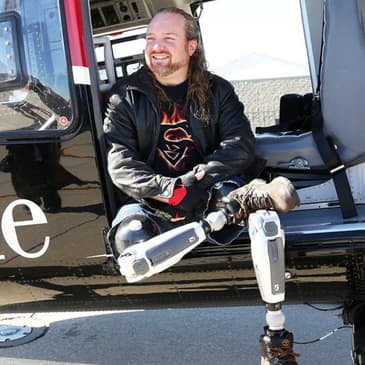
Jeremy Warriner is an advocate for Accessible Diversity, Equity, and Inclusion. He is a motivational speaker. Jeremy’s goal is to raise awareness for the needs of people with disabilities. His mission statement is finding strength in traumatic events and living a resilient life. Walking Spirit is the foundation and their goal is pioneering disability advocacy.
- 3:48 A Youthful Troublemaker Introduced To Karate
- 6:38 The Thought Of Losing It All
- 8:17 The Hinge Moment Of A Vehicle Accident
- 18:32 Reflection On The Accident
- 25:59 A Mindset Shift
- 27:03 The Feeling Of Anger Building Up
- 30:52 Returning Back To Karate For Healing
- 38:31 The Mystery Man That Gives Hope
- 42:36 Finding Meaning In Life Today
- 48:27 Turning New Difficulties To Motivation
- 50:26 Take Control Of Your Story
- 55:21 The Failed Bill
- 56:00 How To Stay Motivated After The Failed Bill
Don’t forget you can also follow Dr. Rob Bell on Twitter or Instagram.
Follow At:
- Twitter @drrobbell
- Instagram @drrobbell
Download Your Daily Focus Road Map!
If you enjoyed this episode on Mental Toughness, please subscribe and leave a review!
[00:00:10] Welcome to Mental Toughness with Dr. Rob Bell. Each week, Dr. Rob sits down with athletes, executives, and expert coaches to talk about mental toughness and their hinge moment. Here's your host, Dr. Rob.
[00:00:23] All electrolyte and hydration mixes and drinks are not created equal. I mean, check the ingredients. They have sugar or sugar alternatives, and there's tons of added stuff. Allow me to introduce you to the best electrolyte mix.
[00:00:56] Light Balance. L-Y-T-E Balance.com. It's a naked electrolyte mix, which means no preservatives, no sweeteners, no flavoring, no caffeine or gluten, and no calories. I'm always on the search for the best hydration, and I've found it. My entire family uses it, and I use it on all my runs. It solved all my hydration issues.
[00:01:23] Your body needs magnesium, potassium, and sodium, which Light Balance conveniently provides in liquid or powder form. Pure, powerful hydration. Light Balance. Go to L-Y-T-E Balance.com.
[00:01:39] So, yeah, 16-year-old turned left in front of me on a county road. It took me a year to even remember that I swerved to not T-bone the driver on the driver's side door at 55 miles an hour.
[00:02:07] And, unfortunately, the young driver slammed their foot down on the accelerator instead of the brake pedal. And, as a result, they sped faster into the intersection and hit me on the passenger side, forcing me off the road into a utility pole.
[00:02:38] Our guest today is an advocate for accessible diversity, equity, and inclusion. He's a speaker, and his goal is to raise awareness for needs of people with disabilities. Part of the mission statement that he has is finding strength in traumatic events and living a resilient life. Walking Spirit is the foundation in their pioneering disability advocacy. Our guest today, his hinge moment occurred in 2005 as he was driving home from work.
[00:03:06] And a 16-year-old turned in front of his Jeep Wrangler and caused a horrific accident. Left him a double above-the-knee amputee and changed the trajectory of his life. Excited about hearing this story today about this resiliency and mental toughness. Our guest today is Jeremy Warner. Jeremy, man, thanks again for taking the time. I'm glad we could connect, bud. It is my pleasure. Thank you for reaching out. So, let's start, man. Like, as a kid, you know, I was reading, and you're a great writer, by the way, man.
[00:03:35] I love the prose that you put out there. But as a kid, man, you just live a couple blocks from school. And I guess pick us up from that, man, because you would get in a lot of fights when you were little, right? I did. I have always been, well, I was always a smaller guy. And I was, I always had this sense of justice that was much bigger than me.
[00:04:02] And so, anytime I saw somebody being treated badly, being bullied, I tended to put myself in the middle. And, yeah, I, very early on, we're talking like fourth, fifth grade. I, if I got into that fight, I would hit somebody with my trombone case and run as fast as I could. And sometimes I wasn't fast enough to get home. So, yeah, my parents recognized that.
[00:04:31] They recognized that I needed to be able to manage my temper and also be able to make good decisions that would keep me out of situations where I might let my temper get control. And so, it was, I want to say I was about maybe eight years old, maybe 10.
[00:04:56] And after one of these instances, my father took me to see a movie. We went to see Poltergeist. And on our way home from that movie, he stopped at this little building off of Keystone Avenue, just south of 38th, if I'm remembering correctly. And it was a karate studio, but I didn't know that. And there was nobody there.
[00:05:24] There was nobody really doing anything when we went in, except for the owner of the school. And he was this really big man who, to my small 10-year-old self, looked like a guy in pajamas. And he went into the office, talked with my dad for a little while, and then brought me in. And I honestly thought I might be getting sold.
[00:05:48] And dad and Herb Johnson was his name, talked to me about what I'd been getting into. And he wanted to know if I wanted to learn how to defend myself. And I had no idea that when I said yes, that that was going to be more than just learning,
[00:06:13] you know, punching and kicking, but actual spiritual development and, you know, mental and emotional control. And these were skills that lasted way beyond even when you kind of spoke, you wrote about, like even in college kind of got away from it, but you had a black belt at the age of 16. And these were skills that lasted your entire life into today, right? They do. And, you know, there came that point, that hinge moment that you mentioned,
[00:06:44] where after that accident happened, and at that point in my life, I was 30 years old. I had just started actually thinking about getting back into the martial arts. And then this car accident happened. And one of the terrible things that happens when you suffer that kind of trauma is that you lay in that hospital bed and you tell yourself lies about what you can do,
[00:07:12] what you can't do, what your past meant. And I remember thinking about how much effort went into getting that black belt by the time I was 16, working towards my second by the time I was going off to college, and how waking up in a hospital bed, having lost both of my legs with my jaw still wired shut,
[00:07:37] but I told myself that that was all a wasted effort. And, you know, not just that. I also told myself that no woman would ever find me attractive again. I told myself that I would never walk again. And I was completely wrong about all three. So let's talk about this hinge moment.
[00:08:03] You're working in hospitality at the time, and this is one of these evenings. Then when you get done, you have about an hour drive home. And do you think you just – hopefully that was a good intro enough, but do you just want to pick us up from there? Oh, no, no. Yeah, that's a fair description. Yeah, so my background is in hotel and restaurant management. I had spent a decade working in that career.
[00:08:26] And, again, also one of those things I told myself that that education was wasted because I didn't see how I could go back into that industry either. But so the night that the accident happened, I was managing the hotel on DePaul University's campus and commuting an hour to and from every day back to Indianapolis.
[00:08:50] And that particular evening, I got in the car and headed towards Indianapolis, stopped at a gas station, called one of my best friends and told him I was going to pick him up on the way home because I was then going to a Halloween party, and he really needed to get out. So that was the plan. And then about 10 minutes after I drove out of Greencastle,
[00:09:18] heading towards Indianapolis on a county road that was a shortcut that just took 10 minutes off my drive. And that particular night, it added about two and a half months to my drive. So, yeah, 16-year-old turned left in front of me on a county road. It took me a year to even remember that I swerved to not T-bone the driver
[00:09:46] on the driver's side door at 55 miles an hour. And unfortunately, the young driver slammed their foot down on the accelerator instead of the brake pedal. And as a result, they sped faster into the intersection and hit me on the passenger side, forcing me off the road into a utility pole.
[00:10:15] My Jeep that I'd always thought that my Wrangler would be like the safest thing that I could be in because, one, it would be durable, and two, if something happened, I could get out through the top if something happened to the doors. When I was hit on the passenger side, I went off the road, hit a utility pole on the driver's side of the vehicle that crushed the dashboard and the door down around my legs.
[00:10:41] And then my Jeep rolled up onto its passenger side, which pinned the top. So I couldn't get the top opened. Not sure what caused what injuries, but before the fire erupted, I had a compound fracture to my right wrist. My forehead, eye sockets, cheekbones, and jaw and nose
[00:11:11] were all fractured and broken. And really, my memory of the accident stops when I hear a woman's voice asking who I am and telling me that I'm going to be okay. And then me responding to that person, saying that I smelled smoke, I saw flames,
[00:11:40] and then that I was on fire. And in my mind, the last thing I remember is looking up at what I thought was the sky, but was really a cornfield because of the position of the Jeep and yelling out, God, this is not how I die. And then six weeks later, I woke up in a burn unit with my jaw wired shut, a trach, and my right wrist splinted,
[00:12:08] a feeding tube coming into my stomach, and both legs had already been amputated, and skin grafting had been done while I was sleeping. Wow. Who was the lady's voice? So that was a retired nurse who her story was that she was sitting at home watching TV and decided that she needed to go for a drive.
[00:12:38] Really? And so she walked out of her house, and this is probably 8.30 at night in October. She turned down a road she'd never driven down before and came upon the scene of the accident. And now, obviously, I didn't know any of this when I woke up. It took, really, until after I was discharged from the hospital and honestly suicidal,
[00:13:08] I found the police report, and the officer that filled out the police report had actually gotten married that summer and had his wedding reception at my hotel. And so I knew his name. I knew his wife's name. I had helped her figure out a lot of the stuff around their wedding reception, and her phone number was still in my memory, so I called her.
[00:13:37] And she put me in touch with the people that had responded, or, well, the people that stopped. Because the folks who rescued me were not the folks that you get when you call 911. They were the people that stopped before they could get there. Now, the person who caused the accident did call 911,
[00:14:03] and so the folks that pulled me out were this retired nurse, a minister who planned to stay home and watch a movie, but had a craving for food he could only get at a restaurant the next town over, and so was on the road because of that, and came upon the scene of the accident. A farmer from across the street that was running fire extinguishers across.
[00:14:32] And when the nurse arrived, she almost walked into the power lines that had come down when I went off the road. Wow. There was a man that walked out of the cornfield at that moment with a flashlight, stopped her, and guided her to the wreckage of my vehicle so that she didn't go into the power lines. They fought the fire for about 20 minutes. The two police officers did arrive,
[00:14:59] and supported them and helped with that fight. Apparently, I was conscious the whole time, and I instructed them to pull the soft top off of the Jeep to get me out that way because they had tried pulling me through the broken windshield, and that wouldn't work because of how I was pinned. So, and it, I mean, the coincidences are all very strange.
[00:15:26] One of the police officers was actually the nephew of the nurse. Wow. And so one had a connection to me through his wedding reception. The other one had a connection to the nurse. They actually drove the ambulance, the officers did, so that all the paramedics could work on me. Their story was that they fought the fire for about 20 minutes,
[00:15:55] and then on their third attempt to pull me out of the Jeep, there was a loud pop as the Jeep was completely engulfed in the flames, and that was when I came free. And so the nurse then checked to see if I was stable, poured some water from drinking water bottles that she had in her car on my legs. Apparently, I would not talk from that point forward
[00:16:24] and would only smile. And then she turned to see if the man from the cornfield needed medical attention because he had been beating the flames out with his bare hands, and he was gone. And to this day, we have not located that individual. Really? Yeah. We have found everybody else, even a volunteer firefighter who responded from another community that night who then, when I connected with him 10 years later,
[00:16:52] he had become a full-time firefighter as a result of what he'd experienced. Hey, good-looking.
[00:17:19] If you like this podcast and are already a badass, but it's all way too complicated, then visit our website, drrobbell.com, and schedule a call with us to help capture your very own hinge moment.
[00:18:09] I appreciate you sharing that, especially in as much detail. With this accident that happened in 2005, when you have time to reflect on that, what do you think about in terms of a nurse having that need to just go on a drive and then the minister wanting to go out to eat? You know, I believe that the universe works in very mysterious ways.
[00:18:39] And that may be a bit of a cliche, but the reality is that from a faith standpoint, the night that that accident happened, I had pretty much lost most of my faith just as a result of the industry I was in and seeing the way that people treated each other and tried to get out of paying bills, just folks working behind the front desk
[00:19:08] who were unfortunate enough to get somebody who had a really bad travel day. You know, and so when I woke up and I learned this story, like I said, I was already at that point suicidal. I had no intention of really living beyond the point that I could get away from my family, who I love very, very much.
[00:19:37] And they were exceptionally supportive. But when I woke up and found that my legs were gone and I hadn't made that decision, I didn't see a quality of life beyond that hospital bed. And so I told myself that I, actually what I told myself was that I would get a do-over and that if I actually committed suicide, that I would be reborn on my original birth date
[00:20:06] to my parents and get to make different decisions and start that life all over again. I've never heard that concept of reincarnation, but it's one of those things that I created in my mind to make it something that I could justify. And so when I learned, after talking with each of the people that pulled me out of that wreckage, what they went through, how they came to be there, the weird, mysterious connections
[00:20:35] between different folks, it came to a point that I realized, regardless of what I believe in from a faith standpoint, that too much had been risked and invested in keeping me alive, not only from those folks who risked their own trauma at the accident scene, but also the nurses and the doctors and the physical therapists
[00:21:04] and the occupational therapists that were working on me while I was in that medically induced coma and had continued working on me to get me to a point where I could be discharged to my parents' home, which at the age of 30, moving back into mom and dad's house where it's not accessible and dad and the next door neighbor have to carry me upstairs to bed each night, you know, it wasn't an ideal thing.
[00:21:34] And so, so yeah, I had had it in my mind that as soon as I was able to get away from all the people I felt like I was living for, I would be able to let go. But once I learned this story, it changed my perspective and framed my life around what everybody else had put into it. And I didn't feel like I could give that away or throw that away. So,
[00:22:03] that meant having to figure out how to live with the trauma, how to learn how to walk on prosthetic legs that I still didn't understand how I was ever going to be able to walk on something that I didn't think I would be able to feel through. And then, you know, basically every day, by beginning the day, by saying, no matter how difficult this is,
[00:22:33] no matter how many phantom pains I have during the day, no matter how many frustrating moments of access or just simply not being able to do things that I always took for granted, that it would be a good day. And then, at the end of the day, ending it by saying, today was a good day, tomorrow's going to be better.
[00:23:02] And eventually, I got to a point through my own, just, because we don't stay stagnant. Even if we just sit, we're still going to physically heal. And so, as I began to heal, really heal, and to develop, and to start to adapt and accommodate, I started to realize that I couldn't keep saying, I can't do, or hearing people say, you can't do,
[00:23:31] which still happens almost 20 years later, but start changing that to, how do I achieve this? What, how can I accomplish this goal? So, yeah. When do you, when do you remember, because I love the, the mantra that you would say in the morning, when do you remember, like, that mental shift, then starting to take place, even early on, in that, that healing journey?
[00:23:59] The point where it went from being, well, so the point that I began that mantra was right after connecting with the people who responded. The point that it started to become a reality, was really, as I did start to return to work, and I started to advance through the prosthetic legs,
[00:24:27] and so starting off, I mean, and physical therapy was, was tremendous, and for me, it ended when my physical therapist looked at me three years later, and said, you're therapizing yourself when you're out in the community, this has become social hour, I need to focus on other patients. That was the graduation, huh? Yeah, that was the graduation, but the point that, that I really did start to believe it, was, was really,
[00:24:57] as my independence, came back through that gradual healing, getting into my own home, modifying my home, getting a car that had hand controls, and being able to drive and access the world without necessarily needing my parents anymore, and so it's a very weird thing to spend your youth claiming your independence, independence,
[00:25:28] and then, around the age of 30, having all of that independence stripped away, back to the point where you're truly relying on mom and dad for everything, and then to get back to that, where you were able to finally say, no, my schedule is my own, where I go is up to me, what I do is up to me, and getting back to that point, that's, I think when,
[00:25:57] when the mantra wasn't even necessary anymore, was when I hit that independence point. If you're struggling with soreness, pain, or inflammation, need to check out Stamina Pro Recovery Patches, developed for over 15 years, the clinically proven technology of Stamina Pro is free from all chemicals, all pharmaceuticals, all drugs, and it's 100% safe for athletes. I only promote products that I use myself,
[00:26:26] and Stamina Pro takes care of all my training needs, pain, and soreness. If you use the code DRB15, you get 50% off, or use the link below, Stamina Pro. Awesome. Thank you for sharing that, man. Jeremy, like, my question, you kind of wrote about, again, I mean, suicidal, have depression, you talked about, like, the anger, even kind of coming back, anger that you would have, like, as a kid, and obviously it was a little bit different, but you had anger then at that time. Like,
[00:26:56] walk us through that type of, like, transformation, then, that you had to start to do. Well, so, of course, first, there was anger at the, the other driver. And, and as I was getting into the physical therapy, I began to realize, and this perhaps is from that martial arts background, that the anger wasn't helping me improve. And so,
[00:27:25] so one of the first things I did after getting home, and getting a little bit more independent, was to reach out to the parents of that 16-year-old. Because I wanted to be able to connect, to let that 16-year-old know that, that I knew that it was a mistake, and that they didn't know who I was, they didn't intend to cause this harm, or this trauma, and that I needed to forgive them.
[00:27:55] And I thought that by doing that, that I, I had actually dealt with what I needed to deal with. And for a time, I was pretty at peace. But then, as I got more and more into the world, and became more and more frustrated by, not only those things that I used to be able to do, that I took for granted, but also those things that I, should be able to do with accommodation, but,
[00:28:24] and with the laws, like the Americans with Disabilities Act, that say how our community should be accessible, but then going into businesses, and other, you know, whether we're talking about restaurants, or hotels, or grocery stores, you know, movie theaters, and amusement parks, or even the hospital, realizing that because, the ADA isn't understood,
[00:28:53] by the people that, actually have to, build it into the design, whether we're talking about the facility, or the program, that I was, and as I became more aware, of what the law actually said, about those things, and how it should be applied, I began to feel that anger building again, and realizing, that the anger that I had, when I was a kid, when I would get mad, because somebody was bullying,
[00:29:23] you know, somebody who was smaller than me, on the playground, somehow that anger, had now transferred, to things like, going to a grocery store, and finding a big, point of sale display, put up in the middle of the aisle, that blocks me, from being able to get around, the store, and so, or going to a, coffee shop, and,
[00:29:53] realizing that the way, that the, the drive-thru, has been set up, at the coffee shop, that it cuts off, the only two accessible, parking spaces, for that parking shop, or for that coffee shop, when, when there are six, spots, designated for people, who can jump out of their car, and run in, and get grab and go, stuff, and, and so, so I, I started to realize, how angry, that was,
[00:30:23] that kind of thing, was making me, which was, it was interesting, to start to feel that again, and connect that, to my youth, and I appreciate you sharing that, and I want to get into, you know, your, your mission, and your advocacy now, even on those examples, but the other question, how did you return then, back to, karate, and how did that impact, and how that helped your healing? So,
[00:30:53] COVID, brought that about, and, you know, COVID taught us, how to communicate like this, and during that time, a, non-profit, called the Center for Independent Living, that is here in Indianapolis, Accessibility is their name, reached out to me, and asked me to do, some outreach work, on their behalf, to, let, people with disabilities, know that, even during COVID,
[00:31:22] during the lockdowns, they had adapted, so that they could still provide services, and, during that, I connected with, a fitness center, out of Atlanta, that was wanting to do, Zoom based, exercise classes, for people with disabilities, and, and, you know, all over, so again, adapting, they took their fitness center, and said, okay, if we can't bring people, into the,
[00:31:52] into the actual fitness center, let's take it to them, and, so, in the process of doing, those exercises, and seeing if this would be, a good fit, for the non-profit, I was working with, I made the comment, to the head of the fitness center, that it reminded me, of, doing karate, in my youth, and, he, then, asked, if I would be willing, to work with, a, young woman, with down syndrome,
[00:32:21] who was a member, of their fitness center, there in Atlanta, on her senior project, on martial arts, and, so, I said, okay, let's connect over Zoom, and see how that works, and, and then, I, I don't know why, I would have thought, that something that fit me, at 18, would fit me at, what, at that point, was 45, your, your gi, yeah, my gi, and, so, I, I tried to put on the gi, and realized,
[00:32:51] I had to order a new one, and, then, I tried to put on the belt, and realized, it didn't wrap around me, twice, and I needed it to do that, so, so, as a result, you know, I, I, I worked with her, I put those things on, again, and, and then, I found myself, asking the question, as I was demonstrating, how to do, punches, and blocks, from a wheelchair, and then,
[00:33:20] had her, demonstrating the stances, and the kicks, and, having her demonstrate, how to combine those things, together, for her project, I started asking myself, can this thing, that I said, was a waste of my effort, in my youth, actually, come back, into the light, and be a part, of my personality, and my, my existence, again, had, and,
[00:33:51] so, I, I did some research, and I found my old sensei, Herb Johnson, had since passed away, but, Joe Hannon, who had taught me, in the, in the dojo, since I was 10 years old, he was one of the instructors there, was still here, in the Indianapolis area, and, was willing to get together, with me, and see if we could figure out, how to modify, the style, which is, Ray go drew, that's the name of the,
[00:34:21] the karate style, um, means graceful, beautiful, hard, soft way, and, uh, so, we, then, about three, three and a half years ago, began, retraining me, and, with each, it, it, it really requires very intimate, um, conversation, and risk, about, you know, what can you do, what are you comfortable trying, and, so,
[00:34:51] where we started, with just the very basics, of, doing punches, doing blocks, putting on my prosthetic legs, seeing if I could get into, shallow versions, of the deep stances, that we used to do, and, um, and if I would have enough balance, supported with my crutches, to be able to do a kick, um, and, then, from there,
[00:35:21] um, I don't know how much you know, about karate, there, is something called a kata, or katas, which are, choreographed forms, and, so, we started again, with the very first one, and modified it for the wheelchair, modified it for the prosthetics, figured out what's different, if I'm in those different positions, and now, we are at a point, where, we are actually working on, um,
[00:35:51] on the bow staff, and the psi, and incorporating those, into my katas, and my general practice, and, um, and also working on self-defense, and, those aspects, although, my reasons for doing it now, are, purely, physical, and mental, and emotional health, driven, um, and, and not so much about fighting, or, or defending myself,
[00:36:20] though it is, good to be reminded, that I, that I can still do that, even, when I am utilizing the wheelchair. Yeah, absolutely, Jeremy, when, and you enjoy swimming as well? Yes, I swim three days a week, um, one of the unfortunate things, that comes along with, uh, with a, an acquired physical disability, can be additional, uh, abilities, and so, I, where I began as a bilateral above knee amputee,
[00:36:50] and a burn survivor, because I wasn't physically active enough, thinking that moving my body around with a wheelchair, was all the exercise that I needed, um, or walking with my prosthetics, was the wrong way to approach my health, and, I, over time, developed type 2 diabetes, and severe sleep apnea, and so, swimming three days a week, and doing the martial arts,
[00:37:20] over the last several years, and swimming is hard to stay on that routine, so, I'd love to say that for three years, or, that every three days, I'm, you know, there, or every other day I am, but, there are all these breaks, and it always takes a concerted effort, to get back to, you know, that routine, once whatever life has thrown at me, that threw me off that routine, has been dealt with, um, but, so, with dealing with that,
[00:37:50] most of the time, my diabetes is under control, um, as long as I don't let my diet get too crazy, and, um, I've actually, within the last couple months, gotten to a point where I no longer need the CPAP machine, so. Great. Yeah. Oh, love it, man. I mean, Jeremy, being back in life, and, contributing, I want to talk about, like, the advocacy work that, that you do. Can I ask a quick question before that, if you don't mind?
[00:38:19] Of course. Um, I just, for some reason, this keeps on popping in my head, but what about the individual that, that I never found, the one with the flashlight, that just came out of the woods? My belief, is that that was truly my guardian spirit. Yeah. And, um, you know, for, for whatever reason, I mean, and it very well may be somebody, who is, absolutely tangible, and had their reasons, for being there, and leaving that night. Um, but,
[00:38:50] either way, that person, those people, they were drawn to that place, when I needed them most. And, and the fact that that person, um, you know, protected the nurse, kept her from walking into the power lines, fought the fire with his bare hands, and then, disappeared. uh, to me, that, that gives me faith every day, that there, without even necessarily getting into religion, um,
[00:39:20] just that there is, more at work in the world, than what we can see, and even feel, and that, um, that there are, positives, when, when it becomes so difficult, difficult to focus on, on the positive things, that happen, because of all the negative noise. Yeah. Uh, that, that is something that I, I do, I go back to, it gives me hope, and it gives me strength, that, that that individual, may or may not be corporeal,
[00:39:50] but, um, um, but that all of those individuals, were brought there, when I needed them. Right. So. And then, so he wasn't around at all, when, the paramedics and police showed up, he had disappeared by that point? So, the nurse is the only one, who remembers, and can describe him. Mm-hmm. Everybody else remembers, there was somebody else there, but they can't remember who. Yeah.
[00:40:22] Which is, which, yeah, that I always found kind of, uh, curious as I, went from each individual, and got their stories. In each of their stories, there was somebody else, but they couldn't remember who it was. Yeah. No, thank you for sharing that, man. I just find that to be a, a really important part, because there's just so many things, we can't describe. It is. Yeah, I love that description. Um,
[00:40:52] I guess the part that stands out to me about that is like, with so much kind of chaos going on, he was, he was focused on helping the individual that was going to be helping you the most. Right. And just pointing out those lines. Right. Um, yeah, thank you for that, man. I think the tough part is like a podcast host is I'm trying to go down these different routes and then be able to extract this. And at the same time, be able to think about it and comprehend it myself. But, uh, yeah, it's just, um,
[00:41:22] it's inspirational, man. I appreciate you sharing that. Oh, absolutely. And it's something I've, whenever I do public speaking, and it depends on what the topic is, you know, sometimes I'm talking to an audience where, you know, we don't need to get into the spiritual, but, you know, I,
[00:41:41] I always believe that it's important to share what I experienced and what the people who went through their own trauma to rescue me that night experienced. Because I do believe that there is inspiration and hope in that story. And I'm not the only person who's experienced something like that. It's just, uh, whether or not, sometimes you, you don't even want to admit it when,
[00:42:10] when you, you hear something about that, because it, it makes you then have to question, well, why, why was I special enough to be saved? And for me, it's been more of a motivator of, because I was rescued, I've got to do something with this life. Right. So talk to us about your life now, like the meaning that you have. So, uh,
[00:42:40] like I said, I, I, I went back to the, well, maybe I didn't say that. I did go back to the hotel industry. I, with on my very first day back in the hotel, I had to deal with a guest complaint. And I realized after I took, I, I walked into the guest's room on prosthetics. At this point, I wasn't comfortable wearing shorts.
[00:43:09] So I was wearing pants that covered the prosthetic legs and I was walking on crutches. And the guests, when I came into the room, made a comment about how I was hobbling around that day. And so I sat down and I pulled a pant leg up and I showed them the prosthetic leg. And then I pulled the other pant leg up and I showed them that one. And then that guest sat down on the bed and they said, you know what? I can deal with the bed being too soft.
[00:43:39] And I walked out of the room and I thought to myself, that was not the right way for me to handle a guest complaint. I just used my disability to make this person feel as if their issue was, was less than mine. And, and I realized at that point that I really couldn't stay in that business, at least not in that capacity. And,
[00:44:06] and I still stuck with it for a year until I finally decided it was time to go out and do my own thing. And so I decided to try to merge my hospitality experience with my experience, my growing experience as a person with a disability. That's what led to the public speaking. And for several years,
[00:44:34] public speaking was pretty much what I did. Anybody who had asked me to come, come talk about what I experienced, whether they were willing to pay a fair market rate for me to speak or could pay me in chicken enchiladas. I was happy to deliver that message. And so I started doing a lot of speaking,
[00:44:55] especially in elementary schools in the local area about people with disabilities and being able to connect with them and engage without being offensive or without being afraid. How to, how to, how to have those conversations.
[00:45:14] And then talking about being a tissue recipient and having received the blood volume of over 20 different adults and why it is so very important for people to be able to donate blood and tissue. And then over time, like I mentioned COVID leading into this outreach work. And it was through that, that I came to,
[00:45:42] I really started hearing the concepts and the buzzwords, if you will, of diversity, equity, and inclusion all the time. But what I was finding was that in most of those conversations, people with disabilities tended to be an afterthought or not brought up at all. And, and then eventually, you know, you start to see those acronyms, the DEI.
[00:46:10] You started to see the A added at the end for accessibility. And as I decided that I really needed to focus on my own business instead of doing outreach work to develop other people's businesses,
[00:46:26] I decided that walking spirit needed to focus on consulting services built around accessible DEI with the concept of fostering a sense of belonging among not only the consumers in our businesses, but also the employees. And, and really taking a holistic view at how accessible is your hotel, your restaurant,
[00:46:56] your movie theater. How, how are the staff trained to offer support, especially in the confines of whatever their accessibility is for that facility? So like, for instance, going to the IMAX, there is a, an elevator that can get you to other levels. So you don't necessarily have to walk up all the steps,
[00:47:24] but you might have to deal with that when you're in there. And so the staff knowing what the most accessible routes are and having an idea of where the seats are, that alone helps make it an easier experience for somebody dealing with my challenges. Mm hmm. No, it's excellent, man. And want to listen to your favorite music, but you're sick of all the commercial interruptions and negative news today.
[00:47:51] Tune into Kuko radio.com music for your mindset. We're a commercial free online radio station. Play nothing but hits. Our free iOS and Android apps are available for download at Kuko radio.com. You know, when we were talking then just even before, I mean, recently, uh, DEI has taken, um, well, really a frontal assault.
[00:48:21] What, um, how has that impacted your mission and, and change? Uh, honestly, I feel like the only thing it's done is provide more drive for me to educate. It got you started, huh? Yeah. Um, and, and not, so I, I do have a couple of clients and over the last year, I worked very closely with, with a, a county hospital on,
[00:48:47] on incorporating the accessibility piece into their inclusion work. And, uh, that my mission, the mission of walking spirit to provide that consulting and support has not changed. Uh, I am not currently rebranding walking spirit. Uh, the brand is accessible. D E I B for the belonging, um, consulting and support services. and,
[00:49:16] uh, really the, the whole concept behind that has always been about removing demographical biases and making certain that merit in the form of education and skill and talent is able to rise to the surface. And, and that you have the most, like all of the most qualified candidates for a job and all of the most,
[00:49:45] um, qualified consumers in your business, because you're able to capture everybody by making certain, everyone can get in the door and everybody can understand the programming. Mm. Well, it's fantastic, man. Um, Jeremy, before I asked like my last question, somebody's listened to this, let's just say the first time, um, really struggling, really going through a difficult time. What,
[00:50:14] what advice do you have? Like what's that, um, what's that part that always keeps you going and moving forward and facilitating change and just being a, a positive beacon of light to in this, in this universe. So going all the way back to the, the early days of the recovery and making that decision that I was going to live and I had to figure out how to live,
[00:50:37] that taught me how to use my own control over my own emotions and my, and my own, um, you know, my own outlook and my perspective. And it's really easy to allow the world and the negative noise and the, um,
[00:51:01] whatever trauma is currently facing yourself or your loved ones and all of that to, to dictate how you feel. And so, so instead of choosing for yourself that again, today's going to be a good day, or I'm going to find the beauty in the dark rainstorm. And I want to see the next version of that tomorrow, you know, or, or,
[00:51:30] or when it comes it realizing that I can frame how I'm perceiving and experiencing the world. And if I don't like the way that it is, I still have to deal with whatever those challenges are, but they're just one interesting piece in the story. Hmm. And, and that, that it is truly, it's my story. It's your story. We are in control of, of what that story is.
[00:52:00] And if we don't take that control, then yeah, we allow other people and, and other events to control that story for us. Mm. Mm. Um, you, you, you had asked about how I got into the advocacy and I guess I left out one of the most, uh, one of the most educational pieces for me, which was, of course we had to look and see what caused the fire.
[00:52:27] And we discovered that the fire was caused by a, what I believe was a defective design in the engine because the plastic brake fluid reservoir in the, the engine of the Jeep Wrangler, was not protected from impact. And, and when you think about what, how they market those vehicles and what Jeep Wranglers are intended to, to be able to do, you would think that that should have some protection. And so we had a lawsuit against Chrysler.
[00:52:57] And then in, I want to say 2008, 2009 Chrysler and General Motors both declared bankruptcy. And when they did that, both of those companies listed anybody like myself who had experienced a life altering traumatic injury or death, um, who had claims against them for those defective designs or vehicle defects,
[00:53:26] all of our cases were swept under the rug. Um, so that if you think about that, I want to say total combined between General Motors and Chrysler was around 3000 cases that because they were never heard in court, no safety recalls were ever determined or issued on, on those, those issues. Um,
[00:53:54] so as a result of that, I actually, the first time I flew after the accident, as an amputee, I received a phone call asking me if I could get on a plane that day, fly to Washington DC and testify in the judiciary committee hearings in the House of Representatives that was being held on the auto industry bankruptcies. Mm-hmm. And that led to three actual, uh,
[00:54:22] journeys to Washington DC during that time period. Only once did I actually get to testify. Um, but, but that was what started to teach me how to use my voice. Uh, and that led to, leading a protest outside of Chrysler headquarters when new Chrysler opened up after the bankruptcy. And, you know, we're still using the exact same factories and selling the exact same products,
[00:54:51] but not the same company that I had sued. Oh, and, and, and, you know, several others. So that was really where the advocacy work began. Yeah. Jeremy, what, um, because I know then that, um, and, and correct me if I'm wrong, but the legislation had passed for like future claims. Did ever come back and were addressed those that existing claims? Uh,
[00:55:22] no, nothing ever came back to, to address the preexisting claims. There was a bill introduced in my name by Congressman Andre Carson. Uh, that had it gotten out of committee and had there been a vote on the floor that would have brought the preexisting claims back, but it never got, um, it never got a vote to, to be able to even go that far. Jeremy, I appreciate your story, man, and coming on and sharing and,
[00:55:52] um, it's helped me. And I always like, I know there's a part that I have missed, but what questions should I be asking that I'm not asking? Uh, well, I mean, I would say in regards to, to that piece, again, how do you stay motivated? How do you, how do you keep going? Like that, that was something that I, I had to look at and not say, okay, you failed because you didn't get that bill passed. Um,
[00:56:19] but recognize that, that we were able to reach, you know, somebody at a congressional level who was, who was willing to introduce a bill and that we did get, uh, even though we didn't get what we wanted out of that, we absolutely got attention given to, to, to those things. And we got those, those future claims covered. So, yeah. Um,
[00:56:49] I, what, what else from a, uh, I would say going back to the martial arts standpoint, the question that I would, would love for more people to ask is what, what can martial arts do for a person with a disability? Hmm. And, and realizing that that is actually just by its very nature, one of the most,
[00:57:19] uh, adaptable sports that is out there. And, and recognizing the people with, there are lots of adaptable sports. I haven't done skiing yet. I would love to, I just haven't taken the opportunity, but I've done water skiing and, and, and, you know, swimming and, and all of those things, when I first looked at them, I said, I couldn't do with the martial arts. It's, it's not only about self-defense. Like I said, it's about body, mind, and spirit.
[00:57:50] And so even someone who, who is paralyzed can exercise their mind by learning the forms and doing the forms in their mind. And that actually, when I swim, I can't keep track of how many laps I have swamped swam. I always, always lose count. I'm either up or down three or four laps. Same here. But if I mentally run my katas in my mind,
[00:58:19] as I'm doing my laps, I get through my mile. So it's, uh, and, and I'm, and I'm working that even as I'm exercising other parts of my body. Yeah. Wow. I love it, man. Um, Jeremy, we're going to put the, um, obviously the website on there. And I just appreciate you coming on, man, and taking the time and sharing so many aspects of, of your journey, man. Thank you so much. Uh, it's my pleasure.
[00:58:48] I really have enjoyed the conversation. Thank you for the work that you're doing. Um, feel free to reach out anytime. Walking spirit.org is the website. Unfortunately, today we are dealing with some issues with GoDaddy. So, Oh, so right now, if you go to it, you're not going to find it, but it will be back up by the end of the week. I'm sure by the time this is released, it'll be, it'll be good, man. Oh, okay. Very good. So then you can, you can edit that out. Thanks man. I forget. We're not live. So thank you very much.
[00:59:18] I really look forward to seeing it. Thank you for the time. So mental toughness with Dr.
[00:59:48] Rob Bell to find out more about Dr. visit his website at drrobbell.com or follow him on Twitter at Dr. Rob Bell and subscribe to the show on your favorite podcast platform to get the next episode of mental toughness as soon as it's available. Thanks for listening. And we'll see you next time.