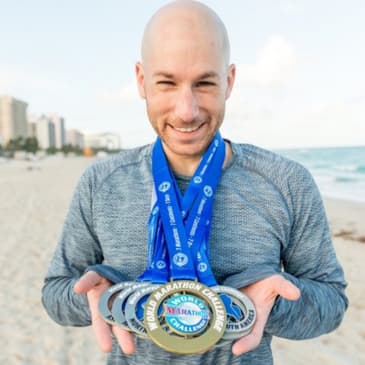
Jared Blank is Chief Of Staff at the University of Texas Football. He has been director of ops at USC and University of Washington. Jared completed the World Marathon Challenge which is 7 marathons, 7 continents, in 7 days. He has written a book titled " Running The Distance." At the age of 5, he discovered he had sensory processing issues and dyslexia. Jared is an advocate for dyslexia awareness and continues to raise funds for the International Dyslexia Association.
- 4:02 Capable Of Anything Entitled To Nothing
- 5:34 The Mental Toughness Of Persevering As A Team
- 6:50 The Importance Of Processes
- 9:31 School Difficulties With Learning Disabilities
- 16:17 Struggles Turn To Strengths
- 17:45 The Need For Movement
- 23:09 How The 7 Marathons In 7 Continents In 7 Days Come To Be
- 24:18 Preparation And Execution For The World Marathon Challenge
- 30:47 Feelings After The Fact
- 31:51 Future Goals To Hit While Racing
- 34:51 How Running Improves Your Professional Life
- 36:23 Running The Distance Scholarship
- 37:50 The Importance Of Sport In Communities
Don’t forget you can also follow Dr. Rob Bell on Twitter or Instagram.
Follow At:
- Twitter @drrobbell
- Instagram @drrobbell
Download Your Daily Focus Road Map!
If you enjoyed this episode on Mental Toughness, please subscribe and leave a review!
Dr. Rob Bell
[00:00:10] Welcome to Mental Toughness with Dr. Rob Bell. Each week, Dr. Rob sits down with athletes, executives, and expert coaches to talk about mental toughness and their hinge moment. Here's your host, Dr. Rob.
[00:00:23] All electrolyte and hydration mixes and drinks are not created equal. I mean, check the ingredients. They have sugar or sugar alternatives, and there's tons of added stuff. Allow me to introduce you to the best electrolyte mix.
[00:00:47] Light Balance. L-Y-T-E Balance.com. It's a naked electrolyte mix, which means no preservatives, no sweeteners, no flavoring, no caffeine or gluten, and no calories. I'm always on the search for the best hydration, and I've found it. My entire family uses it, and I use it on all my runs. It solved all my hydration issues.
[00:01:13] Your body needs magnesium, potassium, and sodium, which Light Balance conveniently provides in liquid or powder form. Pure, powerful hydration. Light Balance. Go to L-Y-T-E Balance.com. So I think it was 2015, I saw it on my couch. I was sitting in my parents' house. We're sitting on the couch. I see this guy on ESPN run seven marathons in seven days on seven continents.
[00:01:41] So I was like, that's the coolest thing ever. I'm like, I'm going to do this. And my whole family was like, you're crazy. You're not doing this race. And so I tracked it for like three years before I actually did it. But I was like, I knew at that moment. And I think it goes back to like, right, how I grew up. Studying, going to school, you know, then working out, then school. I was like, it's kind of no different, right? You're flying, you're running, you're flying again.
[00:02:09] So like, it's the same. To me, it was, there was a synergy to it all.
[00:02:14] Our guest today on episode 160 of the Mental Toughness podcast is chief of staff at the University of Texas football.
[00:02:41] He's been director of ops at USC at University of Washington. He's completed the World Marathon Challenge, which is seven marathons in seven continents in seven days. He's also written a book titled Running the Distance. Our guest at the age of five found school and had sensory processing issues and discovered that he had dyslexia. And very excited about this conversation today. Very passionate individual.
[00:03:11] You meet these individuals that have a warm soul. And this is one of these individuals. So I'm glad to connect. Looking forward to this conversation today. Our guest today is Jared Blank. Coach, glad we could connect, man. Oh, no. Thank you so much. I welcome the opportunity. I'm grateful that you reached out and excited to talk with you. I know you got those books and you're an ultra runner yourself. And it's just, it's great to connect with you. So I appreciate the opportunity to be here.
[00:03:40] Absolutely, man. Well, timing is everything. I mean, I had to wait till the end of obviously the collegiate football season for us to be able to schedule it and do it. But, and one of the mantras for the year that you as the team had is, is capable of anything entitled to nothing. And that's, that's a great one. I just, man, let's just start with that, man, man. Unpack that season for us and, and that mantra. Yeah, no, I think that was something that came out of fall camp.
[00:04:06] And it spoke to me, I think, really like at the core, just because of probably how I grew up in my background. And I know it obviously applies to the team and something that the team took on is, you know, it didn't come from me. So I want to be clear on that, that that messaging is, is, you know, through our head coach. But it's something that resonated and I think resonated with our, our whole, whole operation.
[00:04:36] And just in that we can achieve anything, but we're not entitled to it. And we're not, you know, I think that, that puts you at a humility that's really healthy. And then obviously allowed this team to go all the way to the, to the semifinals with it this year and achieve a number of individual awards. And just really excited, you know, we have amazing staff and coaches were recognized throughout it.
[00:05:04] So I think that's something that hopefully will stay because I think that, that sentence means a lot. Yeah, absolutely, man. So, I mean, you make the semifinals, have a successful season, but on the terms of like outcome, you know, I mean, obviously didn't, didn't reach ultimate goal. But my question for you is this, what, what's one memory that, that stands out to you, whether it was in a relationship with an individual, something that, that you're able to overcome, but what's something that really stands out from this season for you?
[00:05:36] I, you know, I think just this ability for this team to regroup after things that might not have gone the way we wanted to. I think that always stands out, you know, it happens after a tough loss in the middle of the season. And then you see the rebound and you see the refocus and then happens again, you know, SEC championship didn't go the way we wanted to, but then you see the response.
[00:06:03] And just the continuation of being able to work through when things don't go the way of the team and then the response. And, you know, we control our attitude and you could just see that such a positive attitude, such a inspiring place to be because of how this team regroups. So I think that was something that just stood out in my mind and you'd be able to keep seeing it time and time again.
[00:06:31] Yeah. Yeah. What I hope you don't mind this question, man, but what's something you learned about yourself from, from this season? Because obviously, I mean, what people don't see on the outside is how long these seasons go, man. I mean, it's long, a lot of relationships, a lot of up and down. What's, what's something you learned about yourself? Yeah, I think something that I learned about myself throughout this year is just how important process is.
[00:06:55] Process allows you to stay in the focus of the day to day and not get ahead of yourself, not worry about what just happened, but like be in the moment. I actually like I read something on Instagram today that really summed up that point. It was like the surfer mentality.
[00:07:13] Like the surfer mentality is like you're on the wave and you enjoy the wave and you know that at some point that way it's going to end, but it doesn't take away from the focus of what's needed to be on that wave in that moment. And I think that's something that really stood out to me personally for the season is just how important process is and to stay week by week, just stay focused on what we need to do. And, and for me, you know, my stuff is probably this, I call it the stuff you wouldn't see between the lines of the field.
[00:07:42] It's more of the operations and logistics behind the, behind it and work with an amazing team of people that do all that. So like how we stayed focused as a group, I thought that was really cool.
[00:07:56] Hey, good looking.
[00:08:14] If you like this podcast and are already a bad-ass, but it's all way too complicated, then visit our website, drrobbell.com and schedule a call with us to help capture your very own hinge moment. Love it, man.
[00:08:44] So let's go back to your childhood. And this is meaningful to me because my son has a sensory processing issues and has dyslexia as well. Um, and a counselor told us this one and I thought it was pretty righteous statement, but it was like, if, if you're on a phone call and the call keeps kind of cutting in and out, that's, that's how he learns.
[00:09:11] You described it as running with a cut on your foot. And let's start with that, man. When you were, I mean, even, even little before like everything kind of came out, but you know, you were told that like, what was that experience like for you just in terms of, cause you liked learning, but what was the experience like? Yeah, it's a great question. And, you know, so one really fortunate to come from a family with resources and, um, you know, my mom was a teacher.
[00:09:41] And so her recognizing that things weren't clicking for me in the classroom, uh, even at five and then getting, you know, we were living in Oregon at the time and go down to California to get the official diagnosis, dyslexia and sensory processing. And, and all that, that entailed. And then, and throughout this process, we meet with the doctor and I, I learned kind of, you know, hearing the story early. Um, but then like really how it reflected later in life.
[00:10:09] But the doctor basically said like the next 18 years being in school, it's going to be like running with a cut on the bottom of your foot. And it's, she's like, it's going to be painful at times, but you just need to know that you can do it.
[00:10:21] And I think hearing that and especially knowing that later in life, because throughout these, like throughout the journey of going through school, like there's like handwriting is really tough or I'm looking at a piece of paper and the words, there's words on the paper, but I, then they're not processing the way that they would process for somebody who isn't dyslexic.
[00:10:46] Like our frustrating moments, you know, like those are, those are hard moments to be in as I reflect back. And so just how true it all was. And then, you know, like my parents are told at a certain point in my education process, like that, Hey, he might not graduate high school. Don't expect above a C average, like certain things like that. Those are the hard things to hear.
[00:11:09] But if you really think about it, it's like, okay, those are the hard moments, but this doctor, when I first started, told me just keep going. Like, you know, like there's an element of just keep going. And, and, and so having that line or hearing that line and then knowing what it means later in life and how it reflects back kind of ties the story together. Yeah. I don't think she realized how literally I was going to take her on running, but you know.
[00:11:39] Got to put it into play, man. I get it. When, so again, as a kid, a doctor says that, and were you there for that as well? Like, did you absorb that and hear that? I remember hearing it. But I think it was my mom who like, like reiterated it to me, if that makes sense. But I remember being in that room, but it was more like it applied as I was kind of going through. Right.
[00:12:07] Because my mom was good at taking notes on all this stuff. And you've been quoted in podcasts saying that was kind of like a superpower, but I'm always fascinated by this. I mean, you know, 60, 60% of self-made millionaires are, have dyslexia and, and the amount that if you have dyslexia, what you have to overcome, that resilience, that grit, right? Even being creative in terms of you were exercising muscles that if it came easy to you, it wouldn't.
[00:12:33] But like when you were going through that process, did that voice or that memory, did that drive you even further? Like I will overcome this. I will be successful. Yeah. I think, you know, if I was looking for like the driving force, especially as I was like, because the drive, like I started to feel probably in middle school to high school, like that zone really came from.
[00:13:03] I wasn't supposed to be there. I wasn't supposed to graduate. So like that was always kind of the chip on my shoulder. Knowing that information, I was always really super concerned with that, like almost obsessive over like, you know, being in the classroom at high school, like, oh, this is a place I wasn't supposed to be. I wasn't supposed to graduate.
[00:13:26] What work is it going to take to be successful in this place when there is all this doubt? Socially, what do you remember about that for you? Because there is you don't want to be different than your peers when it comes to being able to learn or have extra class time or have to go to tutors. Socially, what was it like for you? It was I think there were unique points, right?
[00:13:55] Like there was elementary school where you're like. Pulled out of class to you had to go to this resource room that everyone knew the kids that went to that resources room was anybody with a disability. So then it's like, why are you going to this room? Like what's going you know, like you're answering those types of questions. And so I think I think it does have a social element to it. As I was going through high school, though, it was like.
[00:14:25] You know, it really took me three hours to do somebody's one hour of homework, you know, so then socially, like I knew I had to make decisions that if I wanted to be successful in the classroom, like there is investments that I had to make. Like, you know, studying, you know, I was studying most of the weekends and staying up late most nights or getting up early to knock out homework. I was just like constantly doing homework.
[00:14:54] I remember, you know, you know, I think about Spanish class, like in order for me to learn Spanish, I had to make flashcards of everything. Not this was it wasn't learning. I was really what I was doing was wrote memorizing everything. Mm hmm. And so. I think you I look back at that and just the time investment it is to to have achievements with dyslexia, you know.
[00:15:20] And we didn't know all the things that we know today back when I was in school, but playing with the cards you're dealt like that's what it took. You know, we had I had tutoring on top of school, so we called it school on top of school, but it was like being in that environment all the time. And you go from a might not even graduate high school to two two separate master's degrees, you know, an MBA.
[00:15:49] That that style of life, because, again, like I always say this one, a worm and horseradish, the whole world's horseradish. Like you don't know any different. Right. You know what it's like for you. You know what your reality is. Right. You have to study before school and after school. You develop the system of how you learn. How did that? And I'm just even talking like with school wise, not even getting to the marathons yet. But like how did that part? What did you notice how that actually helped you later on? Yeah.
[00:16:18] So it's kind of like training a muscle. Right. Like so if you're spending all this time doing something and then you still have a full day of school and then you're doing it again at night, you're like I didn't realize at the time, but I was I was essentially training this this muscle of like. So I would have energy at the end of the day. Like so when I started working full time, like I would have energy at the end of the day. It's like, oh, what can I do?
[00:16:43] And so it's like, oh, there's a master's program like you could go to class for another three hours. And so you kind of kind of think about it that way. And I think, you know, I met with I when I was a child, I met with a person that had dyslexia. They were a grad student at the time. So I knew getting a master's being dyslexic and getting a master's was like possible, even though I was struggling in school.
[00:17:10] And I kind of didn't want to meet that person because it meant more school. But then when I got the opportunity to get a master's, it was like I kind of felt like a push to do it. And maybe not in all the right reasons, but, you know, playing with the chip on my shoulder or wanting to prove something and having energy to do it. It just it kind of naturally fit. Yeah, absolutely, man.
[00:17:35] And then and then the role of sports, like even growing up, man, like obviously you start running early. But like talk to us about your experience, relationship with sports. Yeah. So one of the things I did was I would put on my shoes and go out the door and run until I couldn't really run anymore. And that was usually one or two laps around the neighborhood at the time. But like how old are you at this point? I was probably in middle school when I figured this out.
[00:18:01] So I was, you know, I always had like soccer, like I played soccer as an elementary school, loved, you know, sports. So like my day in elementary school was usually practice spelling with my mom, get up, go to school. Then we go to occupational therapy, go back to school. Lucky if I had like some sort of practice to break up the day and then it was tutoring at night. But what I figured out when I was like I was doing math homework one day and I was frustrated as all heck.
[00:18:30] I was breaking pencils over it and I was like, OK, I need to go. And I went out the door. I went running. I think I went one or two laps around the neighborhood, came back in and I could like do the math. Yeah. Right. And like something happened. I don't know what happened, but I was like and then once I figured that out, I was like, I got to have movement all the time. All the time, man. And just movement was like super key at that point. And, you know, played soccer and ran track in high school and just like having that.
[00:19:00] That is where I would like take a break from studying. That would be the thing that would get me out the door to like do something different. And yeah, ever since then, I've kind of like, you know, you forget that trick, but then you realize like you're working at your desk. And it's like, I don't know how to say this email and you go for a walk or grab a cup of coffee and come back. And it's like, oh, I know what I'm saying now. And it's like so I still use it even today. Yep. Absolutely, man.
[00:19:27] I think that's probably like the biggest thing when it comes like exercise, because it's interesting. Like my whole peer group, everybody I hang out with exercises. Right. Because that's what I do. So it's like when I meet people that, number one, don't like sports, even on any level or don't exercise, it's like really foreign to me. But I think that's the part where if it's like, look, man, if you can just move, everything gets better. Right. You get more creative. The ideas come to you. It's a stress reliever, man.
[00:19:54] And it's like just that power of movement. You see the same thing? Yeah, I totally see the same thing. And I talk to people about that, too. It's like even if you can just get out of your go for a 10 minute workout, go for a 15 minute workout. And my point to them is like, OK, you may think like, oh, 10 minutes isn't going to do anything or 15 minutes isn't going to do anything. But then if you think about it, it's like if you've worked out for 10 minutes or you work out for 15 minutes, how much closer are you to working out a half an hour when you have the time?
[00:20:23] So if you don't have the time to get to a half hour, but you get to 15 minutes when you do have the time to get to a half an hour, you've already conditioned your body. You've been like, I definitely spend another 15 minutes in the gym or I can do, you know. So like I definitely am a champion of like figuring out and it doesn't have to be running. I love running. I could stop running all day. It can be anything. It could be yoga. It could be, you know, weights. It's anything that puts you in a different state.
[00:20:52] I think it's super helpful to our processes. And I want to go back because I thought of something, you know, you talked about the social element of things. Yeah. You know, I got to pick what high school I went to. That was that was my choice. My my parents kind of let me do that. And and I remember like two or three weeks into school, my mom comes to the desk. She's like, hey, you know, you pick this school.
[00:21:18] So it's on you to kind of decide how you want to, you know, operate. And that was one of those aha moments for me, too. It's like, oh, yeah, this is I did make this the choice. And if you want to succeed, you know, like it's on you to, like, figure out what it is you need to do. And that's I think that first weekend I spent three hours studying. And I was like, once I learned I could study for three hours, it was like, oh, I could study for way longer.
[00:21:47] You know, I could do whatever I needed to do to to get it done. Yeah. And that's that confidence piece, right? Like once you do it, then you can you can draw on that later on. Right. And I'm sure you have, man. Yeah. So your mom didn't come to you and be like, hey, we're just going to try it out. If you don't like it, you can transfer. Like she said, you're in. Yeah, I know. She's like, you made this choice. And I wanted to be there. Like there was we had interviewed at other schools.
[00:22:12] And I wanted mainly because I think the soccer coach I had at the time was coaching at that high school. So it's like, you want to play for your coach? This is what it's going to take to stay there. So it was it. It motivated me in that. And I think allowed me to kind of unlock some of these things with time. Want to listen to your favorite music, but you're sick of all the commercial interruptions and negative news today? Tune into KukoRadio.com.
[00:22:41] Music for your mindset. We're a commercial free online radio station. Play nothing but hits. Our free iOS and Android apps are available for download at KukoRadio.com. Absolutely, man. So the World Marathon Challenge, man, like when did the idea come to you that this was something that you wanted to invest in and do? So I think it was 2015.
[00:23:11] I saw it on my couch. I was sitting in my parents' house. We're sitting on the couch. I see this guy on ESPN run seven marathons in seven days on seven continents. So I was like, that's the coolest thing ever. I'm like, I'm going to do this. And my whole family was like, you're crazy. You're not doing this race. And so I tracked it for like three years before I actually did it. But I was like, I knew at that moment. And I think it goes back to like, right, how I grew up.
[00:23:40] Studying, going to school, you know, then working out, then school. It was like, it's kind of no different, right? You're flying, you're running, you're flying again. So like, it's the same. To me, there was a synergy to it all. And I connected the dots. No one else really saw it my way, but I was, yeah. And so 2018, I was fortunate to be able to do that race.
[00:24:05] And so the preparation for that, before we even get into those marathons and hinge moment that happens, is one of those. But talk to us about what stands out about that preparation for it. Yeah, so I, for me, it was, I quit my job in July of 2017 and committed six months to preparing my body for it.
[00:24:32] And I was fortunate to work with some, a local runner up in Oregon. You've seen how we connected after I'd signed up for it, after I'd already kind of trained myself for a month. But like, I recognized I wanted to, needed some help in trying to figure out some things. And it was a lot of back-to-back runs. It was a lot of doing different things. There's a trail in Oregon, Wildwood. It's like about 30 miles long.
[00:25:00] That was, you know, we, so we ran that one day. Like, just kind of like finding different ways to, to, you know, throw your body off, you know, running on a treadmill, doing a marathon on a treadmill. Just, we, we're trying all these different things from, you know, your regular speed work to long runs, but then also kind of messing with the environment a little bit. Mm-hmm. And lay out the structure.
[00:25:28] Like, how did this, you started in, started in Antarctica? Yeah, you started in Antarctica. So you fly as a group, you meet in Cape Town. We met in Cape Town, South Africa. And from there, you fly to Antarctica. And then what they do is they wait till they know that that plane can take off. So they need a 10-hour window. And then that's when they'll start the race. So you're kind of sitting in the bunker. You don't know exactly when you're going to start. But then they'll come and tell you like, all right, we're about to start. Like, we've been cleared to take off.
[00:25:58] So you have eight hours to finish each race. And then from Antarctica, you go back to Cape Town for the second race. Okay. So then Africa's second? Yep. And then you go to Perth, Australia. And then it was in Perth. Like, so everything, Antarctica was an amazing run. Kind of on track time-wise in my head of where I wanted to be. Cape Town was a little hot that day. Sure. So I slowed a bit. But I was still okay.
[00:26:27] Like, I was feeling okay. Get to Perth. And back on pace. Back running, like, really consistent. And then at mile 22, I hear, like, kind of a click. And my whole left side's, like, locked up on me with four miles to go. And I'm, like, on the ground at one point, like, trying to, like, get my leg to respond. And I get up and I'm hobbling. And one of the runners comes up to me and goes, just think about getting to Dubai. Don't think about anything else. And so I hobbled through those four miles.
[00:26:56] Dubai was next, right? Yeah, Dubai's next on this deal. And I hobbled through it. And I called my coach back in Oregon. And I'm, like, I don't know what to do because my whole left side's locked. I don't have a stride. Is your knee? Yeah. It was funny. I go, he goes, where is it at? I'm, like, it's in the knee. He's, like, is it on the outside? I'm, like, yeah. He's, like, is it the middle of the outside? I go, yeah. How do you know all this? He's, like, yeah, it's your IT band.
[00:27:25] It's completely locked up. The good news is you can run on it. I ran on mine when I was doing 100. So you go back to the story of, like, running with a cut on the bottom of your foot. And now I'm, like, linking it all together. I'm, like, okay. So it's going to be hard, but it's possible. Get to Dubai. We had done some work. You know, he told me to do some stretching and some friction stuff. Because I'll tell you what, man. Like, even foam rolling your IT band hurts, man. Oh, yeah. I was doing that.
[00:27:55] I was, like, I was all on it. Like, trying to get it to iron out. Basically, what it was was it was a strain. But it's, like, a 10-day injury. But you don't have 10 days. You're running the next. So I'm running in Dubai. Somehow got the leg. It felt really unstable. But I was still running on it. Mile 23, it locks up on me. This time, I pull out my headphones. I had EDM ready to go. So I'm just listening to some good music and just hobbling through.
[00:28:22] And that was kind of, you know, swinging it out to the side. And I'm going to the next location. So it was we go to Dubai. Then we go to Lisbon. Hadn't rained in Lisbon for eternity. I guess it rained the day we got there. We're running on concrete, wood, and cobblestone. So unstable leg on all the surfaces. Got a record for myself that day. Spent the longest day I've ever had on a marathon course.
[00:28:51] How long did that one take you? About five hours and a half. Five and a half hours to finish. So I was just gutting it. You know, like I ran as much as I could and hobbled the rest of the way, basically, is what that play was. And I'm on the bus. The next spot is Cartagena, Colombia. And I'm on the bus. And my trainer, like a trainer I used to work with at University of Washington actually texted me.
[00:29:21] He's like, hey, here's what you can do. There's pressure points on your leg. Like if you hit them, you might be able to keep rotating as you're like running. So as my leg is like locking up in Colombia, like I'm pulling off and like using pressure points to like keep it going. And I'm keeping a rotation going. And I get back to running kind of at my – I was projecting myself to be somewhere between 350 and four hours for each marathon.
[00:29:49] Like that was my kind of initial thought. And I was – I finished that one in like 4.05. Like I was back on kind of pace. And the last marathon was in Miami. And I realized I could just – as painful as it was, I could just plant the leg and just run off of it like straight. And so I was doing that for like the last – I don't know, the last like eight miles of it.
[00:30:17] But ran the fastest I'd done all week, which was like 4.03 at the time. So it wasn't like a perfect like, you know, experience in regard to where I wanted to be time-wise and finishing. But like I learned a lot about myself out there. Yeah. When you finished that one then in marathon – I mean in Miami, what – walk us through kind of even that feeling that you had and what went through your mind, what you reflected on.
[00:30:47] Yeah. Yeah. So with about a half mile to go, I realized I'm running with all these people. You meet amazing people on this journey. Richard Donovan is the race director, does an amazing job putting this thing together. And I was almost like sad to finish the last half mile because you know then it's over. Right. You start to get in this routine of like waking up on a plane, getting out the door, getting to a location, running, and doing it all over again.
[00:31:14] And it's like kind of just want to keep doing that in a weird way. So it's kind of almost like the sadness that it was ending. Yeah. You know, that's what's fascinating that people that don't do these things that you would have that experience but that totally relate to it. Like even afterwards, after you accomplish this, you get all the pats in the back, everything, and then you're – at some point, right, you're back. You're alone with yourself. Right.
[00:31:42] Did you struggle with, okay, what's next or what now? Or like did you struggle at all like coming off that mountain and that high? It's a great question. And I think I would have had I not done these two things. I had already signed up for an ultra race in the summer before I had left. I didn't tell anyone. Yeah. Which one was that? Tahoe Rim 100. Tahoe Rim 100. Okay.
[00:32:09] I put in for the lottery, got it, and I didn't really tell anyone about it. But I just had that in my head of like this is where I'm going. And then I also had this fundraising goal for the International Dyslexia Association of raising $50,000 while I was doing this challenge. And so I'd finished the physical part of the challenge, but I hadn't finished the fundraising goal. So I had that to work on too.
[00:32:33] So I had these two things that were kind of still like I was already ready to work on. And it kind of gave me – I wasn't like unfocused on what I needed to do in the meantime because I put them – you know, the race was far enough away. The fundraising goal had always been part of the journey. So I think I had these things to focus on as I finished this one challenge. Yep.
[00:33:03] No, it totally makes sense, man. And then when you're doing this challenge as well and then even in the back of your mind, it's just not all about you. I mean you have a cause that you're helping to help individuals with that. Yeah. I – you know, when I decided to run the World Marathon Challenge, yeah, initially like you're right. You're the individual running it. But then I was like if I'm going to do this, I want to do this for something bigger than myself. And, you know, connected – was fortunate.
[00:33:31] I didn't have this plan as I was like going through it. I was kind of figuring it out as I went but connected with the International Dyslexia Association to raise awareness and funds for the organization and what they were doing and the work they did or continue to do. And so that was a big part of it because, you know, I recognized, again, how fortunate and privileged I was to have resources.
[00:33:57] And in the back of my mind, I'm like how much harder was it for students that didn't have those things, that come from marginalized backgrounds, that aren't given those opportunities. And like how much harder are they working to, you know, get to where they want to go and how can we better help them? Yeah, that's awesome, man. How did – you know, I always think about it like this. It's like what some people don't realize.
[00:34:27] It's like I wouldn't say the running becomes the easy part, but there's so many details that if you – I tell you what, man. If you're going to be running in the woods, you're never going to – and you forget your bug repellent. Like you're not going to be forgetting that next time, right? Right. So many details that go into it. How did that – even that process or running in general, how has that helped you professionally?
[00:34:51] Yeah, I think one, it's – there is a lot of preparation that goes into – and you know this too, right? Going into an ultra race, like all the little things you need. By the time you get to the race, you're just grateful that you're running and no longer having to think about the logistics and all those things. So there's something to that. But I think giving me the space away from things gives myself time.
[00:35:16] And so it's like through that movement, through being with myself, it's like you're kind of – I'm constantly like learning things. Like, you know, like, oh, how could I have said this better is a conversation that I'll have with myself when I'm out running. Or how could I have done this better? Or where could I have improved? So I'm constantly kind of like – it gives you that space to like kind of get into that zone. Or for me, it does personally.
[00:35:43] And so that's why I think I enjoy it so much is it's kind of like a new way to learn while you're exercising and, I don't know, have an enjoyment. Where I think, you know, going back to my high school days is like I tried to grind through things too much where I wouldn't get to where I wanted to go because I was just staying in that zone of like studying and staying in the frustration versus like getting away from it. Right. Yeah. Great point, man.
[00:36:14] And then what's your goal like moving forward with the impact you want to make with individuals with dyslexia? Yeah. So fortunate again, I've connected with Park Academy, which is a dyslexic school in my home state of Oregon. It's the only school that's geared like specifically geared for dyslexia.
[00:36:39] So they are using all the methodologies and creating an amazing environment for their students. So created a scholarship fund there called the Running the Distance Scholarship. Love that. So anytime like I speak or do things, the ask isn't monetary for me. The ask is a donation to the scholarship fund. And so I'm working with these people.
[00:37:09] It's called Let's Engage. But like they, you know, so they host a platform for speakers and stuff like that. So anytime I get booked, it's those reasons. I know Let's Engage. Okay. Yeah. So you're familiar. Yeah, absolutely, man. Had them on the podcast. Yeah. So it's been really cool because now there's a way. And I mean, people can just definitely donate to it individually, but there's a way to trying
[00:37:35] to create a sustainability way to keep the scholarship going. Absolutely, man. Jared, man, I really appreciate this one, Coach. One last question. Like what, what questions should I be asking that, that I've just kind of forgotten to ask? You asked some good ones today. I don't know if there's anything left on the table. So, no, I mean, I appreciate this opportunity to talk with you.
[00:38:01] I think, you know, I think that the question, and I think we've been talked about it too, but I think the question I always ask is how does all these things like link together? How does running sports and dyslexia work, education? And to me, that would be the one question, like, how does it all link together? And I think if I was to answer it for myself, it's like, you know, I grew up in Portland, Oregon. We had one professional team really at the time. It was the Blazers.
[00:38:29] And I just, you see what sports can do for community. And you see what the importance of education does for a community when it's done in the right way. Like, it really does breed a better world. And I think if we can figure out ways to continue to evolve our education process to serve all of our students, we're going to build better communities.
[00:38:55] And if we can bring them together through sport, I think that's even going to be a bigger win. Absolutely, man. Coach, man, I'll put the links on there, of course, but really appreciate the time, man. And thank you so much, man. Hey, appreciate it. Thank you so much for having me.
[00:39:32] Mental Toughness with Dr. Rob Bell. To find out more about Dr. Rob, visit his website at drrobbell.com or follow him on Twitter at Dr. Rob Bell. And subscribe to the show on your favorite podcast platform to get the next episode of Mental Toughness as soon as it's available. Thanks for listening, and we'll see you next time.