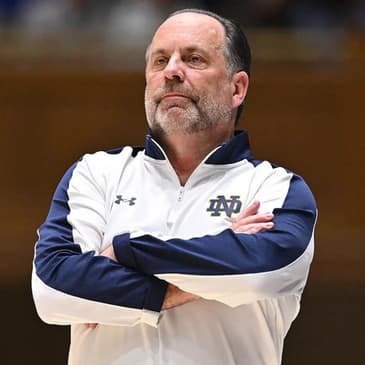
Mike Brey is currently an Assistant Coach for the Atlanta Hawks. He was the Head Coach at The University of Notre Dame from 2000-2023, where he holds the record for most wins at 483. Mike has been the National Coach of the year, amongst many other honors. He was Head Coach at Delaware University and Assistant for 8 seasons at Duke University as well as a coach underneath Morgan Wooten at Dematha.
- 5:23 Learning Under Morgan Wootten
- 6:41 The Duke Network
- 8:54 The Ability To Manage People
- 9:56 The Great Coach Quin Snyder
- 14:45 The Hinge Moment Of Turning Down Auburn
- 17:57 Developing From Being Allowed To Fail
- 21:13 The Life Changing Moment Of Roy Williams Turning Down North Carolina
- 23:25 Experiences With Notre Dame
- 25:54 Coaching For Life
- 29:58 The Ability To Trust Your Gut
- 32:02 Players With That It Factor
- 34:22 Bringing Energy As A Coach For Your Players
- 40:48 Letting Your Team Play With A Free Mind
- 44:16 Don’t Over Coach
- 46:00 All Stressful Situations In Non Stressful Environments
- 48:24 Be The Coach You Want Your Sons And Daughters To Play For
- 49:36 Changing Between A Coach And A Parent
Don’t forget you can also follow Dr. Rob Bell on Twitter or Instagram.
Follow At:
- Twitter @drrobbell
- Instagram @drrobbell
Download Your Daily Focus Road Map!
If you enjoyed this episode on Mental Toughness, please subscribe and leave a review!
Dr. Rob Bell
[00:00:09] Welcome to Mental Toughness with Dr. Rob Bell. Each week, Dr. Rob sits down with athletes, executives, and expert coaches to talk about mental toughness and their hinge moment. Here's your host, Dr. Rob.
[00:00:38] And there's no question as a coach and the leader, when you stand up in front of your group, you know, you have to show, especially in a three game, four game losing streak. And sometimes you got to dig down deep.
[00:00:51] And even sometimes you may have to fake it a little bit when you're standing up in front. You may not be the most confident, but you know you walk in a room and all eyes are on you.
[00:01:02] You better generate some stuff that, hey, we're fine. We're going to move on. We're going to bounce back. You know, I think it's always important for the leader to say, I need to do a better job.
[00:01:14] I've made some mistakes with you. Here's how we're going to attack it. But we need to be better.
[00:01:20] I've always felt that humility when you're up in front of your group asking them to do stuff. If you can point the finger at yourself and they kind of know like, well, man, coach has got us, man. He's got our back.
[00:01:32] Our guest today on the mental toughness podcast is currently assistant coach for the Atlanta Hawks. He was the head coach at the University of Notre Dame from 2000 to 2023, where he holds the record for wins at 483.
[00:01:59] He's been national coach of the year, amongst many other honors. He was head coach at Delaware University assistant for eight seasons at Duke, as well as a coach underneath Morgan Wooten at the Matha.
[00:02:12] Our coach, our guest today is coach Mike Bray. Coach, thanks so much, man, for joining us.
[00:02:17] Great to be with you, man. Look forward to sharing with you.
[00:02:23] So you attended Morgan Wooten's camp like as a 10 year old man. Pick us up from that one, because I mean, that always like spurned an interest at that point, didn't it?
[00:02:31] You know, it really did. So at 10 years old, I went to the Metropolitan Area Basketball School at St. John's High School in Washington, D.C.
[00:02:40] My first coach at 10 years old was Adrian Dantley. The Matha players were the coaches.
[00:02:48] So Adrian Dantley was my coach. But more importantly, as I spent time at that camp, I was around Morgan Wooten at a very key age, him lecturing.
[00:03:00] I was around the Dantley players and those guys were amazing role models.
[00:03:05] And it got to the point when I was 15, I told my dad, even though he was a public school teacher in Montgomery County, that I really want to go to Dantley.
[00:03:15] And I want to play for Coach Wooten and I want to give it a try.
[00:03:18] And I was so fortunate with the parents that I had to say, we want to be supportive of that.
[00:03:24] It's positive. It's good. And let's go give it a shot and go see what you're made of.
[00:03:29] That's awesome. I mean, I grew up in Maryland.
[00:03:32] And so it was always the Matha and then Dunbar.
[00:03:36] I mean, those those are the two powerhouses, man. So it was always pretty neat.
[00:03:40] Well, I hear your Maryland accent a little bit.
[00:03:43] As a matter of fact, we're both we're both coming across probably with a little Maryland twang.
[00:03:48] But you're right. You know, the Matha High School, Dunbar, D.C., that was the city championship matchup almost year after year in a sold out coal field house.
[00:04:02] And growing up in the Washington, D.C. area, as you know, it's just great basketball and you could always find competition.
[00:04:10] You could always find motivation. And I was really fortunate to be around that world and then around and be part of the Matha program as a young person.
[00:04:20] No, it's awesome. I always thought that was such a powerhouse until I moved to Indiana and then Indiana basketball by itself.
[00:04:28] Right. I mean, then 48, 49 other states, it's basketball in Indiana. It's something else.
[00:04:34] Well, you and I talked about this before we started the recording, but I did 23 years in the state of Indiana.
[00:04:41] And I learned to appreciate high school basketball in the state of Indiana, the coaching, the teaching.
[00:04:47] And every kid we recruited from Indiana through my Notre Dame time, they all knew how to play because they were well coached.
[00:04:55] Yeah, absolutely. Let's start with with with Morgan Wooten.
[00:05:00] After you were done playing, you went and then coached underneath him.
[00:05:03] I always found I mean, he had incredible poise as a coach.
[00:05:06] But what part and I always feel this is important because people nowadays like they know maybe of the name.
[00:05:14] But I think it's important to like always keep these stories going.
[00:05:17] But I always thought he had incredible poise. What can you share about throughout your experience?
[00:05:22] Well, what a blessing that I played for him.
[00:05:25] And then when I finished at George Washington University, I came back over.
[00:05:29] I taught U.S. history. I coached the JV. I was the head coach of the JV.
[00:05:35] He made it. He said, you know, if you want to be a coach, Mike, you've got to have your own team.
[00:05:39] You need to come over here with me. I'm going to give you the JV. You're going to work with me.
[00:05:44] But the poise part of it was maybe one of the biggest things I've stolen from him in my time with him.
[00:05:52] And he was always very even keeled. He was the ultimate educator, teacher, positive reinforcement.
[00:06:01] The phrase that I started using at the end of my tenure at Notre Dame with my staff is be a confidence giver, being a confidence giver.
[00:06:10] And so to be with Coach Wooten then in my early years as a coach was just extremely powerful working alongside him.
[00:06:23] You went to obviously, I mean, then all the schools that are coming there just to recruit as well.
[00:06:30] And then you went to Duke University with Coach K. You're there for eight seasons.
[00:06:35] Now, just a side note before we get into it. I was a big Robert Bricky fan back in the day.
[00:06:40] Oh, I mean, I know you don't hear that a lot, but I love watching Robert Bricky play.
[00:06:45] There's a name from the past. And, you know, certainly here with the Atlanta Hawks, I have Quinn Snyder, who I coached, and Tony Lang, who I coached.
[00:06:55] And Grant Hill is a part owner. So we have a lot of Duke stories flowing.
[00:07:00] But Robert Bricky was one of the true, you know, amazingly athletic players.
[00:07:07] Fayetteville High School or Fayetteville, North Carolina came up the road from Fayetteville.
[00:07:12] And some of the dunks that he had over the top of people are quite memorable.
[00:07:19] But you mentioned I was so lucky.
[00:07:22] I've created a network and Coach Wooten sold this.
[00:07:25] He said, if you want to go back to college, come with me because everyone's going to come through to recruit our players.
[00:07:31] And you're going to get to meet all of them.
[00:07:33] Lefty Drizelle was at Maryland at the time.
[00:07:35] Terry Holland at Virginia.
[00:07:37] Dean Smith at North Carolina.
[00:07:38] Certainly Mike Krzyzewski at Duke.
[00:07:41] Bobby Kremins.
[00:07:42] And so I developed a relationship more so with the young assistants who were on the road recruiting.
[00:07:49] And then when Mike Krzyzewski had an opening, fortunately, I think he wanted someone who was going to be with him a while and not just making a pit stop to be a head coach.
[00:08:01] I needed time.
[00:08:02] And I came there with Bob Bender, who was the top assistant at the time.
[00:08:07] And he really taught me the business.
[00:08:10] And I was fortunate enough to be with Mike K for eight years.
[00:08:15] And we went to six Final Fours, which is just not reality when I think back.
[00:08:21] I mean, you definitely got spoiled during that time for sure, man.
[00:08:24] No question.
[00:08:25] But I mean, when you look back, though, I mean, so many questions I kind of want to ask on that one.
[00:08:31] But it's I mean, I just felt like those Duke, you know, from the Danny Ferry time up and through, you know, when Bobby Hurley was there, even even thereafter.
[00:08:41] But I mean, you I mean, that was just a dynasty in terms of what was built and and what took place.
[00:08:48] What stands out to you?
[00:08:50] Like when you reflect on that time, what really stood out?
[00:08:54] You know, the again, I got to I got to be with Morgan Wooten and then I got to be with Mike Krzyzewski.
[00:09:00] And one of the things I thought Mike K's greatest strength is handling people, managing people and and and getting a group to chase a common goal over the course of a basketball season, which is five months and handling individual and team psyche.
[00:09:19] He was much more into where are we at mentally?
[00:09:25] Who needs to be challenged?
[00:09:27] Who needs to be hugged instead of how do we attack the zone defense?
[00:09:32] And I thought that was his greatest strength.
[00:09:34] And it was something certainly I learned a lot about before I became head coach at Delaware.
[00:09:43] Did during that time, did did Quinn Snyder stand out to you like knowing you're coaching him at that time?
[00:09:50] When what stood out to him at that time is like, wow, this this guy's a little bit different in terms of how he approaches things.
[00:09:56] Yeah, I got to I got to Duke when Quinn was a junior.
[00:09:59] He and Danny Ferry were roommates and still extremely close.
[00:10:03] As a matter of fact, Danny's here in Atlanta.
[00:10:04] So we catch up a lot.
[00:10:07] But Quinn was maybe and I've been in I was in college coaching for 35, 40 years.
[00:10:14] The best leader I've ever been around.
[00:10:17] And it was interesting because he was moved to point guard his junior year, even though it wasn't natural position.
[00:10:23] And there were some challenges with that.
[00:10:26] But the one thing he never lost was his voice, his leadership.
[00:10:32] He ran the locker room.
[00:10:34] He ran the team.
[00:10:35] He roomed with the best player and the player of the year, Danny Ferry.
[00:10:40] And he knew how to handle him.
[00:10:42] Quinn Snyder was one of those leaders as a head coach.
[00:10:46] He handled a lot of stuff you didn't even know about because he just handled stuff.
[00:10:52] And I just thought he was an amazing voice.
[00:10:55] And then as I followed him and in the interesting dynamic and timing, I left to take the Delaware job.
[00:11:02] Quinn replaced me as an assistant.
[00:11:04] He took the job in the opening there.
[00:11:06] And the rest is history.
[00:11:08] We've stayed in touch.
[00:11:09] And it's very neat now to be back working with him.
[00:11:12] 40 years later, we're back working together.
[00:11:15] And we probably would say, if you talk to us, we say, you know, I don't think we've changed much.
[00:11:22] We're telling the same stories.
[00:11:23] We have the same sense of humor.
[00:11:25] But just the utmost respect for Quinn as far as leadership.
[00:11:29] Brilliant mind.
[00:11:31] But a big heart and the ability, the really big ability to be able to connect with people and players.
[00:11:40] So one of the best leaders in all your years.
[00:11:44] I mean, that is a, I mean, it's got to be the best compliment you've probably ever given somebody.
[00:11:49] You know, at one of the, and I'm still trying to get the video because I want to show it to our coaching staff here at Atlanta.
[00:11:55] One of the things that Mike Krzyzewski did, and I stole it when I went to Delaware and Notre Dame, at the banquet, the seniors spoke.
[00:12:03] You didn't bring a guest speaker in.
[00:12:05] Your seniors spoke.
[00:12:06] Quinn Snyder went for 45 minutes in 1989.
[00:12:10] It's burned in my mind.
[00:12:12] There was not a dry eye in the house.
[00:12:14] He got emotional and he talked from his heart about what the program meant to him.
[00:12:19] And it was eloquent and passionate and heartfelt.
[00:12:24] And I walked out that night, I was like, unbelievable.
[00:12:28] And, you know, as a 22-year-old college senior.
[00:12:32] So there was always, always something very special about him.
[00:12:37] People gravitated to him.
[00:12:39] Everybody wanted to hang with him.
[00:12:42] And so he is now the ringleader here with all of us in Atlanta.
[00:12:48] I love it.
[00:12:48] Thank you for sharing that, Coach.
[00:12:51] Another side point that just came to mind.
[00:12:53] Were you still there when Joe Smith came and played?
[00:12:56] Oh, I can remember Joe Smith tipping one in at the buzzer at Cameron.
[00:13:00] So this is where I said true success means you have to root for everybody.
[00:13:06] Because, again, being a Maryland fan, like you didn't, Duke fans didn't root for other players.
[00:13:12] But I remember that game and they actually clapped for him.
[00:13:15] They actually, like, appreciated what kind of game that he had.
[00:13:19] And they cheered for him and said, that is true success, being able to root for somebody else.
[00:13:23] Well, you and I have another thing in common.
[00:13:26] You know, I'm a diehard Maryland basketball fan.
[00:13:29] Went to Leftery Gisele's camp growing up in Rockville, Maryland.
[00:13:32] Watching John Lucas, Mo Howard, and Brad Davis, the three-guard offense that was so famous back in the 70s.
[00:13:39] But if you remember in that game, Billy Hawn was coaching because Gary had pneumonia.
[00:13:46] And Pete Daudet was coaching because Mike Kaye was ill.
[00:13:50] The two assistants were running it.
[00:13:52] And Joe Smith tipped in at the buzzer after having an amazing game.
[00:13:56] And you're right.
[00:13:57] As I think back now, I think, like, the Duke fans almost were, like, the tip of the cap in golf.
[00:14:03] Like, okay, man, you were unbelievable tonight.
[00:14:06] It was, like, 28-17 rebounds, five block shots.
[00:14:11] But those Maryland teams, obviously, with Joe were certainly in Keith Booth and Johnny Rhodes and Dwayne Simpkins, former DeMatha product.
[00:14:22] You know, those were great Maryland teams.
[00:14:24] Yeah, absolutely.
[00:14:25] I appreciate you sharing that one, Coach.
[00:14:27] Well, let's talk about you moving forward.
[00:14:32] You took at kind of a hinge moment.
[00:14:36] You turned down the Auburn job and you took the Delaware job.
[00:14:40] So it's always, like, you know, how did you know, like, in your gut, hey, this is going to be a better fit?
[00:14:45] You know, it was interesting.
[00:14:46] We were on a run in the NCAA tournament and actually played against the Big Dog in Purdue in Knoxville, Tennessee, in the regional and beat them to get to the Final Four.
[00:14:56] And in the meantime, I was involved with the Auburn job, SEC job.
[00:15:00] I'm an assistant coach.
[00:15:02] You know, it kind of blows your mind a little bit.
[00:15:04] And I just probably could never get comfortable with that being a great fit.
[00:15:09] And in our profession, in this coaching profession, strategic moves are probably a key or your coaching career can end or you're going to go backwards.
[00:15:19] And I decided I didn't think it was a great fit.
[00:15:23] I did not move forward with it.
[00:15:25] I think they did hire the right person.
[00:15:27] They hired Cliff Ellis, who had just left Clemson, and he was a perfect fit for Auburn.
[00:15:32] So I go back to Duke, and I go another year, and then I take the Delaware job.
[00:15:38] And for a while in the profession, people were, that is the dumbest move I've ever seen, Mike.
[00:15:43] You turn down an SEC job to go to Delaware.
[00:15:47] But I thought at Delaware, it was in my region, the Mid-Atlantic.
[00:15:50] I had contacts.
[00:15:52] I knew where I could go to get players.
[00:15:54] But it also was a place where I knew I was going to make a lot of mistakes.
[00:15:59] But I was making them in front of maybe 2,000 people instead of on ESPN at Auburn.
[00:16:06] And it turned out to be kind of the right move.
[00:16:11] And I got to Delaware at a great time with great support.
[00:16:14] And then we recruited the heck out of D.C., Baltimore, New Jersey, and Philly.
[00:16:18] Right.
[00:16:19] Yeah, absolutely.
[00:16:19] And Jay Wright wasn't there yet, so we weren't competing against him.
[00:16:23] Yeah.
[00:16:24] So just John Chaney?
[00:16:25] No, he was not at Villanova, but Jay was at Hofstra.
[00:16:28] Oh, okay, yeah.
[00:16:28] So we were in the America East together.
[00:16:31] And so we were banging heads there at the end.
[00:16:35] And we had won it two years in a row.
[00:16:37] And then we went to the third championship game.
[00:16:40] And who knocked us out?
[00:16:41] Jay Wright, Speedy Claxton, and Hofstra.
[00:16:43] And then I said, it's time to go.
[00:16:45] I'm going to Notre Dame.
[00:16:46] Right, right.
[00:16:48] We, you know, in college, and then we used to go to Dewey Beach all the time.
[00:16:53] Oh.
[00:16:53] You know.
[00:16:54] So we don't need to tell any of those stories.
[00:16:57] But those are some fun times.
[00:17:00] Well, you know, I had a place in Rehoboth for a long time.
[00:17:03] I just couldn't get back to it enough when I was living in South Bend, Indiana.
[00:17:07] But being at the University of Delaware and certainly being a D.C. Maryland guy, Rehoboth, Dewey, Bethany are fun spots.
[00:17:16] I still get back a bunch and see that gang there.
[00:17:21] And you can't go to Dewey without going to the Starbird and seeing Monty.
[00:17:27] That's right.
[00:17:28] That's right.
[00:17:29] That's hilarious.
[00:17:30] I love it, Coach.
[00:17:33] Before we get to Notre Dame and that hinge moment, talk to us about you're at Delaware.
[00:17:40] You're allowed to fail.
[00:17:43] And what I mean by that is kind of what you alluded to, right?
[00:17:45] I mean, it's not on ESPN.
[00:17:47] There's not so much.
[00:17:48] I mean, obviously, there's pressure, but you're allowed to fail.
[00:17:51] Can you just talk to us about, like, how much of that development do you think was important?
[00:17:56] I think it was really a key.
[00:17:58] You know, I had been a head coach, but only at the JV level at DeMatha.
[00:18:07] But as Coach Wooten said, he was prophetic.
[00:18:10] It helped me because I had my own team and I had to write the practice plan.
[00:18:16] And I had to handle the 15 young men that I had.
[00:18:18] And all of that was really helpful a little bit as I went to Delaware.
[00:18:24] But, you know, you can say you think you're ready.
[00:18:28] But when you slide over, you know, into that head coaching seat and what comes with it
[00:18:33] and the responsibility with it there, it is stressful.
[00:18:38] It takes a lot of energy.
[00:18:41] And I guess my biggest thing was try to take it day to day.
[00:18:46] I had some great advice from Mike Krzyzewski and Morgan Wooten.
[00:18:49] They were great mentors still as I was, you know, learning how to be a head coach.
[00:18:55] Pacing yourself, being positive, being yourself, you know, being yourself, establishing your identity.
[00:19:03] I had two very strong mentors that had their own identity.
[00:19:07] Who was I going to be as I became a head coach?
[00:19:11] But our first two years, we were about 500.
[00:19:14] And now you're getting into year three.
[00:19:17] And in the coaching profession in year three, they're kind of like, well, are we going to make a run here?
[00:19:22] Can we get to the NCAA tournament?
[00:19:25] Or, you know, and fortunately, we won the America East in year three with two DeMatha kids.
[00:19:32] Mike Pagese was a great low post player for us.
[00:19:38] And, you know, that and we kind of went on from there.
[00:19:43] So, but it was a learning experience.
[00:19:45] I got more confident.
[00:19:47] I learned to delegate better as I became a more experienced head coach.
[00:19:53] I think if I look back, I tried to do everything.
[00:19:56] My first couple of years, I wasn't as secure to delegate to staff.
[00:20:03] And I think that's, I tell a lot of young head coaches, learn to delegate.
[00:20:09] Learn, you got to back off it because you can't do everything.
[00:20:12] You need some help.
[00:20:13] Hey, good looking.
[00:20:31] If you like this podcast and are already a badass, but it's all way too complicated,
[00:20:37] then visit our website, drrobbell.com and schedule a call with us to help capture your very own hinge moment.
[00:21:02] You're at the beach house July 7th and you pick up the paper about Roy Williams turned down the North Carolina job.
[00:21:11] Could you pick us up from there, coach?
[00:21:12] Oh man, that's one of the great memories.
[00:21:14] What was that?
[00:21:15] About 25 years ago.
[00:21:18] So it's, it's interesting because the year before in 1999, I had just finished year four at Delaware.
[00:21:26] We had won the league in year three and four.
[00:21:29] We were rolling.
[00:21:30] We had a good group back.
[00:21:31] We had momentum.
[00:21:33] It was, it was a good run.
[00:21:35] I interviewed for the Georgia job and the Notre Dame job in 1999.
[00:21:40] Matt Doherty got the Notre Dame job.
[00:21:42] Um, I turned down the Georgia job because I thought Notre Dame would be a better fit.
[00:21:48] And I waited and Georgia moved on and hired Jim Harrier.
[00:21:52] So I'm back at Delaware and, and I had a good team and I'm like, okay, well, we'll go back.
[00:21:58] And never did you think Notre Dame would open again?
[00:22:00] Cause Matt Doherty was a young coach coming from Kansas as an assistant.
[00:22:04] And then all of a sudden Roy Williams in the summer, a year later says he doesn't want to go back to North Carolina.
[00:22:11] There's only one guy in the family that's ready to do it.
[00:22:14] They bring Matt back.
[00:22:16] And all of a sudden a year later, I'm back in the mix at Notre Dame.
[00:22:20] There's a whole new, there's a new AD, there's a new and end up getting the job in the middle of July.
[00:22:26] It moves so fast.
[00:22:28] And then was able to spend 23 years there.
[00:22:31] So it is amazing in our business when the dominoes start to fall in the coaching profession, how it, it can affect everybody.
[00:22:40] And, uh, I always would tell Roy, Hey man, thanks for turning the Carolina job down.
[00:22:45] Cause Matt left and I was able to slide to Notre Dame.
[00:22:49] Yeah, no, I love it coach.
[00:22:50] These, uh, these hinge moments with, um, I want to talk about your experience at Notre Dame and then things that you have found out.
[00:23:00] Throughout the years.
[00:23:01] Um, could you set this for us?
[00:23:04] Cause I always felt, uh, Lou holds had the best quote about Notre Dame.
[00:23:09] And that was, if you, if you haven't been there, then no explanation can suffice.
[00:23:15] But if you have been there, then no explanation is necessary.
[00:23:17] Can you just talk about like just the overall, uh, you know, pageantry that in, in type of athletes and experience of Notre Dame?
[00:23:25] Well, I, as I tell people, it was the honor of my lifetime to be the head coach there for 23 years to be part.
[00:23:33] And I was, you know, you can't be successful there unless you're a believer in the mission.
[00:23:39] And the one thing about Notre Dame, even through the midst of all the different things that have gone on in college athletics.
[00:23:45] And there's certainly a lot going on now.
[00:23:48] Um, it was about a young person getting a degree priorities in line.
[00:23:55] Certainly there was pressure to win and be successful, but there were some things that at Notre Dame that were non-negotiable.
[00:24:02] You weren't going to change it.
[00:24:04] You ain't needed to understand this is how we do business.
[00:24:07] And, and I embraced it.
[00:24:09] I loved it.
[00:24:10] And I thought what it did was it earmarked a clientele, meaning prospects, recruits that were really motivated, special young men that knew what they were getting into.
[00:24:24] Yeah.
[00:24:24] I mean, I didn't trick anybody into coming to Notre Dame.
[00:24:27] I would say, look, school's hard.
[00:24:28] School's going to be really hard here.
[00:24:30] Um, but you know, that degree and that investment is really more of a 40 year investment.
[00:24:37] If you become a Notre Dame grad, not four.
[00:24:40] Um, and so I was looking back, uh, uh, this past summer, I had, I've had 78 guys in 23 years come through play for me and get their degree.
[00:24:51] That's a lot of sons out there.
[00:24:53] I mean, now I'm going to Johnny Mooney's wedding this summer.
[00:24:56] I'm seeing these guys, their children, Torrey Jackson in Detroit the other night.
[00:25:01] He's a high school coach.
[00:25:02] I'm with his, him and his family.
[00:25:04] I mean, that's what it was all about.
[00:25:06] So, uh, that's a lot of weddings coach.
[00:25:08] That's a lot of weddings.
[00:25:10] I've been to, been to a lot of them and, and, uh, but it was an amazingly special place.
[00:25:15] And I was so honored to, to, to be part of it for 23 years.
[00:25:21] I've had a coach that said, um, you know, you're not coaching them for four years and you've kind of alluded to it.
[00:25:27] I mean, you're coaching them for life.
[00:25:29] And the real success comes when you are going to be a guest at their wedding, when you see them develop.
[00:25:33] Um, could you just share with us in terms of the coaching piece and the relationship that you would build with players?
[00:25:42] Because you, it wasn't one and done players that were coming there.
[00:25:45] They stayed for all four years and graduated and, but talk to us about that relationship, how that developed in, in the true success of coaching.
[00:25:54] You know, I, I think the thing that's, um, I think it was Morgan Wooten who said, you know, they're not going to remember, you know, you young people.
[00:26:02] They don't necessarily remember their teachers, but they'll never forget their coach.
[00:26:08] And, you know, those 78 young men that have come through still to this day, I'll get one or two calls a week.
[00:26:17] One is a celebratory call.
[00:26:19] I'm getting married.
[00:26:20] And, and many times I'll get a call where a young man is in crisis.
[00:26:24] And now all of a sudden he's 35 years old.
[00:26:27] He played for me 20 years ago, but that's the relationship.
[00:26:31] And, and, and I, I, I hope they feel, I think they do.
[00:26:35] Um, you know, that I'm here for a man.
[00:26:38] And that was part of the recruiting process.
[00:26:40] And I think they felt when they played for me, you know, you, you, you really got to know them and cared about them.
[00:26:46] And so, you know, to, to be invited to their weddings, you know, to be, uh, to see them, to get text messages.
[00:26:53] Last night, we beat Boston in a great game.
[00:26:56] I must've had, you know, eight of my guys texted me like, yo coach, what a great road win, man.
[00:27:01] You know, so that's what it's all about as an educator and a teacher and a coach is, is the relationships.
[00:27:08] And when they come back and they say, God, coach, I preach.
[00:27:12] Remember the time, how many times does it happen when, when, when you're a teacher and you're in education and a student, a former student will come back and go, God, remember that time you told me.
[00:27:23] And, and you don't remember it, but you, you, you know, you've had so many, but it, the impact you had at that moment was, and I think, I love your phrase, hinge moments.
[00:27:35] I'm going to steal that.
[00:27:36] I think, uh, I, I like it.
[00:27:39] And, and, you know, that, that's what, that's what being an educator is all about.
[00:27:42] And I think it helped me that I started as a high school educator, uh, and you develop those relationships, uh, and, and they feel free to always connect with you.
[00:27:54] Absolutely.
[00:27:55] I always say hinge moments because every, every door has a hinge.
[00:27:59] Yeah.
[00:27:59] And a door with that hinge of the wall just doesn't work.
[00:28:02] I love it.
[00:28:03] I'm, I'm going to, you're going to see that come up again.
[00:28:06] I'm going to use that.
[00:28:07] I like it.
[00:28:08] Well, I'm going to send you the book then too.
[00:28:10] Please, please.
[00:28:11] Please.
[00:28:12] The, um, the, the reason why that came up coach about the hinge is always, always fascinated by John Wooden and how he was going to take the job at Minnesota.
[00:28:23] And I'm sure you know that story, right?
[00:28:25] Like, right.
[00:28:26] Great story.
[00:28:27] Take that job story.
[00:28:28] And then they're going to turn down this coach, uh, this school from the West coast and Minnesota didn't call UCLA calls.
[00:28:36] He accepts it.
[00:28:37] And it's like, coach, I'm so sorry.
[00:28:38] There was a snowstorm that was here.
[00:28:40] Our university official couldn't get to it.
[00:28:42] We still want you to be the head coach of Minnesota.
[00:28:44] And they backed out and then everything was different.
[00:28:47] And it's like, if I go to Auburn, uh, I, I don't think I would have been successful.
[00:28:53] Uh, and luckily I dodged a bullet.
[00:28:56] I didn't get, you know, uh, blindsided by SEC job or money.
[00:29:02] Cause I don't think I would have made it long-term.
[00:29:05] Delaware was more of a long-term move.
[00:29:07] And then I, you know, not going to Georgia and maybe not going to Vanderbilt when, when you had some offers when I was at Delaware and Notre Dame being, that's the one.
[00:29:17] And so those, uh, you know, luckily those hinges were well oiled and they worked real good when, when those moments came, but it's, it is so fragile at those crossroads.
[00:29:29] There's no question.
[00:29:31] So coach, one of the pieces I'll definitely talk about in order for the hinge to connect is you have to be able to trust your gut.
[00:29:37] Um, when it comes to coaching and that, I mean, especially now, but even, I mean, if you can kind of reflect, cause there's so much analytics that are now like, give us an example.
[00:29:46] How well, cause you even spoke to it.
[00:29:48] You have to be yourself when you are a coach.
[00:29:51] How well did you do that?
[00:29:53] Being able to just trust your gut and allow situations unfold being patient.
[00:29:58] Well, you know, the interesting thing you talk about, you mentioned analytics and in this league, as I found in a short tenure here, a year and a half in the NBA.
[00:30:07] Oh my God.
[00:30:09] Are there numbers being thrown around an event?
[00:30:11] And, and I've had to back off and even tech talk to some of the young staff and say, why don't we push that aside?
[00:30:19] And what do we feel?
[00:30:21] What are we seeing?
[00:30:22] You know, what are we, and, and, and I, and even at my, at my years at Notre Dame, at the end, analytics.
[00:30:27] Certainly was big into college basketball.
[00:30:30] But I think, you know, you, you always have to have the gut feel and the confidence to whether it's in a coaching move, whether it's in recruiting.
[00:30:41] I think that's the kid we should offer, not that kid.
[00:30:45] And, and, and luckily at Notre Dame, we got that right most of the time, but we're not undefeated.
[00:30:50] Made some mistakes there too.
[00:30:52] And then you go back and go, why did we, why did we fumble that one?
[00:30:57] And, and, but I think your gut instinct, your, your feel for people, you know, your feel for things.
[00:31:05] I, I, that, that you have to have confidence in your gut.
[00:31:09] If you're looking at numbers and, and, and, and you're listening maybe too much to the outside stuff, eventually, man, you gotta, what, what, what's it feel like?
[00:31:21] And, and, and I was fortunate enough that, you know, I, I think the two guys that I came under, Morgan Wooten and Mike Krzyzewski were great gut feel people, relationship feel people.
[00:31:35] They, they developed deep relationships.
[00:31:37] So they had a feel for where people were at all the time.
[00:31:42] Yeah.
[00:31:44] In terms of mental toughness, what were some of the characteristics that you saw from, from athletes?
[00:31:50] And it could have been some of your athletes or just athletes in general.
[00:31:53] What were a couple of those things that stood out to you in terms of this, they, they kind of had that it factor.
[00:32:02] You know, the, you know, you look at it and, and, and mental toughness is talked about so much in, in sport now.
[00:32:08] Right.
[00:32:08] And, and, uh, um, you know, the ability to bounce back after disappointment, maybe one of the things that I thought was so cool about us beating the Celtics last night was we blew an 18 point lead against the bulls on Saturday night.
[00:32:23] And felt like dogs for, you know, 48 hours.
[00:32:26] And for this group to go into Boston and then kind of bounce back and do it, I think it was a great moment of growth, uh, uh, for us.
[00:32:37] Um, you know, the, the ability, the ability, what, what is, I'm a big body language, language reader guy, you know, can, you know, what, what is, uh, what is a young person's body language after a mistake?
[00:32:50] Uh, after a missed shot, uh, being taken out of the game and, and how do they move on and, and, and get onto the next play?
[00:32:58] Uh, uh, so to speak.
[00:33:00] And, and there's no question as a coach and the leader, when you stand up in front of your group, you know, you have to show, especially in a three game, four game losing streak.
[00:33:11] And sometimes you got to dig down deep and, and, and even sometimes you may have to fake it a little bit when you're standing up in front, you may not be the most confident, but you know, you walk in the room and all eyes are on you.
[00:33:25] You better generate some stuff that, Hey, we're fine.
[00:33:29] We're going to move on.
[00:33:31] We're going to bounce back.
[00:33:32] You know, I think it's always important for the leader to say, I need to do a better job.
[00:33:37] I've, I've made some mistakes with you.
[00:33:39] Here's how we're going to attack it, but we need to be better.
[00:33:42] I've always felt that humility when you're up in front of your group, asking them to do stuff.
[00:33:48] If you can point the finger at yourself and they kind of know like, well, man, coach has got us, man.
[00:33:54] He's got our back.
[00:33:56] Absolutely.
[00:33:57] Thank you for that coach.
[00:33:58] Did, um, real specific when it comes to practice.
[00:34:03] Practice.
[00:34:04] And when you were in the middle of the season and the energy, when it comes to practice,
[00:34:08] what were the, some of the things you did that, because we always, I mean, we'll always talk
[00:34:11] about the importance of that, having your players bring it, of course, but what were some of the
[00:34:16] things you noticed about, uh, when energy would kind of lag and how were you able to bring that back
[00:34:21] up?
[00:34:22] I think, you know, one of the things I became very mindful of quickly is in a college coaching
[00:34:27] job, your guys are in class until three or four o'clock.
[00:34:31] A lot of times you practice in the afternoon.
[00:34:34] Some teams now are practicing in the morning, but well, you're doing a lot during the day
[00:34:38] as the head coach.
[00:34:39] A lot of times you're putting out some fires, academics, raising money, staff meeting.
[00:34:44] I always felt like I've got to be really good three to five.
[00:34:49] And I may not have all the best juice today.
[00:34:52] Didn't sleep good.
[00:34:53] Maybe we lost a couple, whatever.
[00:34:55] I'm not feeling great.
[00:34:56] Got the flu.
[00:34:57] But I'll tell you what, when, when I walk into that with my whistle on and they turned
[00:35:02] ahead and here he comes, they better see some juice and some positivity and some energy
[00:35:09] and you're bumping guys up and, and you can pass out at five o'clock after they leave,
[00:35:14] you know, you can go, you know, pass out then.
[00:35:16] But I think it's all generated from the leader.
[00:35:20] There's no question about it.
[00:35:21] So I was always mindful of my demeanor, how I came across in that practice session, which
[00:35:28] was so important.
[00:35:29] There are things that, you know, some teaching techniques that we discovered.
[00:35:33] I love, you know, getting a group to talk sometimes and communicate is a big hurdle.
[00:35:39] Maybe the first hurdle you want to climb.
[00:35:41] Will a team talk to each other on the defensive end, on the offensive end?
[00:35:45] Will a guy pump a guy up when somebody makes a mistake and, and, and, and that type
[00:35:50] of thing.
[00:35:51] Sometimes I would go through the first 15, 20 minutes of practice.
[00:35:54] And I told the staff, don't say anything.
[00:35:57] I want them to generate the talk.
[00:36:00] And some days it was popping and they're kind of having ownership of it and, and, and talking.
[00:36:07] And there are other days where you're like, wow, there's a problem.
[00:36:09] And you may have to stop and address it.
[00:36:11] But, um, you know, it's, I think, I think when, when you can get a group to take ownership
[00:36:18] of itself, man, is that so powerful.
[00:36:21] And I think back to my best groups at Notre Dame, there was an ownership from the leadership.
[00:36:28] Not to get too far ahead, but, um, I mean, the, the, the teams with Jerry and Grant and
[00:36:34] Pat Connaughton, were these the teams you referred to?
[00:36:37] And there's the greatest example, doc.
[00:36:40] Great.
[00:36:40] No question.
[00:36:41] Go ahead.
[00:36:42] I did.
[00:36:43] I just want to know that I want you to know that I did my research and of course I was
[00:36:46] always following it.
[00:36:47] And you did pay attention to those teams.
[00:36:49] Yes.
[00:36:50] They were a fun group, ACC champions in 2015 and the elite eight, but Pat Connaughton and
[00:36:56] Jaron Grant ran that group.
[00:37:00] They ran the locker room.
[00:37:01] I tell, I tell coaches, I say, let me ask you something.
[00:37:04] Who's selling your stuff when you ain't around?
[00:37:07] Who's selling my stuff when I ain't around Pat Connaughton and Jaron Grant.
[00:37:12] Ben Hansborough did back in 2011, Luke Herring-Gody did to 2008.
[00:37:17] You know, you can go through it and who, who, you know, with the Hawks right now, we're
[00:37:22] kind of nurturing that a little bit.
[00:37:24] A guy like Larry Nance senior who, or a junior who had a great game last night, a veteran
[00:37:30] new to us.
[00:37:31] Oh, a needed voice, a needed voice and, and selling the message when Quinn's not talking
[00:37:38] really powerful stuff.
[00:37:40] So, but when they take ownership and they feel they own it, man, I think you're more
[00:37:46] than 70% of the way there.
[00:37:49] That's what we always talk about.
[00:37:52] Cause I hate the word buy-in.
[00:37:54] I'm just not a fan of it, coach.
[00:37:55] I like ownership because buy-in means I'm having some people buy, you know, buy into my vision
[00:38:00] that you have.
[00:38:01] I want you to take ownership.
[00:38:02] Like when you own a house, it's a lot different than renting.
[00:38:05] It's a great way of putting it.
[00:38:07] For example, I was telling some of the young staff and, you know, here at Atlanta, they
[00:38:12] were asking about my Notre Dame teams.
[00:38:14] And I say, you know, when you have a Jaron Grant and Pat Connaughton, there were days
[00:38:18] I would see them early in the afternoon and go, Hey, what do you think we should do in
[00:38:22] practice today?
[00:38:23] Well, coach, I think we need to hit these three things.
[00:38:26] Done.
[00:38:28] Done.
[00:38:28] We got it.
[00:38:29] You own it.
[00:38:29] And so, you know, I think it was always being reinforced that this is your team, man.
[00:38:35] Tell me what we need to work on.
[00:38:37] Let me help you.
[00:38:38] And, and so, uh, but ownership over buy-in that's, that's a, that's a key.
[00:38:44] That's a better phrase.
[00:38:46] Totally agree, doc.
[00:38:47] Uh, I knew last year we won the state championship in Indiana with Fisher's basketball.
[00:38:53] And, uh, you know, there were a couple of factors that went into it.
[00:38:55] One Garrett Weininger, just incredible coach, but there was an issue with the player at three
[00:39:00] o'clock one day and all the coaches then were in there and the leader of the team,
[00:39:07] Keenan Gardner is now playing D one basketball said, and didn't really even say anything,
[00:39:13] but just ran through everything and then started doing practice.
[00:39:15] And I kind of pulled him aside later.
[00:39:17] It was about 30 minutes.
[00:39:19] And I said, this is your team.
[00:39:21] You know, it's your team, but I said that what you did there, I said, that was special.
[00:39:25] Can you lead when coaches aren't around and when people aren't watching?
[00:39:29] Uh, there there's the greatest example of it.
[00:39:31] And then you had to feel good.
[00:39:33] And by the way, the Fisher's program is one of the most respected programs in the state
[00:39:38] of Indiana.
[00:39:38] I know that for sure firsthand.
[00:39:40] And, uh, but you're, you know, actually the, the moments I get goosebumps are not when you
[00:39:47] think back of the buzzer going off in the ACC championship.
[00:39:51] Yeah, those are great.
[00:39:52] Don't get me wrong.
[00:39:53] But when you see that leadership or ownership and a young man steps up and speaks or in the
[00:40:01] midst of a meeting goes, coach, could I interrupt?
[00:40:03] I'd like to add.
[00:40:05] And you go, yeah, we got a chance, man.
[00:40:08] We got a chance.
[00:40:10] Want to listen to your favorite music, but you're sick of all the commercial interruptions
[00:40:14] and negative news today?
[00:40:16] Tune into KUKORadio.com.
[00:40:19] Music for your mindset.
[00:40:21] We're a commercial-free online radio station.
[00:40:24] Play nothing but hits.
[00:40:25] Our free iOS and Android apps are available for download at KUKORadio.com.
[00:40:32] No, I love that.
[00:40:34] Um, one more basketball thing, coach.
[00:40:37] It always seemed like, especially at Notre Dame, that you let, it always seemed like
[00:40:41] you let your offenses, I mean, they were always freed up.
[00:40:45] Is that, that was one of your philosophies when, when you were coaching?
[00:40:48] Really was.
[00:40:49] You know, I, I think I evolved into that at Delaware.
[00:40:51] Jay Billis, I thought, and I took it as the ultimate compliment.
[00:40:55] I used it in recruiting.
[00:40:56] He said, man, your guys play with a free mind.
[00:40:59] And, and I, and I, we, we recruited skilled offensive kids, kids that knew how to play.
[00:41:04] We were all pretty good at shooting it.
[00:41:06] We really banged the drum on assist to turnover.
[00:41:09] The ball is gold.
[00:41:10] We want to take care of it.
[00:41:12] You'll love this.
[00:41:13] Finally, my last couple of years, I had a sign up in the locker room.
[00:41:16] I tried to, you know, you, you simplify your philosophy.
[00:41:20] And, and my philosophy was, there was a picture of me and it said, don't skip class.
[00:41:25] Don't throw the ball away.
[00:41:27] You and I will get along just fine.
[00:41:29] Period.
[00:41:30] That was it.
[00:41:30] That's all.
[00:41:31] That was my first team meeting, you know, and, and, and keeping it simple.
[00:41:36] But we, we did.
[00:41:38] I think you wanted guys to play with a free mind.
[00:41:42] I remember Scott Martin from Valpo, who I got on a transfer from Purdue.
[00:41:47] He told me one time when he was on my staff, he said, coach, when I got to you, you told me, he said, don't you even look at the bench when you're playing.
[00:41:55] If you look at me, I'm going to be pissed off.
[00:41:57] You just play.
[00:41:58] He goes, God, man, I needed that coach.
[00:42:00] You just.
[00:42:01] So, you know, you, you, you wanted guys to play and be free and be confident.
[00:42:06] And, and I, and I, it was neat to hear that, you know, guys felt that way.
[00:42:11] And, you know, if you miss three shots, you weren't afraid to take the next one.
[00:42:14] I told Chris one once my first recruit at Notre Dame.
[00:42:18] Now the top assistant with Miami heat, because he was almost overly fundamental as an Ohio kid.
[00:42:26] You know, everything was almost, I told him one day, I said, you know, Chris, if you don't take a bad shot in the first five minutes of practice, I'm going to throw you out.
[00:42:35] And he looked at me like, what?
[00:42:37] I said, loosen up my man, take a fade away a little bit.
[00:42:41] I need you going for it.
[00:42:42] And, and so, you know, I, we, we did have a, a little bit of a swagger offensively.
[00:42:49] And we wanted guys a phrase I would say was let, let it rip, man.
[00:42:53] Let's let it rip.
[00:42:54] Yep.
[00:42:55] I look now at a lot of kids playing and if they're looking in the stands at their parents, it's just happened so often, man.
[00:43:03] It really does.
[00:43:04] Doc, it's, it's, you know, at my last couple summers in recruiting and I know the parents feel the pressure because the coaches are there and are they going to get an offer and where are they ranked and, you know, all those things.
[00:43:17] But, and, and it, it, I'll, even at Notre Dame.
[00:43:22] So we used to, if you remember timeouts, we would move the chair out and we would put, a lot of people were putting the stools, but the kids were facing the stands.
[00:43:32] And my back was to the stands.
[00:43:34] Well, their parents were back there.
[00:43:35] And I would be talking to the five starters and I would see their eyes.
[00:43:41] They're looking above me.
[00:43:42] They're not looking at me.
[00:43:43] And they're looking at, and they'd be like, oh, sorry.
[00:43:46] And I'm like, we flipped it.
[00:43:48] I said, uh-uh, uh-uh, uh-uh.
[00:43:49] No way.
[00:43:50] Flip it.
[00:43:50] I want them on the bench, old school, looking at me.
[00:43:53] I'm sitting with my back to the court because of that right there.
[00:43:57] It is a factor in this generation.
[00:44:00] It's part of the equation and you better be ready to manage it.
[00:44:05] Herb Sendix once said at a conference, he said during the timeouts, they could probably remember like one piece of information.
[00:44:14] Yeah.
[00:44:14] Did you kind of agree with that?
[00:44:15] I agree.
[00:44:16] You know, there can be an error.
[00:44:19] You can overcoach.
[00:44:21] And I felt at the end of my head coaching, undercoach him a little bit.
[00:44:26] And even here in this league, you know, because you have all the time to dive into basketball, you know, you're not recruiting.
[00:44:34] You're not raising NIO.
[00:44:36] It's all basketball, which I've really enjoyed in the NBA.
[00:44:39] But you can overcoach it now.
[00:44:41] You could go down some rabbit holes.
[00:44:43] I told one of the young staff last year, they said, what's the difference?
[00:44:46] I said, look, I love it because it's all b-ball.
[00:44:49] But I said, I'll say this.
[00:44:51] Man, do you guys get down some rabbit holes?
[00:44:53] And I said, how about we bring that back?
[00:44:56] And instead of the seven things, we give them two.
[00:44:58] And so I think in timeouts, too, it was I love getting into a timeout.
[00:45:06] And they were already talking.
[00:45:09] And if it was Connaughton and Grant kind of there.
[00:45:13] And then, yeah.
[00:45:14] And I'd be like, great point.
[00:45:15] Great.
[00:45:16] I mean, I was just.
[00:45:17] Yeah.
[00:45:17] Oh, that's another good point.
[00:45:18] Anything else?
[00:45:19] Let's get out of here.
[00:45:20] You know, they handled the timeout.
[00:45:23] I didn't need to say anything.
[00:45:25] Yeah.
[00:45:26] Yeah.
[00:45:26] No, I love that.
[00:45:27] One of the lines that I use, Coach, and this was from Jeff Van Gundy, but he always said,
[00:45:32] especially during his Knicks days, that we would talk about all stressful situations in non-stressful
[00:45:38] environments.
[00:45:39] So I try to coach that way in terms of helping out parents, helping out coaches.
[00:45:44] But I was wondering if you could just elaborate on that.
[00:45:47] Because what he said was, is we don't talk about who's going to be taking the shot.
[00:45:50] We've already talked about it the night before, and that was a stressful situation with three
[00:45:54] seconds left.
[00:45:55] So can you talk about that, but all stressful situations in non-stressful environments?
[00:46:00] Well, you know, it's interesting.
[00:46:02] You say that, you know, as a coach, we always would do one or two game situations in practice.
[00:46:10] Down three, you know, up three, have to get the ball inbounds, make free.
[00:46:14] And you would do them, and you'd try to give a variety of them.
[00:46:17] And darn, it would show up all of a sudden, the next night, the situation presents itself.
[00:46:24] And you go into the timeout, and I said, fellas, did we just do this?
[00:46:28] Like, oh, coach, we did this yesterday.
[00:46:29] I go, we did this one yesterday.
[00:46:31] We're good, man.
[00:46:33] And, you know, just to sell them.
[00:46:34] And remember, we're going to do this and do that.
[00:46:37] And so that's a great point, you know, trying to have them prepared and confident to like,
[00:46:43] we've seen this, we've done this.
[00:46:45] And that type of thing.
[00:46:47] You know, you talk about non-stressful situations.
[00:46:51] I was always very, I was always trying to, if I met with a player, I tried to not meet
[00:46:58] with them in my office sometimes where that power dynamic is there.
[00:47:03] You know, I'm walking on the court.
[00:47:05] I just worked out.
[00:47:06] I'm sweating a little.
[00:47:07] Hey, hey, come over.
[00:47:08] Jimmy, come on over.
[00:47:09] Let's sit here.
[00:47:10] And maybe there's some things you need to really address, but you're doing it in a more
[00:47:16] relaxed atmosphere and the power dynamic of me.
[00:47:20] Many times after a game, I would come in sometimes when it was a tough locker room, tough loss.
[00:47:27] Maybe we're in a tough stretch.
[00:47:29] Instead of standing in front of them, I would pull up a stool and I sat.
[00:47:33] So I was eye level.
[00:47:34] I was eye level with them.
[00:47:36] Oh, I sat.
[00:47:37] I wasn't standing walking around.
[00:47:39] And I'm like, you know, fellas, we're in it and I got to be better, you know?
[00:47:43] So I was always conscious of that dynamic of, you know, how to communicate with them that
[00:47:49] way.
[00:47:49] But yeah, trying to take the stress off, trying to smiling.
[00:47:54] Yeah.
[00:47:54] People would say, coach, you know, you're funny.
[00:47:56] You were so calm on the sideline.
[00:47:58] I said, I wasn't inside, but I knew outwardly everybody was watching.
[00:48:04] Yeah.
[00:48:04] Body language doesn't talk.
[00:48:06] It screams.
[00:48:07] Yeah.
[00:48:07] Great way.
[00:48:08] Great way of putting it.
[00:48:10] Coach.
[00:48:13] I mean, we could keep talking for hours and I appreciate your time.
[00:48:15] I want to be respectful of it with.
[00:48:18] I always ask this question, but what questions should I be asking that, that I just haven't
[00:48:22] asked or I've forgotten to ask?
[00:48:25] No, I, you know, I love some of the stuff we're touching on here.
[00:48:28] It's, you know, it's, it's such a relationship.
[00:48:33] I'll go back to a Morgan Wooten line that he used to tell us when we worked his camp and,
[00:48:40] and, and he used to say it.
[00:48:41] I never understood it when I was young until I had children.
[00:48:44] He used to say, and it sounds so darn corny, but I really tried to live by it.
[00:48:49] Be the kind of coach you want your own son and daughter to play for.
[00:48:53] And I think back and I had a son who played college football, dar played volleyball.
[00:48:57] And I think back and I go, you know what?
[00:48:59] That's a pretty darn good place to start as far as how you handle the young people that
[00:49:05] you are given and in charge of.
[00:49:07] And man, are they, you know, you, you really have a responsibility when you have a young
[00:49:13] person and, uh, but be the kind of coach you want your own son and daughter to play
[00:49:17] for.
[00:49:17] And I was like, you know, I got you coach.
[00:49:20] That's, that's a good way to start things.
[00:49:22] Absolutely.
[00:49:24] Yeah, absolutely.
[00:49:26] Coach.
[00:49:26] Um, I did, I did have one more question then with how did coaching different from you being
[00:49:35] a parent?
[00:49:37] I was probably very conscious because I dealt with parents as a high school coach at DeMatha,
[00:49:44] certainly, uh, at Duke as an assistant, as an assistant in, uh, in college, you're a
[00:49:50] little more the lightning rod of the parents to take it off the head coach.
[00:49:55] Tommy Erica and I took a lot of lightning over our years at Duke.
[00:49:59] Um, well worth it, well worth it.
[00:50:01] But what that was our role, Delaware, Notre Dame, you know, it was, it was always a dynamic
[00:50:09] that I think you're really conscious of when my son started playing CYO basketball in Wilmington,
[00:50:16] Delaware.
[00:50:17] I was so paranoid.
[00:50:19] I sat in the top bleacher with a hat on and I never said a word after a game unless he brought
[00:50:25] something up.
[00:50:26] We went and got some ice cream and went home.
[00:50:29] Thankfully, doc, he played football and I don't know a darn thing about football.
[00:50:34] So I could never screw him up.
[00:50:36] And, and, uh, but I was always conscious because I had dealt with many great parents.
[00:50:42] Don't get me wrong.
[00:50:43] What song that you just felt sorry for the young person.
[00:50:47] And I was like, I am not gonna, I am gonna just be supportive.
[00:50:51] And I was lucky.
[00:50:52] My dad was a high school educator.
[00:50:55] My mom was an educator.
[00:50:57] My parents were unbelievably supportive.
[00:50:59] I don't ever, my dad remember, like, I can't believe you turned it over like that,
[00:51:03] you know, tonight.
[00:51:04] It was like, how you doing?
[00:51:05] You good?
[00:51:06] And, you know, it was, you know, so I had a great example in my home life.
[00:51:10] And then I had some great examples.
[00:51:12] I mentioned Chris Quinn.
[00:51:13] I used to tell his father, I want you to do a podcast seminar on how to be a parent.
[00:51:18] You know, he was like, Mike, he's yours.
[00:51:21] Coach him up.
[00:51:22] Don't let him complain.
[00:51:24] And don't you call me.
[00:51:25] And I told him not to call me either.
[00:51:28] Love it.
[00:51:29] Love it.
[00:51:30] But it is part of the equation and how we manage a young person and those relationships
[00:51:35] with their parents.
[00:51:37] Those are things you have to work through as the head coach because it's part of the equation.
[00:51:42] Yeah.
[00:51:44] Coach, thank you so much for your time, insight.
[00:51:46] Really appreciate that, man.
[00:51:49] Well, great to be with you, man.
[00:51:50] I'm a fellow Marylander.
[00:51:54] Hopefully, I get crab cakes sent to Atlanta.
[00:51:57] Hopefully, you get them sent to Indy.
[00:51:59] Well, I just don't eat them here whenever I'm heading back to Eastern Shore.
[00:52:04] I mean, but that's when I'll hit them up.
[00:52:06] Yeah.
[00:52:06] I got a good fill this summer.
[00:52:08] I was up there Labor Day weekend.
[00:52:10] I got my one last shot of them.
[00:52:13] But, you know, really good to be with you.
[00:52:16] If you get through Atlanta, please stay in touch.
[00:52:19] And maybe I'll see you when we have to deal with the Pacers.
[00:52:22] Thank you, Coach.
[00:52:23] Take care.
[00:52:25] To Mental Toughness with Dr. Rob Bell.
[00:52:48] To find out more about Dr. Rob, visit his website at drrobbell.com
[00:52:53] or follow him on Twitter at DrRobBell.
[00:52:56] And subscribe to the show on your favorite podcast platform
[00:52:59] to get the next episode of Mental Toughness as soon as it's available.
[00:53:04] Thanks for listening, and we'll see you next time.