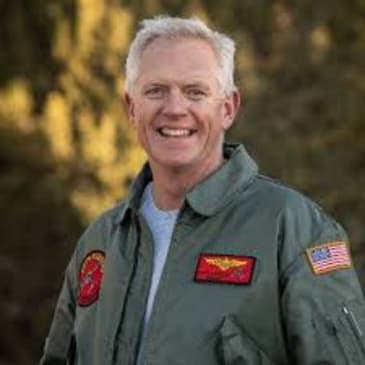
Scott Kartvedt is a naval aviator, author, and keynote speaker. He has conducted 5 tours of duty in Iraq and Afghanistan and has received the bronze star for leadership. Scott was selected as a member of the Blue Angels and flew air shows for three seasons. He was a stunt pilot for the movie Top Gun Maverick and is an author of the book "FULL THROTTLE." He is the current president of Blue Angels Foundation. Our guest is Scott Kartvedt - call-sign INTAKE.
- 3:49 Teaching The Skills Of Mental Toughness To Kids Going Into The Armed Forces
- 6:12 The Insane Skills It Takes To Be A Blue Angel Fighter Polite
- 10:58 The Power Of The Debrief
- 14:44 The Power Of Thank You In The Air Force
- 17:32 Near Death Mistakes
- 25:50 Owning Up To Your Mistakes And Learning From It
- 30:41 Being Brave Enough To Save Lives
- 39:54 The Power Of Saying Yes
- 42:45 Stories From Top Gun Maverick
- 48:51 Know When It’s Time To Ask For Help
Don’t forget you can also follow Dr. Rob Bell on Twitter or Instagram.
Follow At:
- Twitter @drrobbell
- Instagram @drrobbell
Download Your Daily Focus Road Map!
If you enjoyed this episode on Mental Toughness, please subscribe and leave a review!
Dr. Rob Bell
[00:00:10] Dr. Rob Bell, Dr. Rob Sits Down With Athletes, Executives, and Expert Coaches To Talk About Mental Toughness And Their Hinge Moment. Here's your host, Dr. Rob.
[00:00:38] So the cleanest example that I can give from a trajectory standpoint. So I was, because of my time with the Blue Angels, I was asked to run United Airlines demonstration program.
[00:00:50] And I said yes. And then that year, I went to the air show in San Francisco and the Patriot Jet Team was performing.
[00:00:57] And I had a friend that I didn't even know was on the team. And he said, hey, we're looking for a guy. Would you be interested in flying for the Patriot Jet Team?
[00:01:04] And I said yes. And then two years later, the Patriot Jet Team got the cinematography contract for Maverick.
[00:01:13] And they asked me if I would train the actors and actresses because of my combat experience. And I said yes.
[00:01:19] And then they asked me if I would be a stunt pilot in Maverick. And I said yes.
[00:01:24] And I correlate that all back to taking on the additional responsibility of being asked if I would run this 777 demonstration team for United Airlines.
[00:01:33] Because that series of yeses ultimately led to Maverick.
[00:01:39] Our guest today on the Mental Toughness podcast is a naval aviator. He is an author and keynote speaker, great keynote speaker, by the way.
[00:02:05] He has conducted five tours of duty in Iraq and Afghanistan. He's received the Bronze Star for leadership.
[00:02:13] He was selected as a member of the Blue Angels and flew air shows for three seasons, which we'll talk about today in depth.
[00:02:19] He was a stunt pilot for the movie Top Gun Maverick and is an author of the book Full Throttle.
[00:02:26] He is current president of Blue Angels Foundation. Our guest, Scott Cartbett. Call sign intake.
[00:02:34] Intake. Hey, Doc.
[00:02:35] Thanks so much for joining us, bud.
[00:02:37] Thanks for letting me be here. It would be natural for me, Dr. Bell, to call you Doc, because in a fighter squad, we always refer to our flight surgeons as Doc.
[00:02:45] So, I'm glad to be here with you, Doc. And what a pleasure to be on your podcast.
[00:02:51] Absolutely. Well, I'm not a surgeon, man. So maybe, maybe Doc might be too, too high a character for that, right?
[00:02:58] Whatever you're comfortable with though, man. I, I did want to start, man, congratulations on, on your son getting his wings.
[00:03:05] Yeah, I appreciate that. Uh, just spent the weekend with him. Both boys are fighter pilots in the Navy. Uh, and as a dad, I couldn't be more proud.
[00:03:15] Lisa and I are thrilled. They're, uh, serving their country. Uh, the oldest deploys in November over to the Far East.
[00:03:22] So we're really excited and proud of them. Yeah. Um, talk to us about that, uh, being a dad, watching your sons kind of grow up and now they're, um, I mean, they've, they've gone through obviously the training, um, you know, life is going to hit them.
[00:03:40] But I mean, what, what, what's that like from your perspective, you've gone through so much in life, but just being a dad and seeing that transpire. Can you, can you share with us kind of your, your thoughts?
[00:03:49] Yeah, it's interesting. When our oldest son Wyatt went to the aircraft carrier for the first time to get his carrier qualifications, uh, I wanted to have a long conversation with him.
[00:03:58] And I did have a conversation about the mental toughness aspect and, uh, being able to compartmentalize day, night at the ship, the, the physiological and visual illusion of landing on an aircraft carrier.
[00:04:09] How, how, how being able to stay resilient when things aren't going well. Um, and then he left for the ship and I was a nervous wreck and I wasn't sleeping very well.
[00:04:20] And my wife said, what's wrong with you? And I said, well, Wyatt's at the ship. And she said, you went to the ship all the time. And I said, yeah, I know how dangerous it is.
[00:04:30] But when it was me, I was unconcerned. But now that it's our son, it's a different aspect. And she said, that's what we all went through.
[00:04:38] Every time that you deployed, uh, was that kind of anxiety. So it was new to me, uh, as a dad.
[00:04:46] So she shared with you the anxiety they share as a family when you would deploy.
[00:04:50] That's right.
[00:04:51] Interesting.
[00:04:52] Yeah. Yeah. Yeah. Pretty fascinating. And because, you know, you're gone, you don't have, even though we have wifi on the ship and we have email and there are ways to communicate.
[00:05:02] Oftentimes we go into an emissions control mode where they take down all of the emissions, uh, that are coming off of the ship to move silently through the water, if you will.
[00:05:14] So you can go days without communicating, uh, but flight ops are still happening.
[00:05:19] And that anxiety, I know that they knew that I was in operations, either combat or peace time operations.
[00:05:26] And, but they still didn't know how safe I was or what was happening day to day.
[00:05:32] That can cause some challenges for military families.
[00:05:36] Yeah.
[00:05:38] I guess let's start with the blue angels.
[00:05:41] Yeah.
[00:05:42] Um, I was always fascinated by, again, your presentation, fantastic keynote speaker.
[00:05:48] We do, we'll put the links on there, obviously, but I mean, 50% new pilots every year.
[00:05:53] And I was amazed at like, um, I guess let's just start on that.
[00:05:57] I mean, if you talk about the, the communication that you have to have and, um, you know, from, from year to year, but, but start with that and that, that all experience and what we see.
[00:06:13] Yeah.
[00:06:13] So Rob, that's one of the fascinating things that most of the general public, even though they go to air shows and the blue angels are well known and they just came out with that incredible Amazon prime movie.
[00:06:23] Most people don't know that 50% or three of the pilots in the six plane formation are brand new to the team each year.
[00:06:31] And so how do you get them up to speed in a fashion that is expeditious and safe to achieve the level of performance that the blue angels are known worldwide, uh, for that level of excellence.
[00:06:48] And that's just a culture of, uh, bringing your best every day and really holding each other accountable to the standards, that very high standard that is set on the team.
[00:07:02] When you were talking about, um, how the communication, the rhythm of communication, I was hoping you might be able to share with us how that kind of, when, when everyone, uh, you know, up and, and, and how, how they move in formation.
[00:07:19] Can you share that with us?
[00:07:20] That rhythm of communication?
[00:07:21] Yeah.
[00:07:21] So the rhythm of the communication, uh, foundationally is built on trust and respect.
[00:07:26] And so, uh, most fighter airplanes, if you ever see them in an air show, they react.
[00:07:32] So the lead airplane moves and the wingman reacts to that movement.
[00:07:36] That's how they turn together.
[00:07:38] And the blue angels, because we are in some maneuvers, 18 inches, uh, wingtip to canopy separation.
[00:07:46] The, the movement has to be simultaneous.
[00:07:48] So the boss will make a, uh, looping maneuver call that will sound like this.
[00:07:54] Uh, we go a little more whole adding power.
[00:08:02] And so the up, we is the preparatory call on the in go.
[00:08:08] And it's rhythmic for the go.
[00:08:11] Everybody pulls simultaneously.
[00:08:13] We start on the good in go, and we pull all the way through the, Oh, so if the voice inflection
[00:08:20] is up, we go.
[00:08:22] And it's really hard, you know, it's a hard pull.
[00:08:25] If it's a, uh, we go.
[00:08:28] It's a, it's a less of a pull, but we're pulling together.
[00:08:33] Uh, the same thing.
[00:08:34] If we need to move the thrust levers, uh, adding power is rhythmic adding power.
[00:08:43] There's going to be a much more aggressive power correction.
[00:08:46] And it's a two point power correction, power adding is the preparatory call.
[00:08:50] And so the way that we're able to fly as close as we do is the rhythm of the calls and the
[00:08:55] trust and learn and knowing that the other pilots are all going to pull it on the good
[00:09:02] and go.
[00:09:03] And that's where the debriefing comes in.
[00:09:04] And we don't start 18 inches apart, right?
[00:09:07] We start, uh, 10, 15, 20 feet apart, and then we collapse it down to that signature
[00:09:13] blue angel formation.
[00:09:16] You, you kind of led into the next one.
[00:09:18] I appreciate you sharing that real quick.
[00:09:20] Like on that point, like how does that translate into real life?
[00:09:23] That, that rhythm of communication that, that you found?
[00:09:26] Well, so that rhythm of communication, we'll talk about calm brevity.
[00:09:29] And so when I talk to companies or train companies, uh, so oftentimes in cultures or siloed organizations,
[00:09:37] somebody could say something, uh, that is transmitted from a leader or a project manager,
[00:09:42] and it could be received wrong because there's a misunderstanding in military fighter aviation.
[00:09:48] Uh, what is commute?
[00:09:50] We train to certain communication, uh, styles so that the receiver of the communication knows
[00:09:56] exactly what the message is.
[00:09:59] And it just drives alignment strategically, operationally, tactically, when, uh, the brevity
[00:10:07] in the community, not, not the brevity because it can be very direct, but when the language
[00:10:11] and the words that we're using within our standard operating procedures are common, so that I say
[00:10:17] something and I know what I am saying, and I know how it's going to be received throughout
[00:10:23] the organization as opposed to interpreted and oftentimes misinterpreted or misunderstood.
[00:10:29] Yeah.
[00:10:30] I noticed that when talking with my wife sometimes.
[00:10:35] Me too, by the way, at, uh, certainly infallible or fallible.
[00:10:40] I felt the power.
[00:10:42] Your presentation obviously is very powerful.
[00:10:45] One of the best parts that I got from it was in the power of the debrief.
[00:10:48] And you talked about, you know, you would start at hour and a half, two hour debriefs.
[00:10:53] Um, walk us through that and that the whole power of the impact of that.
[00:10:58] Well, uh, foundationally the debrief, uh, on the blue angels, what you take away from
[00:11:04] the blue angels or what you take to, uh, to your follow on fleet squadron is, and fighter
[00:11:09] squadrons, both in the Navy and the air force are really good at this, right?
[00:11:12] You, you have to own your errors.
[00:11:15] And when you, when you work in an organization where everybody you are working with owns their
[00:11:21] errors and are willing to admit their mistakes.
[00:11:24] Now the growth in the trust and respect and understanding of each other's capabilities really
[00:11:30] shines through.
[00:11:31] And so on the blue angels, the term that we use is a safety.
[00:11:35] So as we go around, uh, the, the number one pilot, the boss will start the debrief and
[00:11:42] they, the boss will self-identify his or her mistakes.
[00:11:47] Uh, and they'll say, I'll take a safety for being 20 feet high on this maneuver, 50 knots
[00:11:53] fast on this maneuver, not having the proper pin, talking to somebody with my sunglasses on
[00:11:59] any, any violation of our standard operating procedures is a safety.
[00:12:05] So you, they get to self-identify and self-correct.
[00:12:08] Now it goes to number two.
[00:12:09] Number two will self-identify and self-correct the deviations from the standard operating procedures
[00:12:15] that they had that day.
[00:12:17] And then we'll also have the opportunity to then add anything that number one missed.
[00:12:23] So it builds on each other.
[00:12:25] By the time you get to number six, number six is self-identifying and then can go back
[00:12:30] and add any other mistake that one of the other pilots made on the team.
[00:12:37] And so you always go ahead.
[00:12:38] How, how would say if number four, like how would they identify an error on number two?
[00:12:45] What would be the word there if they were saying safety for their own?
[00:12:49] So let's say, let's say number two went through their debrief.
[00:12:52] Number three went through their debrief.
[00:12:54] Number four sits in the slot position and can see number two or three.
[00:12:57] And so in a certain maneuver, maybe number two should have cleared because they misperformed
[00:13:03] the maneuver, but they didn't mention it.
[00:13:05] We never assumed that they didn't mention it because they're trying to hide anything.
[00:13:09] But number four would say, hey, two, you also got flat and acute and you didn't clear
[00:13:17] in the left echelon role.
[00:13:20] But for instance, and then number two will say, you're right, I'll take a safety for that.
[00:13:26] Because, you know, in a 45 minute show that has maneuvers from 200 knots up to 600 knots
[00:13:34] in multi-planes, sometimes you just forget.
[00:13:38] But number two, this is a really interesting point, Rob.
[00:13:42] Number two would never take that feedback from number four as an attack, right?
[00:13:48] Number two would say, thank you for that feedback.
[00:13:52] Thank you for helping me correct and improve and get better and recognizing I have the capability
[00:13:58] to do it.
[00:13:59] That is a magical component of the Blue Angels is we never take it personally.
[00:14:05] If you corrected me, thank you for taking the time to make me better.
[00:14:12] And that is a monumental shift in human behavior.
[00:14:18] So thank you.
[00:14:20] We lead into the next one.
[00:14:23] Also a wonderful point.
[00:14:25] And you shared that even with your son going into flight school, correct?
[00:14:32] The power of thank you.
[00:14:34] Share with us, how have you witnessed just that response to manifesting and come to be
[00:14:42] in actual real life situations?
[00:14:45] Well, so I'll tell my youngest son, Nick, really smart astrophysics major from the Naval
[00:14:51] Academy, sees many things black and white.
[00:14:54] Great and is very well studied.
[00:14:57] And with that comes his desire to be right, just like so many of us.
[00:15:02] And when he went to flight school, I said, son, you're going to want to defend why you maneuvered
[00:15:10] the plane or made decisions in the plane when your instructor's debriefing you.
[00:15:15] When your instructor debriefs you, just say thank you.
[00:15:18] Take what they debrief you on and say thank you.
[00:15:20] Don't defend.
[00:15:21] Don't make excuses.
[00:15:22] Just say thank you.
[00:15:24] So he finished primary flight training and selected jets.
[00:15:27] And he said, dad, I had no idea how powerful those two words could be because when I would
[00:15:33] say thank you and my instructors would turn around and say thank you for saying thank you
[00:15:38] because it's human behavior to defend.
[00:15:40] And well, let me tell you why I made the decisions that I made.
[00:15:43] When you're getting debriefed and somebody is offering you their advice or their experiences,
[00:15:50] thank you.
[00:15:51] Thank you for taking the time to share that.
[00:15:53] So it was very powerful for my son.
[00:15:56] What I have found in my professional life now is if I get debriefed after a keynote or talking
[00:16:03] to somebody after a keynote or after some corporate training, I still fly with the Patriot Jet team.
[00:16:09] If somebody gives me feedback, thank you.
[00:16:11] Thank you for the feedback.
[00:16:12] I never take it personally.
[00:16:13] I'm always grateful that someone has tried to make me better.
[00:16:16] And that will shift the way that you can accelerate your performance.
[00:16:21] Mm-hmm.
[00:16:40] Hey, good looking.
[00:16:41] If you like this podcast and are already a badass, but it's all way too complicated,
[00:16:47] then visit our website, drrobbell.com, and schedule a call with us to help capture your very own hinge moment.
[00:17:08] One of the fascinating pieces, and you shared that, was 27 feet.
[00:17:15] Can you walk us through that experience?
[00:17:18] And kind of, that was the only part that you kind of left out because there were a couple of, I guess,
[00:17:26] factors that went into it.
[00:17:27] But walk us through that scenario and sort of that, I mean, that was close, right?
[00:17:33] Yeah.
[00:17:33] And so the scenario you were talking about was January 16, 2001, flying the number six jet for the Blue Angels,
[00:17:39] the opposing solo.
[00:17:41] We were demonstrating a maneuver for the first time.
[00:17:43] So I had not flown the maneuver, but we were flying it for the first time with number five and six.
[00:17:50] And so we bumped up the safety altitude.
[00:17:53] Our minimum altitude in the maneuver was going to be 2,000 feet.
[00:17:56] At the conclusion of the maneuver, we would basically dive straight towards the ground.
[00:18:02] And then on the ready-hitted call, we would pull for the opposing cross between number five and six.
[00:18:11] And there were several things that went wrong from a communication perspective,
[00:18:17] from a situational awareness perspective, from a monitor cross-check perspective.
[00:18:21] And what we call in aviation, the holes in the pieces of Swiss cheese were aligning.
[00:18:31] And so there were minor causal factors that were beginning to compound very rapidly,
[00:18:38] which led me to missing the ground by 27 feet.
[00:18:42] And we went back, and in the debrief, as we debriefed it rigorously,
[00:18:48] we found that there were holes within the standard operating procedures.
[00:18:52] And collectively within the team, we went through our standard operating procedures
[00:18:56] for the flight maneuvers to ensure consistency, which drives to the safety piece
[00:19:03] to prevent that type of scenario from happening again.
[00:19:07] So the hard deck was 2,000 feet?
[00:19:11] And you got it to 27 feet.
[00:19:13] Just to try to give the listener some perspective.
[00:19:16] Yeah, right.
[00:19:16] Yeah, yeah.
[00:19:17] So 1,973 feet below the absolute minimum that day.
[00:19:23] For your listeners to think about 27 feet, walk outside, look around for a two-story building
[00:19:29] or a two-story house, whether you're at work or at home,
[00:19:33] and imagined the afterburning part of the F-18 ripping through the roof of that two-story building.
[00:19:43] And that's how low the aircraft was.
[00:19:46] Mm-hmm.
[00:19:47] And then, because, I mean, it's difficult for you to have it.
[00:19:51] Well, I guess it's over water.
[00:19:53] Is it really difficult then to have any kind of perspective in terms of how far you are from the ground?
[00:19:58] Or is that over ground as well?
[00:20:00] No.
[00:20:01] So over ground, you have the depth perception three-dimensionally.
[00:20:05] And so even whether you're staring directly at the ground, you have the perception of the ground
[00:20:10] through your peripheral vision.
[00:20:12] And your brain can process that.
[00:20:14] Out over the water, blue sky, occasionally you'll get a horizon either with the beach or some landmark.
[00:20:23] A boat can help immensely.
[00:20:26] But over the water, you don't have the depth perception.
[00:20:29] So much so that in carrier aviation, if you were to eject from an airplane and found yourself floating in the parachute,
[00:20:38] we train to not release your parachute or your coat fittings until your feet hit the water
[00:20:44] because you may think that you're 10 feet above the water when you're actually at 3,000 feet.
[00:20:50] So you can release early thinking that you're close to the water and create some damage.
[00:20:58] So there's no depth perception out over the ocean or over the water.
[00:21:04] Intake.
[00:21:05] So what was like the major lesson that you learned from the 27 feet?
[00:21:12] Yeah, I think from the 27 feet is really an overall question on the lessons learned from my time with the Blue Angels,
[00:21:19] which really drives to standards.
[00:21:22] People want to perform.
[00:21:25] Certainly the majority of people want to perform.
[00:21:28] And what I learned was that if you set the standards high and say this is how our organization operates,
[00:21:36] this is the culture that we operate in, we hold each other accountable to this level of greatness, excellence,
[00:21:47] then the majority of people that I have met in my life want to know what the standard is so that they can achieve the standard.
[00:21:54] If you set the bar low in the expectation of people low, then that's what they'll achieve
[00:22:02] because they're just going to meet that expectation.
[00:22:05] And so I took the lessons learned from the Blue Angels as I went into my department and tour
[00:22:11] and subsequently F-18 command and F-35 command and realized that I needed to set the expectations high,
[00:22:18] hold people accountable in a fair manner to those expectations.
[00:22:22] And people may fall short.
[00:22:23] That's okay.
[00:22:24] Debrief them.
[00:22:25] Remind them what the expectation is and hold them to that level.
[00:22:31] And most people, the majority of people will achieve that level of excellence.
[00:22:36] Do you agree, like if you treat people as they could be, that they'll become that?
[00:22:41] Or if you treat them as they are, then they will stay as they are?
[00:22:44] I think that's a fair statement.
[00:22:48] I think that's a fair statement.
[00:22:49] I do get asked a lot, like what if somebody, here's an example.
[00:22:55] So when I was in command of VFA 83, we would hold meetings.
[00:23:00] And I would say, look, we'll hold the meeting every Tuesday.
[00:23:04] It's a battle rhythm meeting, an operational meeting.
[00:23:06] We'll have it at 8 a.m.
[00:23:07] And the OPSO would say, hey, look, we can't get everybody there at the meeting on that Tuesday.
[00:23:11] So we need to slide the meeting.
[00:23:12] I'd say, no, we'll do the meeting and have surrogates come in for the person that can't make it.
[00:23:17] But we can't delay the transfer of communication in our operation.
[00:23:22] So part of that is leadership continuity as well.
[00:23:25] So we'll start at 8 o'clock.
[00:23:26] And then at 8.05, or I would start at 8.
[00:23:31] And they would say, look, not everybody's here.
[00:23:33] And I'd say, well, if the meeting starts at 8, we're not going to hold everybody else because one or two people are late.
[00:23:40] We'll start the meeting at 8.
[00:23:41] And what you'll find is the second time you have the meeting, more people will show up on time.
[00:23:46] And by the time you have the meeting the third time, everybody will be there.
[00:23:50] And they'll be there at 8 because of that consistency.
[00:23:53] But if the first meeting is supposed to start at 8, and I started at 8.10 because we're waiting for people,
[00:23:58] then the next time everybody's going to show up at 8.10 or 8.15.
[00:24:01] Then the third time, people are going to show up at 8.15 or 8.20.
[00:24:04] And that's a very simple description of holding the standard just with a meeting.
[00:24:14] I used to, when I was number seven, I would go to the air show early.
[00:24:17] And I was the executioner of the air show, meaning I executed the air show.
[00:24:22] And I'd always arrive into the city.
[00:24:24] And I would have a meeting with all of the air show people, 30, 40 people.
[00:24:29] And on my schedule, I would say it started with one.
[00:24:31] And I would show up and I'd say, all right, it's one o'clock.
[00:24:34] Let's start the meeting.
[00:24:35] And the producer would come over and say, not everybody's here yet.
[00:24:38] And I would say, well, is this how the air show is going to run all weekend?
[00:24:41] Or are we going to run on time and execute in a safe manner?
[00:24:46] So I'm going to start and we'll set the tone for the whole weekend so that we can do the best we can.
[00:24:53] And I would argue that occasionally that can be perceived as breaking a little glass and not being a good team player.
[00:25:03] But, you know, with a smile on your face and we're going to be on time.
[00:25:08] Like, let's execute and hold each other accountable to that.
[00:25:12] It's like the green M&Ms with Van Halen, right?
[00:25:16] Yeah.
[00:25:16] Familiar with that one?
[00:25:18] Yeah.
[00:25:19] Yeah.
[00:25:21] Yeah.
[00:25:21] That was always good.
[00:25:26] The, we listen to you talk and we always talk about hinge moments, the moment, event, decision that makes all the difference in our lives.
[00:25:37] And the one I wanted to address was just when you're first and then second time applying for the Blue Angels and owning the mistakes.
[00:25:46] I was hoping you could elaborate on that and tell us that story.
[00:25:50] Yeah.
[00:25:51] The first time I applied to the Blue Angels was in 1998 and I was selected as a finalist.
[00:25:58] And I was in the interview room with the team and it's a fairly, I don't want to say it's intense, but it's certainly dynamic because you're trying to join the world's greatest flight.
[00:26:10] Not a lot of jokes being thrown around there, right?
[00:26:13] No, no, no, no, no.
[00:26:14] They make it very comfortable, but you understand the weight of that moment.
[00:26:19] And so V8 Burissimo, who is now an admiral, he was number five at the time.
[00:26:23] And he said, hey, intake, tell me the dumbest thing you've ever done in an airplane.
[00:26:27] And I thought, well, I'm applying to the Blues.
[00:26:29] I can't admit that I did anything dumb.
[00:26:31] So I'm going to just tell him something that is not that big a deal.
[00:26:37] So I told him in primary flight training, I was 50 feet off altitude and, but that I corrected it.
[00:26:43] And I was trying to make myself the hero of this story.
[00:26:47] And that was the year that I was not selected.
[00:26:50] And in 1999, I reapplied and I had gotten, I had some good mentors that had coached me.
[00:26:56] And I went back in and I was selected as a finalist.
[00:26:59] And they said, hey, intake, tell us the dumbest thing you've ever done in an airplane.
[00:27:03] And I told him a story where I was over in Japan.
[00:27:06] We were doing what we call an air power demonstration off the USS Independence.
[00:27:11] And we had employed some live weapons too close to the aircraft carrier.
[00:27:17] And the dignitary that day was the chief of naval operations and his staff.
[00:27:22] And they were on the flight deck of the USS Independence watching this air power demonstration.
[00:27:27] Well, we dropped our ordinance too close to the aircraft carrier.
[00:27:31] And bog fragmentations began to hit the flight deck of the carrier, which is very dangerous.
[00:27:37] And the Japanese chief of naval operations dove on the ground and his white uniform was covered in hydraulic fluid and gas and fuel.
[00:27:45] And it was a big deal.
[00:27:46] And as I was telling the story, the number four pilot at the time, Dave Silkey, who's still a good friend of mine, said that was you?
[00:27:55] Because it was a well-known international incident in the F-18 community.
[00:28:00] And I said, yes, it was.
[00:28:01] But let me tell you what I learned from that.
[00:28:05] As a wingman on that flight, and I talked about the leadership effectiveness of being an advocate and knowing what was right and what was wrong.
[00:28:12] And I told them what I had learned from that particular event.
[00:28:17] And that was the year that they picked me.
[00:28:20] And you talk about hinge moments.
[00:28:22] I told them about what the biggest failure in my life to date as a pilot.
[00:28:27] And that was the year that they picked me.
[00:28:30] And they picked me because I was willing to own my mistakes, which meant that I was willing to acknowledge them and learn from them.
[00:28:38] And the learning piece is what they wanted, Rob.
[00:28:41] And I didn't understand that the first year, but I understood it clearly the second year and going forward.
[00:28:51] And what, picturing it in my mind again, I saw the pictures of it.
[00:28:55] What were you dropping in the water?
[00:28:57] They were just bombs?
[00:28:58] Yeah, no.
[00:28:59] So we had a two ship of F-18s.
[00:29:02] Okay.
[00:29:03] Pags Paganelli was the leader, the flight lead.
[00:29:05] He was department ed.
[00:29:06] He was new to the squadron.
[00:29:07] He was a senior junior officer.
[00:29:09] It's kind of an honor to fly in the air power demonstration.
[00:29:12] We were dropping what we would call a string of Mark 82s, which is 500 pound bombs.
[00:29:18] We were going to drop them at least greater than a half a mile of being the ship so that the fragmentation pattern of the Mark 82 would be well clear of the aircraft carrier.
[00:29:29] But we were tight and our angle to the carrier drove us in too close.
[00:29:34] And I didn't speak up.
[00:29:36] I didn't say anything, even though I assessed that we were closer than we should have been and aborted the run, which would have been the safe thing to do.
[00:29:44] Which is where the bomb fragmentations from the Mark 82s sprinkled the deck of the aircraft carrier.
[00:29:50] And there were people on the flight deck.
[00:29:51] I mean, we were fortunate that nobody was injured.
[00:29:57] I love it when you share that story, though, man.
[00:29:58] That's a really good one.
[00:29:59] Especially when you end it, because you're like, that was you?
[00:30:02] Like, I love that.
[00:30:04] Yeah.
[00:30:04] Oh, I remember it very clearly.
[00:30:06] And Wolfie Silky was the one that looked at me.
[00:30:10] And we're good friends today because of how we feel about each other.
[00:30:16] And he's actually helping us with the Blue Angel Foundation, which is great.
[00:30:21] Intake, you, on the aircraft carrier, one of the opening points you talked about was everyone can signal flight operations.
[00:30:30] And the power of owning the mistakes and owning safety.
[00:30:37] Talk to us about that, because I thought that was very powerful as well.
[00:30:41] Yeah, Rob.
[00:30:42] So on the deck of an aircraft carrier, you have all ages.
[00:30:44] I think the average age on an aircraft carrier is less than 21 years old.
[00:30:50] And so a lot of young men and women, very high-priced machinery, $80 million F-18s, V-22 Ospreys, helicopters, H-60s.
[00:31:03] So it's an exceptionally high-risk environment.
[00:31:08] But it's also very well controlled.
[00:31:12] And so what you're talking about is the authority of any individual on the flight deck.
[00:31:18] If they see a safety incident, they are expected to have the courage to speak up and correct that safety environment.
[00:31:29] Or should the environment require stopping flight operations, then anybody on the flight deck can put their two arms out in front of them in a big X.
[00:31:43] And that is a visual signal to stop.
[00:31:48] And once anybody sees the X from somebody else, then they put up the X.
[00:31:54] And everybody stops flight operations because everybody has gone to the X.
[00:32:00] And flight operations are stopped.
[00:32:02] They find out who initiated it and run over to that individual and say, why did you stop?
[00:32:08] What did you see?
[00:32:09] What's happening?
[00:32:11] And what I talk about in the keynotes is an individual may have lost a tool.
[00:32:16] And that tool could be somewhere in an airplane and could create the loss of an aircraft or personnel.
[00:32:22] So they stopped flight operations until we find the tool.
[00:32:27] And what's important about that is the authority and responsibility given to even the most junior or youngest person on the flight deck
[00:32:35] to stop flight operations on a multi-billion dollar aircraft carrier.
[00:32:41] And we thank them for that, for doing the right thing.
[00:32:47] And that's part of the culture that allows us to operate in this incredibly high-risk environment
[00:32:53] in such a safe and effective manner worldwide with aircraft carriers and strike groups around the globe operating 24-7.
[00:33:06] And it's because of that culture.
[00:33:08] And it takes courage, correct?
[00:33:11] Oh, it takes a lot of courage.
[00:33:13] You're 18 years old.
[00:33:15] It's your second day on the flight deck.
[00:33:16] And you look in your tool pouch and you realize that you're missing a tool.
[00:33:19] We would first, human behavior would be, I'm not telling anybody.
[00:33:23] Right.
[00:33:23] Because I don't want to get in trouble.
[00:33:25] That's what 99 out of 100 people would think.
[00:33:29] But we have to instill in them in the training phase that we expect you to acknowledge that mistake.
[00:33:36] Because if you acknowledge it and we find it, everybody's good.
[00:33:41] If you don't acknowledge it and somebody gets hurt, now you have done something that is very wrong.
[00:33:47] We're not going to beat you up for losing the tool.
[00:33:50] That happens as human beings.
[00:33:52] We make mistakes.
[00:33:55] But if you compound the error with bad head work and not having the courage to speak up, now we are at risk.
[00:34:04] What are one of the biggest leadership lessons in your role leading others that you've discovered throughout your time in so many different positions?
[00:34:21] I always found the value and respect of all of the sailors that I had the privilege of serving with.
[00:34:32] Whether they worked for me.
[00:34:34] I always considered my job as a naval leader to serve those within the command or within the ship.
[00:34:41] And it could be something as simple as when I'd walk past a piece of trash somewhere in the aircraft carrier, pick it up and throw it away.
[00:34:49] Right?
[00:34:49] Because especially as I got more senior, if somebody junior saw me pick up trash and throw it away, then clearly they can pick up trash and throw it away.
[00:34:58] And then pretty soon you have a really clean ship because everybody cares.
[00:35:04] But allowing the communication transparency.
[00:35:07] And here's the example I will give.
[00:35:09] We were deployed a lot in 2009 and 10 with Strike Fighter Squadron 83.
[00:35:14] 17 months, 13 months of deployment in a 17-month period.
[00:35:22] And when you're pulling into port and you're in and out of combat operations, alcohol-related incidents in port can be a challenge.
[00:35:32] Because people want to pull in and they want to let off some steam.
[00:35:35] And I was always very clear that, hey, look, if you go out and have a great time with your friends in port, that's okay.
[00:35:46] But we have to take care of each other.
[00:35:48] And so take a cab and don't drive home if you have a car when we were back in Virginia Beach.
[00:35:56] And I told them that, hey, look, I'll pay for your cab fare.
[00:35:59] It's so important to me that your safety is paramount, that if you show up Sunday morning, you hand me a receipt for your cab fare or Uber fare.
[00:36:09] I'm going to pay you right away and I'm not going to ask any questions.
[00:36:13] And so nobody believed me, right?
[00:36:14] Because they just think that the old guy, the skipper, is just speaking.
[00:36:19] And one day I had a young man come in on a Monday morning and he handed me his receipt.
[00:36:24] And he said, hey, I was out having a great time this weekend and I drank a lot and here's my receipt for the cab.
[00:36:29] And I said, hey, great.
[00:36:30] Pulled out my checkbook, wrote him a check, handed it to him.
[00:36:33] And then I immediately called quarters for all of the sailors in the command.
[00:36:39] And I brought him forward and I thanked him for, number one, making the right decision and not drinking and driving.
[00:36:46] And I let him know.
[00:36:47] And I said, what did I do?
[00:36:48] Did I tell you I was going to pay you?
[00:36:49] What did I do?
[00:36:50] Did I pay for the capper?
[00:36:51] And he said, yeah, you did.
[00:36:52] I mean, here's the check.
[00:36:53] And that was as clean a message as I could make to the 250 sailors that their safety was paramount.
[00:37:00] Didn't have anything to do with the money.
[00:37:01] Didn't have anything to do with the drinking.
[00:37:03] It had to do with the safety and ensuring that we were all able to get back to work on Monday and execute the mission of the nation.
[00:37:12] Yeah.
[00:37:13] And he never cashed that check, did he?
[00:37:15] Would you cash a check from intake?
[00:37:17] He did cash the check.
[00:37:18] Yeah.
[00:37:18] No problem with him.
[00:37:19] Cash the check.
[00:37:20] Yeah.
[00:37:21] Yeah, of course not.
[00:37:22] Oh, yeah.
[00:37:23] Yeah.
[00:37:24] Yeah.
[00:37:24] Rob Noah, Sailor's definitely going to cash that check.
[00:37:27] There was, what was interesting was Sam Snead, you know, I mean, just a Hall of Fame golfer.
[00:37:34] He was the pro at the Greenbrier Resort for many years.
[00:37:38] And he would kind of walk around to the members and, you know, sometimes the members then, you know, he'd comment.
[00:37:46] Sometimes the members then would get a little invoice in their mailbox, you know.
[00:37:50] Well, the way that he always, if he ever lost a bet, he would always write him a check.
[00:37:56] And the reason was, would you cash a check that had the signature of Sam Snead on it?
[00:38:01] You know, and it was hilarious, right?
[00:38:03] It was like, yeah, that's so good, man.
[00:38:06] Yeah, that's really great.
[00:38:09] Yeah.
[00:38:09] And honestly, as a result of that, which is just, hey, the transparency, I know that you're going to go out and have a great time on the weekend.
[00:38:15] When we're in port, when we're at home, that's okay.
[00:38:18] But take care of each other and make sure that we're watching each other being safe.
[00:38:21] And so we actually ended up going, I think it was like 486 days without an alcohol-related incident in command.
[00:38:31] I mean, it was well over almost a year and a half.
[00:38:36] Unheard of.
[00:38:38] And I only ended up writing one check.
[00:38:40] But the culture was established with that maneuver, if you will.
[00:38:47] Absolutely.
[00:38:47] And that's not fair.
[00:38:48] I don't even want to use the word maneuver.
[00:38:49] I wasn't trying to manipulate anybody.
[00:38:51] I was totally serious.
[00:38:53] It was cheaper for me to write a check than it was to do the paperwork and try to administratively separate somebody from the Navy who had simply made one bad decision at one moment in their time.
[00:39:03] What I was giving them the authority to do was not make that decision and not have it cost them $30.
[00:39:10] I'll pay the $30.
[00:39:11] You get home safe.
[00:39:12] And that was the message that was transmitted and received.
[00:39:18] Yeah.
[00:39:18] Want to listen to your favorite music but you're sick of all the commercial interruptions and negative news today?
[00:39:25] Tune in to KUKORadio.com.
[00:39:28] Music for your mindset.
[00:39:30] We're a commercial-free online radio station.
[00:39:32] Play nothing but hits.
[00:39:34] Our free iOS and Android apps are available for download at KUKORadio.com.
[00:39:41] You talked about the power of saying yes.
[00:39:44] Many of the opportunities that have come in your career is just the power of saying yes.
[00:39:52] Can you elaborate on that one?
[00:39:54] Sure.
[00:39:56] I was asked to give a keynote at a gala right after I had done the stunt flying with Maverick.
[00:40:04] And I said, well, what do you want to talk about?
[00:40:05] And they said, well, talk about the things that have made you successful.
[00:40:08] And I'd never really thought about it.
[00:40:11] But I realized that I'm very good at seizing opportunities.
[00:40:20] Because I say yes.
[00:40:22] And the clearest example would be you and I met at a keynote down in Florida and had a great conversation.
[00:40:31] And you said, hey, would you come on the podcast?
[00:40:33] Yes, of course I'll come on your podcast.
[00:40:36] Why?
[00:40:37] I'd love to talk to you.
[00:40:39] Right?
[00:40:40] And we'll reach an audience.
[00:40:42] And maybe some of the mental toughness things that we're talking about might help somebody through a challenging time.
[00:40:47] And that's all goodness.
[00:40:50] And so the cleanest example that I can give from a trajectory standpoint.
[00:40:55] So because of my time with the Blue Angels, I was asked to run United Airlines demonstration program.
[00:41:03] And I said yes.
[00:41:04] And then that year, I went to the air show in San Francisco and the Patriot Jet Team was performing.
[00:41:09] And I had a friend that I didn't even know was on the team.
[00:41:12] And he said, hey, we're looking for a guy.
[00:41:14] Would you be interested in flying for the Patriot Jet Team?
[00:41:16] And I said yes.
[00:41:18] And then two years later, the Patriot Jet Team got the cinematography contract for Maverick.
[00:41:25] And they asked me if I would train the actors and actresses because of my combat experience.
[00:41:30] And I said yes.
[00:41:31] And then they asked me if I would be a stunt pilot in Maverick.
[00:41:35] And I said yes.
[00:41:36] And I correlate that all back to taking on the additional responsibility of being asked if I would run this 777 demonstration team for United Airlines.
[00:41:45] Because that series of yeses ultimately led to Maverick.
[00:41:52] And when I talked to young men and women, I'll say, look, you'll need help.
[00:41:59] Ask for the help.
[00:42:00] And it's okay.
[00:42:01] When somebody asks you for help, say yes and help them.
[00:42:04] Because someday you're going to need the help.
[00:42:06] And when you ask, those people will say yes.
[00:42:09] And collectively, you move further, faster together.
[00:42:15] So when asked, say yes.
[00:42:17] And don't be afraid to ask.
[00:42:19] Because someone is going to say yes to help you out.
[00:42:22] And it'll open doors and opportunities.
[00:42:25] And you can tell clearly by the passion, Rob, that I believe it is a fundamental foundation for the things that I have been able to do.
[00:42:33] Mm-hmm.
[00:42:34] No, it's fantastic.
[00:42:35] It's a great segue into Top Gun Maverick.
[00:42:40] Talk to us about, well, what story can you share from that?
[00:42:45] There's so many stories, actually.
[00:42:48] That's what I thought I'd let you pick.
[00:42:50] Yeah.
[00:42:51] One, I was asked originally, again, based on my combat experience in training to help train the actors and actresses.
[00:42:59] So we went into California.
[00:43:02] We were flying out of Camarillo.
[00:43:04] Tom had put together an incredible training program for the actors and actresses.
[00:43:09] They got to fly, I think it was Cessna 172s.
[00:43:12] Then they got an extra 300s, which is an aerobatic propeller plane.
[00:43:17] And then he wanted to run them through the L-39, which is the airplane that I fly now with the Patriots.
[00:43:24] And so Randy Howell and I went down and we trained the actors and actresses and talked to them about G tolerance
[00:43:29] and anti-gestraining maneuvers and three-dimensional maneuvering.
[00:43:32] And we took them out in the jets in a high dynamic jet and did some dogfights.
[00:43:38] And then they moved from there into the F-18s where the active duty Navy Marine Corps pilots were flying them.
[00:43:44] And I thought, oh my gosh, this is amazing.
[00:43:46] I can't believe I get this opportunity to work with the actors and actresses and be part of Top Gun Maverick.
[00:43:55] And then seven months later, when it came time to film the final fight scene,
[00:43:59] when Maverick and Rooster steal the F-14, they asked me if I would come and spend two weeks
[00:44:07] filming that final, what turned out to be six or seven minute fight scene at the end of the movie.
[00:44:12] And I said, oh, absolutely.
[00:44:14] And it was intense.
[00:44:16] Flying three times a day, working with Kevin La Rosa and his team was just incredible.
[00:44:23] We were up in the mountains of Northern California, flying out of Chico near Lake Orville,
[00:44:29] where the big granite rocks are that you'll see in the movie.
[00:44:32] And I think the most unusual movie specific memory is the proximity in which we flew to helicopters
[00:44:47] to get the really dynamic shots.
[00:44:51] And so we tremendous trust and respect with Kevin La Rosa, who was just an incredible helicopter pilot.
[00:44:59] And he had the sure shot cameras.
[00:45:01] But we would point up in one of the maneuvers, if you look at the movie, you'll see where they're looking down the intake.
[00:45:08] The camera is looking down the intake of the jet as the jet is coming up towards a helicopter.
[00:45:13] But what you can't see is as you get really close to the helicopter, then you pitch underneath the helicopter.
[00:45:19] And even as a blue angel, I remember telling Kevin, I'm like, oh, my God, that was pretty close.
[00:45:25] Hope it didn't make you any comfortable.
[00:45:27] And he'd come back on the radio and say, no, intake, I need you to get closer than that.
[00:45:32] Okay, Kevin.
[00:45:35] And so those were really dynamic flights to get that incredible shot to demonstrate the speed that was happening at the time.
[00:45:49] And they all experienced, all the actors all experienced just that G-force, correct?
[00:45:56] Oh, yeah.
[00:45:57] No, in the F-18s, they all pulled seven and a half Gs and sustained G because the afterburning engines of the F-18F.
[00:46:05] Yeah, absolutely.
[00:46:05] They did.
[00:46:06] And what does that do to your body?
[00:46:09] Yeah.
[00:46:09] So physiologically, what happens is the brain goes to the lowest point.
[00:46:13] So you're sitting in a chair for your listeners.
[00:46:15] If you're sitting in your chair at home, you know, put your feet on the floor like you're flying a fighter.
[00:46:20] And now if you're pulling G because you're at one G, it's seven and a half Gs.
[00:46:24] 200 pound person weighs 1,500 pounds.
[00:46:27] And so the blood, the liquid in your body goes to the lowest point.
[00:46:30] So what happens in your brain is you have auditory exclusion.
[00:46:35] You lose your ability to hear.
[00:46:37] Then you have vision tunneling and you lose, slowly lose your vision.
[00:46:42] You may have heard the term a gray out, tunneling and gray out, and then it goes away.
[00:46:46] And then you lose your cognitive capability and your body goes limp, which allows your heart to now push against that to get the blood back into your brain.
[00:46:58] And so it's critically important in a fighter airplane, but you have to fight against it.
[00:47:04] So for the listeners, if you want me to walk through real quick, if you're sitting in your chair, curl your toes, you feel your calves tighten up,
[00:47:10] kind of pinch your buns a little bit and push yourself up on the chair.
[00:47:13] That tightens your glutes and your hamstrings, tighten your abs, keep your chest loose, and then say the word Hick.
[00:47:19] And when you say the word Hick, it tightens off the throat and closes the arteries in your throat,
[00:47:25] which helps keep the blood up in your brain.
[00:47:28] And you do that all simultaneously.
[00:47:30] Then you exchange oxygen every three seconds.
[00:47:32] So you breathe, take a really quick breath.
[00:47:35] So if I was doing it, I would say Hick, Hick, Hick, until I won the fight, essentially.
[00:47:46] Awesome, man.
[00:47:47] Love it.
[00:47:49] And that was the thing, right?
[00:47:51] I mean, you must have been so proud because everyone always talked about just how great that footage was from the movie, right?
[00:47:57] I mean, to see that one in the big screen, I mean, that was better in Titanic, right?
[00:48:04] I mean, it was incredible.
[00:48:06] Right, yeah.
[00:48:07] And it was dynamic to fly.
[00:48:09] You know, when you think about the combat mission, I did five combat tours, three of Iraq, two of Afghanistan,
[00:48:17] and then flying with the Blues, at least between airshows and practices, way over 750 airshows and practices.
[00:48:23] But that flying in Maverick was very dynamic because we needed to be low.
[00:48:30] We needed to be fast.
[00:48:31] We needed to be close to the ground.
[00:48:32] We needed to be close to the other airplanes, the film platforms, whether it's a helicopter or a phenom jet.
[00:48:40] And so, yeah, it was dynamic flying for sure.
[00:48:46] And, Tick, what questions should I be asking that I haven't asked?
[00:48:51] Well, I mean, since we're talking about mental toughness, you know, I think it's important that people recognize when it's time to ask for help and that it's okay.
[00:49:04] A lot of people, when you get asked for help, you to all your listeners, I would argue the majority of people are willing to help.
[00:49:14] Agreed.
[00:49:15] You know, and think about something as simple as asking for a battery jump in a car parking lot because your car's battery is dead, right?
[00:49:24] If somebody comes over and says, hey, do you have any jumper cables?
[00:49:26] You're going to say, yes, if you do, and then you're going to go help them.
[00:49:29] They're going to jump the car and they're going to be on their way.
[00:49:32] But when we're the ones that are going to ask for the jumper cables because our batteries are like, oh, man, I wonder if I should call a tow truck or I don't want to encumber somebody with my problem.
[00:49:44] Ask, hey, you got any jumper cables?
[00:49:47] If they haven't, they're going to say, yes, I have jumper cables.
[00:49:50] That's the reason that I carry them so that I can help you and assist you.
[00:49:53] That's a really simple, basic description.
[00:49:56] But now think about more complicated challenges.
[00:49:59] You're going through some mental difficulties, you know, in your life.
[00:50:06] Ask for help.
[00:50:07] It's okay to be vulnerable and seek assistance and seek support, whether it is professionally or with a friend.
[00:50:19] And when you're wondering whether or not you should remind yourself that you would be the one that would be willing to give that support.
[00:50:27] So ask because there's somebody out there in your network that's going to support you through those challenging times when you need a little boost to your mental toughness.
[00:50:40] Awesome, man.
[00:50:41] Appreciate that.
[00:50:42] Your dad encouraged you to write the book, correct?
[00:50:45] Yeah, he did.
[00:50:46] So my dad was always a writer.
[00:50:48] I was an accountant, so I'm very math based.
[00:50:51] And he said, oh, your stories are outrageous.
[00:50:53] You should write a book.
[00:50:54] And I said, I'm not a writer.
[00:50:56] I'm not going to write a book.
[00:50:57] And then he came down with dementia.
[00:50:59] And I thought, you know, maybe it is time that I write a book and put some of these stories down to put them on paper.
[00:51:05] Might be enjoyable for my kids to read someday.
[00:51:08] And maybe it'll inspire someone to do things that they didn't think were possible.
[00:51:13] And so I went ahead and wrote the book.
[00:51:17] Actually, after filming Mission Impossible 8, I decided to sit down and write the book and talk about some of the highs and lows of my own life to hopefully inspire some folks.
[00:51:32] So I wrote Full Throttle from Blue Angel to Hollywood Stunt Pilot.
[00:51:39] It's available on Amazon.
[00:51:40] And there's a couple of entertaining stories in there.
[00:51:45] Oh, I love it, man.
[00:51:46] Thank you again so much for your time, man, sharing your insight.
[00:51:49] Really appreciate it.
[00:51:51] Thanks, Intake.
[00:51:52] Rob, thanks for having me on.
[00:51:53] It's been a pleasure chatting with you.
[00:51:55] Thank you.
[00:51:55] Mental Toughness with Dr. Rob Bell.
[00:52:20] To find out more about Dr. Rob, visit his website at drrobbell.com or follow him on Twitter at Dr. Rob Bell.
[00:52:28] And subscribe to the show on your favorite podcast platform to get the next episode of Mental Toughness as soon as it's available.
[00:52:36] Thanks for listening, and we'll see you next time.