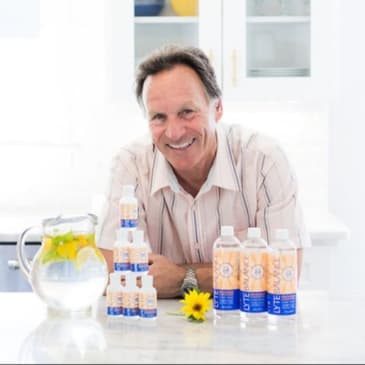
Tim Cunninghamm is CEO of Smell Taste Technology. He is owner and creator of Lyte Balance electrolyte drink, Lyte Balance is a 100% pure electrolyte concentrate with no calories, sweeteners, preservatives or caffeine. Their slogan is “Go Naked with your Electrolytes”. Our guest is Tim Cunninghamm. For Tim along with his partner Karen Nielsen it was a 30 year process of developing an electrolyte drink.
- 4:04 The Hinge Moment Of Meeting The Wizard Of Elk
- 7:57 The Start Of Lyte Balance Electrolyte Drink
- 10:04 The Science Behind The Business
- 16:00 Challenges Of Marketing
- 17:17 Devoting His Life To Make Your Life Better Through Hydration
- 18:28 Making A Partner Out Of Your Taste And Smell
- 21:08 Challenges Through The Entrepreneurship Path
- 23:49 The Best Partner In Life You Could Ask For
- 27:08 The Power Of Time
- 28:42 The Cycle Of The Body
- 30:01 Explaining The Big Interest In How The Body Works
Don’t forget you can also follow Dr. Rob Bell on Twitter or Instagram.
Follow At:
- Twitter @drrobbell
- Instagram @drrobbell
Download Your Daily Focus Road Map!
If you enjoyed this episode on Mental Toughness, please subscribe and leave a review!
Dr. Rob Bell
[00:00:12] Each week, Dr. Rob sits down with athletes, executives and expert coaches to talk about mental toughness and their hinge moment.
[00:00:21] Here's your host, Dr. Rob.
[00:00:30] Well, that's curiosity is what it's the key of it. I mean, once you, you can use all kinds of products. No question.
[00:00:37] And a lot of those products are going to get you something guaranteed. Something that's going to shift.
[00:00:42] You can't put important electrolyte salts into your body without having it affect you.
[00:00:49] The questions are, how is it affecting me? Is it just subjective? Oh, I like it because or are you actually able to look at what is my blood pressure, heart rate and body temperature and relationship to what I'm using?
[00:01:00] And two, does it always taste good? Or do I kind of get tired of it? How many people have closets full of supplements that they read were great for them, but they just don't really take them.
[00:01:30] So our guest today on the mental toughness podcast is CEO of smell taste technology. He's owner and creator of light balance electrolyte drink.
[00:01:41] Now it's one of my favorite electrolyte drinks that's out there. Light balance is 100% pure electrolyte concentrate, no calories, sweeteners. None of that stuff is going to be in there, especially that what you see most of the supermarkets.
[00:01:57] Their slogan is go naked with your electrolytes. Our guest today excited for this conversation is Tim Cunningham. Tim, my man, thanks for joining us, man.
[00:02:07] Thanks for having me great to be here.
[00:02:09] So I prefaced this by saying I need to share the story and I put light balance on here. Now again, I always say if we are sponsored, you are not sponsored this podcast.
[00:02:22] So I just want to say this is 100% testimonial. But this is my favorite electrolyte drink. Well, drink mix because of two reasons. One, not only is, you know, does it work, but it's not full of anything else.
[00:02:40] But I love the application of it. I love how you can take this and just put it in a drink. I know like the powders are very popular and those work, but I just love the drink man like the mix.
[00:02:56] The story I want to start with is carrying this around from an ultramarathon on 100 miler. And I'd have this in my pouch, and I'd have my two water bottles and unscrew the water bottles and always put a little bit in it.
[00:03:09] Now this was probably a mile 60 and I just have this one filled up. And I asked the lady, I said, can you just put some into the drink? Right. So I handed her my water bottles and it comes back and like there's no bottle.
[00:03:24] I said, you know, do you have the little bottle? She dumped it all into my water bottle, man. Let me tell you then. So you know, right. That was so salty when I was getting it. I was like, boy, I've got to make this work for another 40 miles.
[00:03:38] So now I'm sipping on this one and then drinking, trying to just drink the water from like the other ones. I had to make the mix work that way. But that was a funny story, man. I just needed to share that with you.
[00:03:51] That's a great story. It's happened many times in my life. Yeah.
[00:03:57] Let's start at the beginning, man. The impetus, the hinge moment, right? 1979. Talk to us and start with that story, please.
[00:04:03] Well, I was down south in California where I was raised and I was looking to go to college up in Northern California. And I got a call from a friend.
[00:04:12] Can you house it for a couple of months up here in Spokane, Washington? Where's that? So he tells me go to Seattle take a right and drive four and a half hours. Okay.
[00:04:23] And the timing was great. I wasn't starting till spring the following year.
[00:04:28] So I drive up to Spokane. I get a little apartment. It's cheaper. I end up working as a bartender.
[00:04:36] Well, that's the first hinge point really. I got here. But that Christmas in the time that I was spending because I finally had the freedom to research all day in the library, go to bookstores and look for things I was interested in, color therapy,
[00:04:53] shiatsu, all kinds of fun things in health. I didn't know what I was going to do with my degree. And I met a guy.
[00:05:00] And the guy said, I want you to meet another guy.
[00:05:03] So I want you to meet the Wizard of Elk. And I'm like, look, I don't, I don't do wizards.
[00:05:09] And he said, no, I think you're gonna like this guy and this went on for about two months.
[00:05:14] So finally I said, okay, I'll go meet the Wizard of Elk. A fellow named John Kikoski.
[00:05:21] So I drive up there and in this meeting there's one other guy about my age from a large Catholic family like mine.
[00:05:29] And like, what are you doing here? Well, he's got all kinds of issues with working in the automotive industry, scoliosis and phosphoric acid burn from spray paint.
[00:05:39] So he's not doing so well. Well, number one, he becomes my best friend for the next 42 years.
[00:05:46] And number two, the gentleman that we met was highly involved in his version of a method of what you would call free choice and free choice is something that's been used with animals for hundreds of years.
[00:05:58] You can put out several kinds of feed for the animals. Sometimes you can put different mineral salt leaks and they'll pick the ones they need.
[00:06:08] If you give them an array, they'll, they make really good choices just animal mind, right?
[00:06:14] So he sits us both down and it was magic. It was the first time I'd ever seen something that made so much sense. I thought I have to follow this.
[00:06:25] And we tasted a bunch of minerals.
[00:06:28] And he could predict by their taste what was happening in our body, what was happening with our blood pressure. And I'm like, I know that's how do you do that?
[00:06:37] But he could also predict which ones in the next set would taste better to us.
[00:06:43] But he wouldn't tell us what they were. He just says the Wizard of Elk.
[00:06:47] You just go ahead and do it.
[00:06:48] And he was like 95% correct. And I thought, how do you know that?
[00:06:54] And he said it's your body's knowledge, not mine. Your taste buds and your sense of smell unlock certain things about your biochemistry that belong to you and only you.
[00:07:07] I was hooked. That was it. I spent 10 years with that guy.
[00:07:12] So the body knows.
[00:07:14] The body knows more than even you and I could properly express.
[00:07:19] Yeah.
[00:07:19] Your DNA.
[00:07:22] We go to we go to 23 and me now and we look back at our generations, we go, I'm Northern Europe and I've got this percentage of German and this percent of Irish and blah, blah, blah, blah. That's great.
[00:07:31] And if I'm here.
[00:07:34] I'm a survivor.
[00:07:35] And if I'm a survivor, I carry with me a whole set of knowledge about what helped me survive.
[00:07:41] That's all locked up in here in the chemo sensory system attached to our whole body.
[00:07:48] So that initial meeting then what did that what transpired after that in terms of your mission and how you wanted to help people.
[00:07:57] I was there every week up at his house learning how to use this program for myself learning how to take three biomarkers that became critically important blood pressure, heart rate and body temperature.
[00:08:09] And compare those to all the tastes and smells of all the different supplements and watch how they converge in kind of a midpoint and this happened over a year.
[00:08:20] And in that timeframe I decided I wanted to work with this man.
[00:08:25] So I pretty much work nights as bartenders and work five days a week, six days a week, helping him start the first iteration of this product.
[00:08:35] And then throughout that how did light balance come to be so over the 10 years where of course is all good things go you work in the startup and you finally decide.
[00:08:48] I can't do this anymore.
[00:08:49] I want to have a life right so we split.
[00:08:52] And I said okay see you later.
[00:08:54] And then along the way somewhere, I had to make a choice about whether I was going to provide these tools for myself and my family.
[00:09:03] So I started to make them in my basement.
[00:09:06] Just from memory what I had learned they weren't for sale. It would just have them for my family.
[00:09:12] That's pretty much the origin of light balance.
[00:09:15] When he passed on 12 years later from a heart defect, which nobody could have seen.
[00:09:23] I thought well, I'm going to have to keep making them and maybe share them with my friends which is what I did.
[00:09:29] And that was actually when we got started in this.
[00:09:32] Yeah.
[00:09:33] So I'm always fascinated. I think when it comes to just general hydration.
[00:09:40] Majority of people just don't understand the relationship of the magnesium, the potassium, the sodium and and even the calcium and how they contribute.
[00:09:52] I guess on the 101 version of it. Can you kind of just walk us through hey how do how do all three of those worry for those even kind of connect with one another and then work.
[00:10:04] Great. It's a great question is one of my favorite ones. If you think of your body like a landscape.
[00:10:10] And we're going to talk about intracellular and extracellular don't get confused. It's like plasma and what's outside the cell and then what's inside the cell, and then what divides them.
[00:10:20] Three main players here.
[00:10:23] Sodium is the king of the extra cellular region where sweat tears air wax all your body fluids come from.
[00:10:32] Intracellular is where all your mitochondrial motor, electrical generated DNA governed. Everything comes on the intracellular side and the guy that sits on the border is magnesium.
[00:10:44] And his best friend is calcium.
[00:10:46] And they do an amazing handoff between each other for each electron of sodium or potassium that comes in or goes out.
[00:10:55] And when they go in they take in food, and when they come out they take out the garbage. So you have this complete circular event going on, especially when you mix all four of them together which is the number one reason why this is a liquid that is put into dairy products.
[00:11:11] Got to say put that calcium in there with some fat and you have basically a hospital grade drinkable electrolyte. All cells are covered inside and outside, and the membrane itself has its functional partners in and out.
[00:11:29] Magnesium, calcium.
[00:11:30] Hey, good looking. If you like this podcast and are already a badass but it's all way too complicated then visit our website, DrRobBell.com and schedule a call with us to help capture your very own hinge moment.
[00:12:17] You talked about sodium is muscles clenched and I like that description. Can you elaborate on that one?
[00:12:28] Well, as much as I'm not really a biochemist or a biophysicist or even a pure body physiology guy, basically the difference between a clenched muscle and a relaxed muscle is the tension it creates.
[00:12:43] Sodium is a really interesting tension creator and it runs that just it runs that exercise. We use our sodium. And even though there's some potassium being used as well, it's the leader of the pack.
[00:12:56] And then when we relax they switch places and potassium is the leader of the pack for muscle relaxation. It's also interesting to know that sodium has a more physiological effect.
[00:13:08] And potassium under stress is a more emotional effect. Emotional stress will drain your potassium. Physical stress will drain your sodium. That's another big way to look at it.
[00:13:21] If you're in a stressful situation, you're running out of potassium faster than you're running out of sodium. Unless you're also lifting weights or running from a tiger, then you're burning them both.
[00:13:30] Okay.
[00:13:32] How does, can you elaborate on that point a little bit just in terms of hey, general society with their hydration with these minerals? How does it affect their cognitive workload and just focus throughout the day?
[00:13:48] It's primal. It's very important.
[00:13:51] There isn't a single part of our body that doesn't rely on a constant infusion and switching mechanically, electrically or mechano electrically throughout the system.
[00:14:03] Waters are conductive medium.
[00:14:06] I'm going to come back to the membranes in a moment, but the first thing is about electricity. It's just like a light switch. Everything is governed by this pattern of on off on off.
[00:14:17] Billions of cells going through on off all the time and your liquidity of that system across both sides of the membrane. And that's another interesting point.
[00:14:26] Your blood pressure is a really great indicator of whether you've got intercellular and extracellular fluid geography balanced.
[00:14:33] You run around a 120 over 70 right in the middle, and you're pretty much got enough extra cellular and intercellular to keep that wave going back and forth. It's a dance.
[00:14:42] When you get too low, you end up with a high intracellular and a low extra cell. You're kind of dried out. You're a little bit drawn and you're kind of dehydrated, but you're over hydrated at the potassium level.
[00:14:55] You go the other way. You got a high blood pressure. You're over hydrated extra study. You're pressured. You're kind of quick to quick to jump.
[00:15:04] But your emotional side is a little low. So if you can kind of imagine we don't have weightlessness, but when the membrane and the cells are satisfied and replete, there's a weightlessness to your bloodstream and a weightlessness.
[00:15:19] They can walk back and forth across the membrane without a lot of stress.
[00:15:24] Right. Right. And that's really important because I'm not borrowing from other categories to get that job done for sure.
[00:15:31] It's a primary load.
[00:15:34] When you went to market and then, I mean so much especially in the United States is just about marketing and gimmicks and schemes.
[00:15:43] And I'm not going to mention like two of the big ones that are out there but I mean they're just covered in sugar and I'm just not a big fan of those products.
[00:15:50] But what's been the biggest challenge?
[00:15:53] You know, having such an awesome product in into market and then go into the next level.
[00:16:01] That's a great question and I can tell you that's when we work with almost every day because it's, I'm actually looking at something that can't be seen in trying to express it.
[00:16:14] And that can't be seen entity that is with all of us is our own human nature and our animal nature and how we are living in a really beautiful spaceship.
[00:16:24] We're living in this body that's made for this earth.
[00:16:28] And it has stories to tell, and it's really hard to tell somebody else's story for them.
[00:16:34] You just have to explore it to experience your own.
[00:16:37] So rather than take the path that says we wear lab coats, we look cool. We've got a lot of money you should use this. It's like really you should try this.
[00:16:49] It's interesting what it does and most of the experiences are just like yours people like wow this made a difference and I can't even tell you I planned that to be honest with you.
[00:17:00] It's just the beauty of what happened in that evolution.
[00:17:05] What do you see the, what's the overall impact. I mean you're definitely insightful guy I mean I know there's a lot of purpose and meaning what's what's the major impact that you want to make on on people's lives.
[00:17:19] Agency of self.
[00:17:22] You have an incredible bio computer inside you.
[00:17:25] It's very curious. It's only one purpose is to see you upright balanced and healthy in whatever your stressors are.
[00:17:36] And it goes on 24 seven.
[00:17:38] It's always there for you. So how do you make that your ally asking the right questions of it. Yes, are they biochemical ish. Yes, what do you do when you respond to taste changes tells you everything about what's going on in your body.
[00:17:53] If I had a mission, I would say well first you have to hydrate because then you'll you'll experience what I'm talking about and then you have to become a good hunter.
[00:18:01] But once you hit point A and you get the hydration level up, then you start to click on like step changes along the way.
[00:18:11] Every other aspect of what you're trying to solve and ultimately you're trying to solve being better in the place your app with whatever you've got going on.
[00:18:21] So that agency of change talk to us about that next step that that hunter piece I'm curious about that.
[00:18:28] Well that's curiosity is what it's the key of it. I mean, once you you can use all kinds of products no question and a lot of those products are going to get you something guaranteed something that's going to shift.
[00:18:40] You can't put important electrolyte salts into your body without having it affect you.
[00:18:47] The questions are how is it affecting me. Is it just subjective. Oh I like it because or are you actually able to look at what is my blood pressure heart rate body temperature and relationship to what I'm using.
[00:18:59] And to does it always taste good, or do I kind of get tired of it how many people have closets full of supplements that they read were great for them but they just don't really take them.
[00:19:10] So the whole idea of agency is once you make a partner out of your sense of taste and smell and start hunting.
[00:19:17] You will uncover things about yourself that only yourself knows, and that pathway becomes uniquely individual to you, but you have a tool.
[00:19:26] You have this computer in here.
[00:19:29] Was that part of the reason why like light balance.
[00:19:34] You made sure it was over the list and tasteless and call list for that.
[00:19:39] Well it's not tasteless. It has a naturally salty.
[00:19:42] And that's exactly right because.
[00:19:46] Now I've tested all artificial taste sorry, but correct.
[00:19:50] Yeah, I'm right. I wanted it naked because I every one of the salts that's in there I have a relationship with.
[00:19:57] I've tasted sodium sulfate I've tasted the chlorides I've tasted the phosphorus I've tasted the salt I've tasted them all.
[00:20:03] And they all have a different relationship to my body and they've changed over time.
[00:20:09] And so I know when I'm in a zone with all of them that's just a really good place to be there's seven salts.
[00:20:16] So there's seven salts in there but they're like four endings and three salts so you go well four times three that's 12.
[00:20:23] That's 12 possible combinations of what is my body need and your kidney when it gets a hold of those it's like it restacks that shuffling deck I always think of those bulldogs sitting around with cigars shuffling cards.
[00:20:36] All right, they're shuffling all the cards and it's moving around so it takes the phosphorus puts it where you need it puts the software it's so it's a constant uplift to that system of choice.
[00:20:48] It'd be hard to explain all the pieces but having a relationship with your taste buds about these salts is key right your health with.
[00:21:00] With your product in terms of entrepreneurship what's been what's been some of the biggest struggles for you.
[00:21:09] Putting words to this, it's more fun to be in a dialogue with somebody who is curious and then there's many jump off points you can go to and enjoy while you're doing that.
[00:21:20] Trying to put all those words out into the thought atmosphere and everything is it's kind of challenging we don't read as much anymore we don't think about things.
[00:21:31] So I kind of get down to the simple just put your mouth on it and try it for a while, and that's been the biggest challenge is trying to encompass in a restricted environment of being able to talk about what it does from my perspective.
[00:21:45] I can have all the experiences in the world about what I've seen with everything the full spectrum from chronic to wellness. Okay, or as we like to say we look for chronic wellness.
[00:21:56] The point is, I can't really speak to those things my associates the people that use the product have to speak to that for themselves that's the conditions that are set up in the marketing world.
[00:22:11] When is that the restrictive environment you're talking about. It is restrictive in the sense that you can't really say okay, they're in my world I don't even use the word cure it's a word that I think about paint curing or epoxy curing.
[00:22:26] When I think about people I think about people mending and tending and tending their mending so that they're moving forward. So, that kind of language is quite a bit different than what you find out there, all the time.
[00:22:41] So we try to lay back on that a bit and just stand up with the tending and mending.
[00:22:48] I'm writing that one down because there's always a point in every podcast episode that I have where, you know, we title the podcast. And I think I think you just did that there because that's that's awesome stuff the mending and tending and tending the mending. Yeah.
[00:23:02] Yeah. Want to listen to your favorite music but you're sick of all the commercial interruptions and negative news today. Tune into cuckoo radio calm music for your mindset. We're a commercial free online radio station play nothing but hits are free iOS and Android apps are available for download at cuckoo radio.
[00:23:26] Tim, talk about like your relationship like with your partner for many years. Karen, you know, and again, condolences on her past in this year but talk about your also relationship and development.
[00:23:50] Hey so when I got started in this back in the 7980 year Karen was one of the first clients that came to us.
[00:23:59] Yeah, she recently passed and it's been difficult and when I was with her partner the other day, Jane was here.
[00:24:07] She said I remember you told me about Karen starting I said yeah, she was kind of small and gray and and kind of quiet and mousy to the librarian.
[00:24:18] She took on this program.
[00:24:21] And she changed herself and she worked with my mentor for almost 23 years where I had worked with him for 10 and stayed friends.
[00:24:30] She also had a challenge to her physiology that none of us really knew about.
[00:24:36] And it was where her breastbone was growing into her body, therefore creating more physical impacts on her heart.
[00:24:46] Jane and I now believe the work that she did gave her a chance to get another 20 years the life expectancy with that pectus excavated and I think it is, it was in the 30s or 40s and she made it to 68.
[00:25:00] Karen was instrumental in the fact that she had a brain and a love of care and nurturing.
[00:25:08] Not me. I'm close. I enjoy it, but it's not something I go to every day. She was the careful one.
[00:25:15] She was the one that would take the calls from the elderly people, take the calls from the moms that had children with different spectrum issues and walk them through how to help their children find a place to use their taste and smell, because sometimes all they wanted was one kind of food, they wouldn't touch anything else.
[00:25:33] So she had a way to get them to explore these other taste variables and look for different things.
[00:25:40] That was the best part of Karen, the part that I probably will never be able to replicate. She was a careful person.
[00:25:47] And she knew the difference between perfect solutions and appropriate solutions.
[00:25:54] Hmm.
[00:25:55] It's grand.
[00:25:57] You know, I appreciate the pause that you took there and what obviously she meant to you with what came to mind when you were pausing there.
[00:26:08] Well,
[00:26:10] Thanks, Rob.
[00:26:12] You're welcome.
[00:26:15] The young man that I met the first day I met my wizard friend.
[00:26:19] He passed away last year after a 16 year battle of leukemia.
[00:26:22] Hmm.
[00:26:24] So I've lost two allies in this 43 year quest to help open up this technology to people and it's, it's been difficult as difficult as it gets. Yeah.
[00:26:41] Yeah.
[00:26:43] Well, I appreciate that. And I mean, the difference obviously making people's lives with
[00:26:50] That's it. Can you can you share with us your perspective and experience and strength and hope on on time and the power of time?
[00:27:10] Another one that's just a great question to ask.
[00:27:15] Now they say time heals all wounds.
[00:27:18] And time is your best friend. We don't think often medicine has really messed up our framework about time.
[00:27:25] You hurt yourself, you take a drug, you're better. Wow. I feel better immediately. It's kind of a mind mess because in real time your body needs cycles to improve.
[00:27:41] And those cycles can involve everything from what you're drinking and what your nutrients are.
[00:27:46] They also involve time with friends with family. They also involve deeper connections with your ancestors with your grandparents, all of the things that come before us.
[00:27:57] So awareness that we're much larger than this moment, even with you at this moment that I have behind me. Karen sitting behind me and John and all of my experiences.
[00:28:12] It just shifts the way you feel about time. So I can't explain it like a physicist, but I can sit with it and settle out a bit.
[00:28:28] Can you elaborate on the cycles?
[00:28:35] Can you delve into that just a little bit more instead of like the taking something we're going to get better from it, but kind of the cycle piece.
[00:28:43] Now they say we rebuild our body every seven years, but I can assure you there isn't one starting point for all those cells.
[00:28:51] So it is a constant wave forward. Pardon me for a moment of digression. Bertolucci's dome at El Duomo in Florence.
[00:29:01] And read the book about how he built that it actually predates Buckminster Fuller's octagon and how perfect that was. And he did it with bricks, but the way he did it was a herringbone pattern.
[00:29:15] And the herringbone pattern is a step forward a step up, but not the same distance a step forward and a step up. So it appeals to me that our bodies have a step change like chemistry, where a little bit of titration moves everything forward a little bit of it.
[00:29:30] And the whole cycle that we just talked about whether it's friends and family, whether it's meals together, whether it's getting good sleep, whether it's enjoying the kinds of shows that lift up your heart, not just make you want to fight and run, but the ones that lift up your heart.
[00:29:44] So all of that mixes into that variable.
[00:29:49] I appreciate that.
[00:29:53] Tim, what question should I be asking that that I haven't asked?
[00:30:02] Thank you.
[00:30:05] Hmm. Why would you want to be that curious about your body?
[00:30:15] Yeah, it's a scary subject for a lot of people. They don't really want to.
[00:30:22] That's okay just and yeah, you can have that relationship with your body. It's perfectly okay.
[00:30:31] But you can also have more deeper and more interesting relationships as well.
[00:30:38] Can you elaborate on all that answer for you?
[00:30:41] Yeah, we all have challenges in our life, whether we get caught up in our addictions or caught up in our nervous behavior or caught up in our blocks.
[00:30:50] And you have to challenge them sometimes you don't want to and okay, don't but there's going to come a time when you will.
[00:30:58] Knowing that and accepting that as part of what you talk about mental toughness. Yeah, I can run away for a bit but you're coming for me and I know it.
[00:31:07] I think challenges with even for guys, you know it's it's challenging to stay emotionally acutely aware. It's challenging for women raising children and there's so many facing up to those takes a kind of mental toughness where you agree to surrender to how much it takes to actually be present.
[00:31:28] That's basically the best way to put it and yes I struggle with it.
[00:31:34] Yeah, well said is so I mean obviously toughest part of running the podcast I think is operating the podcast is being able to stay in that consciousness of thought.
[00:31:53] Right.
[00:31:54] I'll be able to take your answers and kind of work with them massage them and see like what that next step is but I guess my question one is this and this is I'm just relying on instinct but is there anything else that you want to share.
[00:32:16] Rob, that's extremely generous to ask.
[00:32:19] I'm almost not sure I'm going to look in my pockets right now for what's in my heart.
[00:32:25] This has been one of the most incredibly wonderful adventures I could be on. I work with besides Karen and Johnny.
[00:32:33] I've worked with three of the best people on the planet to work with we have a small family business were united.
[00:32:40] I believe every day I get up and thank, thank the good Lord that I'm here and I get to be and do what I do.
[00:32:48] I think the only thing it says hey peeps cheer up we can do this you have incredible guidance I do honestly you learn how to trust that you will be surprised at the results and that's really what fills me up every day you just keep working it it'll teach you.
[00:33:07] Thank you.
[00:33:09] Thank you for this really appreciate the time and expertise.
[00:33:14] Yep, I just will put the links in there obviously but just want to thank you for the time really appreciate that.
[00:33:22] The same it's an honor and it's been really challenging and beautiful. Thank you.
[00:34:04] Thank you.