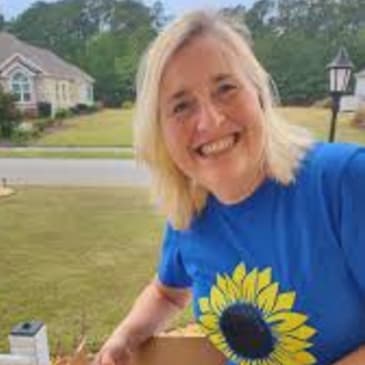
Teri M. Brown is an author, podcast host-“online for authors” - connecting readers with characters they’d like to invite to lunch. Winner of 2024 Positive Change Podcast Award. Teri is based in North Carolina. She and her husband have ridden a tandem bicycle across the United States. Join us as we learn about Teri's story.
https://www.terimbrown.com/online-for-authors.html
- 5:04 Reading from day one
- 9:38 Creativity across writers
- 11:14 The Process Of Developing Characters
- 15:52 The Hinge Moment Of Biking Across America
- 22:11 Key Moments In That Journey
- 26:46 Learning The Most On The Bike
- 30:15 The Mental Toughness Of Dealing With All Sorts Of People
- 34:24 Using The Experience Of Riding Across America To Better Life After
- 39:38 The Key Question: What Is Something You Aren’t Doing And What's Holding You Back
Don’t forget you can also follow Dr. Rob Bell on Twitter or Instagram.
Follow At:
- Twitter @drrobbell
- Instagram @drrobbell
Download Your Daily Focus Road Map!
If you enjoyed this episode on Mental Toughness, please subscribe and leave a review!
Dr. Rob Bell
[00:00:09] Welcome to Mental Toughness with Dr. Rob Bell.
[00:00:13] Each week, Dr. Rob sits down with athletes, executives and expert coaches to talk about
[00:00:18] mental toughness and their hinge moment.
[00:00:21] Here's your host, Dr. Rob.
[00:00:39] Well the next day was fabulous.
[00:00:41] We had a fabulous day and I no longer wanted to quit.
[00:00:44] And the next four days after that were horrible but it kept going back in my mind to Dont
[00:00:49] Quit On A Bad Day.
[00:00:50] And I think that's when I realized that I had something in me I wanted to quit.
[00:00:59] I mean every part of my body was screaming, we cannot do this and yet I still managed to
[00:01:04] get up the next morning and get back on that bicycle.
[00:01:06] I think there's that idea, that understanding that our minds can do things our bodies
[00:01:13] can't.
[00:01:14] You know, my body was telling me you're done.
[00:01:19] And my mind overrode that and we rode anyway and we made it.
[00:01:25] And I think sometimes that's an important lesson is to understand that we really can
[00:01:31] do more than we think we can.
[00:01:33] When you think you're done, there's probably more in you to give.
[00:02:05] So our guest today on the Mental Toughness Podcast is an author, podcast host or podcast
[00:02:13] is online for authors.
[00:02:15] Connecting readers with characters they'd like to invite to lunch.
[00:02:18] Absolutely love that.
[00:02:20] They were the winner of the 2024 Positive Change Podcast Award.
[00:02:25] She's based in North Carolina.
[00:02:27] Her and her husband also had ridden tandem bicycle across the United States.
[00:02:32] So it would be the second guest to ride across the United States on a bicycle
[00:02:37] on this podcast.
[00:02:38] Very excited for this guest today.
[00:02:40] Looking forward to her insight and heart.
[00:02:42] Terry M. Brown.
[00:02:44] Terry, thank you so much for joining us.
[00:02:47] Thank you so much for having me.
[00:02:48] I'm super excited to be here.
[00:02:50] What is the M?
[00:02:52] What's the M stand for?
[00:02:53] It's Marie.
[00:02:54] Oh, nice.
[00:02:55] Yeah.
[00:02:55] And the whole reason that I did Terry M.
[00:02:58] Brown is believe it or not, there's another Terry Brown spelled P-E-R-I who is an author.
[00:03:05] And so when I went, yeah.
[00:03:07] And so when I went to try to like get Terry Brown as my Instagram and everything else,
[00:03:13] I was competing against someone else.
[00:03:15] Now she's not, she hasn't written anything in several years, but she still has that out there.
[00:03:20] And so I decided, well, I'm just going to be Terry M.
[00:03:22] That's who I am.
[00:03:24] Love it.
[00:03:25] You know, obviously there's a very famous Rob Bell, so I can't be the best Rob Bell I can be.
[00:03:30] Except his handle is the real Rob Bell.
[00:03:33] So I don't know what that really means.
[00:03:36] But I still have to figure that one out.
[00:03:37] Does it say something about you not being real?
[00:03:39] I don't know.
[00:03:39] Right.
[00:03:40] You know, or maybe he has to show you the real one.
[00:03:42] I'm not sure.
[00:03:43] Who knows?
[00:03:44] Who knows?
[00:03:46] I wanted to start off, you were born in Greece.
[00:03:50] And what was that like then growing up just in terms of family with, you know, in the Air Force?
[00:03:58] So my dad got out of the Air Force when I was pretty young.
[00:04:01] So I didn't have a whole lot of moving around in terms of that.
[00:04:05] But I always thought it was cool as a child that, you know,
[00:04:08] my friends would say, well, you know, I lived in Ohio growing up.
[00:04:12] And they would say, you know, well, I was born in Camp and I was born in Hartville.
[00:04:16] And I was, and I would say I was born in Athens, Greece.
[00:04:18] And it made me feel extraordinarily special, like well beyond what I should have felt.
[00:04:24] And my brother was born in the United States.
[00:04:26] And so I kind of lauded it over him that I was more special than he was because
[00:04:32] I was born somewhere else.
[00:04:34] I was born in Athens, Greece.
[00:04:36] And I don't know why I just always thought that that was so much cooler than anything anybody else was doing.
[00:04:41] Like I had any, yeah, but like I had any involvement in that.
[00:04:47] Sure.
[00:04:48] But nonetheless, I owned it.
[00:04:51] You know, I was born in Athens, Greece.
[00:04:54] And you have fantastic conversations with authors.
[00:04:58] When did you, what was your journey like just in terms of the reading aspect?
[00:05:02] When did you really become passionate about reading?
[00:05:04] I have loved to read my whole life.
[00:05:06] I don't remember not reading.
[00:05:08] My mom tells a story.
[00:05:09] Apparently I caught myself to read.
[00:05:12] She had told me that I would learn to read in school.
[00:05:15] And I figured out the process somehow on my own.
[00:05:19] And I was underneath the cover in the bedroom with a flashlight and a book.
[00:05:24] When mom came in, you know, it's night.
[00:05:26] I'm supposed to be sleeping.
[00:05:27] She's upset that I'm not sleeping and that I'm using the batteries on the flashlight.
[00:05:32] I thought she was going to be angry that I had taught myself to read.
[00:05:36] And I remember saying, I'm sorry.
[00:05:38] I'm sorry.
[00:05:39] I couldn't wait until I got to school.
[00:05:42] So I don't ever remember not reading.
[00:05:45] I used to read everything I could get my hands on.
[00:05:49] I loved mysteries.
[00:05:50] There was that whole time where like I read all the Truxy building
[00:05:53] and then I read all the Nancy Drew.
[00:05:56] And then it made me very angry that they had the hearty boys
[00:05:59] that were supposed to be for boys.
[00:06:00] So I read all of those too, because I didn't think it was right.
[00:06:03] But I shouldn't be allowed to read all of the boy books.
[00:06:05] And so I read all of the hearty boys and then everything.
[00:06:09] Like if I could get my hands on it, I read it.
[00:06:12] I lived in the library.
[00:06:13] I would bring home stacks of books that I would just read.
[00:06:16] So I've always, always loved reading.
[00:06:19] Yeah.
[00:06:20] So I didn't know that the hearty boys were just made for boys to read.
[00:06:25] Well, that's what they're supposed to.
[00:06:26] I mean, it was kind of like the book end set to Nancy Drew.
[00:06:31] Nancy Drew was like the girl.
[00:06:34] She was the girl sleuth and the hearty boys were the boy sleuths.
[00:06:38] And it was created, I'm sure, to get reluctant boy readers
[00:06:43] to read because the boys didn't want to read about some girl sleuth.
[00:06:46] But they'd be more likely to read about the boy sleuth.
[00:06:49] But my mother was the one who said, oh no, that's for boys.
[00:06:53] Oh, okay.
[00:06:54] Yeah.
[00:06:54] It's interesting how, go ahead.
[00:06:57] Yeah, no, but it was like, yeah, well, that's not going to happen.
[00:07:00] And for me, I'm reading it.
[00:07:03] I'm reading it.
[00:07:03] I didn't like that.
[00:07:05] You even have it on your website.
[00:07:07] People can sign up and we'll put the link on there.
[00:07:09] People can sign up for like five pretty unknown fiction books
[00:07:14] that you find to be pretty classics.
[00:07:16] Yeah.
[00:07:17] Yeah.
[00:07:17] I'm, I don't think that we should stick to just what the New York Times
[00:07:23] bestseller list tells us is good because I have met in the last couple of years in particular,
[00:07:29] I have met hundreds of really amazing authors writing some really amazing stuff that don't
[00:07:36] ever make the New York Times bestseller.
[00:07:38] But it doesn't mean that they haven't written books that should or could be there.
[00:07:43] It just means that for whatever reason they haven't, they haven't connected in that way.
[00:07:48] And so I like people to say, let's step outside the box.
[00:07:51] Everybody knows, and I'm not bashing them, but everybody knows James Patterson.
[00:07:56] Like we all know the name, you know the name even if you've never read one of his books,
[00:07:59] you know who he is.
[00:08:00] And let's go beyond that.
[00:08:03] Let's look at some of these lesser known authors, the titles that you don't hear of
[00:08:10] Oprah isn't touting them.
[00:08:12] Let's look at some of these other authors.
[00:08:15] And one of the reasons why I started the podcast as an author myself,
[00:08:19] I found I had a really difficult time finding a way to get my books out into the public view.
[00:08:25] There's only one of me.
[00:08:26] I can only be so many places.
[00:08:28] I don't have a world of money that I can jet set around the country and do things like,
[00:08:33] how do I get my voice out there?
[00:08:36] And so I found that podcasts being a guest was kind of a good way to talk about what I am
[00:08:41] and what I do.
[00:08:42] And then realize there's not enough of them.
[00:08:45] And so many of the people had never read my books.
[00:08:48] And so they would come to have this big long conversation with me about my book,
[00:08:52] but they had only read the back cover.
[00:08:54] And I thought, I want more than that.
[00:08:57] So I sit down and I read the book and I get these authors to come on and I let them tell
[00:09:02] their story and talk to me about what they're doing and why they write and,
[00:09:05] you know, what sends them and what's next and all of those things that
[00:09:09] I think I kind of wish that other podcasters who claim to have me on for my book
[00:09:14] would actually have done for me, which is read it and then let's talk about my book.
[00:09:19] Right, right.
[00:09:20] Fantastic.
[00:09:21] With so many guests, I guess my question is with this,
[00:09:26] so many guests that you have, what are some themes that kind of stick out for you in terms of like
[00:09:34] their writing process and the creativity and character development?
[00:09:39] One of the things that's interesting is how there isn't one way
[00:09:43] for a long time, I felt like maybe I was doing it wrong because, you know,
[00:09:48] you'd read a book on character development and be like, oh, that's not quite what I do.
[00:09:52] And then you read another book and it's like, oh wait, that's different and it's not what I do.
[00:09:58] And wait, I read a third book and that's also not what I do.
[00:10:01] And then I start talking with other people and I realize there's a lot of people who don't
[00:10:05] follow any particular book, like they have their own process.
[00:10:10] But I also have found that there are a lot of similarities as well.
[00:10:14] There's a lot of what I call voices in our head and however that manifests itself.
[00:10:20] But this idea that I have characters who come up, what feels like out of nowhere,
[00:10:27] who gain a voice when they start talking to me and say, hey, I've got this story and you
[00:10:33] need to tell it. And it's, and I listen and I tune into that.
[00:10:38] And I know that what that is, is that's the creative part of me that's been at work and it's
[00:10:43] been taking in things. But can I stop and listen to that voice?
[00:10:47] You know, and the number of writers that I've talked to who've said, oh yes, they have voices.
[00:10:52] Yeah.
[00:10:52] It's like, well, good, at least I'm not crazy or if I am crazy, I have company.
[00:10:57] So that's good either way.
[00:10:59] Can you share with us just the overall development of a character development?
[00:11:05] Because I'm a nonfiction guy, right?
[00:11:07] I mean, that's mostly what I read.
[00:11:09] But I'm fascinated by that process.
[00:11:11] I mean, walk us through like, what does that kind of look like?
[00:11:14] So for me, it's been, there's something that happens in life.
[00:11:19] Some little thing my grandfather told a story or gave me he was in World War Two
[00:11:26] and he bought in Germany and we're of German descent.
[00:11:30] I was maybe 15 years old and he said to me, I always wondered if the person on the other
[00:11:35] side of my gun was a cousin.
[00:11:38] Well, that stuck with me.
[00:11:40] Then now years later, I decided that I want to, okay, I want to write, what am I going to write?
[00:11:46] That thought came to me.
[00:11:48] And immediately there was a character and this character was saying, that's me.
[00:11:54] I was a first generation German-American and I fought in the war in Germany
[00:11:58] and I realized I'm more like the enemy than I was different from him.
[00:12:02] You have to write my story.
[00:12:04] I mean, and he was right there.
[00:12:07] And so for me, it starts out with something like that, some little seed
[00:12:11] that then pops into something else.
[00:12:14] And then I start to kind of get to know them and I do it very organically.
[00:12:18] Some people love an outline.
[00:12:20] I don't have any problem with people who do it that way, but it's not how I work.
[00:12:23] I start writing.
[00:12:25] I start writing the scene that's in my head.
[00:12:28] And then where does that take me?
[00:12:30] And based on what I've written now about this character, what else would this character do?
[00:12:35] And then I just keep moving through and usually the character is developing with me as I'm writing.
[00:12:42] Love it.
[00:12:43] But like I said, some people are very different.
[00:12:46] They have a whole outline and they already know so much about the character before they ever get started
[00:12:53] and it just doesn't work that way for me.
[00:12:56] I'm kind of more of an exploratory way of leaning who it is that I have in my head at the moment.
[00:13:04] Did he fight in battle the bulge?
[00:13:07] No, he did not.
[00:13:09] I can't even remember.
[00:13:10] He was more along the German and then...
[00:13:17] I don't know, he was along some border and I can't even remember now.
[00:13:21] He was toward the end of the war.
[00:13:22] This is something that we still do not know.
[00:13:25] He's passed.
[00:13:26] No one ever thought to ask him.
[00:13:28] He joined the war late and my dad was four years old and he didn't have to go.
[00:13:35] And something prompted him to in 1943 decide that he was going to go into the army and go to war.
[00:13:45] So he was there at the tail end and he ended up staying in Germany for about eight months after the war was over
[00:13:53] because the people who had been there longer got to come home first.
[00:13:56] And so he was still there and he was doing a lot of things with
[00:14:02] teaching.
[00:14:03] So he taught soldiers that were also waiting and was teaching them.
[00:14:07] He knew how to do drafting and so he was teaching drafting classes and other things.
[00:14:14] What's what's the part you said there was a part that you still don't know?
[00:14:17] We have no reason why he chose to sign up for the war.
[00:14:22] Like I would have understood it if it had happened right around the time of the bombing of Pearl Harbor.
[00:14:29] But the war had gone on for quite some time at this point.
[00:14:32] It had been going on for well over two years.
[00:14:35] He had a child at home and he wasn't drafted.
[00:14:40] And none of us who are living understand what what
[00:14:45] precipitated that.
[00:14:46] Like people don't normally just wake up one morning and say, you know what?
[00:14:49] I'm going to sign up for the war.
[00:14:51] Right.
[00:14:52] Like I feel like something had to have happened and I don't know what it is.
[00:14:55] So in my book, I made up a reason and I came up with the fact that he felt like
[00:15:00] he was being watched as a German citizen.
[00:15:03] As someone who was first generation and that he was being watched and he wanted to prove
[00:15:07] that he was American.
[00:15:09] Love it.
[00:15:10] And so so I don't doubt that's why my grandfather did it.
[00:15:13] We had been in the United States as a family for 200 years.
[00:15:16] So I can't imagine that was his reason.
[00:15:18] But I had to have something for the book, right?
[00:15:21] No, that's fantastic.
[00:15:23] Terry, thank you.
[00:15:23] It gives me a little glimpse then too in the creative process for you.
[00:15:26] Yeah.
[00:15:27] That's fantastic.
[00:15:28] Yeah.
[00:15:29] One of the pieces that we talk about here are the hinge moments.
[00:15:35] The one moment person event connects who we are with, who we've become since every door has a hinge.
[00:15:41] And you've did a TEDx talk on the tandem bicycle riding across the United States with your husband.
[00:15:49] But could you share that with us?
[00:15:51] I'm always fascinated by it.
[00:15:53] So I had lived, I'm going to have to step back just a little bit to give you the
[00:15:58] lead up to why this is so important.
[00:16:00] I lived for 14 years in an emotionally abusive relationship.
[00:16:05] And when I finally got out of that relationship, I was pretty damaged in terms of how I felt about
[00:16:13] myself.
[00:16:13] I didn't believe that I had the capacity to do much of anything.
[00:16:17] I didn't feel like there was a whole lot of rupus in my life anymore and doubted
[00:16:23] there ever would be.
[00:16:24] Right?
[00:16:24] I just no longer really believed in myself.
[00:16:27] During that time, my son had a friend who started walking the Appalachian Trail.
[00:16:34] And he was writing this blog.
[00:16:36] I was reading the blog like a drowning woman and I kept thinking, that's what I want to do.
[00:16:41] I want to do something big and bold and I don't know, it just really spoke to me.
[00:16:48] A few months later, I meet my now husband, Bruce.
[00:16:51] I was never getting married again ever.
[00:16:54] I had tried it, didn't work.
[00:16:56] I'm out of here.
[00:16:57] But he tells everyone that he chased me until I caught him.
[00:17:01] And so if you can ever figure out what that means, but that's what he tells people.
[00:17:05] And while we were dating, he talked about his desire to ride across the United States on a
[00:17:12] bicycle and he had wanted to do it since 1976.
[00:17:16] Apparently some group of college students did it for the bicentennial.
[00:17:20] He was in the Marines at the time.
[00:17:23] He tells everyone that his sergeant wouldn't give him three months off.
[00:17:26] And he'd wanted to do it ever since.
[00:17:29] And immediately my mind went, that's an adventure.
[00:17:33] And so I said to him, is this something you're going to
[00:17:37] talk about until the day you die or is this something you're going to do?
[00:17:41] And he said, no, I want to do it.
[00:17:42] I said, count me in.
[00:17:44] And we weren't married and I didn't plan to get married.
[00:17:46] But I thought, I can do it.
[00:17:48] So this would have been in 2019.
[00:17:52] And so I thought, count me in.
[00:17:55] It would have been in 2018.
[00:17:57] Count me in.
[00:17:58] Let's do this.
[00:18:00] I had no intention of...
[00:18:00] My favorite words, by the way.
[00:18:02] Yeah.
[00:18:02] Oh, and I thought, I have no intention of marrying him.
[00:18:05] But I can go on an adventure with someone.
[00:18:07] You don't have to be married.
[00:18:08] They have an adventure, right?
[00:18:10] And in the meantime, we then started practicing for this adventure.
[00:18:15] I had not been on a bicycle in 40 years.
[00:18:18] So I mean, this isn't like Harry went out and did something that was normal.
[00:18:22] This was way outside my comfort zone.
[00:18:24] I enjoy activity, but things like walking along the beach and picking up shells,
[00:18:29] not like jumping out of airplanes.
[00:18:32] So I'm just kind of the calm outdoor activity kind of person.
[00:18:36] And so we started all of this practicing.
[00:18:38] We ended up getting married because, like you said,
[00:18:41] he chased me until, you know, until I caught him or however he words that.
[00:18:45] And then now it's getting time to go on this adventure.
[00:18:52] And COVID comes.
[00:18:55] So we were getting ready to leave in May of 2020.
[00:18:58] And in March of 2020, it became apparent we're not going.
[00:19:03] We can't... everything's closed.
[00:19:05] There's no going.
[00:19:06] I watched my husband look so distraught over this not being able to go on this thing
[00:19:13] he'd wanted to do for 40 plus years.
[00:19:16] And I said, well, let's look at other plans.
[00:19:19] What else could we do?
[00:19:20] Maybe we can wait and go on a more southern route and wait until the winter.
[00:19:25] Or maybe we can put it off one summer or maybe we can...
[00:19:29] We started, you know, doing that.
[00:19:30] And then we decided if we could get started by the middle of July,
[00:19:34] we could still make it back in time to avoid the cold weather.
[00:19:40] Things started opening up a little bit and we decided we're going to do it.
[00:19:44] And so during the summer of 2020, leaving at the end of June,
[00:19:49] we rode across the United States from the coast of Oregon to Washington, DC, 3,102 miles.
[00:19:56] And I tell people that I always add the two miles because I know which two miles they were.
[00:20:01] And there were some really tough, tough days.
[00:20:06] And it was very... it was hard, especially for someone like me.
[00:20:10] I'm not an athletic woman.
[00:20:11] I weigh too much.
[00:20:14] I'm not in shape.
[00:20:17] It was a tough trip.
[00:20:19] We were sleeping in tents and it was hot.
[00:20:22] And you never really knew what the next day was going to bring.
[00:20:25] And there were flat tires and mosquitoes.
[00:20:28] And it was just... it was tough.
[00:20:31] So now we come to the very last day.
[00:20:33] And we're coming up, we stopped at the Marine Corps Memorial in Washington, DC,
[00:20:37] because my husband is a retired Marine.
[00:20:40] And we were raising money for toys for tots.
[00:20:43] And so it seemed really fitting that that was like the perfect place to stop.
[00:20:47] And as we're coming up the hill, he says, do you see that flag?
[00:20:50] I said, yes.
[00:20:51] He said, that's the flag on the memorial.
[00:20:53] And I started to cry and laugh, cry and laugh.
[00:20:57] All this... it was just a big mix of emotions.
[00:20:59] And all of a sudden I thought, I did it.
[00:21:02] I made it the entire way across the United States on a tandem bicycle.
[00:21:06] I can do anything.
[00:21:09] And then I realized it's not a matter of, can I do something, but what do I want to do?
[00:21:17] And I decided, I know what I want.
[00:21:19] I want to be an author.
[00:21:20] And 14 months later my first book was out.
[00:21:24] So that's kind of my... that's my hinge.
[00:21:26] I mean, it was in that moment I recognized that I was capable.
[00:21:32] It was a matter of what did I want to put my energy into.
[00:21:38] So yeah, it gets me choked up.
[00:21:39] Sorry.
[00:21:41] Well, that's the importance of the hinge.
[00:21:43] It connects who you are with who you're going to become.
[00:21:49] With... tell us one piece about the process.
[00:21:52] Because I always think the process is more important than the product.
[00:21:55] Like you finish it, you have a sense of accomplishment,
[00:21:58] but I've always think it's the reflection of it in that journey that we have.
[00:22:04] Perverable, but yours was real.
[00:22:06] Right.
[00:22:06] What is one of those moments that really stand out to you about that journey?
[00:22:12] We think that it was...
[00:22:15] So there was one day in particular that was hard.
[00:22:18] It was a 70 mile day, which is very long on a tandem bicycle.
[00:22:23] Very hilly, very hot.
[00:22:27] No trees.
[00:22:28] And the wind was blowing at us instead of behind us.
[00:22:32] And so we're into the wind and we had three flat tires that day.
[00:22:38] And we got to the end and I thought, I'm not having fun anymore.
[00:22:42] This isn't fun.
[00:22:44] It isn't even close to fun.
[00:22:46] I think I'm going to call this.
[00:22:48] I think I'm done.
[00:22:50] I just... I don't have it and I'm done.
[00:22:53] And I kept a blog the whole way across the United States
[00:22:56] and I was very honest in my blog.
[00:22:58] And so I had written that I think that we might be done.
[00:23:02] And I had a friend reach out to me who said,
[00:23:05] you know, you can feel proud of everything you've accomplished
[00:23:08] even if you decide that you're done with this trip.
[00:23:11] You've done more than most people would do.
[00:23:15] However, I want to give you a little piece of advice.
[00:23:18] Don't quit on a bad day.
[00:23:20] Right.
[00:23:21] You'll always wonder if you should have continued on.
[00:23:26] And she said, if you have a good day and then you decide
[00:23:30] I really still am not having fun, then you can quit and feel good about it.
[00:23:33] Well, the next day was fabulous.
[00:23:35] We had a fabulous day and I no longer wanted to quit.
[00:23:38] And the next four days after that were horrible,
[00:23:40] but it kept going back in my mind to don't quit on a bad day.
[00:23:45] And I think that's when I realized that I had something in me
[00:23:52] I wanted to quit.
[00:23:53] I mean every part of my body was screaming, we cannot do this.
[00:23:57] And yet I still managed to get up the next morning and get back on that bicycle.
[00:24:01] I think there's that idea, that understanding that our minds can do things our bodies can't.
[00:24:09] You know, my body was telling me you're done.
[00:24:13] And my mind overrode that and we rode anyway and we made it.
[00:24:20] And I think sometimes that's an important lesson is to understand
[00:24:24] that we really can do more than we think we can.
[00:24:27] When you think you're done, there's probably more in you to give.
[00:24:31] Yeah.
[00:24:32] You just got to figure out where it is and pull it up, right?
[00:24:36] There's always a moment of every podcast I have that titles the podcast and don't quit on a bad day.
[00:24:42] That definitely titles it because when it comes to boxers, you never want to quit on the stool.
[00:24:47] When it comes to ultra runners, you never want to quit
[00:24:52] at the age station.
[00:24:54] And that's the importance of it.
[00:24:56] It's, hey, just keep moving left foot, right foot, just to make it to that next age station,
[00:25:02] make it to that next destination and then reevaluate.
[00:25:05] But my husband said that as we were riding that it was one pedal stroke at a time.
[00:25:10] You didn't think about anything but the next pedal stroke.
[00:25:13] It was, you know, sometimes you could think about a whole day,
[00:25:18] but mostly we were thinking about the hill that we were on.
[00:25:22] And sometimes we weren't even on the hill, but you see that sign when we get there, we're taking a break.
[00:25:28] We're just getting to the sign.
[00:25:30] Can you give it everything you've got to get to that signpost and you'd get to the signpost
[00:25:34] and you would stop and you would grab some food and water and get yourself ready and get back on
[00:25:39] and do it again and do it again until all of a sudden you were at the end of your day.
[00:25:44] And now you're, you're making camp and yeah.
[00:26:05] Hey, good looking.
[00:26:06] If you like this podcast and are already a badass, but it's all way too complicated,
[00:26:12] then visit our website, DrRobBell.com and schedule a call with us to help capture
[00:26:17] your very own hinge moment.
[00:26:32] So the tandem piece is significant in this because, you know, probably without that being
[00:26:38] what your future husband wanted to do, it might not have happened.
[00:26:41] Like what was the experience like in just debriefing and reflecting with him?
[00:26:47] So, to kind of explain, riding a tandem across the United States is not normal.
[00:26:54] Most people do single bikes.
[00:26:57] They might go together, but riding a tandem is hard because going uphill on a tandem,
[00:27:02] especially when you're pulling a trailer with all of your gear is slow and hard and very difficult.
[00:27:08] We also have to work together.
[00:27:11] Now, our pedals are put together with a timing chain such that when one's going, the other is going,
[00:27:19] but if you're not putting in the effort, the other person can't pull you up a hill alone.
[00:27:24] And if I'm on the back, I can't push us up the hill alone.
[00:27:26] We have to work together and you have to work together such that
[00:27:30] you both feel comfortable with the speed at which you're pedaling,
[00:27:33] the amount of pressure that you're putting into it, how stiff are you allowing the gears to be?
[00:27:39] All of these things have to come together and we were newly married.
[00:27:43] So I tell everyone that we've been married now for five years in earth life,
[00:27:49] 25 years in tandem time because that three months on the tandem was like 20 years of marriage.
[00:27:56] We had to learn so much about one another.
[00:28:00] I did ask him, I was very afraid that my husband is athletic.
[00:28:06] He's run triathlons, he's run marathons, you name it, this guy has done it.
[00:28:13] And I was afraid that he wasn't going to be satisfied with what we could accomplish together
[00:28:19] because as a team like that, you can only be as good as the weakest person.
[00:28:25] Like he can bring me up a little but I'm going to bring him down.
[00:28:29] I can't do what he does.
[00:28:30] So I was really worried that he was going to be disappointed that he wasn't able to make 80 miles
[00:28:36] every day and do these kinds of things and he wasn't.
[00:28:39] He was absolutely thrilled that he finally got to go do this thing that he'd always wanted to do.
[00:28:47] And I think maybe because we're newly married and it was still the honeymoon phase,
[00:28:52] it felt wonderful to do it together.
[00:28:55] Like, you know, this was a dream of his that morphed into a dream of mine.
[00:29:00] I wanted an adventure he wanted to ride across the United States.
[00:29:04] Those two worked beautifully together and we allowed both of us to get what we needed from
[00:29:10] that trip. You know, he got that experience of riding across the United States and I got
[00:29:15] the experience of recognizing that I could do hard things and that my life wasn't over.
[00:29:19] Just because I had had a bad relationship, it didn't mean that that was the end and now
[00:29:25] I was just going to be a sad lonely person for the rest of my life.
[00:29:28] You know, I just learned a lot. I healed a lot. It was an amazing experience.
[00:29:55] You talked about people focusing on the similarities as opposed to differences because
[00:30:01] there's a really significant time as well in this summer 2020.
[00:30:06] Yeah, political unrest.
[00:30:08] Yeah. Can you share with us just one of those significant moments when it came to,
[00:30:12] you know, the relationships with people?
[00:30:15] When you're out on a bicycle, you are very vulnerable.
[00:30:19] You know, when you're in a car traveling and you see somebody that looks frightening,
[00:30:23] you can roll up your window and you can lock your door and you can, you know,
[00:30:26] you can push on the accelerator and you can just get out of an area.
[00:30:31] When you're on a bicycle, there's no window to roll up. There's no door to lock.
[00:30:35] You can't do on a tandem. You can't go on a even on a hill.
[00:30:41] You don't go more than 20 miles an hour. And so there's we're very vulnerable.
[00:30:47] So you have to kind of open yourself up to we're out here in the world,
[00:30:51] going through time and space with other people.
[00:30:55] And you meet a lot of people who are very dissimilar to you.
[00:30:59] You know, when you think about it, most people who are out and about in their day
[00:31:04] or traveling by car or maybe Uber or something, very few people are just out and exposed.
[00:31:11] And we were out and exposed and we met other out and exposed people.
[00:31:15] And and we would run into people who had very different life experiences than we did.
[00:31:21] And it could have been very easy to be afraid and to wonder like, are we safe?
[00:31:27] You know, should we carry a gun? Should we, you know, we would sleep in a tent.
[00:31:31] So we're often, you know, in a campground in a tent, like we never had a lot.
[00:31:36] And it wasn't like there was a very rarely did you have a place that you could hide.
[00:31:40] And so I think we learned to just be very open with people and we found in general,
[00:31:45] people were so kind.
[00:31:47] We the one that really sticks in my mind because it was a political summer.
[00:31:51] It was very, it was a unrest.
[00:31:53] There was a lot of, you know, you heard of violence and riots and these things.
[00:31:59] We never saw any thankfully while we were going, but, you know, you're hearing about it.
[00:32:04] And we were standing in the yard of some man standing in his front yard.
[00:32:08] He's chatting with us.
[00:32:09] We know that we have political differences because of the sign in his front yard,
[00:32:14] and we know what we believe and we see his sign.
[00:32:16] So we know that this could be a horrible, tense conversation.
[00:32:21] It could be, but we didn't choose to do that.
[00:32:25] Instead, we talked about his family when we talked about our family and we talked
[00:32:31] about things that united us to the point that by the time we were done with the
[00:32:36] conversation, it didn't matter at all what his political leanings were versus our political leanings.
[00:32:42] And I think that's the thing that was really interesting while we were on this trip.
[00:32:48] It never mattered.
[00:32:49] I never asked people what their religion was or their political affiliation or their sexual
[00:32:54] orientation or their nationality because it didn't matter.
[00:33:00] What mattered is they were human.
[00:33:01] I was human and we were having a human conversation.
[00:33:04] And we always found something that we could talk about.
[00:33:09] You know, it could be our destination.
[00:33:11] Oh, I've been to Washington DC once.
[00:33:13] Oh yeah, what was your favorite thing there?
[00:33:15] I mean, it could be anything.
[00:33:16] But as soon as you started and opened that up and you found any connection,
[00:33:22] the fear level that you had would go away completely because now you're talking human to human.
[00:33:27] And once you do that and you recognize most people get up in the morning,
[00:33:32] they go to work, they come home, they want to do things with their families.
[00:33:37] They want to find happiness and joy and love.
[00:33:40] That's what they want.
[00:33:42] That's what we all, not all, there are those crazy people who don't want that.
[00:33:47] But generally speaking, this is what people want.
[00:33:49] And if you can focus on that, the things that separate us really don't matter as much.
[00:33:55] No, I love that Terry.
[00:33:59] With back to sort of that hinge moment then, when you get finished,
[00:34:05] you're reflecting on it and you have this strength, this empowerment that came from it.
[00:34:11] Share with us then what was that next step then for you
[00:34:15] in terms of relying on your experience of what you just did
[00:34:20] and then transforming that into strength.
[00:34:25] I tend to have a lot of anxiety, like fear of getting started on something new
[00:34:31] because my mind goes to all the what ifs.
[00:34:34] Well, what if it doesn't work well?
[00:34:35] What if they reject you?
[00:34:36] What if you're not a good enough writer?
[00:34:38] What if, what if, what if, what if, what if?
[00:34:39] And those things can really stop you and keep you from moving forward.
[00:34:43] But after this trip that I took, a what if would come into my mind and I would say,
[00:34:50] and what if I make it like I did across the United States?
[00:34:54] And what if I am a good writer?
[00:34:56] And what if I can find the publisher?
[00:34:59] And what if I do become an author?
[00:35:02] And I just had a different thought pattern, which then led me to say,
[00:35:07] okay, I have a manuscript.
[00:35:10] I've been writing.
[00:35:11] I loved writing, but I'd never shown it to anyone.
[00:35:14] Which of the two manuscripts that I have written right now
[00:35:17] do I feel is in the right space to want to move forward?
[00:35:22] Who do I show it to?
[00:35:24] Where do I start looking?
[00:35:26] And some of it was very, I feel like it was just very lucky that I ran into the right people
[00:35:31] at the right time.
[00:35:33] But I picked a book and I said, this is what I want to do with it.
[00:35:37] It wasn't ready.
[00:35:38] I shouldn't have been showing it, but I didn't know any better.
[00:35:41] And so I showed it and I found someone who saw in it what it could be.
[00:35:46] And they got me hooked up with a good editor who said, okay, this is what you need.
[00:35:51] I read it and I liked what I read, but let me see a little more here and a little more here.
[00:35:57] And this character needs a little more development.
[00:35:59] And gave me that kind of education that I didn't have with it.
[00:36:03] And I went and did the rewriting.
[00:36:06] I think for me it almost felt like another bicycle ride in terms of there was a starting point
[00:36:11] and a finishing point.
[00:36:12] The starting point was I had this manuscript and the finishing point was
[00:36:16] I wanted to be published.
[00:36:18] And so I'm just going to keep going forward until I get it there,
[00:36:21] just like I did on the bicycle.
[00:36:23] You wrote every day until you got to the end and with the publishing,
[00:36:26] you write and you revise and you send in and you do all the things until
[00:36:32] you have this book and it's published.
[00:36:34] Yeah.
[00:36:35] Often say there's really not any good writing.
[00:36:38] There's only good rewriting.
[00:36:40] Oh yeah.
[00:36:41] Oh yeah.
[00:36:41] I tell everyone.
[00:36:42] In fact, I tell people the first draft.
[00:36:45] I call it word vomit.
[00:36:47] I mean, so if that gives you any idea of what I'm talking about and it's just because I'm,
[00:36:53] I just let it out.
[00:36:55] I have a story that's coming out and I don't worry about character development.
[00:36:59] I don't worry about whether my scenes look good and I don't worry about words.
[00:37:03] And if I use the word big six times in the same sentence,
[00:37:06] I'm not even worried about it.
[00:37:07] I just get this story out.
[00:37:10] Someone said, and I don't know who said it, but I love it,
[00:37:13] which is you can't write it a blank page.
[00:37:17] And I remind myself of that whenever I start feeling like I need the word Smith,
[00:37:21] whatever it's like, no, no, no, stop.
[00:37:23] Let it out.
[00:37:24] Get your story out on paper.
[00:37:26] You know your process and my process is get it out on paper.
[00:37:29] Let it sit a couple of weeks while I'm still thinking about it, but it's sitting.
[00:37:35] Read it.
[00:37:36] Recognize how bad it is.
[00:37:38] Figure out what you're going to do to fix it.
[00:37:40] And then start rewriting and then let it sit and do that process again.
[00:37:45] And then let it sit.
[00:37:46] And it's that sitting time, I think that really helps because you get to step away.
[00:37:51] Yeah.
[00:37:52] You know, back off just a little bit.
[00:37:54] Hey, take a breather from it and come back with fresh eyes.
[00:37:57] And then those fresh eyes say this is what still needs to be done here.
[00:38:00] Right, right.
[00:38:01] So yeah, I look at that as like marinating.
[00:38:04] And then in the process of time, right?
[00:38:06] I mean, times I think most powerful resource we have.
[00:38:09] Oh, it is.
[00:38:10] And the ability to kind of step back and allow yourself, you know, how people like to mint
[00:38:16] between meal courses, you know, to freshen their palate, right?
[00:38:22] I feel like that's kind of what you do when you take a step back is you're giving yourself that
[00:38:28] I'll do something totally unrelated to writing.
[00:38:31] You know, I'll go and say I'm going to take a day at the beach and then I'm
[00:38:35] going to go shopping and I'm going to get unrelated so that when I come back to writing,
[00:38:40] my brain is like, ah, writing.
[00:38:43] Now we're ready for this instead of we've been writing for days and I can't think straight anymore.
[00:38:48] So yeah.
[00:38:50] Yeah, it's fantastic because I look at the, I mean, the writing piece, it's pretty lonely
[00:38:54] at times.
[00:38:55] I mean, it takes you some dark places.
[00:38:58] Well, and writing is solitary.
[00:39:00] You don't really do it in a group.
[00:39:01] I mean, you can, you can, I've done these Zoom writings before where everybody's writing,
[00:39:07] but you're all silent and you're all, you're just there.
[00:39:10] And then at the end of the time, you do get in and say, yes, I accomplished what I said
[00:39:15] I was going to accomplish, but the writing piece, we're all in our own world.
[00:39:20] We're not.
[00:39:21] So even when we try to make it something that's like a community event, it's not,
[00:39:26] it's solitary when you're writing.
[00:39:28] Yeah.
[00:39:30] Perry, I've enjoyed this.
[00:39:31] I've always asked my guests what, what question should I be asking that I'm not asking?
[00:39:39] No, I think you've done a really good job.
[00:39:41] The, I mean, the only thing that we really haven't talked too much about is,
[00:39:45] is my podcast, which we talked a little bit about.
[00:39:48] But I mean, the question people need to be asking really is of themselves.
[00:39:55] What is it you want to be doing that you're not doing and what's holding you back?
[00:39:59] You know, because all of us have a dream of some kind.
[00:40:04] And if we're not pursuing it, there's a reason.
[00:40:07] And what is that reason?
[00:40:08] And is it something you can fix?
[00:40:11] You know, and if you can, why aren't you doing it?
[00:40:14] Like go out and do it.
[00:40:16] And then the other thing I learned while, while all of this happened,
[00:40:20] my husband now has brain cancer, which is, you know, it's a sad turn.
[00:40:27] If we hadn't gone on the trip when we went on the trip, we may have never been able to go.
[00:40:32] Right.
[00:40:32] And so I no longer believe in bucket lists.
[00:40:36] I don't want to die with a bucket full of things.
[00:40:38] I want to die having done things.
[00:40:42] And so now instead of a bucket list, I have a to-do list.
[00:40:45] And I don't make it long and I make it whatever I can do in the next six to 12 months.
[00:40:51] And then I have reevaluated every six to 12 months.
[00:40:53] And I add things and I remove things that maybe no longer seem as important to me
[00:40:57] or aren't going to be able to happen because of circumstances or whatever.
[00:41:00] And so I don't, I don't want to ever think, well, I went to my grave
[00:41:04] with a whole bucket full of things I wish I had done.
[00:41:08] Let's just go ahead and do them.
[00:41:10] Yeah.
[00:41:11] So.
[00:41:12] Yep.
[00:41:12] Oh, I love it, Terry.
[00:41:13] That's fantastic.
[00:41:14] Can you share with us what are one of those things?
[00:41:17] What that I want to do or that.
[00:41:19] Yeah.
[00:41:19] Yeah.
[00:41:20] Um, so I have been wanting, believe it or not, to write a children's story.
[00:41:24] I had an idea while traveling across the United States.
[00:41:27] I had two children's story ideas come to mind.
[00:41:31] And writing a children's story is significantly different than writing a novel.
[00:41:35] It's everything about it is different.
[00:41:38] And I've been saying, I think I'll do it.
[00:41:41] I think I'll do it.
[00:41:42] I think I'll do it.
[00:41:42] And my granddaughter said to me, grandma, when are you going to write a book that's for me?
[00:41:47] Yeah.
[00:41:48] Yeah.
[00:41:49] And I thought, okay, I'm going to do that now.
[00:41:52] And so hopefully by Christmas, as long as everything, I say hopefully by Christmas just
[00:41:58] because I'm not in full control.
[00:42:01] I have an illustrator and I have other things that aren't me.
[00:42:05] And so I'm kind of having to wait.
[00:42:06] But as long as everything goes the way it should,
[00:42:08] I'm hoping by Christmas to have a book to give my granddaughter.
[00:42:11] Oh, that's awesome.
[00:42:14] Terry, again, thank you so much for coming on and sharing.
[00:42:17] We're going to put all the links on there for your podcast.
[00:42:21] I think you just do a tremendous job.
[00:42:23] So thank you so much.
[00:42:23] Thanks so much.
[00:42:24] Thank you for having me.
[00:43:05] See you next time.