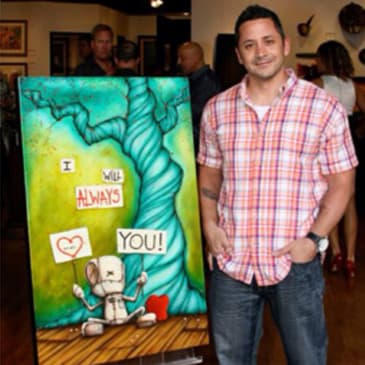
Fabio Napoleoni is a professional artist. He is known for vivid colors and captivating emotional character set in simple landscapes. He has a heart in every one of his paintings. Fabio has authored 3 childrens' books, the Dragonboy series. He comes from a family of artists,and was born in Puerto Rico. His passion and love of art started at a young age. He was born with asthma so his mother got him art supplies to occupy him in hopes to not overexert his lungs. Tune in today as we delve into Fabio's impactful story behind the heart in all of his artwork.
- 03:01 The Start To A Great Artist
- 05:43 911’s Impact On The Career Of Art
- 12:33 A Daughters Impact
- 25:50 Relating Through Conversation
- 34:37 The Mental Focus Of An Artist
- 36:52 Love and Nahsaga
- 47:52 AI’s Affect On The Art Industry
- 49:48 The Motivation Behind The Dragon Boy Series
Don’t forget you can also follow Dr. Rob Bell on Twitter or Instagram.
Follow At:
Twitter @drrobbell
Instagram @drrobbell
Download Your Daily Focus Road Map!
https://drrobbell.com/
If you enjoyed this episode on Mental Toughness, please subscribe and leave a review!
Dr. Rob Bell
[00:00:09] Welcome to Mental Toughness with Dr. Rob Bell. Each week, Dr. Rob sits down with athletes, executives and expert coaches to talk about mental toughness and their hinge moment. Here's your host, Dr. Rob. The two best drugs on the planet is love and nostalgia.
[00:00:42] You have love when you're a child and nostalgia when you get old. You know, and then you just go back to those moments. I mean, I wouldn't trade anything to where I am now at 52 to go back to like eight years old and
[00:00:54] begin, you know, bullied on the schoolyard or anything. I just wouldn't do it. But I love going back and I so listening to men like trying to think the song Black, it's a wonderful life. So if you're listening to that song, just popped on one day.
[00:01:15] I'm listening to, I don't know if it was 80s on eight or something, but it popped on and it just, it brought me right back to being 15 years old.
[00:01:59] So our guest today is a professional artist. He's known for his vivid colors, captivating emotional characters set in simple landscapes. He has a heart in every one of his paintings, which will be a topic that we talk about today.
[00:02:14] It was one of the things that drew me to him. He has authored three books. I can't call him the Dragon Boy series. He has a very impactful story, really excited about this conversation today. But our guest today is none other than Fabio Napoleoni. Fabio. Excellent. Thank you.
[00:02:33] Thank you, man, for joining us, man. I'm really excited about this conversation. My pleasure. And I really appreciate you asking me to join you. Love it, man. So let's just start off like early on, like your entire family were art.
[00:02:47] You're born in Puerto Rico and you suffered from asthma as a kid. And that actually directed you towards, you know, painting, man. Start there. Talk to us about that. Yeah. So I was born in 72 to get myself away.
[00:03:04] And at that time, what modern medicine is today for asthma just didn't exist. So, you know, I went my weekly, I guess sort of shots or sort of steroids that would keep me breathing properly. And my mother would just keep me inside to avoid just over-exerting myself.
[00:03:25] And since my asthma is allergy-induced, I didn't really know, you know, then what it was that was causing me to have these horrific asthma attacks. She kept me inside, provided me with colored pencils and crayons and coloring books basically set my button from a TV.
[00:03:43] So I got to watch cartoons, a lot of, you know, Looney Tunes, Warner Brothers, Chuck Jones characters, things like that. And that was really the birth of it all for me and tracing characters, coloring them. And, you know, it started sort of something that I enjoyed.
[00:04:02] I guess I was related art to having fun and always being a pleasurable thing. You know, and from there, my mother never really, she never pressured me into being an artist. She always just let me do what I wanted to do.
[00:04:21] You know, she always encouraged the art but never said or discouraged me from pursuing it as a career. I should say that. You know, because there's a lot of parents, I will tell you,
[00:04:31] you're a good baseball player and do this or you should go to med school like you, you know, and have these things. My mother, she knew I was an artist but encouraged whatever avenue I pursued. Yeah. No, love it man. And I never went to med school, man.
[00:04:45] I'm not a real doctor. Oh, okay. Just a Ph.D., man. Yeah, you get the wrong, sir. We all have different avenues we travel in and art was always, I loved music so that was another thing too.
[00:04:58] I always just loved, I played baseball and soccer and that physical aspect too, even with asthma, I enjoyed doing that. But there was something about the art that I loved the attention as growing up through high school.
[00:05:13] I loved the attention I got from the girls too, you know, being that guy in art class. I was able to do things and help them out. I enjoyed it and I still do. I just enjoy it.
[00:05:26] I do it every single day and I wouldn't trade it for anything. Yeah. No, I love it man. And I want to delve kind of into the story but, you know, you mentioned something like right even before we started was
[00:05:36] even five days after 9-11, it was impactful for you. Talk to us about that. Yeah. So at the time, my wife and I, we just been recently married a couple years and we had our son, Marcus, our first child. And I was actually working.
[00:05:56] I had just started working maybe three, I think three or four months post 9-11 or pre 9-11. I was working with abused children. So and I mean, what I abused by that, I mean, it's kids that were removed from the home, either they were being abused
[00:06:11] or they were abusing other kids and I worked in the crisis unit. So as they would be removed, they would have to come into the unit. I would be the one that would instruct them what the state of Maine required them
[00:06:22] or we were offering them as a service. I was not the most liked individual at that moment. And so five days after 9-11, my wife had said to me, you know, if you we wanted to buy a second car, funny enough. And she encouraged me.
[00:06:42] She's like start selling your work on eBay and eBay was not quite at this infancy. I've been around for a couple of years, but she said, you know, let's start doing that. So that opened up that avenue to learn how to sell myself on eBay.
[00:06:56] And I started not this, not the artwork you see today with the characters, but it was more very pop art little drawings here and there. But it's been a supply to me with a little bit of income that helped me have a second car.
[00:07:10] So that was my first real true dabble into understanding how you can make some sort of money from selling our. Okay, love it, man. What were you for not? What were you for 9-11? I was in Philadelphia. Oh, man. My I had Tuesdays, Tuesdays and Wednesdays off.
[00:07:29] And I believe 9-11 was on a Tuesday morning. And we had just dropped off my son at my mother's house, Marcus. She was going to babysit him as my wife and I were going to drive
[00:07:40] to Bangor, Maine, which is about a 96 mile drive an hour and a half to go to a mall. And as we dropped our son off the first plane, my mother was watching the news already on NBC.
[00:07:52] And the first plane had already gone through and she was, we had no idea that even occurred. And we're watching it and we're watching it and we're watching it. And then we literally watched the second plane go into the building, into the second.
[00:08:10] And I was like, there's no way this is real. There's just no way. You know, and man, I get goose pimples just thinking about it. And my wife were like, well, do you still want to go to the mall?
[00:08:25] And we're just like, there's no way this has got to be, it's got to be something crazy. It's got to be an accident for. And as we're driving that hour and a half to Bangor, Maine,
[00:08:34] we're listening to the radio and it's just news and the news and things are coming and people are trying to explain all these things. And then we get to the mall, which was always jam packed with people. And there wasn't a soul there.
[00:08:47] My wife and I and maybe a couple of other people were just there and the mall was closing. And so we went to Ruby Tuesdays. We're like, well, let's just grab a lunch and head back home.
[00:08:58] And then we basically sat at Ruby Tuesdays with a couple of other people that were there and their employees and we sat there for hours and watched. Just watched. Yeah. Yeah. And then we ended up watching it coming down and everybody in Ruby Tuesdays was crying.
[00:09:11] It was horrible. I mean, I haven't really had a conversation about it since then. And then just now it's like, it's a breathtaking. You know what I mean? It's just like, it just takes away from you that that was 24, three years ago.
[00:09:27] You know, it's just, it's still that they just, it just, yeah, your mind just starts to wonder. And my wife and I, we drove back home and then my mom was a mess. She would just sit there. She couldn't believe it.
[00:09:38] You know, and it's a, it's a weird thing. A quarter of a century later, still just devastated by it. Yeah. We, one of the things we watched with our kids, because we weren't like, the history is important to our family.
[00:09:50] Like I want our kids to know things, especially like music and stuff like that. Like I never want them to not know who the Ramones are. You know what I'm saying? Like I don't want you to listen to a Beatles song and you'd be like, hey, who's that?
[00:10:02] Like so, and so we'll watch documentaries. One of the documentaries we watched was like inside the towers. So like last calls from people and who they called like in their last moments, you know, and it's, it's very moving.
[00:10:18] But if you haven't watched that one man, it just brings a lot of context to it. Yeah. I've heard a couple of things too on the man that jumped. The, the right. Yeah, I never watched that one. Was that good one?
[00:10:32] Yeah, it's just, you know, there's, there's theories on who it is and who the, you know, the, but it's still undefinitive sort of, you know, and it's to me, it always, it always makes you wonder like this person is here and then they, they're not.
[00:10:45] So how do you know that that is that person or not? Because it, fortunately people do disappear, you know, and you don't know what that case may be. Just to be off a little bit like Pete Davidson's dad, you know, the comedian, you know, he passed away on 9 11.
[00:11:03] And it's just, it's a weird thing how that even later, how that we're listening to him as a successful comedian, you know, and then he talks about missing his father and his father never got to see,
[00:11:14] you know, the person that he, you know, he came out to be and how successful and that must bother, you know, I've never had a loss like that in my, in my life.
[00:11:24] My mom passed away two and a half years ago, but she was, you know, 68 going on 69. It wasn't like I was a child, you know, so I can't, I can't imagine what that must go,
[00:11:36] you know, have some effect on you as a, even as you get it to be an adult and how successful you are, it has to, it has to wear on you. Yeah. No, I appreciate you sharing that man.
[00:11:48] It's not anything I bring up in every podcast, but it's felt, it was significant to talk about. So thank you for that. You know, obviously 9-11 was a hinge moment. This podcast we talked about hinge moments, so that one moment, one person, one event that
[00:12:03] makes all the difference in our lives and especially for you with your daughter being born in 2004. And I like how you tell this story and I'll kind of lay it out and let you take it.
[00:12:13] But during the ultrasound, your wife is looking at the monitor and you're looking at the technicians and their reaction on their face and talk to us about that experience and then through her.
[00:12:30] Yeah, so just to step back from that, we have been trying to get a home, our first home. And we, my wife also was having some complications and because we've been trying for three years
[00:12:44] to have Lauren and all at the same time, she was supposed to have this procedure done. We were waiting to get approved on a home and the same day we were told we were going to,
[00:12:57] we were approved for a home, my wife came home and told me that she was late and then we ended up. You know, she was pregnant. So we're super excited. A home is being built.
[00:13:09] So those progressions as you go, my wife is 20 weeks pregnant and we go to have an ultrasound done. And as we're sitting there, I see the technician, you know, you put the lotion, the jelly on the belly
[00:13:24] and she, and then she could go around, go around and go back to this spot. And I noticed her going around, going around, go back to one spot. And then she sat there and I watched her press it in, pull it back, press it in.
[00:13:35] And something in my mind was just like, why does she keep going back to that spot? So then as I was, like I noticed that I was watching the screen, but then I was looking at her.
[00:13:47] And as she was pressing the machine on her belly and just focusing on this one spot, I could see her just intensely looking at the screen. And then I just caught my attention and I thought, this is kind of weird.
[00:14:05] And so then it was this 98, we're living in Maine. It isn't like I have an iPhone and I can Google what's happening here. So in my mind, I just thought there's something, something's not right.
[00:14:18] So the tech gets off and wipes her belly down, starts telling us and she just gets really sober and just says, I'm not sure if it's anything big, but it just, it does something that doesn't seem right.
[00:14:34] So I asked my wife asked, but she can't say because she's a technician. You know, so she leaves the room and then comes back maybe five minutes later and says, we have to schedule an appointment with a pediatric cardiologist.
[00:14:48] And that is when like life just gets sucked out of you. You know, and what does that mean? So then of course, you know, we go home, we get on a computer and we, what is it? You know, what does it, what does that mean? What is it?
[00:15:01] So the worst thing ever is you look and you go onto whatever not WebMD, whatever was available in 2004. And you just start reading all these things. It drives your mind crazy because now, and now we're in Maine, we're not in
[00:15:16] Orlando. You make an appointment today, you get one in a week from now in Maine. It's like three weeks later. And then we have to drive four and a half hours to go see the cardiologist. And so that was that moment devastated us.
[00:15:30] And then we went to see the cardiologists and in Portland, Maine, and it was Dr. Moran. And I adore that man and that whole entire team. He just basically, we sat there, had a very elaborate detailed ultrasound.
[00:15:45] And after we were done, we sat in his office and he just, he said to us, I don't know if you're religious or if you do, you know, the herbs or any, anything like that. He said, but what's wrong with your daughter?
[00:15:59] All the prayers in the world and herbs and are not going to fix it. And he said, but what I want you to do is, you know, and then he gave us a calm, you know, gave us this great confidence that, you know,
[00:16:12] get, she's just time and by the time she natural birth and there'll be little things that we'll get fixed. But this little mitral valve issue is not, you know, it's, we'll fix itself to a certain point.
[00:16:23] But after that, you know, we'll have to do the rest of it. And he laid out a timeline when all these little things are going to happen. And man, he just, he's like the nostadomist because he nailed that like five months into it. I mean, he nailed that.
[00:16:36] Like he like, you know, you can tell this, he's, this is what he does for a living. Like the timeline, he nailed it. And then, you know, my wife was a mess and I was a mess.
[00:16:50] And then we left that building and we're out in the parking lot and I just, it's lost it. I like, like I just lost my cool in the parking lot. Just lost it screamed yell through my phone half across the parking lot.
[00:17:06] And my wife was in the car crying. And then the first one that came to mind was like, I got to call my mother. So after I looked for my phone, I find it, I call my mother and she, you know,
[00:17:18] I bawled and told her everything that was going on. And my mother never, her voice never cracked. And I know that after I get off the phone, I know she fell apart, you know, but my mom was a rock all four foot, 11 of her.
[00:17:32] And she just said to me, you need to be strong. You know, Marcus is here. Marcus is only about five and a half years old. And you just need to, you need to keep it together because your family's going to need you.
[00:17:44] And you can't, you know, you can have these moments and that's what I'm here for. And just regroup. And, you know, so I had a good five, five, 10 minute conversation where there, and in the drive home, it was like a light switch.
[00:17:56] My mom was just like, think positive. Do, do, do. Do, you know, just don't be so pessimistic, you know. And I grew up in a single family home. My mom raised myself, my brother and then basically my best friend.
[00:18:13] So being an optimist was not always the greatest, you know. Right. Yeah. It wasn't it wasn't the easiest time. So I changed that was the, that's when the birth of, you know, that scan and then, and then go in to see Dr. Moran, his office in Portland,
[00:18:35] and then having that conversation with my mom is where it just, I flipped the switch. I try to be a little more positive in the outcome. And he asked us before we left, he goes, don't go on the internet and don't Google these issues. Don't, don't do it.
[00:18:53] And I know for me, I've never gone. I've never, my daughter's 20 years old and when the doctor says, this is what we're looking at, I've never gone and looked. I've never done. Oh great. I don't believe my wife has done either because I just,
[00:19:07] we just, we've had faith in our doctors, you know, in our doctors. And we just, we just never have. And as it's a, you know, knock on wood things have turned out. Well, I love it man because you follow the doctor's orders.
[00:19:22] Most people would say so the doc said, don't do this. We immediately went and looked at. So I'm, I'm fascinated about the transformation man because you, you mean you have the number five tattooed on your arm for the number of major heart surgeries that your daughter's had.
[00:19:38] And then you talk about, and I wonder if you could just pick up from this. Sure. Like being in the hospital during those times and your art started to change. You started to paint differently. Can you talk to us about that? Yeah.
[00:19:53] So prior to the birth of Lauren, you know, I just did, like I said, I just wanted to make a little money here and there. So I would do little pop art stuff, you know, just, I knew things that were popular and I would do that.
[00:20:06] But once, once literally it started even before birth, like right after we, that conversation with the doctors, I'm at home and I started drawing and I was doing these trees that I've been doing since I was in high school, you know, these lying little pen and ink,
[00:20:23] pen on paper type trees. And they were, I started incorporating one little heart hanging off a branch. And it was the weirdest thing because I never told a single person on eBay why what that meant. I kept it very secret. I never shared.
[00:20:42] I didn't share that our daughter was sick or had a heart issue, you know, and I feel like today's society, everybody, like the minute your child has an issue, everybody puts it up for the world. I'm not, I wasn't raised out.
[00:20:55] You know, this is a family matter and once things are better and, you know, close, it's a close knit community of friends that we keep it together. And we share secrets and things like that. So I never shared that.
[00:21:07] But what I did notice is that people were catching on, man, that people were catching on to the hearts being in there and they wanted to know a lot. So I would say, well, this means to me that, you know, trees are life.
[00:21:23] And this is what is providing you. And so they would be like, oh, this is great. And then the artwork just started selling more than it was before. And I was like, well, that's, that's clear.
[00:21:35] There's a lot of somebody else out there that can understand what this means. Then I started creating these goofy little characters. They weren't handsome and by any means they were just little blobs. Some had ears. Some of them, you know, didn't have a nose.
[00:21:48] They're about as homely as can be, but they all carried his little heart that meant the world to them. And that again caught on. And for me, it was a way of sort of releasing the stress.
[00:22:01] Instead of having a conversation with my wife about the things that were concerning with our daughter and what was happening, I sort of drew it out. And I noticed that that caught on. After she was born, she was five months old.
[00:22:16] And just like Dr. Moran said, around five months old, things are going to be sort of falling apart. That's exactly what happened. We were in the hospital for a long period of time. I was still selling on eBay and I would just go off into the atrium
[00:22:29] and I would just do little things at night or the things that occurred throughout the day. And I would just sort of put them down. I was able to use a computer on there so I would take pictures of my phone
[00:22:38] and basically work out of the atrium at the Barbara Bush Children's Hospital in Portland. And then, you know, that's just the art just grew from there. I just started drawing, creating characters that affected the way life was for us. And it just caught on.
[00:22:57] And that was just what I realized then is that there were more people like in my situation that I thought, you know, you think to yourself, you're the only person in this situation. But what I learned from the art still today is that there are people,
[00:23:11] there are always someone that's suffering and can understand without having to share a story. You know when something is issues. Yep. You said, you know what the heart wants and what the heart needs.
[00:23:27] Can you elaborate on that quote? Because I always thought that's such an epic quote, man. Because you know, when you talk about your painting and impact, grew when you made this emotional connection? Well, it's funny because, you know, it's like the same thing with your heart.
[00:23:41] You want a lot of things. But sometimes what you need, you know, people want a ton of money. You know, you wanted this, you want that. And you think that with a ton of money, life is going to be easier for you. And it's not always that way.
[00:23:54] It isn't. It is for some people and you later documentaries come out 100 years later, you find out they're miserable with all the money on the planet, you know. But what your heart needs is always it's compassion, it's understanding,
[00:24:07] you know, be able to love someone and love them, you know, to be loved and love back. And sometimes that doesn't even need to be the case either. You can love someone and never, you know, get that back in return.
[00:24:20] But a great friendship, you can have that for the rest of your life too. And I think those are things that are needed, you know, an extra car or a fancy home, those things aren't, you know, those are just all, those are all wants.
[00:24:34] And I think when it comes to with our daughter, we know what we needed. You know, you might want her to do, gots to do this or to do that. And but what you need is to be there for her.
[00:24:49] And, you know, when your child gets up in the morning or after surgery, the first face she sees is yours. You know, those are those are the things that you want to be there.
[00:24:58] So my wife and I, we just sit for six hours and one of us would run and get food and run right back because we didn't, we wanted to be there for her. And I think that's that's what I mean by that is just the want is fantastic.
[00:25:13] But you got to have the need first, you know, what you need is that that love, the understanding compassion for you to be able to grow. That's awesome, man. You also said like you want to be known as the guy who didn't hide,
[00:25:32] the guy who listened and shared stories with his collector. I admire the people who collect my work kind of on that emotional connection piece, man. Can you talk about that? Yeah, it's I just related to a second ago.
[00:25:45] It's it's, you know, the understanding how people when I was selling the heart and then I didn't. Like it's it's the computer thing is always it's always fascinating me a little bit because I wouldn't be where I am today without computers because it made my art go everywhere.
[00:26:05] But the part that I still and my kids say because it because I'm old because I'm 52 and I don't understand. But I to me still human touch this kind of like right now, you know, you and I
[00:26:19] look what looking at each other having a conversation even though you're, you know, 100 plus miles away. And this is what people need not, you know, chatting back away and through text or whatever.
[00:26:32] But the first show I ever went to was in Denver in 2009 and I kept saying to myself, no one's going to buy this art. This is too depressing. And people are not going to do it. And my very first show I went to everything sold.
[00:26:48] And the gallery owner was like, I've never I've been in this business 20 something years when people say they're coming back, they never do. But people came back for you really. Really. And my publisher at the time said, I don't know if the art is great,
[00:27:05] but I think people enjoy talking to you. And so when people were coming by the art, I wouldn't brag about myself. I wouldn't tell my story. But what I would always say to them is like, what drew you in?
[00:27:18] What is it about this piece that called you that you needed to be a part of it? And then that's when people would open up to me and they would say, I relate to this piece because your character is me. I've been in this situation.
[00:27:33] And that is when it even made me think deeper. And I started writing after every show, I still do it today. I listen to the stories. My wife and I talk about them. We write, I have totes and totes of notes that I have stories
[00:27:53] that people have personal stuff that people have told me. And that influences the art too. So you'd have these conversations then after the show, you would just write? Oh, it is a great majority of paintings that I've created characters out of people I've met
[00:28:08] because they affected me personally. I mean, I have this little lion character, Leo, and that was from the very first I was having lunch with my publisher in San Diego. And the waitress that kept coming over, I said to my publisher,
[00:28:22] I'm like, is it me or is that girl leaving? And he said, beeping, like a beep, beep. And I said, well, what is that? So she came over and then I asked him, like, I'm sorry, what's that beeping sound? And she's a diabetic.
[00:28:38] So and then she told us a story about growing up and having diabetes. And she was born in the month of July. I mean, so I was born in the month of July, just little things like that. And then so she asked what we're doing there.
[00:28:50] And I said, I'm here for the Chuck Jones Gallery. And she goes, I go there all the time and we're like, oh, do you like Chuck Jones? And then she said, no, there's a character there that I love. And I was like, it was me.
[00:29:02] So it just completely blew my mind. I've been in the art business one year and it blew my mind. And then she sat with us and I talked to her. And in her, I saw, I'm like, she was 24 years old. And I saw like, oh my God.
[00:29:17] So he was this debilitating disease and these girls functioning life. And I thought to myself, my, oh, this is amazing because I could see my daughter being like this girl. And it just influenced that so that the character Leo was created from Alison Melrose in San Diego.
[00:29:40] That's who that and that was in 2010. So that character was created from that. And it's just little things like that that have inspired me over the last 16 years, almost 20 to just keep creating characters from situations I've been in or people I've met. Hey, good looking.
[00:30:16] If you like this podcast and are already a badass, but it's all way too complicated, then visit our website, DrRobBell.com and schedule call with us to help capture your very own hinge moment. The character, and I want to pronounce this one right. So is it Marcinibo? Marcinibo.
[00:30:45] Yeah, close. Marcinibo. Marcinibo. Yeah. Is that right? It's Marcinibo. Marcinibo. Yeah. Oh, okay. Okay. Got to put the emphasis on the syllable. Yeah. I got it. Marcinibo. I try to do as much prep as I can, man. And sometimes I... It's a tough one.
[00:31:05] I had to go in with the Italian name. So it's rough. Talk to us about the development of that character. Yeah. So I started developing him just shortly after we found out Lauren was having a heart condition.
[00:31:22] And I was working with a bunch of different characters and they used up rag doll, as what kept popping into my mind. But I didn't want him to look like your traditional rag doll, you know, the stumpy legs and the stumpy arms.
[00:31:41] And I wanted to give him more of a humanistic view to them and a little pocket where his heart was kept. That had to be there. And over time what I ended up doing is just picking little pieces of
[00:31:57] sort of hodgepodge of different characters I created at the time. And then during Lauren's stay in September into October of 2004, I just kind of drew him out. And the way he looks today is very refined. He was very rough looking, very long gated head,
[00:32:19] body was kind of gangly, feet and hands didn't kind of match. Kind of like a very used up rag doll. Like our early Homer Simpson. Yeah. Posed to now. So it worked and I just refined him over time just because also I never painted anything.
[00:32:45] I didn't start painting until 2005. And that was at the request of a person who was buying my art on eBay. So the very first five to six years of trying to paint him was horrific. But he was born during that time.
[00:33:03] And it wasn't, I didn't give him a name until 2009 after my very first show in Denver where people kept asking me what his name was. And my publisher at the time said he has to have a name.
[00:33:15] He just can't say he's a rag doll and give him a name. So I went home and my mom. So I was talking to my mom and she said you should give me a grandfather's name. That's unique. And you know, so we talked about it.
[00:33:30] I'm like, I've never heard the word my my grandfather spells it with a Z not a C. So we put Marcello and then that was that's where he's been since. And now it's funny because you could literally put in Marcello. I think in Google and he comes up.
[00:33:47] So it's a weird thing. I love that, man. Yeah, it's awesome. I want to delve into a little bit, man, about like your process in terms of painting. You know, I love I mean just recently, at least recently to me, right?
[00:34:05] I like I love seeing like the sloth. I mean, and Chuck. Yeah. And you know, you talk about you have movies playing in the back. Talk to us and if you can share like when you really get into the zone
[00:34:26] and the flow of your artistic side and really just dialed in and time stands still and you're just you're just acting right. You're just doing it. Talk to us about that experience.
[00:34:37] Yeah, it's this sad part is I like right now I we run my business is run out of my home. My wife works for us. My son also works here too. So majority of the day I spent either doing things like this or very little painting
[00:34:55] and drawing in the studio that happens usually at 10 o'clock at night when my wife has gone to bed. My son no longer lives here. So that's when you'll do it. Ten at 10 o'clock. 10 o'clock at night till about I get more work done between 10 and 2 o'clock
[00:35:10] in the morning than I do from 8 to 5. Love it. Yeah, so in that process is pretty much I go in. I already know what I'm going to watch either on Netflix or let's just say I just decide to get things started with Whitesnake 1987. I'll throw that in there.
[00:35:31] And I'm going to go ahead and I'm going to go ahead and I'm going to that you know Bad Bad Boys very first song on there and that just kicks it in and it's awesome background and it's just the music is just flowing. I could put movies on.
[00:35:45] I could put John, you know anything by John he was Breakfast Club or Pretty in Pink or any movie like that. I could watch on Flipside. I could watch First Blood, Rambo. I could go through the entire four or five movies
[00:36:00] and that is what I watch and what I create and I could create the most beautiful you know soft paintings while I'm watching Rambo because it's just it's a it's sort of like comfort food to me.
[00:36:14] It's the music and the movies and nostalgia is key to how I produce how I produce artwork. I mean I could listen Elvis Sinatra and it just works. So the nostalgia piece which I totally connect with.
[00:36:31] Can you just delve into that and impact that just a little bit further? What happens with you when you're in that mode? Oh man it's uh I to me the two best drugs on the planet is love and nostalgia.
[00:36:48] You have love when you're a child and a nostalgia when you get older you know and then you just go back to those moments. I mean I wouldn't trade anything from where I am now at 52 to go back to like
[00:37:00] eight years old and being you know bullied on the schoolyard or anything. I just wouldn't do it but I love going back and I so listening to man like I'm trying to think the song Black it's a wonderful life.
[00:37:18] So if you're listening that song just popped on one day. I'm listening to I don't know if it was 80s on eight or something but it popped on and it just
[00:37:27] it brought me right back to being 15 years old and the girl that I was dating at 15 years old and then it brought me to some of the you know it's things that you I haven't thought about
[00:37:39] in 40 years and it just brought me right back to a couple of because she was older and she said something to me that has just stuck with me. Don't let this town change you know and I was like that's really that's
[00:38:00] that just stuck with me and then I go back to being like 15 years old and I'm listening to the rest of it that's the hit songs in 1985 and it just brings back movies and clothing and you know all
[00:38:15] these things I might see a color hot pink and blue baby blue and I'm like boom there's those colors are in that piece you know or that that vibe where it's a young Marcello and a young Marissa
[00:38:32] and they're sort of looking at each other and there's a red cord from his chest to her chest like you're just connected to life you know those are things that come out of my mind while
[00:38:42] I'm thinking of nostalgia because it just brings you right back to a good it's always a good it's always a good place for me you know it's always a good thing that occurred and then I'm like I have
[00:38:53] to capture that I have to do that so I'll write myself notes I'll put all kinds of the feeling that I was having at that time is what I will that I will jog down and then I get to come back
[00:39:04] or write the song exactly what it is a certain phrase and it works. Want to listen to your favorite music but you're sick of all the commercial interruptions and negative news today tune into
[00:39:15] Cucoradio.com music for your mindset worry commercial free online radio station play nothing but hits our free iOS and Android apps are available for download at Cucoradio.com there's always a point
[00:39:32] in the podcast where we title the podcast I think you just did it man the love and nostalgia are there any songs now that stand out to you that totally mean something different now that you are
[00:39:47] you know your 50s as opposed to when you heard it when yeah I don't it's uh my wife is more current on on the music that's out right now um well I mean a song I mean a song that
[00:40:02] train you know the way I listen to it now is not the way I listen to it back when I was 18 oh I feel like that way about movies too you know it's um uh uh Eddie uh oh my god what is his name um
[00:40:18] uh mardones eddie mardones this song at the time it starts out she was uh she's only 16 years old leave her alone they said you know to me when that song came out I think I was 14 or 15
[00:40:33] and I just moved to uh we just moved to Maine a small town or from New York you know dark skinned kids and we're just a little bit more cultural than the way it wasn't made so you
[00:40:45] kind of stuck out a little bit that song kind of was to me is like don't don't date that weird guy from New York you know and it's so that song you listen to it that's what it meant to me when I was
[00:40:56] you know 14 15 years old you listen to it now you're like it's a bit it's a bit creepy you know or or you know 17 by winger and you listen to him now you're like oh that's that's not a good song
[00:41:10] you know and all the johnny hughes movies are a little iffy too but then it's it's a different time you know as long as you grow and accept the change in things you know it's it's cancelling
[00:41:23] movies from the 80s now it just doesn't make any sense you know we all we we grow and that's that's part of that's part of uh the you know venture forward my wife and I were talking the other day
[00:41:36] and uh there's there's certain movies that when they come on like it doesn't matter what she's doing she's gonna stop and watch so steel magnolias is one of them and another one of
[00:41:46] is uh his pretty in pink yo and um but we were talking the other day we were so glad since so many movies get remade and like the originals like not even that old right but we talk about we're so
[00:41:57] glad that uh breakfast club hasn't been remade yes and say no most fire like two two of those movies are glad they they just weren't remade because they were just so classic 100 percent I
[00:42:08] I uh I just recently watched Roadhouse um I'm a huge one oh yeah we uh our son liked it but he's never saw he didn't see the original and to me anybody who thinks of redoing a Patrick Swayze movie she
[00:42:25] just be thrown into an island casted away from Hollywood that's just it's the wrong it's you just don't do that you know um it uh dirty dancing that comes on and if my wife and I are doing dishes
[00:42:42] or cocaine or doing whatever we literally just stop and just sit there and watch it doesn't matter saying before the chorus gump is another movie um the pickup artist uh weird Robert Downey Jr. yeah
[00:42:54] anything with Robert Downey Jr um our son saw Tropic Thunder I don't know maybe a year ago and he was not blown away he's like how did this movie ever get made? Oh right right because
[00:43:08] and that one day but wasn't even that long ago it violates he goes it violates everything you know and but it's it's been stiller and you know and uh Robert Downey Jr. and that's I think
[00:43:20] that's the only reason it got to where you know where it went so yeah it's interesting man because I tell my daughter I said I just think comedy should be off limits you know you should be
[00:43:30] off limits towards anything criticism stuff like that because we we uh one laughter you need it you gotta laugh every day and you have to be able to laugh at yourself which I'm not the best
[00:43:39] that right but I think you have to laugh every day and I just think you have to grant them leeway to go ahead and make fun of whatever it is you want to make fun of
[00:43:50] because that's your job right and if we it's like it's like saying and I loved it when Rob Zombie said this it's like saying if you want to make a scary movie but don't make it too scary yeah
[00:44:00] that doesn't make any sense you know what I mean no no it's you know that we we all no one's holding you no one's holding you down and making you watch these things you know we my wife and I
[00:44:12] once on days we put we have tv outside and we put it on and we watch comedy after comedy and there are some some guys are like and this guy wasn't that funny you know so you just move on
[00:44:21] and but but we don't it might go a little bit too far this way a little bit too far that way but we all have the option to just move forward that's just the way it is you know to dwell
[00:44:34] that's the other thing to dwell on negativity you're deep down inside you're harming yourself more than anything you know you don't want to be you don't want to be that individual I
[00:44:44] I know people that are just dwelling negativity all the time and as I've gotten older you know I've known in my entire life and just dwelling on negativity I realized like I don't I love this person
[00:44:56] but every time I'm with them it eventually steers down you know down a negative path so you either hang out all day or you know that 20 30 minutes in hey it was nice seeing you and
[00:45:08] right you move on leave a positive note get it yeah exactly leave an positive note and then that's the way it is and that way you you still maintain a relationship you know when to remove
[00:45:18] yourself from from that scene yeah um one of the quotes that you've mentioned before and I'm a quote's hound right but you said like uh and this was uh from Picasso but he said it takes a lifetime
[00:45:31] to paint like a child it's you know um and I I I like that and as I as I've gotten older and my art has gotten better it's 100 percent I there are there are things that I used to be able to do
[00:45:52] 10 15 years ago that seemed very raw and natural like a like a child you know it's for the first time you're doing something and um as you get older and your art gets better it gets refined
[00:46:07] and I've had people that have asked me you know it's like oh I loved the way you did Marcello in 2005 and I'm like I can't paint that horrible anymore I can't I can go back I can try
[00:46:21] and but I can't do it and I think that's that's the rawness I think that's what I take from that quote is that as the the first time you try to draw a cat you know and it's imperfect and the ears might
[00:46:34] be crooked you're like that's childlike but us as adults are trying to constantly improve that and eventually you're doing a surreal you know cat over here with the fur and the eyes and the
[00:46:50] beautiful glow where the raw cat over here that's a little bit off along the tail one legs longer than the other that's the that's the pure the pureness of you I believe that's just when
[00:47:04] your true raw emotion went into that cat for the first time and struggling to draw it we're here now you've done it so often it's just muscle you know your muscle reactions just do it and that's I wish
[00:47:17] that I could do that at times where I could just like I see something in the background of my art I'm like oh if I could do that and then I try to reproduce something I did 10 10 plus years ago
[00:47:30] and it's still it just I can't can't capture right yep how has AI not necessarily like any specifically with you but how has that changed the industry you know I had a good conversation with um her name is Ruth Ann Thorn she's a publisher our publisher for
[00:47:53] a very very successful artist in California and she asked me what my thoughts on that were and at the end of the day um I think you know everything goes through a little popularities
[00:48:06] and AI is fantastic and I will tell you I mean if you think of an idea for me and I'm like oh I wonder what a you know cat serving on the back of a rhinoceros would look like you know I could
[00:48:18] think of it a bunch of different ways you throw it in AI and they'll come up with an idea and then that gives you an idea but then you still with your hand you know and that is what we the
[00:48:29] conversation we had is it's a great fact and it's a great way to sort of get ideas instead of spending all day thinking on the idea AI sort of gives you sort of like a snapshot of what
[00:48:42] you might be thinking or maybe didn't think at all but your what you suggest it was you know an idea you see it and it's sort of like the same way when I hear a lyric
[00:48:53] the idea is that come to mind just from that one lyric I think AI kind of kind of does the same thing but I don't uh I think at the end of the day you people are going to want to see it you're
[00:49:03] going to want to see the brushstrokes the imperfections in the art you know to know that a man labor over um that piece of art that may have taken them three hours or three months
[00:49:16] I think that at the end of the day I don't think that will ever go away I think that that us as humans are always going to want to see someone else's labor opposed to just anybody
[00:49:26] suggesting something in the AI and then calling it out yeah thank you for sharing that man yeah um and then you've you've written illustrated three children's books dragon dragon boy yeah dragon
[00:49:39] boy dragon boy uh in the wonderful night and then dragon boy in the hundred hearts right yeah what was the motivation and story behind that so um my old our oldest is uh 25 years old um
[00:49:55] and he was the only child for about almost six years or loram was born and uh in around maybe two three years old he just uh really just just all of a sudden he was loving spongebob and
[00:50:10] the par puff girls and and he's he's still now just loves dragons loves getting thrones anything else with dragons he also he's a computer computer guy who's uh game design
[00:50:23] computer science that's what he's got his degree in so um at around man I want to say 2008 or so I had just signed with a publisher um so he would have been almost 10 years old and we
[00:50:39] started dueling at my table and he's like oh you should draw this guy you should draw this guy you should draw this guy so I started drawing little you know a little boy and this literally
[00:50:49] you know this little guy right here and uh so I started drawing drawing things um and so the birth of dragon boy is really just my then 10 year old but now he's 25 you know um so it's it's um
[00:51:05] I hid the fact that I had drawn created him and his friends from a publisher because a publisher the minute you introduced that into the art world belongs to him while you're in a contract
[00:51:17] publisher so I sort of held it aside did uh drew it under a pen name for six years um and in 2015 I was at a gallery show and I introduced him as a character that I've been working on since 2008
[00:51:32] and oddly enough he's the one that he ends he ends up getting the children's book because it's in the in the sense of Marcianiboy is a very melancholy kind of character where dragon
[00:51:42] boy is a pure imaginative world you know he's a little boy doesn't care what you think about him he's gonna wear a suit he's gonna do what he feels like doing um and then that's the that's the
[00:51:54] book a little character that little brown books just just adored and they're like let's I was hoping for one book and we ended up with three so love it's good what is the um what is the
[00:52:11] one question that should be asked in that that I just haven't asked I don't know I think we've covered a lot maybe we talked about nostalgia I think uh um well it's uh the one oh the about the art
[00:52:30] business I think that's the one that a lot of people don't don't ask yeah so the uh the art business is like any other job you know when you think about it it's you go to work someone
[00:52:43] hires you because they you have a talent that they want and then they pay you for that talent and then as you grow as you your talent gets better gets better you get a promotion
[00:52:53] you move on and you move on more the art business isn't quite worked out you're an artist and galleries do take a chance on you and you know and you sell the artwork and all that
[00:53:02] but as you get better you don't get promoted the promotion comes from making more making more income you know um and in that of course that's a that's a plus because now you're
[00:53:14] you know you have your wife employed and your son employed but it's it's always a very um uh in me understanding the art business as I come up in it I noticed gentlemen that were very very
[00:53:28] popular when I came in and have sort of vanished there were some guys that came up at the same time I came up skyrocket you know in success and then plummeted and then they're gone so for me
[00:53:43] I've always been very conscious of not over uh pricing the artwork or saturating at the same time or galleries wanting all this artwork and then they're like discounting it so they can get
[00:54:01] rid of it you know so it's it's a um outside of that's where I said you know when you're working when I'm working I spend more time I probably creating art is probably about 25 percent of
[00:54:11] what I do on a daily basis which is sad because I should be doing it 100 but there's a lot in the art business that you have to constantly um you're you're watching what the galleries do
[00:54:24] you're making sure no one steals your artwork but then you're copywriting everything because if you copyright everything and someone puts t-shirts on amazon you can tell amazon hey listen this is my copyright this is this is not and they take it down but don't people will make copies
[00:54:41] of your art you know and insist those are all the things about the art business that this all started from a beautiful place but then it once you become successful you have to watch
[00:54:51] that you know because uh it's sadly at some point the the reason how you got here sort of vanishes a little bit and that's the sad part you know that it it doesn't with the collectors but it does
[00:55:06] with the people who invested that makes sense you know I feel that at the the reason it got into it is the story was great the people were loving it but as you become more successful
[00:55:20] you sort of become he's going to come on this day he's going to come on this day he's going to do so many things but the story behind it sort of fades and then I feel at 15 16 years into the business
[00:55:33] I feel like I'm telling the story again myself because I need to the new collectors because nobody else did that that story that sort of you know it's the how the foundry how it all
[00:55:46] came together you still have to say it all the time because if you don't and you depend on people around you to do it for you some it's not gonna happen that's fantastic great thank you for that
[00:55:59] no problem one more question brother yeah so what is the legacy that you want to leave oh man um that's a good question um since um I was a young kid I've always uh
[00:56:20] like um I always wanted to do something that after I was gone I I've been I just like I love Sinatra and Elvis and Winston Churchill you know and in all kinds of facets Picasso van Gogh
[00:56:33] and it's not always about you know what they created or did but it's more about the man that they were you know um Churchill with the high balls and then long cigars and the trickery that he would
[00:56:46] put the pen in so the ashes would stay long and you know they would bid on how long his ash would be before it fell but nobody knew until later that he had put a pen in the cigar
[00:56:56] so the ash would never fall you know those are all just little things like that that you find out you know van Gogh too in the ear and go gone and you know nobody knows whether he was gay or
[00:57:05] if he loved the prostitutes or just things like that fascinated me but I for me whether um you know my artwork gets bigger and it goes somewhere else it's after I'm gone
[00:57:23] that it lives on that to me knowing that I I've created a body of work um so what I've what I produced so far what people have seen is probably a tenderly artwork I've created you know it's
[00:57:37] it's all catalog and after I'm gone I'm hoping that my kids take it and then after they're gone I hope that their kids take it because there's enough artwork there sort of like like
[00:57:48] Keith Herring, Abbas Kiad or Warhol how the art just continues those men's obviously at a different level but what I mean is that it continues to hopefully have that same effect that it does now
[00:58:01] on people and no I don't see how it would because there's always sadly there's always going to be sorrow there's always going to be a parent that you know might have a child with a heart
[00:58:09] condition or a child that's ill or you lose a parent and you know 100 years from now or so someone sees an old print or a painting of mine that that spark it's like oh my god who created
[00:58:23] this you know and then they look at the art that's what I would like my my legacy to be and it's one of the uh I think I said in last this past weekend of my wife it one of the things that always
[00:58:35] sadly we've lost and you know a couple of friends they're in their fifties and I always say to her I'm gonna die mad if I don't get to complete everything I've wanted to you know so I'm like
[00:58:47] a madman all the time I'm doing sculptures and bronzes and trying you know doing the retrospective book and the sculptures and now the children's book those are things off my list have a couple other things in mind that I want to get done and then you know before
[00:59:02] they take me away and then I'm like these are the things I want to get done so then I just have I leave more behind you know because I think of my kids too
[00:59:10] after I'm gone my son can literally run my the polishing aspect of it from here yeah thank you absolutely love it man well I hope in some small way man that this podcast will
[00:59:22] at least help contribute to that man and oh this this is just fun having this conversation with you I mean yeah I appreciate it but I mean it's I just enjoy it and I like when you have that
[00:59:32] you know the good conversation back and forth no one's kind of stuttering for what to say next it's good it's good yeah awesome man hey man really appreciate you I'm gonna put the links on
[00:59:41] obviously with this nose but Bob thanks so much man for taking my time and just doing what you do man make an impact in the world I appreciate it same to you thanks for listening to mental
[00:59:54] toughness with Dr. Rob Bell to find out more about Dr. Rob visit his website at drroppbell.com or follow him on Twitter at Dr. Rob Bell and subscribe to the show on your favorite podcast
[01:00:07] platform to get the next episode of mental toughness as soon as it's available thanks for listening and we'll see you next time