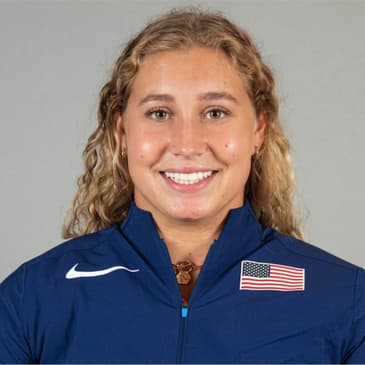
Adelaide Aquilla is an elite shot put athlete and two-time NCAA Indoor and Outdoor Champion. She represented the United States at the Tokyo Olympics and won a bronze medal at the Pan American Games. With a personal best throw of 19.6 meters, Adelaide was also honored as the Buckeye of the Year at Ohio State University. Join us as we delve into Adelaide's journey and insights on mental toughness and athletic excellence before she heads to Paris to represent the United States at the 2024 Olympics.
- 03:39 The Meaning Of A Tie Dye Sweatshirt
- 09:43 One Thing To Look For At The Olympics
- 15:49 The Mental Toughness Of Going ALL IN
- 20:07 The #1 Mindset To Perform Your Best
- 25:12 Break Down The Process, Build Up The Athlete
- 28:17 Championship Mental Lessons
- 35:16 1000 Reps While In Bed // Visualization
- 39:51 Remember Who Your Are // Imposter Syndrome
Don’t forget you can also follow Dr. Rob Bell on Twitter or Instagram.
Follow At:
- Twitter @drrobbell
- Instagram @drrobbell
Download Your Daily Focus Road Map!
If you enjoyed this episode on Mental Toughness, please subscribe and leave a review!
Dr. Rob Bell
[00:00:09] Welcome to Mental Toughness with Dr. Rob Bell. Each week, Dr. Rob sits down with athletes, executives and expert coaches to talk about mental toughness and their hinge moment. Here's your host, Dr. Rob.
[00:00:23] Honestly, like when I am my most relaxed, that's when I have my furthest throws. When I threw my PR 1964, I was dancing around singing like the entire time just really like I knew what I needed to do. And I was confident in myself. And I knew that if I was relaxed, if I worked on one specific thing out of the back, I would do it.
[00:01:04] So our guest today on the Mental Toughness Podcast is a throws athlete. She specializes in the shot put. She's a two time indoor and outdoor NCAA champion. She's an Olympian. As we always say, there are no former Olympians ever. Representing United States in Tokyo. And she's also a bronze medalist in the Pan Am Games. Longest throw is 19.6 meters. Hopefully I have that one correct. She was Buckeye of the year at Ohio State
[00:01:36] University. And excited for this conversation today. Our guest is Adelaide Aquilla. AA Adelaide, thank you so much for taking the time and joining us.
[00:01:48] Yeah, thank you for having me on.
[00:01:51] So let's I always like starting off with kind of the simple questions just to get it going. But I mean, on your Instagram, which you do an excellent job of that as well. But, you know, congrats on your engagement.
[00:02:03] Thank you.
[00:02:04] Is in the fall and I love the funny caption there because you said it guess he wasn't tying his shoe. Just tell us about that experience for you.
[00:02:12] So my now fiance and I had been like talking about getting a cat for a while. And he brings me to the car. He's like, all right, put the blindfold on. I think we're going to get a cat and he's like
[00:02:27] Fully like prepping me. He's like, all right, like, it's going to be kind of heavy when you get it. Like, don't drop it. And I'm like holding my arms like this. And he's like, okay, you can take off your blindfold, but put your arms like back like that.
[00:02:40] And he's like down, like fiddling with his shoe and he like pulls during it. And I'm like, oh, you are sly. That was a good one. So kind of pulls out the whole thing. We have a little get together with our friends and
[00:02:55] Go see our family the next day. And yeah, it was really nice. It was good. I've been with him.
[00:03:02] Coming up on seven years or something like that.
[00:03:05] Okay.
[00:03:05] Okay. Yeah, yeah.
[00:03:08] That's, that's, that's fantastic. Congratulations. Very, very cool.
[00:03:12] Thank you. Yeah.
[00:03:15] You know, with your journey.
[00:03:17] I guess let's just start kind of with like the hinge moment if you can. They know that one moment one person one event makes all the difference.
[00:03:24] Your parents. So they encourage you to play sports every season. You had to play something and we're kind of the same here in our house, but talk to us about that.
[00:03:33] And then how you kind of got into track and then and then, you know, shot put and throw is specifically
[00:03:39] Yeah, my parents kind of like unspoken spoken rule was you either get a part time job or you do a sport. So obviously you're going to take the easier route and get the sport or do the sport. So I kind of was just trying everything basketball cross country.
[00:04:01] Soccer volleyball. Nothing was really like sticking and then I got to track. I really liked the team aspect of it. It's very team oriented because you want to win those championships, but it's also very individual focused and
[00:04:18] Your middle school right
[00:04:20] Yes. Oh, yes. Yeah.
[00:04:23] Very individual focus, but it's also just like fun. You know, there's always something going on. There's always a different event running throwing jumping, whatever it might be and my middle school did a
[00:04:37] Little kind of like competition throughout the year on whoever could do every event on the track in the field and just complete everything in one season, you would get like a tie dye sweatshirt.
[00:04:52] Back when tied I was like super cool and middle schooler. You're like, this is the best thing that's ever happened to me. I need the sweatshirt. So going along trying out all these different things.
[00:05:07] And I get to shot put one weekend and I think I was in like sixth or seventh grade or something like that. And I do shot put
[00:05:18] And my throws coach at the time. Mr. Gimli he passed last year, unfortunately, which is very sad for me, but
[00:05:27] He looks at me. He's like, at like you're in like seventh grade and you just dominated all the eighth graders, like I think you have something special.
[00:05:36] You should stick with this. So unfortunately, I never ended up getting sweatshirt but I stuck with it and then
[00:05:44] Went and did it at high school. I was pretty successful during my time there. I think the best I did was I got second at states as a junior and
[00:05:56] My senior year. It was me and then a girl who committed to Indiana, who I competed against a lot in college, a girl who committed to Akron
[00:06:07] A girl who committed to Cincinnati to play soccer there and we were all in the same district and
[00:06:14] I was already committed to Ohio State at the time. And so we go into districts and I throw a throw like 44 and a half feet or something like that, which should guarantee you like a spot at states. But obviously I have all these other girls as competition and
[00:06:33] By one spot. So I remember calling my former coach Ashley. I'm like, I just threw like 45 feet. I have no idea like what to say. And I looked at my mom. I'm like, I threw my second best throw ever. So I don't know, like, I'm not sad about it. But it's also just like crap. I could have gone to states.
[00:06:56] So,
[00:06:56] So that was just how competitive that district was and
[00:06:59] Oh, yeah.
[00:07:00] Yeah, it was, it was crazy. Yeah, like normally to get out of districts or regionals or whatever it was takes like 4042 feet maybe 43 on a good year. So I was just like completely blown out of the water at the time. I was like, I don't know how to react. So
[00:07:22] It's interesting.
[00:07:22] It's interesting.
[00:07:24] You know, during so during high school and you know throws and then shots put specifically did you
[00:07:30] Because I'll talk about like you getting to Ohio State in a second and kind of the transition. But did you love the sport and what like what did you love about it.
[00:07:40] Yeah, I definitely as I grew up, I started to like the sport more and more. I mean shot put
[00:07:47] I'm a very type A person. So very like detail oriented very it has to be this way, not this way.
[00:07:54] Shot put is exactly like that. You know, if you mess up a singular little detail out of the corner of your throw, which is
[00:08:02] Normally what people would say is the most important part of your throw.
[00:08:06] That's where all the details and the nitty gritty stuff kind of come into play. And it's very
[00:08:12] You either through this far through this far. There's no oh I tried my best and it's very numbers focus. It's very detail focused and that's kind of really what I like about it. It also has aspect of
[00:08:26] Weight lifting and being an actual athlete, you know, everybody just assumes you're trying to chuck the ball as far as possible.
[00:08:34] But there's a lot of technical work that goes on behind scenes as well as a lot of weightlifting and just training like random muscles, you know, over the past few years we've really started focusing. There's my cat.
[00:08:49] We really started focusing more on becoming athletes. So we've incorporated a lot more of like jumps into it single leg jump single leg RDL and just like
[00:08:58] Really honing in on these athletic motions that we see in our throw that also we can have in our weightlifting program.
[00:09:08] Yeah, absolutely. Because I noticed that in the weightlifting program and you know what the last half dozen years. I mean the the speed of the the lift as well. Yeah, it's one thing to be able to squat.
[00:09:18] Yes, 50 but the the velocity of doing it. Yeah, I noticed that on Instagram and so real quick. But in before we get into a house date.
[00:09:29] When we are watching Olympic Games and we're watching throws athletes specifically shot putting you mentioned the corner. What's one thing that we should be looking for like technique based with, you know, with you and the best in the world.
[00:09:44] So it kind of varies from person to person. There's two different ways to throw the shot put there's the spin, which is where you start facing the back of the ring and then end at the front of the ring.
[00:09:56] And there's also the glide, which is a singular motion straight across the ring. Now, there's a few athletes in the world. The woman from Portugal.
[00:10:07] And the Chinese athletes that also that use the glide but majority people use the spin when I'm talking about the corner. I'm specifically talking about the spin because that's what I do.
[00:10:20] So one of the things that is really important is making sure you properly get over your left leg.
[00:10:27] So ensuring that you have the pressure through that leg that you can use it as a run off of the back. So you're able to create that momentum in the middle, which helps you catch the ball back and create a big torque in the front and all that stuff.
[00:10:44] Oh, I love it. I love getting the intricacies and no one like the minutiae in terms of technique based so that's fantastic.
[00:10:51] I could go into a lot more detail, but I figured that would be for another time.
[00:10:55] No, it's great. But I mean you even mentioned it.
[00:10:58] So when it comes to the things you can control.
[00:11:01] I mean, even the surface of the concrete can make a big difference for you, can't it?
[00:11:06] Yeah. Yeah. So that's actually really funny that you mentioned that at Hayward Field a couple of years ago during Olympic trials or leading up to Olympic trials. Sorry, I'm skipping ahead a little bit.
[00:11:18] But everybody was, it was a newly built facility and laying the concrete becomes like a very specific task.
[00:11:28] So they had to meet there before and it was raining and the best people in the world were slipping and falling all in that ring, which is not a common thing.
[00:11:38] You know, if you're the best in the world, you have good technique and you know how to work through the rain and that type stuff.
[00:11:43] So the concrete would definitely play a big factor and luckily we our ring in Columbus was poured really nicely.
[00:11:53] So it's very fast ring. So going there, you kind of like figure out what it's going to be like and it's not going to be as scary when you feel that faster surface.
[00:12:05] Okay. Yeah, I love it.
[00:12:07] Hey, good looking. If you like this podcast and are already a badass, but it's all way too complicated, then visit our website, drrobbell.com and schedule call with us to help capture your very own hinge moment.
[00:12:29] So you get to, I mean, you think you were a walk on there at Ohio State.
[00:12:39] Never lifting really in high school. You show up then one of the best universities in the country and then I mean, then start weightlifting program there.
[00:12:48] But talk to us about that phase of your development and journey.
[00:12:53] It was, it was a big like shock to me when I got to college.
[00:12:59] Like you said, I barely lifted in high school. I mean, starting my senior year, that's kind of when I actually started lifting, but I just did like Olympic movement, snatch clean jerk, occasional deadlift, but I never benched.
[00:13:15] So once I got to college, we had every Sunday. It was like a two to two and a half hour lift where you would do clean, clean pull deadlift bench squat and then six or seven auxiliaries mixed in there.
[00:13:33] So kind of I walked into it, eyes wide open, never having to do this stuff before.
[00:13:41] So it was a little, it was a little weird, but I mean, you really use your freshman year as a learning experience.
[00:13:49] I did not have any expectations on me at the time. There was other girls who were referring a lot further and I was expected to redshirt that entire year.
[00:13:59] So I just used it as myself. Hey, this is a new program you're going into. These are new classes. It's going to be a lot more strenuous in all of the aspects of your life.
[00:14:10] Adjust to it and then start setting your goals and learning how to compete with the girls in the weight room, compete with the girls during practice and all of that stuff.
[00:14:22] So you actually then took that whole first year, you're able to mentally take a step back and say this is just all scientist phase, right? Like this is all learning everything I'm going to need to in order to take that next step.
[00:14:34] How did like how did you mentally do that with being so driven as you are?
[00:14:40] I realized once I got there, I'd never, I had benched once in my life. I had to learn how to bench right when I got to college.
[00:14:52] So that was kind of like my first indicator of like, you kind of need to take a step back before you can take a step forward.
[00:14:59] So I learned how to bench and then my coach at the time completely like tore apart my technique, just saying all this stuff that I do wrong, which is a normal occurrence.
[00:15:12] You know, you normally take everything apart before you put it back together. So we completely took apart my technique, worked on the things and then started putting it back together.
[00:15:25] But it wasn't moving forward at the pace that either of us like. So that's where we made the decision, hey, we're going to red shirt this year.
[00:15:33] Okay, well, that's fantastic though. With when in your collegiate career, when did you kind of take that leap of, hey, I'm good?
[00:15:46] I always mix up if it's my junior year or my sophomore year. I think I was like the last one or the first person out of regionals.
[00:16:00] So there's a website for track and field. It's called Teefers.
[00:16:07] And the way to get to nationals is they divide the country into two sides, east, west. And they take top 48 on the east, top 48 on the west and then top 24 of each go to nationals.
[00:16:24] I think I was like 49 or something and I didn't make the region to meet. I was like, this was my first year competing.
[00:16:34] And I barely missed out on this. I think I could be good in these upcoming years. So I kind of had that mentality switch of like, I've been doing what I needed to do to stay in the program and to continue to like improve, but I haven't been doing it well enough.
[00:16:54] I haven't been doing it well enough at like a spot where I'm fully committing myself to it.
[00:17:02] You know, I was like kind of just dipping my toe in the water seeing if I really liked it.
[00:17:06] And so that's kind of when I was like, all right, we're going to take my summer life seriously. I'm going to stay down here.
[00:17:14] Do my classes, do my summer classes down here and work with our strength and conditioning coach on our summer programming.
[00:17:22] And then I come back my junior year, really just working on my throwing technique, my lifting technique and just kind of like making that switch of like, I am a student athlete.
[00:17:40] I have a life outside of it, but making nationals, winning nationals and all that stuff is more important than the other social aspect of it.
[00:17:52] Sure. So it's really making that commitment of being all in.
[00:17:57] Yes. Yeah.
[00:17:59] One of the big things that I changed was I started making like daily, like timed out lists of what I did.
[00:18:09] So I was like, all right, you'll wake up at 8am, you'll have breakfast, you'll go and go for your walk in the morning and then you'll go do some schoolwork and just kind of like planning out my days and weeks that way.
[00:18:22] So I knew like, okay, this is the time when you have to like engage yourself in practice.
[00:18:30] This is the time when you have to engage yourself in this. So I had the dedicated space to know what part of my brain was flipping on and off.
[00:18:38] Obviously at the time I didn't really think about that, but now looking back at it, I'm like, this is for sure to save myself the little bit of energy that I was putting into everything else.
[00:18:48] I would be like, all right, you have to think about shot put during this time.
[00:18:52] Right. Yeah.
[00:18:54] I mean the compartmentalizing them and that's fantastic skill there. I mean, and you just came up on that on kind of your own and
[00:19:04] My, my coach gave me a talk going into my junior year.
[00:19:11] And she was like, you can be very good at this. Like I said, like you have to commit yourself to it like fully commit your time effort money, whatever it might be and you'll see the results from it.
[00:19:24] And that's what motivated me to start being like, okay, we're going to be more detail oriented on the throwing aspect. The schoolwork aspect, making sure everything's done on time, making sure I'm to practice 15 minutes early and just really putting the effort into making the effort in other things.
[00:19:45] Mm hmm.
[00:19:46] Fantastic.
[00:19:48] So you go on to win.
[00:19:51] Not once, but twice indoor and outdoor NCAA champion.
[00:19:58] I guess when I asked you to reflect on one of those.
[00:20:02] What specifically stands out to you about one of those championships.
[00:20:11] I think my mindset going into all of them was very similar.
[00:20:18] It wasn't me looking at the other competition and saying, oh my gosh, this person has thrown this previously.
[00:20:25] They just warmed up so far. I've never, I've never thrown that far in my life. It was just me focusing on me the entire time.
[00:20:35] And just having fun with it. Honestly, like when I am my most relaxed, that's when I have my furthest throws. When I threw my PR 1964.
[00:20:47] I was dancing around singing like the entire time, just really like I knew what I needed to do.
[00:20:54] And I was confident in myself and I knew that if I was relaxed, if I worked on one specific thing out of the back, I would do it.
[00:21:05] I love it.
[00:21:06] See, I think so many athletes think that there's one way to make cookies.
[00:21:11] That's just the Betty Crocker. Just follow this recipe.
[00:21:15] When, man, you got to have fun making the cookies, right?
[00:21:19] Like if how important is that to you?
[00:21:22] Because I mean, just having fun and doing what you want to do.
[00:21:27] I mean, you just said it right, but it's crucially actually performing your best, isn't it?
[00:21:32] Yes. Yeah, that's one of the big things that I focus on lately.
[00:21:38] I think early in my career, I was so goal driven and just focused on being the best that I could at the time that I didn't really like take time to see myself as anything other than an athlete.
[00:21:55] And at the time that worked out really well for me. You know, I was very focused.
[00:22:00] I was very committed. But now it has kind of taken a toll on me and it just like I have to take time for myself and show that I'm not just an athlete.
[00:22:12] I have hobbies outside of it. I love to do yoga.
[00:22:16] I love to go for walks. I love to play with my cat or board games or whatever it is, you know, that having fun outside of the sport as well as in the sport is so crucial.
[00:22:28] Because if you just continue to like focus on being just the athlete, once you're done with it, you have a complete like disheveled.
[00:22:39] I don't know what I'm going to do with my life kind of like midlife crisis. Right. Right. Exactly.
[00:22:44] No, it's fantastic. And even so then that balance and kind of mental wellness that you would put into outside of just being an athlete.
[00:22:55] Yes, that even actually helped you then perform better, didn't it?
[00:22:59] Mm hmm. Yeah, that's I whenever I was gearing up for a big meet, I would make sure to do like specific like activities outside of track that I think are fun and that gives me like bring me a lot of joy.
[00:23:15] Like I would always go for a coffee at like a cute little coffee shop on Sundays. That was like my fun activity. I would do painting with a friend or something and then I always try to like read a good book.
[00:23:29] So those are my like three activities that I kind of do leading up because then I feel good about myself as well.
[00:23:38] I feel good in my competition form that I know that okay, you did everything right. You know what you're doing. Let's see something go far.
[00:23:49] Coffee, painting, and a good book.
[00:23:54] Very simple life.
[00:23:57] I love it. I just think, you know, it's too often and I think mental toughness gets a bad rap in terms of it just means how bad do you want it? And I think that's just like that's sort of the foundation.
[00:24:11] That's the baseline of it. But unless you're able to even just allow your mind to disconnect and relax, you know, it allows you I think to just have a better perspective heading into how well you want to do.
[00:24:24] Yes, I 100% agree. I think that's one of the things that has kind of changed over the years.
[00:24:33] It's kind of been like, oh, how much do you want it? How much are you willing to do? Versus now it's how much do you want it? How much are you willing to do? But also, what are you doing outside of it?
[00:24:45] What are you doing for yourself? And there's a bunch of different aspects that have been added to it. Versus just the one singular how bad are you wanting it?
[00:24:57] So, again, I said this but I messaged your coach hey what's what's one question I need to ask her and he said, you know what, and you kind of talked about it but what has mentally changed for you in your development through the past several years.
[00:25:13] I think kind of touching upon what you just said.
[00:25:18] Very much so, I was driven to the goal.
[00:25:23] And I didn't really take time to set the not set the foundation, set the foundation to continue to achieve these goals.
[00:25:33] I said, all right, let's get to this goal as soon as possible. Best way possible.
[00:25:39] And then go from there. And now, my coach and I are really focused on taking the time to understand the different things that go into the throw, as well as like how I mentally perceive the balls.
[00:25:54] So, during my shot put practices will do a lot of like light balls and heavy balls.
[00:26:01] We've really taken the time to talk about how I perceive the heavy balls.
[00:26:09] Versus how I perceive the light balls because you me throwing them is two completely different things. I will work super hard to get all of my positions and engage my legs with the heavy balls versus the light ball and like, oh, it's a light ball, I can go fast.
[00:26:28] So we're really trying to bridge the gap between the two.
[00:26:32] And make me think that the light balls, the heavy ball.
[00:26:39] Kind of like, like aspect or like abstract topic. But right. That's one of the big things I would say that's mentally like changed over for me for the past few years, as well as I feel like just in the throws aspect is general.
[00:26:57] There has been a big change of.
[00:27:01] Oh, you need to be super strong. You need to lift a ton of weight versus now it's, you still need to be strong, but how fast can you move it.
[00:27:12] How many. What's your velocity that you're doing at how many watts are you putting out. Are you athletic in other movements are you and just the whole sport I would say is evolving so much.
[00:27:25] And it's weird I was reflecting on it with somebody the other day.
[00:27:30] I was just kind of like talking about how much the standard of the sport has changed you know everybody always talked about how, oh all the throwers are big and strong first now you see a bunch of like athletic girls and just like everybody has their own way to
[00:27:49] throw the ball far it's not just one way is the way.
[00:27:53] First now 20 different ways to do it.
[00:28:02] When, when you won some of your championships.
[00:28:08] And this is a question I kind of just like to ask champions.
[00:28:12] How long did that feeling last for you.
[00:28:17] I think I.
[00:28:22] It's different for each one.
[00:28:25] The, the first championship, I think I had like a nice two or three days where I was like excited celebrating it.
[00:28:38] The second one. It was like a one day thing, because that one was right before the Olympic trials I was like, Yes, I won the national championship, but I want to make the Olympics so I'd rather put my energy into that then continue to relish on the past.
[00:28:58] My last national championship my last outdoor national championship I think was the one that I like thought about the most just because that was like the end of my eligibility. That's where I threw an IPR, and my whole family was there.
[00:29:12] So I was able to celebrate with them. And then I came back home. And my friends were able to put something together for me. So that one was really special is kind of like the end of the new beginning.
[00:29:26] So, that one was the most I think my videos of all them like I'll watch them and still they'll make me smile. I'll be like, Oh, that was like so much fun. Just thinking back on the memories of them, but honestly, none of them out to more than a week.
[00:29:46] Yeah, is.
[00:29:48] I mean the journey about like who you're becoming in the process. It's more important than the actual mountaintop isn't it. Yes, yes. Can you talk to us about that and how you've kind of navigated that.
[00:30:01] Yeah, if you really want to have I feel like, in my opinion, if you really want to have continued success. You can't just focus on. There's this one time that I was super successful at the top of the mountain, you have to think about all the stuff that helped you to do so.
[00:30:21] What kind of schedules. Did you make, did you go to yoga every week, did you focus all your time at practice you know all that stuff is so much more important, at least in my opinion then that one pivotal moment, because you wouldn't be able to.
[00:30:40] You wouldn't be able to get there without that stuff that helped you get to the top of the mountain.
[00:30:47] Yeah.
[00:30:49] I had to marry the some laughing on.
[00:30:53] And she's awesome right but I mean she was a throws athlete and yeah she's the best. And then, you know, with with her lifting career and we spoke about and one of the things she talked about what carried into her lifting career was she had a win one time, you know,
[00:31:09] in the rain. And she always kind of held on to that because she was like no matter how bad this situation is going to be she kind of relied on hey the things she had to overcome she won in the rain when that's championship in the rain so it was like, how, how do you handle.
[00:31:26] What have you experienced about yourself by handling the difficult situations you know whether you have two fouls whether it is raining like logically like you spoke about not letting emotions kind of get in the way but talk to us about your process for that.
[00:31:42] One of the biggest things that, like, kind of like sticks out to me is some of our lifts are just like super grueling. There'll be like four sets of 12 on squat at a super heavy weight.
[00:31:57] And I kind of remind myself that, hey, you just squatted, whatever 350 pounds for 12 reps or whatever I did for that set.
[00:32:08] You can throw 8.8 pound ball.
[00:32:13] 18 meters.
[00:32:15] You did.
[00:32:17] Whatever in the weight room, you through the 12 pound ball.
[00:32:21] 14 meters.
[00:32:23] You can throw the eight pound ball four meters for you.
[00:32:28] You know, I think I just pull a lot from my previous experiences.
[00:32:34] And I think the one thing that really sticks out to me is my first big 10 title outdoors.
[00:32:43] I remember to win it, but that was the first time I thrown 19 meters. And that was kind of like my pivotal moment of you can throw really far and you compete. You can compete against the best in the world.
[00:32:58] And it was a little rainy at the time, of course.
[00:33:03] But if you can jump here and you can win it against all these college girls, you can compete against the best in the world.
[00:33:13] Love it.
[00:33:14] As I introduced you said there are no former Olympians which I always find to be really cool. Right. Just like there are no former. Well, I guess they'll say former president but I always believe like there's no former Olympians.
[00:33:26] When you were there, just as you know opening ceremonies. What was that experience like for you.
[00:33:34] I actually did not get to go to opening ceremonies. So during coven.
[00:33:40] That's right. Yeah, they only let you fly out like three days before. And then you had to leave the day after you grew.
[00:33:51] I threw him the 30th or the 29th or something I left on the next day.
[00:33:56] Should have done my research on that. I should have known that you're good. I didn't know that.
[00:34:01] Wow. So that'll be another experience and that's they looking forward to. Yes. Oh yes.
[00:34:06] Okay, only is track is way at the end. It's like the last part. So I'd be out there for quite a while.
[00:34:15] It might be tough convincing my coach to come out there for the entire time. Yeah, yeah. Good point. Good point. When the toughest part about doing the podcast is as a host like I have the questions idea.
[00:34:31] But then when athlete throws me something like that and then I'm like, oh yeah what's the next question I need to ask like to possibly kind of go through that, at least we're not on time crunch of like 15 minutes so we got 45 but
[00:34:43] Want to listen to your favorite music but you're sick of all the commercial interruptions and negative news today. Tune into Kuko radio.com music for your mindset. We're a commercial free online radio station play nothing but hits our free iOS and Android apps are available for download at Kuko radio.com
[00:35:06] You talked about before in terms like mental game. I mean, you're really big on visualization. You talk about laying in bed and actually visualize and walk us through that experience for you how that's helped.
[00:35:17] That is I that's one of my favorite things to do. I think just not only picturing what my throw is going to be like, but trying to picture what it's going to feel like trying to picture what it's my reaction is going to be like how I'm going to save it and the smells that I'm going to see and all this like different stuff.
[00:35:41] Everybody always is like, oh, how are you going to know when it's the throw. I've done 1000 mental reps in my brain. I know when I'm going to have that throw. It's just a matter of getting out there at the right time and showing everybody it
[00:35:57] You know, I think this is one of the most like underrated things just because it helps you gain confidence that you normally wouldn't have it practice or you could start thinking about something. Oh, why do I do this in my throw? Huh, let's talk to coach about that tomorrow.
[00:36:15] Book market, bring it back to practice and then kind of figure out the next aspect of it. But I think that's like one of my favorite things I do, especially at like places I've already been. I've been to Hayward millions of times. At least it feels like it.
[00:36:32] So I know what to expect there. I know how the atmosphere is going to be. I know where my parents are going to sit. I know where my coach is going to stand, what the rings look like, what the rings feel like and just all this stuff plays into the mental reps that if I threw million reps a week, my arm would be dead at the end of it.
[00:36:54] This allows me to take some stress off of my body, but still think about how I'm competing at my best.
[00:37:03] Yeah.
[00:37:05] Well, you said something there and I think it's really crucial again as a mental coach. I mean, you incorporate all those senses into what you're doing and then laying that out. I mean, that's fantastic.
[00:37:18] Yeah, it's I really enjoy it. I mean, it helps me just like relax into it because I know even if I've only thrown there once, I'm like, okay, you mentally pictured what you see in each aspect of the ring. You know what the ring feels like. You can go through the motions and compete against everybody here.
[00:37:42] And do you ever visualize yourself like having to overcome then, you know, some obstacles or some adversity that's going on?
[00:37:51] I do a little bit. I would say more so in the beginning of the season.
[00:37:56] Okay.
[00:37:57] I think as the season progresses on, my confidence in my form grows. So I feel like at the beginning of the seasons when I really do the, okay, you have two fouls. What are you going to do to dig yourself out of this hole?
[00:38:13] Versus at the end of the season.
[00:38:16] I don't like putting like, oh, if I have two fouls, what am I going to do in my head just because I'm not going to have two fouls.
[00:38:26] I'm not going to let that happen. So at the beginning of the season, I'll allow myself to go through those scenarios but towards the end, I'm just focused on success and competing and my perfect throw.
[00:38:41] Yep. Love it. And I appreciate you sharing that. It's fantastic.
[00:38:45] Um, Adelaide what what question should I be asking that I just haven't asked?
[00:38:52] I think we covered a lot of topics, I think.
[00:38:57] Something that would be interesting to talk about would be like a little bit of like, I struggle with a lot of imposter syndrome.
[00:39:08] I'm not going to be able to get across my success so rapidly that it's still hard for me to be like, walk on Olympian. Where's the where's the in between? You know, we kind of talked about a little bit of the process but I think just like I struggled with that super heavily.
[00:39:28] So, yeah.
[00:39:31] So, we'll talk to us about that I mean because that makes sense and I hear it in every, you know, whether it's an entrepreneur that's now, you know, multimillionaire, business owner, athlete.
[00:39:46] When that sort of happened then what what's been sort of your strategy to navigate that?
[00:39:53] I don't think there's like a set strategy that I use.
[00:39:57] I kind of just talk to my coach and be like, hey, I'm struggling today. I don't feel like I should be going to this super prestigious meet. I don't feel like I should be going to the Olympics like I didn't do anything to deserve to be here.
[00:40:12] And that's kind of where we take it back and we say, hey,
[00:40:18] I talked about this earlier, you've squatted 405 for however many reps. You've thrown the 12 pound ball this far and just kind of going back to that and then slowly you start to see the light at the end of the tunnel.
[00:40:34] It's not like a switch that flicks like that. It's just like a slowly, oh, I did do all this stuff and just kind of gaining the confidence in myself again.
[00:40:46] So I think that's one of the things that raffles over the season, you know, I always feel like there's like, all right, you made it to this level. Can you do the next? Can you do the next? And just growing on that and believing in yourself.
[00:41:01] Right. No, I think it's great, right? Because you have to rely on those successes and remind yourself of that. That's how powerful I think confidence in the mind is, right? Because we forget, right? We dismiss it all the lifts that we've done.
[00:41:13] We dismiss it because kind of what we're expected to do that. But right. Yeah, gotta actively hold on to that confidence.
[00:41:19] Oh, yeah. Yeah. Yeah. And that's where you also have to hold on to like the stuff that you didn't want to do. Also, that's where I'm holding on to. Okay.
[00:41:30] You've practiced in the rain X amount of times you threw outside when it was 30 degrees. You can handle a little bit of like you can handle 60 degree weather when it's in the summer, you know, all that type of stuff.
[00:41:44] All the even the successes as well as like the failures that you've had, you know, you just change your mindset a little bit. The failures don't look as bad as they did during the time. Yeah. Yeah. Great point. Great point.
[00:41:59] I try to remind my athletes that
[00:42:03] You know, they play the sport, not the context. Because the only thing that really changes in the stage is just a bigger stage. But you've done this. You've done this movie done this sport like so many times. The only thing that changes is the stage. Right? That doesn't change what you do in your process. Yes. Yeah, I think that's a great thing that because
[00:42:28] That's when I always throw my best whenever I'm focused on just myself, not where I am, not on the other people. Like I kind of talked about earlier, whenever I'm focused on myself, how I'm throwing what I'm doing, how relaxed I am. That's really where I have my best success.
[00:42:46] First, if I'm focused on everybody else what they're doing, I tend to tent up and not do the best of my ability. Yeah. Well, I didn't love it really enjoyed this conversation. And, you know, obviously we'll be rooting for you and wishing you the best. But thank you so much for again for taking the time and sharing your insight and experience strength and hope with this. It was great. Yeah, no problem. Thank you for having me on.
[00:43:12] Thanks for listening to mental toughness with Dr. Rob Bell. To find out more about Dr. Rob, visit his website at drrobbell.com or follow him on Twitter at Dr. Rob Bell and subscribe to the show on your favorite podcast platform to get the next episode of mental toughness as soon as it's available. Thanks for listening and we'll see you next time.