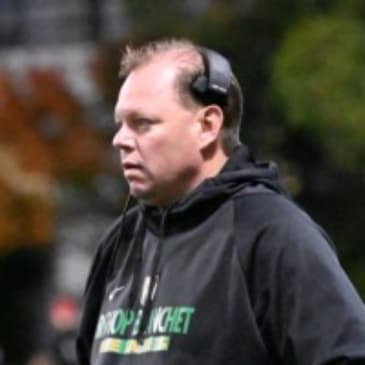
DJ Wilson is the CEO and co-founder of Playbook Clinics, modern football coaching clinics developed by coaches to meet the challenges of today’s game. With an extensive professional career in event and digital media management across diverse sectors like healthcare, politics, and communications, DJ brings a unique perspective to the field. He also coaches high school football in Seattle. Tune in to today's conversation as DJ shares insights on coaching, athlete transformation, and building things that last.
- 04:05 The Hall Of Fame Mentality
- 10:25 Playbook Clinics - More Than X’s And O’s
- 18:37 Everything Built To Last, Was Built On Love
- 26:45 The Mental Toughness Of Building A Business
- 30:06 Emergency Surgery And Cleaning Toilets // Hinge Moments
- 37:57 Better People Make Better Athletes // Finding Your Why
- 42:30 The Most Effective Way To Transform Athletes
- 44:58 College Football’s Future
Don’t forget you can also follow Dr. Rob Bell on Twitter or Instagram.
Follow At:
- Twitter @drrobbell
- Instagram @drrobbell
Download Your Daily Focus Road Map!
If you enjoyed this episode on Mental Toughness, please subscribe and leave a review!
Dr. Rob Bell
[00:00:00] Welcome to Mental Toughness with Dr. Rob Bell.
[00:00:13] Each week, Dr. Rob sits down with athletes, executives and expert coaches to talk about
[00:00:18] mental toughness and their hinge moment.
[00:00:21] Here's your host, Dr. Rob.
[00:00:39] We are the most prominent, most consistent voice in our head and if we are not positive,
[00:00:45] we cannot do positive things.
[00:00:46] So we have to be intentional about loving ourselves just like we do with anybody else.
[00:00:51] And if we are not, we are not going to be successful.
[00:00:54] Our guest today is CEO and founder along with his wife, Karyana, who started Playbook Clinics
[00:01:03] which is created by football coaches to meet the challenges of today's game.
[00:01:09] Our guest is also a linebacker's coach at Bishop Blanchett in Seattle.
[00:01:14] He's coached the Seattle Majestics.
[00:01:16] He's an entrepreneur, visionary, a lot of different careers.
[00:01:21] And excited about this conversation today with coach, I was called coach.
[00:01:25] DJ Wilson, DJ man, thank you so much for taking the time and joining us today.
[00:01:28] Rob, I'm honored to be here and appreciate all you're doing to support coaches and
[00:01:33] people in general.
[00:01:34] Rob Bell I've always researched the individuals that
[00:01:39] I'm getting ready to interview and your life, which I want to talk all about took
[00:01:43] a lot of different turns.
[00:01:44] But what I noticed was you spent many years early on in politics.
[00:01:49] Like this is always slow-pitched off ball question, but
[00:01:52] did you have a dream of pursuing politics?
[00:01:56] Oh yeah, man.
[00:01:57] I, boy, from the earliest days, so I'm 48, so I'm a Cold War baby.
[00:02:03] And I remember very clearly things like the presidential debates in 1980 and
[00:02:10] the Reykjavik summit in 1985 and the threat of maybe going to Nicaragua in 1983.
[00:02:18] And some of those really palpable moments in the 80s.
[00:02:24] And so I felt this kind of protector kind of urge.
[00:02:30] And I thought that at the time, and for the early part of my life,
[00:02:33] I thought that the best way to help keep level heads to support and
[00:02:38] protect our community was to get involved in politics.
[00:02:41] And I still think that's a noble profession and I run for office and one,
[00:02:48] but mostly lost and work behind the scenes to support folks that I appreciated
[00:02:54] and liked and that took the shape of working on both sides of the aisle.
[00:02:58] I worked for a Republican Senator, US Senator, a Democratic,
[00:03:02] couple of Democratic elected officials, US Senator, a member of Congress.
[00:03:05] And they say that people who are in the middle of the road get run over and
[00:03:13] we call them roadkill.
[00:03:15] It's more successful to be on a far left or the far right these days,
[00:03:19] and that was never really my home.
[00:03:21] So it was a fun time.
[00:03:24] So you founded eight different companies and I'm always fascinated.
[00:03:31] Obviously by the successes, you had two successful exits.
[00:03:33] You talked about two being mediocre, but then you had two epic failures.
[00:03:37] And I'm a firm believer.
[00:03:38] I know we learn way more from our failures.
[00:03:42] And let me just preface this by I failed as well and I know that it takes
[00:03:49] like part of your soul kind of out of you at least for a little bit.
[00:03:52] I mean, you have to kind of search because your identity is so wrapped up in it.
[00:03:56] Can you talk to us about those failures and coming out of those and
[00:04:03] what you learned about yourself during those?
[00:04:07] Yeah, I think our failures make us who we are.
[00:04:11] There's this great, great book that's just been out by Rick Rubin called a creative,
[00:04:17] I think it's called The Creative Act, A Way of Life.
[00:04:20] And I just finished it.
[00:04:22] One of the things he says in there is that failure is the information you need
[00:04:28] to get to where you're going.
[00:04:30] And you really don't learn that much from success because you feel like you must be
[00:04:37] the smartest guy in the room.
[00:04:39] It's really just the failures that force you to be self-reflective.
[00:04:44] And part of what I've taken from my failures over the year is just a reflection
[00:04:52] that if you are in baseball and you get a hit one out of three times,
[00:04:58] you're going to Hall of Fame.
[00:05:00] If you strike out two out of three times, but you get a hit one out of three times,
[00:05:05] you're going to the Hall of Fame.
[00:05:06] So we got to take our cuts and we got to be ready to accept setbacks.
[00:05:14] So we talk about in our companies and our culture that we want to be 80% 80% of the time.
[00:05:22] And if we can be 80% effective, 80% of the time, we're going to be very, very good.
[00:05:29] And that the whole notion this is particularly important, I think for smart,
[00:05:33] high achieving people, particularly early in their career, because smart,
[00:05:37] high achieving people think they need to be 100%.
[00:05:40] Like that's how they're trained in college.
[00:05:42] That's you know, they got to get straight as 4.0.
[00:05:44] And that is not how life works.
[00:05:46] And so we try to take young people, particularly early career,
[00:05:50] or even sometimes mid-career professionals and say, hey, look, man,
[00:05:55] you can put yourself on a pathway for 100% success.
[00:05:59] It means you will never stretch, you will never try,
[00:06:01] you will never do anything hard, you will only take the easy path.
[00:06:05] And your life is so much should be so much more than that.
[00:06:09] And so, you know, our failures in business, my failures in business
[00:06:15] have just reminded me that boy, I've got to stretch.
[00:06:18] I'm more alive when I stretch.
[00:06:19] And if I get one hit at three at bats, I'm going to be just fine.
[00:06:25] Hey, good looking.
[00:06:29] If you like this podcast and are already a badass,
[00:06:33] but it's all way too complicated, then visit our website, DrRobBell.com
[00:06:38] and schedule a call with us to help capture your very own hinge moment.
[00:06:43] I love that, man.
[00:06:44] I think you named the podcast episode there too, DJ.
[00:06:47] That's going to be great.
[00:06:49] I'm going to go ahead and do a quick video.
[00:06:51] I think that's so important, man.
[00:06:53] If you could do B work four days out of five,
[00:06:56] you're going to be so much farther ahead of everybody,
[00:07:01] not just your competition, but who you can be.
[00:07:05] And as you know, like most of success in the world,
[00:07:11] sports otherwise is just avoiding unforced errors.
[00:07:14] And I think that's a great thing.
[00:07:16] In the world, sports otherwise is just avoiding unforced errors.
[00:07:21] If you can just avoid self harm, you are ahead of the game.
[00:07:26] So the team that makes the fewest mistakes usually wins.
[00:07:31] I'm seven from a general,
[00:07:33] Neland Maxim guy went to University of Tennessee.
[00:07:35] So I mean, that's that's Maxim number one.
[00:07:38] The team that makes the fewest mistakes usually wins.
[00:07:42] Wait, true.
[00:07:43] But I will say, sorry, Rob, just to just to add one final.
[00:07:47] Oh, you're a hero, man. You run.
[00:07:51] We are evolutionarily hardwired going back millions of years,
[00:07:56] but also in all recent modern history
[00:08:00] to overestimate the risk of anything we're facing.
[00:08:05] We are hardwired to take care and to
[00:08:11] to not take action unless we think it's safe.
[00:08:15] And and I think this actually fits within the construct of your recent book,
[00:08:21] which is like I think being patient is
[00:08:25] like its graduate level. It's like next level stuff, right?
[00:08:28] Because our first inclination is to not act.
[00:08:33] And people people will just sit on their hands and say,
[00:08:36] oh, I'll do it tomorrow or it's too scary
[00:08:39] or the risk of failure is too great.
[00:08:40] We're hardwired to think that that's the case and it's not.
[00:08:43] It's not as scary as we think.
[00:08:45] And then so this idea of taking action, sometimes it is OK to take action.
[00:08:49] Even if you don't, I mean, don't have all the answers.
[00:08:53] I think that you should be willing to just jump in the jump in the thing and go.
[00:08:57] And once you understand that like there's a time and place for action
[00:09:02] and you have developed the competency to move into act,
[00:09:06] then like that's when you get to this sort of sweet spot where you're talking
[00:09:09] about terms of like be patient.
[00:09:12] You don't have to swing at every pitch.
[00:09:14] Sometimes you just go wait for the right one.
[00:09:19] That's why it was such a hard book to write
[00:09:22] is because I've always been a ready fire and guy.
[00:09:27] That's how it's always been for me.
[00:09:29] I when fear would would be present, I would go towards it
[00:09:32] because like I hated the notion of being afraid.
[00:09:37] And so I'm going to force myself to go for it.
[00:09:40] And no matter what that was, whether that was talking with somebody,
[00:09:43] whether that was taking the shot and Andre Agassi strength coach
[00:09:47] told me this a long time ago, he just said some battles are worth fighting
[00:09:50] even if you lose like I wanted to shot.
[00:09:52] No one that I don't care about missing like I failed before.
[00:09:56] It sucks for a while, but most of the story is in our head.
[00:10:00] But what I saw was
[00:10:03] there was a huge inability to be patient and wait for the results to happen.
[00:10:07] You know, so it was that's why I always felt that was such a hard book to write
[00:10:11] because it was a dichotomy of, you know, no one's ever going to say urgency is bad.
[00:10:16] I'm not saying that.
[00:10:17] I'm just saying urgency is the workout and patience is like the recovery.
[00:10:21] You've got to have recovery that's in there too, because that's when the muscles grow.
[00:10:25] Yeah, the notion of I love that you build out this sort of notion
[00:10:29] of urgent versus the important because that.
[00:10:33] That tension is this a central tension that leaders have to deal with, right?
[00:10:38] They have to put out the fires, but they can't.
[00:10:41] They always have to create room for the important.
[00:10:43] If you stop creating room for the important.
[00:10:49] You know, you're going to you will fail the people who are depending on you
[00:10:53] because as a leader, your job is to to keep the important in mind
[00:10:59] and only deal with the urgent to the extent that your team can't deal with it without you.
[00:11:05] And that takes particularly in this world where we have these notifications
[00:11:10] and we've got all kinds of like, you know, cortisol and oxytocin,
[00:11:13] all these things floating around and we're building these kind of neuro pathways
[00:11:17] related to our phones and email and all that stuff.
[00:11:21] You have to be able to face that down and say, I'm going to let these balls fall.
[00:11:28] And I'm going to be patient and carve out space to do this thoughtful, important work over here.
[00:11:33] And I know that
[00:11:37] that kind of realization happens for different people at different points in their career,
[00:11:41] but it's super cool that you spend so much time on it.
[00:11:44] Yeah.
[00:11:46] Well, my wife would disagree.
[00:11:47] It was a brutal process writing that stuff.
[00:11:50] But I appreciate the notion of a recognition for it.
[00:11:54] Yeah.
[00:11:54] We're talking about focusing on that, which is important.
[00:11:57] I mean, Playbook clinics, I mean, have 15 different sites across the country as an entrepreneur.
[00:12:03] I mean, the.
[00:12:06] Let me start with this part and then we'll kind of get into the entrepreneurial logistics part.
[00:12:10] I mean, the part that really attracted me to Playbook clinics was the convening panel.
[00:12:17] So you.
[00:12:19] You want to do what the coaches wanted to talk about, what they wanted to address.
[00:12:23] I mean, just fantastic notion, right?
[00:12:26] And you spoke about it before we just go find speakers.
[00:12:29] We've found the topics that coaches wanted to learn more about and then found speakers
[00:12:35] that would attach to that.
[00:12:36] Can you talk about that process?
[00:12:39] Yeah, I think there's a lot.
[00:12:41] There's a lot in there.
[00:12:43] Part of it is people want to be asked and they've got really good ideas and the closer
[00:12:48] to the closer to the center of the action that you can get and hear from and listen
[00:12:54] to them, the more raw, the more vulnerable, the more authentic, the more valuable
[00:12:59] the conversations will be.
[00:13:02] Part of it is if you want to create good clinics to support coaches and you want
[00:13:08] to do it in a place as diverse as Portland, Oregon, Atlanta, Georgia.
[00:13:13] Those are very different ecosystems.
[00:13:14] And so you'd be a fool not to ask for help and have guys kind of tell you
[00:13:20] like, this is how we do it in Charlotte or this is how we do it in Kansas City
[00:13:23] or Orange County.
[00:13:25] And so our why came from this idea that we have a couple of kind of key stories
[00:13:37] here. But if you could let me sort of frame it.
[00:13:42] Let me give you the whole story if I can just kind of give you the longer
[00:13:45] context because this will put some things into context for you.
[00:13:49] So in 2020 when COVID hit, my son was with three kids and my son was in eighth grade.
[00:13:58] And I'd just been a dad.
[00:13:59] I'd been his like flag football coach and my daughter's soccer coach
[00:14:03] and basketball and all that stuff.
[00:14:04] And as we were coming into 2021 and freshman football, he at that point
[00:14:11] a year or so into the pandemic, he was really struggling with his mental
[00:14:16] health like a lot of our kids are.
[00:14:18] Like a lot of us, all of us were and continue to be in some cases.
[00:14:22] And my football experience in high school was toxic and bad.
[00:14:28] And I did not want to send him into that environment.
[00:14:30] But I knew that the positive things about football would really help shape him.
[00:14:35] And so his COVID coming out of COVID, he could have gone a lot of different directions.
[00:14:39] And I just wanted to make sure that that football experience for him was positive.
[00:14:44] So I reached out to the head coach and asked if I could hold water on the sidelines.
[00:14:48] It's like, yeah, sure. Why don't you come help coach the freshman team?
[00:14:50] And then they said, oh, you didn't you don't suck that bad.
[00:14:53] Why don't you come help us on varsity?
[00:14:54] And and I coached at the semi pro level a little bit, just get some reps in.
[00:14:58] And and what I saw from that was that at our school, we exceeded all of my expectations
[00:15:05] in terms of culture and support.
[00:15:08] And and but that it was also clear a lot of other programs,
[00:15:12] a lot of other head coaches didn't have the tools they've hadn't really been taught
[00:15:17] how to develop culture, how to support mental health of kids coming out of COVID,
[00:15:22] how to do things like deal with parents who might have an acute anxiety
[00:15:24] about how their kids are performing, how to talk about string
[00:15:27] and conditioning in a way that talk that leads to injury prevention.
[00:15:30] And not just like what your bench is.
[00:15:33] So it became clear that the things that I cared about,
[00:15:37] there needed to be some place where we could support coaches
[00:15:41] in their development related to mental health, related to culture,
[00:15:45] related to leadership and these other things.
[00:15:47] And at the same time as a new coach, an old or new coach,
[00:15:52] I needed to go back to school on things like hand placement and footwork
[00:15:56] and some of the fundamentals and the clinics that I attended
[00:16:00] didn't didn't meet my needs.
[00:16:02] And so they didn't meet my needs on either the fundamentals or this
[00:16:07] this this other kind of soft skill stuff.
[00:16:10] And so as we started talking to head coaches,
[00:16:12] they the head coaches would all, you know, formally say, yes,
[00:16:15] we need that soft skill stuff and conversations because nothing can prepare you
[00:16:19] to be a head coach. Nobody talks about that stuff.
[00:16:23] Head coaches generally.
[00:16:26] Aren't always looking to their assistant coaches to help them think about these
[00:16:30] things. They don't always get an opportunity to connect with other head coaches,
[00:16:34] except for this clinic space.
[00:16:37] And so we thought, boy, coming out of covid,
[00:16:40] if there were an opportunity to support head coaches at 16000
[00:16:45] high schools across the country and they trusted you and they would turn
[00:16:48] to you on one weekend out of the year to come and learn from other coaches.
[00:16:54] What would you tell them?
[00:16:56] Like what would you give them in that one weekend?
[00:16:59] And so we built these convening panels to ask those guys, hey,
[00:17:04] what do we want to talk about? What do you want to talk about?
[00:17:06] Who do you know that would be awesome to speak about those issues
[00:17:09] and kind of percolated up.
[00:17:11] And there was kind of this natural confluence of both our why
[00:17:15] and our story about why we're getting involved in coaching high school football
[00:17:20] and what head coaches across country actually said they needed more information
[00:17:25] about more support of, which was the softer skills.
[00:17:27] Everybody knows scheme. Everybody has an opinion on about, you know,
[00:17:31] what kind of offense they want to run, even if you have no idea what you're
[00:17:34] talking about, you still have an opinion about the offense you want to run.
[00:17:36] But you didn't know maybe about
[00:17:40] how do I build community around my program?
[00:17:44] How do I get moms to feel like our program is going to be safe for their young men?
[00:17:50] How do we get teachers and parents or administration in the building
[00:17:54] to better support our program? How do we fundraise?
[00:17:56] How do we do strength and conditioning?
[00:17:57] All of these other things that have nothing to do with scheme.
[00:18:01] So we want that's kind of the long story.
[00:18:05] You know, you had the X's and O's.
[00:18:08] But as you mentioned, that building culture, program development,
[00:18:11] the mental health, dealing with parents, navigating recruitment, all these aspects to it.
[00:18:16] As you went around and for facilitating the clinics,
[00:18:21] what were a couple of the ideas, concepts
[00:18:28] that really gave you pause and made you think about it in terms of,
[00:18:33] hey, that is a great strategy. Any in particulars really stand out?
[00:18:38] This last weekend I was in Charlotte helping to host our Charlotte Clinic and
[00:18:45] sort of two kind of things really stood out to me.
[00:18:49] Like there's a bunch of stuff there. That was an awesome clinic,
[00:18:53] soul-filling kind of clinic.
[00:18:54] And one was this 80-year-old online coach, man.
[00:19:03] Coach McNally, he has spent 47 years coaching in the NFL.
[00:19:07] He was with us and at 80 years old, he's climbing up on these tables showing
[00:19:12] like how you have to, as you pass, protect,
[00:19:15] you got to pitch and toe your back foot just in a little bit.
[00:19:18] You stand up on this table at 80 years old
[00:19:22] and guys are there holding his hand, making sure it doesn't fall.
[00:19:25] And it's just like so awesome to see his passion
[00:19:29] and the love around him of all those guys in that room.
[00:19:33] And that was just one breakout room.
[00:19:34] I just thought like this is exactly what we're trying to do.
[00:19:37] We're trying to build a scaffolding where people who have passion and love can come
[00:19:41] and like help help spread that because that becomes an infection.
[00:19:45] So it's so cool.
[00:19:45] So Coach Jim McNally, rock star at 80 years old,
[00:19:49] I wish I could have half his energy when I get even now.
[00:19:53] And then this other experience after was all done and we had.
[00:19:58] We took everything down.
[00:19:59] We had broken everything down except for one room.
[00:20:01] There was about 10 guys still talking and we had a whiteboard in there.
[00:20:05] And they were just still whiteboarding together an hour and a half after the
[00:20:08] clinic was done and Coach Austin Trotter and a bunch of guys,
[00:20:14] Coach Tatum and Coach Gee were in there.
[00:20:16] And it was just like community.
[00:20:19] You know, it's like just a safe place where they could talk
[00:20:24] and build relationship.
[00:20:26] And it's like one of the it was just a reminder
[00:20:30] in that second example of kind of the challenge we face,
[00:20:33] particularly as men, particularly as we get older in building relationship
[00:20:38] in fighting isolation.
[00:20:40] And so the sort of kind of coolest things for me were
[00:20:46] were not necessarily about exes and those.
[00:20:48] It was about in the case of Coach McNally, passion and love
[00:20:52] and how that just becomes infectious.
[00:20:56] And this other piece like, hey, man, community is super important
[00:21:00] and we don't have as many opportunities as we get older.
[00:21:03] I'm forty eight now and some of those guys in that room were all younger than me.
[00:21:08] But we just have a lot of opportunity to build relationship
[00:21:11] once we leave college and move on in our lives.
[00:21:14] So just really awesome experiences, both of those.
[00:21:18] Yeah, I appreciate you sharing that.
[00:21:21] I mean, your passion comes out just talking about the
[00:21:24] you know, what you've been orchestrating put together.
[00:21:27] I mean, you put together the playing field and allowing these coaches to collaborate.
[00:21:31] I picture that in my head, right?
[00:21:33] Like all these coaches sitting around hour and a half after the conference is over.
[00:21:38] You know, I mean, how dedicated they are
[00:21:43] to being a coach.
[00:21:46] I'm convinced about this.
[00:21:48] I think the coaching blood runs so deep
[00:21:52] that it wouldn't matter what sport they were in.
[00:21:54] I bet they could be coaching chess or tennis and they would still be as
[00:21:58] effective coaches as they were because not about necessarily the sport,
[00:22:01] it's about the coaching rights and navigating the relationships.
[00:22:05] 100 percent, 100 percent.
[00:22:06] I tell our guys,
[00:22:11] our coaches, but also our kids like
[00:22:14] it turns out in the history of the world,
[00:22:17] nothing great that stood the test of time was built on anything except for love.
[00:22:24] You know, the Catholic Church, regardless of one's opinion of it,
[00:22:29] was not built on hate, you know, schools where we send our kids,
[00:22:34] you know, in all of our communities, those were not built out of indifference.
[00:22:40] Everything that has stood the test of time was built in some way, shape or form
[00:22:44] on love. And so championship football is the same thing.
[00:22:47] Championship anything is the same thing.
[00:22:50] It's built on love.
[00:22:51] And so in football, we talk about
[00:22:55] the sort of three pillars of that you have to love to compete.
[00:22:59] You have to love your team and you have to love yourself and love to compete.
[00:23:03] Means you got to be willing to get out of bed and go do the hard work
[00:23:05] because you want that thrill of being able to be able to be seen and have
[00:23:10] people look at you and say, you are good enough, you are a champion or you
[00:23:13] are not good enough, you came in eight out of eight teams.
[00:23:18] But it takes a vulnerability and that requires a love of competition
[00:23:22] and love for your team.
[00:23:24] And even if it's like tennis or golf and you still have a team around,
[00:23:28] you have coaches and sport, you have to understand that all of those people
[00:23:34] when you are a champion are all pulling in the same direction,
[00:23:37] you have to love and honor and respect all of what they are putting in
[00:23:41] to your success. And then ultimately, as you know, like you got to love yourself,
[00:23:45] you got to like we are the most prominent, most consistent voice in our head.
[00:23:51] And if we are not positive, we cannot do positive things.
[00:23:54] So we have to be intentional about loving ourselves just like we do with
[00:23:57] anybody else. And if we're not, we're not going to be successful.
[00:24:01] So I just think like a good coach, a good coach comes from a place of love.
[00:24:08] And whether that's chess to your point or football, if you don't have that heart,
[00:24:13] you're not going to be as effective as you could be.
[00:24:16] Which one of those three pillars do you think most coaches struggle with?
[00:24:22] I mean, I think we all, whether you're a coach or not,
[00:24:25] I think we all struggle the most with being loving yourself.
[00:24:29] Right.
[00:24:32] The idea that I mean, particularly high achievers,
[00:24:36] high achievers tend to focus on the 3% that I didn't get when I got the 97% score,
[00:24:44] or they focus on the one hit on the course where you tried to fade it and it turned
[00:24:49] out it just went straight.
[00:24:51] So we focus on the negative for good reason.
[00:24:56] But what that means is we have to be intentional about the positive.
[00:25:01] And, you know, sometimes that's like, I mean, I will when I'm when I'm down,
[00:25:06] I live in Seattle and so it's like gray in the winter and that will impact,
[00:25:11] you know, my mental health sometimes.
[00:25:13] And so sometimes I'll just be like, I'll look in the mirror and say, man,
[00:25:17] look how good you look today.
[00:25:19] You know, just to tell myself something nice because we all go through life.
[00:25:23] And like when was the last time somebody came up to you and said,
[00:25:25] man, you look good. You look good today.
[00:25:27] In my life that never happens.
[00:25:29] So so I have to help build myself up if I end.
[00:25:33] And so coaches, if we are not being intentional about saying nice things to ourselves,
[00:25:38] we are only going to be saying, look at this shortcoming.
[00:25:41] Look at that shortfall.
[00:25:42] Look at how you didn't succeed here and we're going to miss miss an opportunity
[00:25:47] to build ourselves up in the same way we want to try to build up to kids and
[00:25:50] people around us.
[00:25:51] Yeah, well said. Well said.
[00:25:55] Coach, again, you have 15 different sites this year.
[00:25:59] You know, as an entrepreneur who, you know,
[00:26:02] you study relationships and obviously the logistics, can you just talk about
[00:26:07] the logistics of putting this in place all across the country?
[00:26:11] What were what were the biggest challenges that you had to overcome?
[00:26:15] Yeah, it's been a heck of a ride.
[00:26:18] You know, first we had to go back to March of last year, 2023.
[00:26:23] We started negotiating with hotels and
[00:26:26] so we had to kind of take guesses on which hotels and which markets would be
[00:26:29] successful and and had to figure out models that would would work.
[00:26:35] Financial models for the hotel would work for us.
[00:26:39] Then we had to build a team, a great team of folks who
[00:26:44] understood our vision, bought in with a team of six and
[00:26:48] and so we're small but but mighty and and everyone had to understand kind
[00:26:53] of our why and and and then they had to go kind of find good coaches that wanted
[00:26:59] to help kind of amplify the why and understood how it fit with their their work.
[00:27:06] And so that took a lot of phone calls,
[00:27:07] a lot of conversations, a lot of email, a lot of Twitter DMs like
[00:27:12] but soon that kind of generated its own kind of momentum where people would say,
[00:27:16] hey, great conversation here are three other dudes I think you should talk
[00:27:19] to because I know them and they would love this.
[00:27:21] And so pretty soon we were
[00:27:24] networking pretty pretty widely and people were coming to us.
[00:27:28] And and then, you know, as we built the agenda, we had this kind of framework
[00:27:33] in a model and sort of secret sauce about how you kind of tee up some of these
[00:27:36] things and finding the speakers was super hard.
[00:27:39] We have 55 speakers on average at every one of our clinics.
[00:27:42] That's a lot of speakers that's a lot of people to come and get lined up.
[00:27:46] And then the logistics of actually holding the thing like we,
[00:27:50] you know, a lot of hotels like you rent the AV and protectors and screens.
[00:27:55] And if we did that, we would we would not make it financially.
[00:28:00] So we bought all this gear.
[00:28:02] We rented vans and we drove three vans all around the country.
[00:28:07] So for instance, I said I was in Charlotte this last weekend.
[00:28:11] After our clinic, I drove that van to Indianapolis.
[00:28:14] I met Emily on our team.
[00:28:16] Actually, I met Emily who was in Indianapolis.
[00:28:18] We met in Lexington, Kentucky.
[00:28:21] And then I transferred some gear to her van.
[00:28:23] I drove my van to Orlando.
[00:28:25] She drove her van to Minneapolis.
[00:28:28] We had another van that was going up and down the California coast.
[00:28:31] So like we're we're out on the road grinding and I drove 16 hours one day.
[00:28:36] I got up at four o'clock in Charlotte and then my day in Macon, Georgia.
[00:28:40] And went up to the Kentucky and the state line.
[00:28:43] So that's just hard work.
[00:28:47] That's just kind of just doing the thing that it takes.
[00:28:52] I'll add this, this is sort of parenthetically, but just
[00:28:56] there's this idea of science of complexity, which maybe only three of your
[00:29:00] listeners will even care about.
[00:29:01] But there are things there's chaos where nothing is related.
[00:29:05] There's simple or linear things where if A, then B, if B, then C kind of stuff,
[00:29:10] there are complicated things which are just
[00:29:15] a bunch of if A, then B things.
[00:29:17] And then there are complex things where there's multi variables and every
[00:29:20] variable influences each other and we are not in that complexity place.
[00:29:25] It's just complicated.
[00:29:27] And so for things that are just complicated, all that means is you just got to take
[00:29:30] time, you just got to do the work and you just got to put the puzzle pieces
[00:29:33] on the table and put it all together.
[00:29:35] So it's been hard, but not impossible.
[00:29:37] Yeah, no, I love it, Coach.
[00:29:40] With what that said, and I always talk with every one of our guests kind of about
[00:29:44] their hinge moments, right?
[00:29:45] That one moment person or event that connects who we are with,
[00:29:52] with who we eventually become.
[00:29:55] Sometimes we don't know these moments happen to a week's months, years later.
[00:29:58] But tragedy is obviously our immediate hinges because from that moment on,
[00:30:01] everything's different.
[00:30:02] But what's a hinge moment that you can share with our listeners?
[00:30:07] You know, the
[00:30:10] my top three hinge moments, the three most impactful things in my life are one,
[00:30:14] marrying my wife, far and with most important thing that I've ever done.
[00:30:18] And two, having my kids,
[00:30:21] we have three kids and, you know, gosh,
[00:30:25] I'm just super proud to be their dad.
[00:30:28] How did you and your wife meet?
[00:30:31] We met at a bar like it was, you know, why did you go to that bar that night?
[00:30:37] So my friend had an emergency surgery
[00:30:43] and had to go into the hospital.
[00:30:46] And I was teaching community college in those days.
[00:30:50] And so his girlfriend at the time called and said,
[00:30:52] hey, there's this thing happening, emergency surgeries going under general
[00:30:56] anesthesia, they're kind of open.
[00:30:58] Can you come down and be here when he wakes up?
[00:31:00] And I was like, absolutely.
[00:31:01] I ran down and I was like,
[00:31:03] I was like, man, I was with a friend.
[00:31:06] I was like, I can really, really use a drink right now.
[00:31:10] Why don't we go pull off a little steam and get a beer or something?
[00:31:12] And so we went up and I was just looking like,
[00:31:15] you know, I look and I had Stan Smith's shoes on and wrinkled khaki pants
[00:31:19] and wrinkled polo and I just went up and I was like,
[00:31:22] I'm going to be here.
[00:31:24] And I was like, I'm going to be here when he wakes up.
[00:31:27] And I was like, absolutely.
[00:31:29] I ran down and spent the spent the day there kind of being with him
[00:31:32] and wrinkled polo and I just was down the mess.
[00:31:34] But we showed up to this bar
[00:31:37] and then my wife to be was there and she had come in from work.
[00:31:42] She was all dressed up and and it's like, hey,
[00:31:47] you know, do you want to dance?
[00:31:48] And so we dance at this like little, you know,
[00:31:50] and neither of us were very good dancers.
[00:31:52] She was better than me.
[00:31:53] And then just went from there and I was so poor.
[00:31:59] I couldn't I couldn't I asked her out
[00:32:02] like, you know, I lost her card.
[00:32:04] I asked her out three weeks later and I was so poor.
[00:32:08] I was like, I can't what am I, you know,
[00:32:10] I'll ask her for coffee because, you know, Seattle go get coffee.
[00:32:13] She's like, I don't like coffee.
[00:32:14] It's like, well, how about hot chocolate?
[00:32:15] She's like, OK, hot chocolate.
[00:32:17] And so my our first date,
[00:32:19] start with hot chocolate and so that
[00:32:22] also that's like the hand moment.
[00:32:25] Obviously, there's layers to it, but your friend having surgery.
[00:32:29] If he doesn't have immediate surgery,
[00:32:30] you don't go to that bar then.
[00:32:32] Correct. Now these these and so I always love to take that just a little bit
[00:32:38] different route, you know, but I appreciate you sharing that.
[00:32:41] What was the third one?
[00:32:42] What was the third hinge moment?
[00:32:44] Go on to Gonzaga University, change my life.
[00:32:48] And that's sort of an interesting story, too.
[00:32:50] I grew up in Bend, Oregon
[00:32:52] and I worked at a place called Jake's Truck Stop.
[00:32:55] I had a lot of jobs grown up, but I was working at this place called
[00:32:58] Jake's Truck Stop in high school and, you know,
[00:33:05] truck stops are not for the glamorous and this one was not either.
[00:33:10] And I asked the owner one day, I was like, hey,
[00:33:13] what do you know about this university in Spokane called Whitworth University?
[00:33:17] Said a lot of nothing about Whitworth University,
[00:33:19] but I know the smartest guy I know went to Gonzaga.
[00:33:22] Why would you like to talk to him?
[00:33:23] I was like, yeah, sure.
[00:33:25] I was, I guess, 17th time.
[00:33:28] And so four or five hours later into my eight hour work day,
[00:33:33] I was upstairs in the bathroom cleaning toilets at a truck stop.
[00:33:38] That's not something everybody gets the opportunity to do.
[00:33:42] Oh, Norwood one, two.
[00:33:44] And this guy shows up and I'm in like in this stall, cleaning stuff up.
[00:33:49] And he's like, hey, you know, is there a DJ in here?
[00:33:52] And I said, yeah, he's like, OK, well, just take your time, come on out
[00:33:55] and I was like, I'll be there in just a second.
[00:33:57] And so he came out and I came out of the stall after I was done.
[00:34:01] And he's like, hey, you know, I hear you're interested in Gonzaga University.
[00:34:05] And so this guy was kind of a big shot in the in the oil and gas industry.
[00:34:10] And he stopped what he was doing and came talk to me.
[00:34:11] And and I was probably like the last kid in to Gonzaga.
[00:34:19] But they created room for me.
[00:34:21] And and it was a and his, you know, he was very kind and and help say nice things
[00:34:28] about me. And and so that cleaning stalls moment at Jake's truck stop got me
[00:34:34] connected to Gonzaga University, which then becomes my one of my hinge moments.
[00:34:39] I love it. I love it.
[00:34:40] Coach Gonzaga, right? Not Gonzaga.
[00:34:42] That's right. That's right.
[00:34:44] G-U-N-Z-A-G-A go Gonzaga.
[00:34:46] You're going to make sure that is that's clear for the list.
[00:34:49] That's right. That's right.
[00:34:51] Not the first Gonzaga that Gonzagian
[00:34:56] that we've had on the on the show, believe it or not, though,
[00:34:58] Sandy Zimmerman, who was also on American Ninja Warrior, she went to Gonzaga,
[00:35:03] played, played basketball there, believe it or not.
[00:35:04] So first mom to ever hit the buzzer on American Ninja Warrior.
[00:35:09] Really? That's great.
[00:35:11] Yeah, she's she's a fantastic lady.
[00:35:13] She still lives there and great, great hinge moments, great person.
[00:35:17] She still lives there in Washington as well.
[00:35:18] So that's great.
[00:35:21] DJ, what question
[00:35:24] should I be asking that that I haven't asked?
[00:35:28] Oh, I don't know.
[00:35:31] How about you? I mean, tell me,
[00:35:33] give me give me the the biggest dream,
[00:35:37] the biggest goal that you have,
[00:35:41] that you have not allowed yourself to believe you can achieve yet.
[00:35:46] The thing that you're like,
[00:35:48] boy, it would be so amazing if we could do that.
[00:35:51] But that's a little that's a little bit of a stretch.
[00:35:52] It'd be so amazing if we could do this.
[00:35:53] But all these other more manageable dreams,
[00:35:56] but the thing that be like, wow,
[00:35:58] this would be so super cool and I actually might do it,
[00:36:01] but I'm not quite ready to commit yet.
[00:36:05] What is that for you?
[00:36:07] Well, I still think it's
[00:36:10] I mean, the biggest one is still having a major winner.
[00:36:13] You know, being able to be in the mental coach for a
[00:36:15] major winner.
[00:36:17] I've had a PGA tour winners,
[00:36:20] but not a major winner yet.
[00:36:22] And the life of a sports psychology coach
[00:36:26] with professional athletes in particular,
[00:36:28] sometimes it's long, sometimes it's short,
[00:36:30] just depends on the athlete mindset where they are in their career.
[00:36:36] And I put yet in that because I know it will happen.
[00:36:39] I just don't know when.
[00:36:41] But that is where
[00:36:44] you know, to win a major event.
[00:36:46] Very few people do it.
[00:36:47] There's only four year obviously
[00:36:49] it's happened with with tennis on the double side,
[00:36:53] but it hasn't happened on the golf side.
[00:36:55] So that's the one
[00:36:58] that is still the North Star that is that is directing and
[00:37:04] and again, it'll happen.
[00:37:07] A lot of that is in God's hand, though.
[00:37:09] But I'm always
[00:37:11] doing the best job I can with every athlete I work with.
[00:37:15] So I'm sure
[00:37:18] any of us who have competed at all
[00:37:22] know that only one really good team or one really good athlete
[00:37:26] ends the season with a win.
[00:37:29] Everybody else falls short.
[00:37:32] And you are probably a tremendous caregiver for all of your athletes.
[00:37:39] How do you think about your own self care when
[00:37:43] you have poured yourself into a season or tournament and you
[00:37:48] you're the people that you care about that you're working with come up short?
[00:37:52] How do you then reflect back and say, OK, I have to actually heal a little bit myself here?
[00:37:57] Yeah, the biggest thing that's helped with me, I mean, obviously,
[00:37:59] I think there are strategies with the biggest back to to your identity and my identity.
[00:38:04] And it's not really in my performance.
[00:38:06] I mean, most of the life it has been, but it's rooted in God and what God says about me.
[00:38:10] It's the only way to be able to cope with the highest level
[00:38:14] of athletics and to come up short
[00:38:17] is to know that I'm not my performance because if I am my performance, then
[00:38:21] I'm only as good as my last performance.
[00:38:23] I'm only as good as what other people are going to say about me.
[00:38:25] And that that's that road does not last.
[00:38:30] And it's a roller coaster of
[00:38:33] ups and downs.
[00:38:35] And even when you're the best, you're not the best very long.
[00:38:38] And
[00:38:39] it's that that's what it's always been rooted in is my identity and God and Christ.
[00:38:47] How do you think about
[00:38:50] transformation of your athletes?
[00:38:54] How do you think about transforming lives?
[00:38:56] Sometimes the
[00:38:59] sometimes the ego that can be associated with competition and winning
[00:39:04] stands in conflict with our soul or spirit or message that we're carrying.
[00:39:11] How do you how do you think about that?
[00:39:16] So
[00:39:17] that one is
[00:39:20] depending on where the athlete is right then on their journey.
[00:39:24] So the earlier we can get them, I'd say we can get them.
[00:39:28] But the earlier that people are speaking truth into the life, the better path
[00:39:31] they're going to go on.
[00:39:33] What I mean by that is better people make better athletes,
[00:39:38] better athletes do not make better people.
[00:39:41] So just because somebody is excellent in one skill set does not make them a great person.
[00:39:46] And I want to work with great people and I want to work with people that
[00:39:51] and basically answer that question.
[00:39:53] There has to be a why that is bigger than just holding up that trophy.
[00:39:58] I've worked with athletes who why
[00:40:02] whose why is to build tennis courts and underserved communities.
[00:40:07] That that runs deep because that's not about them.
[00:40:09] And so it's really it's having them tap into what is a why that is greater
[00:40:14] than themselves, because if it's greater than themselves, then it becomes
[00:40:17] a unity piece and it becomes
[00:40:20] you know us, we and I try to say this one a lot.
[00:40:26] But it's a better us makes a better you and a better you is what makes us.
[00:40:31] So it's just about making the us
[00:40:34] larger and having that greater mission than just what the.
[00:40:39] Non-amiguitity of sport can provide.
[00:40:42] And so what do you find your your mission to be?
[00:40:47] So and I like the way that you flip this, by the way, because they're still recording.
[00:40:52] I don't get to talk a lot on my podcast, man.
[00:40:55] My North Star changes.
[00:40:58] So it has two things.
[00:40:59] One, I want people to recognize and seize that hinge moment
[00:41:02] that you don't know what it's going to look like or what it's going to be.
[00:41:05] But the other part is I want people to operate free of fear and anxiety.
[00:41:11] Want them to be
[00:41:13] that's how I want to perform free of anxiety and fear.
[00:41:16] And that that is the ultimate goal.
[00:41:20] I love that.
[00:41:21] I mean, I think that's we have so many.
[00:41:26] Things pushing us towards fear or the or shame or the shadows and.
[00:41:33] There's nothing.
[00:41:36] There's nothing good.
[00:41:37] I mean, we're a little bit most of us are a little bit past and removed.
[00:41:42] Pure survival modes where we need to worry about the lions on the Savannah.
[00:41:47] You know,
[00:41:50] most of us, as you know, to your point, are.
[00:41:54] Holding ourselves back because we're not because we're living in fear or shame or
[00:41:59] guilt or something, it's the most corrosive influence out there.
[00:42:05] So we got to overcome that.
[00:42:07] How do you how do you what council?
[00:42:10] What advice would you have for coaches of high school kids?
[00:42:15] In terms of like trying to heal themselves, overcome
[00:42:19] some of that fear, guilt, shame and then how to roll model it so that these young
[00:42:24] people know they can see what overcoming looks like.
[00:42:29] Yeah, it's it's multifaceted.
[00:42:32] One, I think of coaches that they can't do it all.
[00:42:37] So you have to bring in those that are around you.
[00:42:40] That network is going to be around you and then be able to equip these
[00:42:43] coaches to handle those sort of responsibilities.
[00:42:47] That's the importance, I think, of mental coaching,
[00:42:51] sports psychology in general is being the other is
[00:42:56] coaches job is to create that environment where people feel loved.
[00:43:02] They feel worthy not on what they do, but just who they are as an individual.
[00:43:06] You know, and if you pay attention like everybody has that's something
[00:43:10] that they bring to the practice, it's not always going to be in the
[00:43:17] stat column or the box sheet.
[00:43:19] But they have that gift.
[00:43:21] And I think if we can create that and make sure people just understand that
[00:43:25] this skill that you have like this, this gift, this sense of humor that you
[00:43:29] have with this ability to look somebody that I like, that's going to last
[00:43:33] way beyond what sport is over.
[00:43:36] And so when coaches create that environment,
[00:43:41] then what it also does in my belief is allow them to coach the athlete hard
[00:43:47] because they know that they're going to be loved and they know that they're trying
[00:43:50] to get the best out of them.
[00:43:53] Too often we miss that step and just coach them really hard.
[00:43:57] But then we miss the real growth, I think, that takes place.
[00:44:03] So I think if athletes can understand that look, they're loved and appreciated
[00:44:08] for more than what they do performance wise, that that's just part of it.
[00:44:14] That that's how they respond.
[00:44:16] And I hate the term buy in.
[00:44:18] I don't use buying at all.
[00:44:19] I think it's allowing the athletes take ownership of it.
[00:44:22] When they take ownership of it, boom, now they're communicating better.
[00:44:25] Right now they have a little bit more confidence.
[00:44:27] Now, now they're leading.
[00:44:30] And these are skills that last way beyond what sports over.
[00:44:32] And that's that's what I think like the real goal of it is.
[00:44:35] And the higher that we get, the more that there just becomes more external
[00:44:40] influences in with that.
[00:44:41] But the fundamentals always stay the same. Fundamentals never change.
[00:44:44] Everyone's walking around with that special sign that says make me feel special.
[00:44:49] And the more and more that coaches can do that, the better I think the athletes
[00:44:52] are going to become better people and they're going to respond on
[00:44:56] on and off the corner of the field.
[00:44:58] Want to listen to your favorite music, but you're sick of all the commercial
[00:45:02] interruptions and negative news today.
[00:45:04] Tune into KUKO radio dot com music for your mindset.
[00:45:09] We're a commercial free online radio station.
[00:45:12] Play nothing but hits are free iOS and Android apps are available for download
[00:45:17] at KUKO radio dot com.
[00:45:22] It's interesting, you know,
[00:45:24] I don't know anything about a lot of stuff.
[00:45:26] And one of the things I have no idea about is
[00:45:29] high level golf and tennis and
[00:45:33] but I will say in the football world, particularly,
[00:45:37] particularly the college level right now.
[00:45:41] A lot of coaches are just very unhappy, miserable.
[00:45:47] Good example,
[00:45:48] so a guy named Ryan Grubb, who was the offensive coordinator at the University
[00:45:53] of Washington, went to the University of Alabama with his head coach,
[00:45:57] came on the board and then opted to go to the NFL as the offensive coordinator
[00:46:03] for the CLC Hawks all within a matter of a couple of months because he said like
[00:46:08] the NFL is a better, healthier place than college football.
[00:46:12] And
[00:46:14] nobody would have said that even just a few years ago.
[00:46:17] But like college football now, like
[00:46:22] I don't know anybody who.
[00:46:25] Gosh, I guess maybe that's not quite right,
[00:46:28] but I don't know a lot of guys who are healthy and happy in college football
[00:46:35] coaching right now. It's such a grind.
[00:46:39] Think figuring out how to take care.
[00:46:42] It's very hard to take care of others if you can't take care of yourself.
[00:46:44] And I know in the football world, we're all a little bit kind of worried
[00:46:48] about what's happening in college football right now and
[00:46:50] how it's getting kind of deconstructed and the influence of money.
[00:46:53] Money's always been there, but it's just changing and different now.
[00:46:56] Yeah, you know, until I said this to ADs years ago, I mean, early 2000s,
[00:47:03] I said as long as football remains
[00:47:06] connected to the university and the University Sports Department, I said it's
[00:47:11] not going to work because we know the model is broken, but we don't know
[00:47:14] how to fix it and let's just keep getting money and keep winning.
[00:47:17] Right? We just, well, when you have an entire conference that just dissolves
[00:47:24] in a matter of a weekend, I mean, just dissolves, man, it's gone.
[00:47:30] I mean, it shows you the fragility of the foundation that we're operating on.
[00:47:34] And so until you can remove football and it's separate, completely separate
[00:47:39] from the athletics department, it's just not going to work because you have
[00:47:43] competing entities on both sides that are always going back to one another.
[00:47:46] And every time I mentioned to the AD, they just kind of poo poo it and say,
[00:47:51] yeah, that is never going to happen.
[00:47:52] You know what I mean? Well, I was like, OK, that's fine.
[00:47:54] But I mean, you have competing interests because it's just it's such an entire
[00:47:59] business by itself that it's just it will eventually turn there.
[00:48:05] But I think you need to have some figureheads that are going to take
[00:48:07] really the lead and make that make that happen.
[00:48:12] But again, I mean, man, it's just what I see because I agree with you.
[00:48:16] Yeah. And even guys like Chip Kelly, who was the head coaching
[00:48:20] University of California, Los Angeles, UCLA, opted out.
[00:48:25] He's been an NFL guy.
[00:48:26] He's been successful college coach opted out of the head coaching
[00:48:30] profession so he could go be the OCA Ohio State.
[00:48:34] That's that says a lot.
[00:48:36] And when you've got and he was one of these figureheads, right?
[00:48:40] He came out and was advocating that we need to carve out into its own sort
[00:48:44] of league college football, at least amongst Power Five.
[00:48:48] And people haven't particularly outside of college sports don't understand how
[00:48:53] this trickle down effect will impact women's sports and impact all other sports,
[00:48:57] except for maybe college basketball, men's college basketball.
[00:49:00] But all other sports are at risk and in some peril because of funding
[00:49:07] because of things like Title Nine.
[00:49:10] You know, it's we're just we're watching
[00:49:13] the deconstruction of college athletics as we know it right now.
[00:49:17] And it is I mean, it's totally separate.
[00:49:19] You cannot say men's tennis team or women's
[00:49:24] rolling team is the same as a college high level program.
[00:49:30] Like it's not even close to being on the same.
[00:49:32] But they share the same resources and are thrown into the same pot.
[00:49:36] So, hey, man, I can go years on this button.
[00:49:39] We get into sports sociology piece.
[00:49:41] You know, I love it. But DJ, man, I never really had a few times where people flip
[00:49:48] the script on me, ask me questions, but these are really high intelligent people.
[00:49:52] So I can tell that is definitely one of you.
[00:49:55] I'll let you drop the mic.
[00:49:57] Just put the plug in, man, because you had a really successful 2024 with
[00:50:02] with Playbook clinics, just working people find more information about you
[00:50:07] and the clinics for 2025.
[00:50:10] Yeah, I'd love to have them check us out at Playbook clinics.com.
[00:50:14] We got a lot of great stuff, including videos of like some of our clinics and under
[00:50:18] our news tab there, sort of featuring some of the guys who are pouring their heart
[00:50:23] into young men and into these clinics and our Twitter feed just at Playbook
[00:50:27] clinics has a ton of stuff in terms of elevating voices from coaches across
[00:50:33] country who've been involved or maybe are just coming in and learning about us.
[00:50:36] So wherever we can shine a light on somebody doing great stuff,
[00:50:40] we want to do it. And thanks to you, Rob, for just continuing to do the same kind
[00:50:44] of thing, right? Putting a light on good stuff and casting a bunch of seeds
[00:50:50] and letting those grow into and the prosperity for folks.
[00:50:53] So thanks for doing what you're doing.
[00:50:55] Awesome. Thanks, CJ.
[00:51:02] Thanks for listening to Mental Toughness with Dr. Rob Bell.
[00:51:06] To find out more about Dr.
[00:51:07] Rob, visit his website at DrRobBell.com or follow him on Twitter at DrRobBell
[00:51:14] and subscribe to the show on your favorite podcast platform to get the next
[00:51:18] episode of Mental Toughness as soon as it's available.
[00:51:22] Thanks for listening and we'll see you next time.