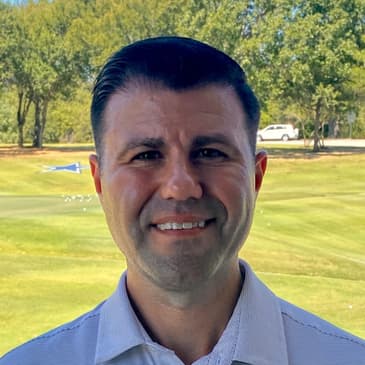
Mike Mandakas is a PGA professional and the founder of Elevation Golf Academy. With a wealth of experience as the head golf coach at the university level and as a PGA professional at renowned courses like Olympia Fields, Medinah, and Desert Mountain, Mike brings a unique perspective to the world of golf instruction and shares insights from his entrepreneurial career.
- 07:09 The Ideal Junior Golfer
- 11:30 Golf Development’s Biggest Evolution
- 17:11 Struggles the Every Golfer Faces
- 22:31 Going Pro: Expectation vs. Reality
- 26:54 What Your Child Needs for the Next Level
- 29:04 In The Trenches // Hinge Moment
- 34:20 “I had six head pro job offers, and I turned them all down.”
- 41:42 Grit & Golf
- 47:48 The Future of Elevation Golf Academy
Don’t forget you can also follow Dr. Rob Bell on Twitter or Instagram.
Follow At:
- Twitter @drrobbell
- Instagram @drrobbell
Download The Best Mental Toughness Quotes That Will Make You BETTER
https://drrobbell.com/quotes-on-mentaltoughness
If you enjoyed this episode on Mental Toughness, please subscribe and leave a review!
Dr. Rob Bell
[00:00:00] Welcome to Mental Toughness with Dr. Rob Bell.
[00:00:13] Each week, Dr. Rob sits down with athletes, executives, and expert coaches to talk about
[00:00:18] mental toughness and their hinge moment.
[00:00:21] Here's your host, perform, recover.
[00:01:42] This is episode 132 of the Metal Tuffus Podcast.
[00:01:45] If you like golf episodes specifically
[00:01:48] when it comes to Metal Tuffus, start with this man, tell me about, you know, what's it been like being a Chicago sports fan past. Couple years, I guess. It's been a rough couple of years here, but I think he's got a spot on an NFL roster. And with the right with the right scheme and the right coaching, I think he's got an opportunity.
[00:04:23] Yeah, that's fair, man.
[00:04:24] You know, the backup quarterback went on to coaching. And when when people are successful and helping others, comes down to a good team. And I believe that COVID helped bring a lot of new people, new energy into,
[00:05:42] into into golf, which has been great. But like, hey, what does that process kind of look like? Somebody has been, you know, just started out with a game where they're playing and they have that will to get better.
[00:07:00] Like walk us through like, hey, what does that development sort of look like?
[00:07:04] Correct. Yeah. The ideal, the the two main things that we look for
[00:08:22] and how we're going to coach the kid
[00:08:24] is what is their base athleticism, and the endurance that handles, but then there's the little bit of lack of the upper body motor skill that a baseball player and a soccer player are almost the perfect combination. Then you look at hockey. Hockey players really have that hand-eye coordination,
[00:09:40] the balance and the agility that's going to be important for golf.
[00:10:45] Then visit our website, DrRobBell.com, and schedule call with us to help capture your very own hinge moment.
[00:10:49] Yeah.
[00:10:51] How have you seen golf instruction in particular?
[00:10:57] I mean, again, it's difficult to say, hey, what it was, right?
[00:11:00] Like back in the day, like back in the day was 2006, I think, right?
[00:11:04] Because I mean, that was when, you know, still called social networking. But instruction has changed from the times of really creating one-on-one technical training. I think it's evolved into more of biomechanics. And I think biomechanics is something that my team we really specialize in is how the body works to get the club to do what we want the club to do
[00:12:20] to eventually to get the ball to do what the been, like what are some of the biggest struggles that you've encountered with entrepreneurship and melting that like with golf instruction and the different locations you have across the country? Time. Time I think is, I think that's the biggest thing.
[00:13:42] You know, not having enough time to see that understanding that, hey, you're coming to our Elevation Golf Academy, whether it's in Chicago, Indy, Texas, or any of our future locations, it's what they're getting is our programming
[00:15:01] and our expertise that we've put years and years and years
[00:15:05] into developing these strategies and ways maybe a couple, they see them weekly, but I come in and see them once a month just to kind of kind of see where they're at, see the progress they've made, and then kind of put together a new a new program to... We do a lot of things monthly, monthly works for us because, you know, four weeks of the month, four and a half weeks of the month, we can really develop a program,
[00:16:23] but then after a four-week process, we can make has struggles. People are playing the PGA tour, people are playing the LPGA tour. They have struggles, they revert back to old tendencies. So really the first 20 minutes of meeting a new student is that crucial moment for us to identify what do they do good, what do they not do so good.
[00:17:41] And once we identify that, then that helps us shape how we work with them and how we
[00:17:46] coach them. and we try to develop a more connective part so that we can relate to that person and they can relate to their swing better than they did when they first started with us. So I think that's really the biggest part is the biggest struggle. Obviously, the biggest result struggle is probably 70% of golfers. So is it feel, isn't real? Feel is not real. 90% of the time. Tell me about that. Yeah, I mean, feel, you know, if I take 10 people in and we're trying to feel something
[00:20:20] and I get them on video and I say,
[00:20:23] all right, what does that feel like, right?
[00:20:26] And then I show them, you know, my kids are really good and they want to play on the PGA tour or to say the kid wants to play on the PGA tour, seen that, but it happens all the time in golf, right? I mean, that's the part that I see that's totally different. I mean, a kid can hit it for. Oh my God. Right. Cause kids are going to be like a PGA tour when they have no idea. Yeah. No, it definitely happens more in golf. Um, I think because it's an individual sport.
[00:23:04] There's more of a showcase on each individual in golf.
[00:23:07] Good point.
[00:24:04] and that you want them to come up with that conclusion. But what we do is we establish, we say, okay, well, here's what it's going to take to become
[00:24:09] a PJ Tour player.
[00:24:11] You need to be, you know, you need to be gradually improving at each level.
[00:24:16] You don't need to be the best junior golfer that's out there.
[00:24:19] You don't need to be the best high it's going to happen or not happen. But I'd be the first one to put someone in their place from an expectation standpoint and say,
[00:25:41] here's where you are, here's where you need to be at certain levels.
[00:25:45] And if you're there, then we're on track. playing in college, like there are a couple of things like, hey, I would want to look at this in terms of if they have what it takes to take it to the next level. For sure. Yeah. Uh, number one thing is coachability. I think that's the biggest, I think that's the biggest key that we look at is how well do they work with their instructor? How well do they work with their trainer?
[00:27:02] How well do they work with their high school coach?
[00:27:04] Um, and, and then their team around them 100 miles an hour, you were going to be a college golfer. So that benchmark just keeps increasing with speed and power, but power speed and then obviously putting journey. So for me, you know, working at, you know, a few of the clubs, three of the biggest clubs in the country, working at those facilities, you know, the glory that Medina did or some of the other big clubs. But in recent times, we've had some big tournaments there. And the history there was unbelievable, but the membership was awesome. But it just the landscape, it was either I stayed on that road
[00:31:01] and wait until the director of Alfredo retired,
[00:31:06] or all the head pro jobs that I was offered at the time. for me happening college, but really, that hinge moment happened in 2010 when I left Olympia Fields Country Club and probably having one of the best jobs in the country to then opening up my own academy. And it was a tough time financially because banks weren't lending any money.
[00:32:22] I had no experience actually owning my own business. I always wanted to be run a business necessarily, but it ended up being in a golf business just because I became pretty good at learning how to take care of people and being and working at the country clubs. I worked at it also helped me define my role as a golf instructor, club fitter and all the other hats that I try to wear.
[00:33:41] But ultimately, you know, that time was terrifying young. So at that point, you know, some of the, some of the bigger clubs I would have liked to work at, they're just like, hey, you're a finalist, not sure you're going to get the job, but, but it was that moment when I was like, okay,
[00:35:01] well, I'm going to have to take a step down here. If I go big play. I love it, man. I love that. Well, we wouldn't have been connected without it. Absolutely. Yeah. How does the sport of golf, like to sport itself, the grit that's involved in that because times are not always going to be good, right? And so you have to experience the good and the bad or, you know, to developing it from square one so that so it can really shape you. And I think
[00:37:42] golf has, because of the opportunity, because of, I did all the trench work and they need to, if they understand that and they see that, they're like, well, okay, well, the platform that we've created is for them to be successful and maybe they don't have to get down to the trenches like I did, but they can kind of learn from the mistakes that I made
[00:39:03] to be successful for themselves. the things you do and to develop all these good habits, bad habits, taking that to the golf course is learning from your experiences. You know, things you do well, things you don't do well. You know, making mistakes in a tournament, you know, and then helping you so that next time you're in that was starting my business and moved close to my outdoor academy. My dad and I spent a lot more time together at that point. We also got under each other's skin
[00:41:44] a lot more because we were two stubborn the end of his life, and through the beginning of my business ventures, we were able to spend a lot more time together. And it was great. So through that timeframe of being able to spend more time with my dad, it was just, it was very,
[00:43:00] the support that was there was amazing.
[00:43:02] And it really connected us a little bit further.
[00:43:04] And now those are some of the lasting memories I've been working on because I do, I see opportunity and I might jump on it a little too soon or a little too rash, but I think I've created a good calculated risk scenarios nowadays. And I think patience is a big attribute to that.
[00:44:20] And just weighing out my pros and cons
[00:44:24] and then figuring out how to figure out the right time
[00:45:25] I don't know that it's that much better, but I've just been able to adapt to it. But there have been certainly some times where hanging back and letting things kind of play
[00:45:31] out.
[00:45:32] I think I've definitely gotten better with that.
[00:45:35] And sometimes it's cost me, but then other times it's been a huge, it's been very beneficial
[00:45:43] as well. I'm a realist and I understand that everything happens for a reason. So in the long run, I don't, in the short term, I think I looked at it as it was a bad decision by not acting on it. But in the long run, some of those opportunities that originally felt like a miss or not the
[00:47:00] right decision really have played might be a good question. Like what's next for us as an academy? And I think that that's, we've always kind of laid in weeds per se, and we've always kind of,
[00:48:21] we haven't really thrown ourselves out there to the public.
[00:48:26] I mean, obviously word of mouth things that is, you know, we've talked about the hinge moments and we talked about the past and the present. But I think the future is, is that's what's coming next? Yeah, so.
[00:49:40] Love it.
[00:49:41] Mike Mann, Dakis, Elvish and Gahl,
[00:49:45] thank you so much man for taking time,