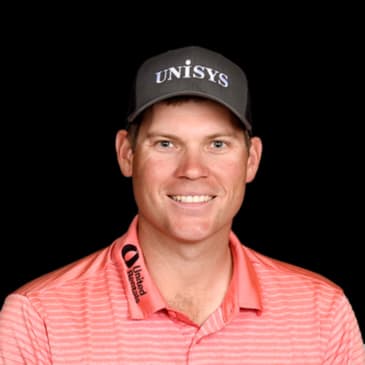
Adam Schenk has been on the PGA Tour since 2018. A native Hoosier, Schenk played college golf at Purdue University before turning pro in 2015. This 2023 season, he has five top 10’s, two 2nd place finishes, and stands top 50 in the world golf rankings. Additionally, he ranks top 20 in the FedExCup standings.
- 03:47 The Birdie Hunting Mentality
- 11:29 Luck and Golf
- 14:57 The Pro-Putting Process
- 17:19 Patience on the PGA Tour
- 20:09 The Power of Perspective
- 24:15 “Where you finish is completely irrelevant.”
- 29:05 Emotions Cost Strokes
- 32:50 Bad Golf Is Motivation
- 38:40 “The closest thing to being perfect is to try to be.”
- 41:01 Making Your Bad Golf Better
- 44:08 Big Picture Golf
- 49:38 Adjusting the Small Things
- 53:37 To Parents of Golfers
Don’t forget you can also follow Dr. Rob Bell on Twitter or Instagram.
Follow At:
- Twitter @drrobbell
- Instagram @drrobbell
Download The Best Mental Toughness Quotes That Will Make You BETTER
https://drrobbell.com/quotes-on-mentaltoughness
If you enjoyed this episode on Mental Toughness, please subscribe and leave a review!
Dr. Rob Bell
[00:00:00] Welcome to Mental Toughness with Dr. Rob Bell.
[00:00:13] Each week, Dr. Rob sits down with athletes, executives, and expert coaches to talk about
[00:00:18] mental toughness and their hinge moment.
[00:00:21] Here's your host, perform, recover. So our guest today on the mental toughness podcast has been on the PGA Tour since
[00:01:41] 2018 Turn Pro in 2015. will make the cut. You know, with that share with us, like your mindset, when you are over par, you know you need to get stuff going. Talk to us about like that mentality just how many greens we can hit today. It's not my favorite course. I think everyone that is close to me kind of knows that, but there's still a PG-2 return amount. They're giving away a lot of FedEx gut points. They're giving away a lot of money.
[00:04:20] And you want to play well.
[00:04:22] You don't nobody likes the miscuts.
[00:04:24] And we just really grinded it out. three heard of folks listening it's like 175 yards when they're supposed to be off the right and into a little bit or off the right and I tried to cut a seven and I pulled it hooked it and it's actually out of bounds it's rolling on the road that's like 20 yards over the green and it actually rolls back and the ball the road is out of bounds but my ball is hanging over the edge of the road
[00:05:41] touching grass which means it is in bounds so the last two. I know it's kind of a long winded story, but we mentioned how far along we'd come this week and we grinded, grinded, grinded. Not had much good things happen and we had 12, 15 feet on the last hole. It was just really fortunate to see that pucker
[00:07:00] land to make the cut because we'd worked so hard
[00:07:03] and hadn't gotten much out of it.
[00:07:04] And his son's here and hitting some good golf shots. Kind of that was walking up the first hole. I was telling Brad, I'm like, look, let's just hit a bunch of greens today because I feel like so many times how I've played in the past and what I see people out here do is you shoot not a great first round, but then you just try and be too aggressive. And that changes like often you may make a lot
[00:08:22] of birdies, but you're also going to make number, we did a really good job of that. And when you mentioned that like on the part three, what's that?
[00:09:41] Sorry, I'm checking.
[00:09:43] And well, I said we did a good job that group but. This golf course is is so it's been difficult for it. Everyone's gonna get unlucky. Everyone's gonna get lucky and you just have to understand that that's a major part of the game and you have to use that to your advantage. So if you're getting unlucky, you hope you you hope you get all your good breaks at once and I feel like that's the way mine have come and gone like I get a
[00:12:21] Lot of bad breaks in a row where nothing really good's happening and then I have weeks where I've played well Hey, good looking. If you like this podcast and are already a badass, but it's all way too complicated, then visit our website, drrobbell.com, and schedule a call with us to help capture your very own hinge moment.
[00:13:40] Um, I mean, one of the strengths, going to get the luckiest. So from one tournament to the next, or one day to the next, it's a lot about luck because I think I gained, you know, point eight shots are almost a shot today on the Koreans, but I made a lot of pots and I missed a lot of short ones, but tomorrow they could all go in or they could all not go in.
[00:15:00] I'm still, Brett and I go through a process,
[00:15:02] we pick out what we're aiming at,
[00:15:04] where it's going to roll over.
[00:15:05] And I try and match that line up to the speed Mm-hmm. Yeah. No, and I appreciate that answer man for sure. I mean you talk about Without into your process control what you can control with the mental skill of patience I mean, I was gonna bring this up, but you know, it's one thing about talking about it's another about imp, you know, imposing it
[00:16:25] How do you go about implementing, you know end up well at the end of the season.
[00:17:43] And that's just how I look at it is if I'm playing great
[00:17:48] and not making any putts, by five or losing by five, it's really sounds weird to say, but it's irrelevant. Yeah. You have a new son, AJ. You talk about perspective, right? I mean, you've mentioned it
[00:19:00] before. I mean, there'd be times that you think about him out there on the course. But if I'm doing the correct things, if I'm preparing the way I know how that I'm putting in maximum effort, if I missed the cut, it just didn't work out that week. I'm showing up, not being prepared, showing up late, not working hard, then missing the cut. And that's not okay. So there is a difference. But this week showed up, and we really put
[00:20:20] in a lot of work. I improved so much from Tuesday to on the situation at hand, not knowing whether it's going to go in or not, whether I'm going to hit the ferry with the drive or whether I'm going to hit this pitching wedge close, but as long as my thought process is correct and I'm doing the correct things, then the outcome is honestly irrelevant because if I keep stacking good decisions
[00:21:41] and playing the whole,
[00:21:44] playing the shot that's most the time meant to be played
[00:21:46] and knowing what shot I'm going to hit you go from like 50th and then there'll be some 25th, 30th place finishes. Now, hey, there's obviously the fifth, but you're staying up there. Even if you start off 30th, you know, you're 20th and you know, you're finishing fifth or you know, you're contending there at the end. Um, before coming on, I spoke with, uh, with coach Rob Bradley,
[00:23:01] I produce your alma mater because I asked him, I said, what question do you want me
[00:23:04] to ask?
[00:23:06] And he said, ask him what's changed. Now, I don't completely, if I play terrible, I play terrible. I might just completely throw the baby out with bathwater and start over next week. But if I was close and it didn't make some pots and didn't have, you know, maybe a few good breaks happen that I needed to, then I have something to build off of and I use it. What I did well and I try and continue that and I take what I did poorly
[00:24:21] and try and figure out that for the next week.
[00:24:23] And then building, like I've used it as like a full circle.
[00:24:25] I'm building a process and I gave away three shots. So what's the easiest way to stop giving away shots is every time I'm in a situation, I handle that situation, whether it's off the tee, into the green in position with a green light, out of position, complete red light. I just handle that and don't give away anything to my competitors, don't give an inch.
[00:25:41] And that's been the difference of,
[00:25:44] all right, you've made two what I am I was you know second or third going into the round. And now we're I don't know I think I was like 24th place and it's easy to let it snowball from there and try and get to a graph and make.
[00:28:05] becoming, you know, a good player and then becoming elite is, you know, I'm striving to be.
[00:28:12] What, um, what are a couple of those mistakes that really, really bother you when you kind of look back? So I had one on whole seven. It was like 220. When the wind was supposed to be down off the
[00:28:23] left, but we had the wind like left to right. It all right, you know, this putt, I've putt in these fringes before it sucks, bald as a roll. So I could have hit, I should have knowing that I should have hit it a little harder than I thought, given myself 15 feet per par and made bogey, most likely. But I got greedy and it's not that I forgot about
[00:29:43] the process. I just didn't care because I was upset and wanted to try and steal one I had the win switch is a little bit out here too. So it was fairly windy and switching, so that makes it a little more complicated. But yes, when emotion gets involved, that is when bad things happen a lot of times. And I think that's when you can take the emotion out of it. By the time it's time to hit your neckshot,
[00:31:00] because John Rong gets plenty of testosterone.
[00:31:02] I mean, he's just fiery as they come, Spanish.
[00:31:06] Spaniard, obviously's much harder. Simple, not easy. I guess is the word you'd use. I think we've talked about that before. But it's not completely 50th. So like the only difference between me playing, playing good is looking at results or what somebody else tells you, you don't have to look at the results to know how you played. If you, if you played good and you didn't have the results, then, then that's okay.
[00:33:41] You played good, but it's, it's tricky looking to see, you know, if I finished the top 30,
[00:33:46] I played good.
[00:33:47] Well, I finished 20th, but that's the difference of not complaining, not getting down on yourself and just being a career grinder, which is what I am. And I've got better this year, but that's the kind of golf I have to play in order to be successful and give myself the best chance to win. Yeah.
[00:35:01] I mean, I think one of your superpowers
[00:35:02] is your ability to take a step out of yourself,
[00:35:06] objectively look at the kind of the situation and the shot that a person is able to hit and their potential miss don't line up. And they have to, you have to be smart or else you're gonna make a quick five or a quick six. And that's, you know, those trouble situations are what you have to get by because if you're good at something, if it's 140 yards in the fairway,
[00:36:21] everyone's pretty good at that shot. There's a thousand more players in the world
[00:36:23] that are good at that shot.
[00:36:23] You're not gonna separate your, I mean, you might make it,
[00:36:25] you might hit it to basically hit your golf shot. Maybe a minute if you take long, but like there's a lot of information to process very quickly. And having a little bit of a plan going into it helps me a lot because sometimes when things get going fast out here, it's it can be really hard to slow down.
[00:37:44] Growing up and then to about your career, were you ever told that you weren't good enough? I was just gonna, I just stuck in the ground. I had 160 yards left on 17, had a terrible two iron, really bad actually. And couldn't get to the green because the rough is so damn thick out here. And I hit a nine iron out, and it didn't slam that club, didn't break it,
[00:39:01] handed breath in the next,
[00:39:02] handed breath in the nine iron, took the 60.
[00:39:04] And then it finally got to me
[00:39:05] and I stuck it in the ground.
[00:39:06] And I threw it down and pulled it out you've kind of mentioned this before, but has it been a result just of this season of just cleaning up the bad rounds and not making as many mistakes? Absolutely. It's just making less mistakes because everyone's good golf is really good. Doesn't your corn fairy Canadian to or playing a West Florida event? Like if you go and
[00:40:20] play out West Florida, then you don't play well. For one, you're not going to win. Two,
[00:40:25] you're probably not going to finish the top five or 10. You might only make the cut.
[00:41:22] the reason they have a thousand more FedEx cup points or more than me is the reason John Romer-Cheffler has
[00:41:26] a lot more wins and a lot more dollars in the bank account.
[00:41:28] But that doesn't mean that I give up and throw in the towel.
[00:41:30] I just have to figure out ways for myself to get better
[00:41:35] and to gain a little bit of the shots back
[00:41:37] through course management and handling my game,
[00:41:42] which can be hard to do when they're doing the same things
[00:41:45] that I'm doing and they're better at golf than me. do well, everyone blows you up, everyone texts you, tells you a great job, great room. Few years ago when it's struggling, when you're on 125 and need to play while coming in, nobody blows you up when you shoot an 82 or whatever. I mean, sorry, 75. What changed or what has changed or what have you seen
[00:43:02] in terms of like outside people or influences,
[00:43:05] pat some of the back, text messages
[00:44:04] at time with him, I don't know. So it's not like I can help him when he's struggling. But as soon as he plays good, first thing I do is call him. So it's just how it works.
[00:44:09] And I've understood that and I don't get offended when I shoot 79th open and
[00:44:16] know when text me or if I almost win and I get 90 text messages or whatever it might be.
[00:44:20] That's just no hard feelings towards anybody.
[00:44:24] It's just how it works because as soon as Joe Weiler plays on the corn fairy tour awesome. So cool. So cool. Um, being here with, uh, Brett and his son, give, give us a son two extra days here. Phenomenally cool. But if it misses, it, it's not that big a deal. It would have just been more hurtful to have, um, him go home and not get to have two more days. Because he's
[00:45:40] here, um, getting to go back to school, just having a cool experience, getting to, you
[00:45:44] know, got to walk inside the ropes on Tuesday go in. So that's what I remember. It's a great point, man. Yeah, absolutely. Another great point is so like a fairway is pretty wide, right? So if you push a drive and it catches the right is a fairway. All is happy, right? Good. Good drive, you know,
[00:47:04] good job driver. Good, good, good way to go. Way an inch. You didn't hit that bad a putt. We're not computers, we're not robots. So that's something, I forget who told me that like a year ago, it was just something that's kind of stuck with me and I think it's really important to remember. And that's where I say you can learn something from everybody and if you, good and bad. So if you keep an open mind and are always willing to learn,
[00:48:24] you can, you know, you can learn a lot being out here
[00:48:27] on the PGA tour.
[00:48:28] Best players in the world. Is it possible probably, but Using the shots I'm good at and the shots I can actually repeat for this week, you know 20 to 30th my pretty good for me. I grinded I grinded my tail off we grind our tail off just to make the cut so I think it's
[00:49:40] It's just really important to understand how you have to play golf courses according to your
[00:50:42] club face, it's going to have no spin and squirt right. So I need a little more loft, a little more spin.
[00:50:45] And we made a change today.
[00:50:48] And I drove it phenomenally.
[00:50:50] I would not have made the cut if I didn't make a small change
[00:50:53] tweak with my driver.
[00:50:56] And that that was a big portion of why I played good today, because I gave myself.
[00:51:02] I'm glad you mentioned that, man, because a lot of times I look at the
[00:51:05] mental game is is our ability to make adjustments and to trust.
[00:55:02] I don't get too down on myself and I just always want to learn. you just putt butter and if you start to talk positively about their game but always mention they're a bad putter or they're a bad putter they're a bad putter. clean up bad attitudes, encourage your kids, don't be hard on them. If it's a fine line, wanting to love them, wanting to help them, I'm sure.
[00:55:04] I'm just recently into a father of three months.
[00:55:05] So I'm not talking golfer, but you just keep completing the process. And you bogey hole 11, and you're going to run off six birdies at some point. And we did. I love it, man. Man, I'm so glad we were able to get this. And thank you again for taking the time, Adam. Appreciate my man. No, if you're happy to come on
[00:56:23] and I'd love to do it again. Hopefully we can get that first one sometime. I'd love to come on